


This section summarises the most notable events that took place during this week, from Friday 20 Jumada al-Ula to Friday 27 Jumada al-Ula 1446 AH, across the Muslim world.
Palestine
Gaza Strip
The Gaza Ministry of Health said the toll of the Zionist aggression had risen to 44,363 martyrs – along with those presumed to be martyrs – and 105,070 injured since 7 October 2023. It said the Gaza Strip is on the brink of famine and that there have been deaths inside hospitals due to hunger.
The Gaza Civil Defence said more than 2,300 martyrs and missing persons since the occupation began its military operation in northern the Strip. The Gaza Red Crescent stated: a large number of the wounded are at risk of death due to shortages of medical supplies and the targeting of hospitals. ▫️Red Crescent: "The occupation refuses to open safe corridors for transporting martyrs and the wounded despite international appeals."
The Gaza Ministry of Health announced that the Israeli occupation committed 7 massacres in the Strip, from which 120 martyrs and 205 injured reached hospitals within just 48 hours! And 35 martyrs and 94 injured reached the Strip's hospitals as a result of the occupation committing 4 massacres against families – within just 24 hours.
Occupation forces destroyed the Al-Awda Mosque entirely in the city of Rafah in the south of the Strip. Quadcopter drones fired at areas north-west of Nuseirat in central Gaza.
Occupation artillery fired shells east of the Al-Bureij and Al-Maghazi camps in central the Strip, coinciding with the sound of gunfire. Occupation artillery targeted the Al-Zaytoun and Al-Sabra neighbourhoods south of Gaza City, coinciding with gunfire from occupation vehicles.
The first moments after the occupation shelled a group of Palestinians opposite Al-Amal Hospital in Khan Younis in southern Gaza.
Dr Hossam Abu Safiya, director of Kamal Adwan Hospital, was injured when an "Israeli" drone struck the hospital in the north of the Strip.
UNRWA said around 70,000 people in northern Gaza are facing difficulties obtaining clean water, and that residents of the Gaza Strip face the risk of dehydration due to fuel shortages and the halt of water wells. Obtaining meals has become an impossible task for families in Gaza. It said 33 aid trucks have been stationed for six months near the border with Egypt due to restrictions, and that Gaza residents suffering from malnutrition face an additional risk of disease in winter.
The Gaza Ministry of Health also held the final examination for trainees who completed their training in the following medical specialties: "general surgery, internal medicine, paediatrics, ophthalmology and anaesthesia."
A cry of pain and humiliation from displaced people whose tents were flooded by rainwater and sea water tonight amid severe cold.
Palestinian Nour Suleiman Abu Jouda from Khan Younis in the south of the Strip completed memorising the Holy Quran in full despite the conditions of war and displacement.
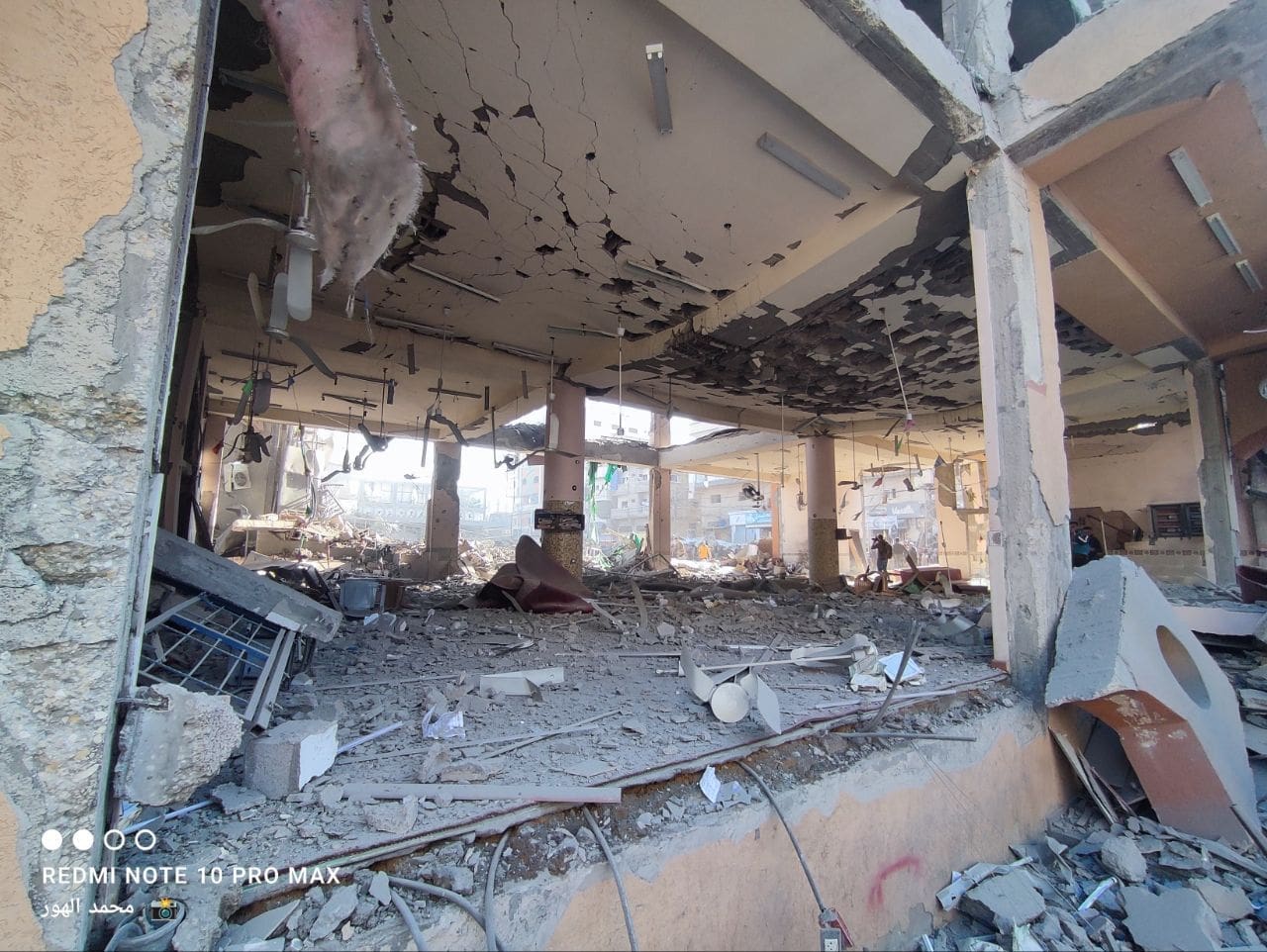
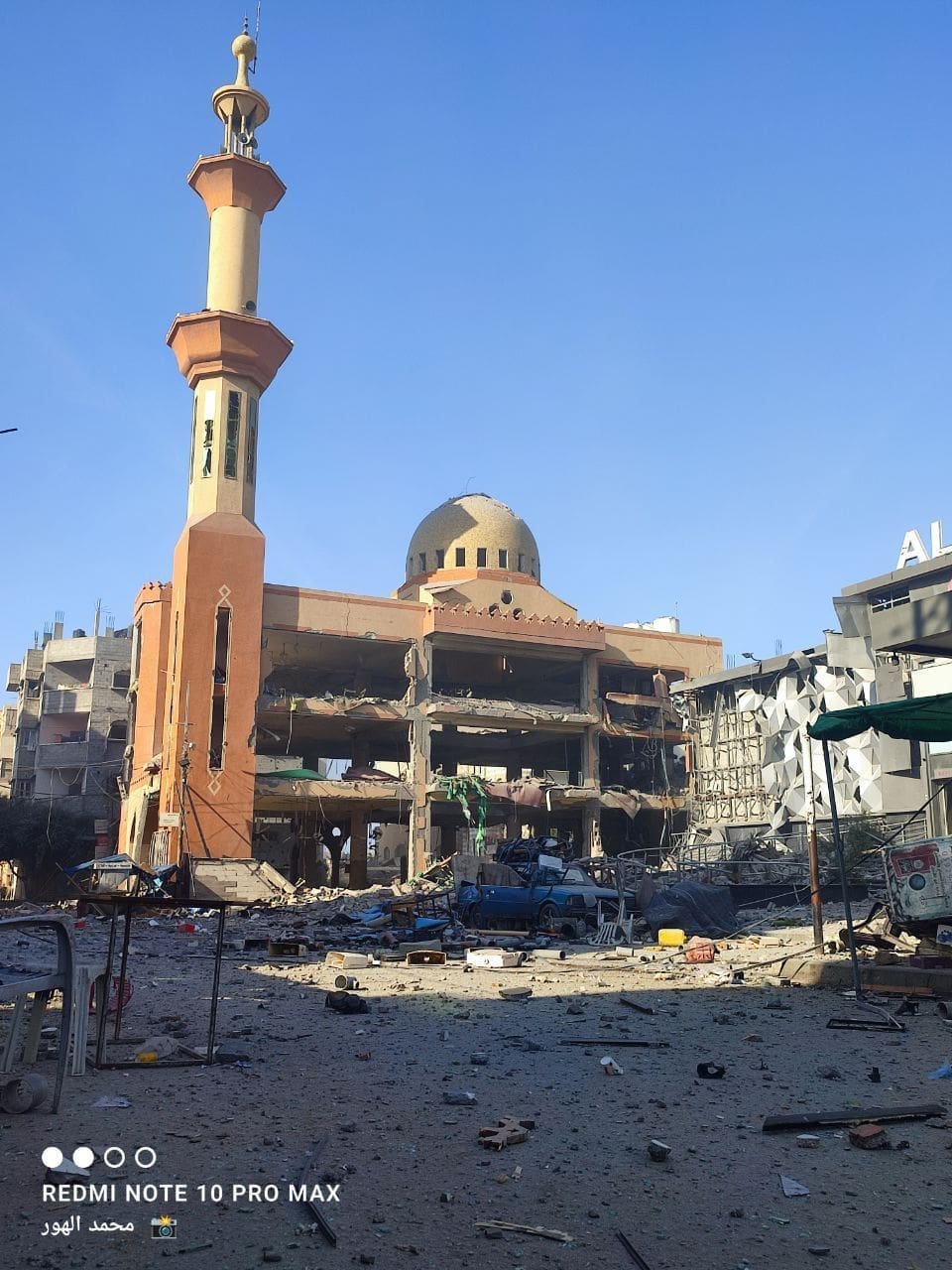
Occupation warplanes destroy the Al-Farouq Mosque in the Nuseirat camp in central Gaza Strip.
The Gaza Government Media Office said the number of journalist martyrs had risen to 189 since the start of the Israeli aggression on the Strip, following the martyrdom of journalist Wael Abu Dagga.
The occupation army also issued new evacuation orders in Gaza, saying this is because "these blocks are in the Shujaiya area, which witnessed the firing of rocket shells towards Israeli territory."
The Gaza Government Media Office said: the occupation is targeting the Kamal Adwan Hospital and its medical teams for destruction and killing, and has killed more than 1,000 doctors, nurses and health workers in the Strip, detained more than 310 medical personnel and tortured them inside prisons, and prevented the entry of medical supplies and health delegations into the Strip.
The occupation also committed a new massacre: martyrs – along with those presumed to be martyrs – and injuries fell when occupation aircraft struck the Al-Tabi'een school, which shelters displaced people in Gaza City, the school where the Fajr prayer massacre took place. Eight martyrs – along with those presumed to be martyrs – including children, in the occupation's strike on the Al-Tabi'een school sheltering displaced people in Gaza, while the search for missing persons continues.
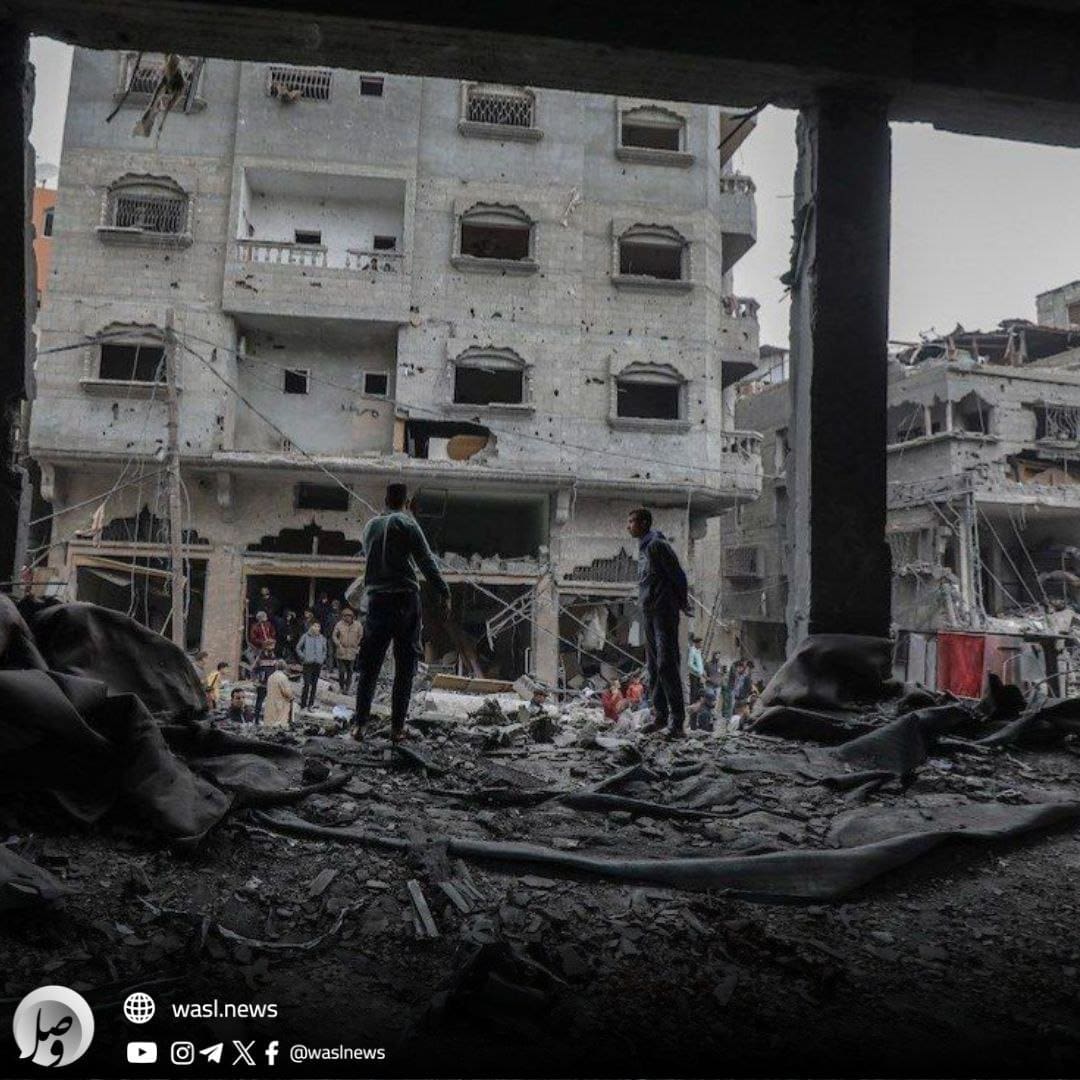
Traces of destruction at the Al-Qassam Mosque in the Nuseirat camp in central Gaza Strip after it was struck by the occupation.
"We were cooking for people at the soup kitchen, and thank God He saved us"… the first moments after the targeting of the soup kitchen at Camp 5, north of Nuseirat in central Gaza Strip.
UNRWA said residents of Gaza are continuously at risk of dehydration and disease due to fuel shortages that prevent water wells from working, and that around 70,000 people in northern Gaza are struggling to obtain clean water.
The Gaza City Civil Defence said:
- Our teams are operating with only one rescue vehicle due to the unavailability of the necessary diesel; the remaining vehicles are still out of service.
- The occupation continues to completely halt the Civil Defence system and is holding its vehicles in northern the Strip.
The risk of fuel shortages threatens Gaza's hospitals
The Palestinian Ministry of Health in the Gaza Strip warned that Gaza's hospitals could stop working or reduce their services within 48 hours due to a fuel shortage, while the occupation army refuses to allow fuel into the besieged Strip.
The General Director of Field Hospitals in the Gaza Strip, Marwan al-Hams, issued an "urgent warning" in this context, and warned that all of the Gaza Strip's hospitals could stop working or reduce their services because the occupation is obstructing the entry of the fuel needed to operate them.
Al-Hams called on international institutions to make use of "the International Criminal Court's decision to halt the genocidal war and to allow in everything the Gaza Strip needs of fuel, medicine and basic necessities, and to send medical delegations to the Gaza Strip in general and the north in particular."
It should be noted that Gaza's hospitals have been threatened with a complete halt to operations since the start of the war, due to the lack of fuel needed to run their generators and various devices, as well as the major shortage of medical supplies.
Earlier, the Palestinian Ministry of Health in the Gaza Strip stated in a statement that "late last night the occupation forces again targeted the Kamal Adwan Hospital in northern the Gaza Strip," according to the Quds News Network.

Three Palestinian women killed over a "loaf of bread" in Gaza
Three Palestinian women were killed on Saturday morning after gunfire outside a bakery operating in Deir al-Balah in central Gaza Strip. The incident occurred in front of the "Zadna 2" bakery on Al-Barakeh Street in Deir al-Balah, when shots were fired at the location, amid conflicting accounts of the circumstances of the gunfire and whether it was deliberate or the result of an error.
Every day, for hours, long queues of Palestinians stand in front of bakeries to obtain a single "loaf" of bread consisting of around 22 loaves, including from the bakery where the incident occurred. It is one of the most well-known bakeries and the only one that has barely stopped working, before being forced to close its doors after the painful incident.
While the bakery owners said the women were killed by gunfire from outside the bakery, after a stampede outside it, and that its source was not from the guards who stand to organise the queue and protect the bakery from theft, but resulted from a dispute outside between members of two families, eyewitnesses said the gunfire was fired by one of the guards, but not deliberately; rather, it resulted from his weapon going off accidentally after he fired into the air.
After standing in queues for long hours, the price of a single "loaf of bread" inside the bakery reaches 3 shekels (just under one dollar), while outside the price reaches 30 or 40 shekels (equivalent to around 11 dollars), while the price of a single bag of flour in central and southern the Strip reached 1,000 shekels or more (equivalent to around 255 dollars).
Two girls and a woman also died of suffocation due to the crush while trying to obtain bread in front of a bakery in Deir al-Balah in central Gaza Strip.


Conditions for citizens are becoming increasingly difficult in the Nuseirat camp in central Gaza Strip due to falling rain and continued aggression.
What happened around the Awni al-Harthani shelter centre near Kamal Adwan Hospital in northern the Strip:
- At 4:30 am, the incident began with the occupation firing five missiles that left a belt of fire in the area, followed by intense flights of drones firing heavily.
- The occupation vehicles then advanced and surrounded the school from all directions, amid artillery shelling and continuous gunfire.
- One vehicle took position at the school gate and began calling out, via loudspeakers, to those inside to come out.
- Women, together with children, came out first and were directed towards the hospital via Beit Lahia Street.
- Later, men were called out; all of them were detained and taken to an unknown destination.
- The operation lasted two and a half hours, leaving widespread destruction and large fires in the area.
The director of hospitals at the Gaza Ministry of Health said:
- Only 5 hospitals are still working, but they suffer from a shortage of capabilities.
- We suffer from a severe shortage of medicines and cannot treat thousands of patients.
- We have lost around 75% of the hospitals' capacity in the Strip.
- The health situation in the Strip is catastrophic.
- We have a severe shortage across all surgical departments, which has caused many of them to stop.

The people of Gaza experienced the coldest winter nights this week, with a shortage of clothing and no means of heating.
10,000 tents were destroyed and the suffering of displaced people in Gaza worsened with the arrival of winter
The Gaza Strip Government Media Office announced on Monday that around 10,000 tents sheltering displaced people had been damaged and swept away by sea waves over the past two days due to an atmospheric depression.
It said the Israeli occupation army "prevented the entry of 250,000 tents and caravans (mobile homes) into the Strip in light of a dangerous humanitarian situation."
The office noted that around 81% of displaced people's tents have become unfit for use, adding that "around 110,000 tents out of 135,000 have been damaged and completely worn out and are in urgent need of immediate replacement."
"Oh Lord!" The moment a father recognised his child, a martyred boy, after their home was struck in the Khan Younis camp in southern Gaza Strip.
The Gaza Ministry of Health also announced on Tuesday that the Israeli occupation has committed 7,160 massacres against Palestinian families in the Gaza Strip since 4 Rabi' al-Thani 1446 AH (7 October 2023) until the beginning of Jumada al-Ula (November) of the current year.
In an infographic post, the ministry said the Israeli occupation "completely erased from the civil register around 1,410 families, with a total of 5,444 individuals, in the same period." It explained that the number of families that were entirely wiped out, with no survivor left, reached around 3,463, with their members totalling 7,934 Palestinians during the same period.
The ministry stated that the number of families subjected to Israeli massacres and of which more than one survivor remained reached around 2,287, with 9,577 Palestinian members.
More on the website: The Israeli occupation commits 7,160 massacres and wipes out 1,410 entire families in Gaza
The Al-Qassam Brigades said: we sniped 4 occupation soldiers and killed two of them during a combined operation near the Burj Awad junction in Rafah city. We targeted a Zionist Merkava tank and a military bulldozer with Yassin 105 shells during the combined operation in Rafah city, and we observed the landing of helicopter aircraft to evacuate the dead following the combined operation near the Burj Awad junction in Rafah city. We targeted an occupation personnel carrier of the "Namer" type with a "Shuwaz" device on Martyr Ahmed Yassin Street in the Safataoui area north of Gaza City.
It stated that in a combined operation near the Burj Awad junction in Rafah city in the south of the Strip, its fighters managed to target a Zionist engineering infantry force of 5 soldiers with an anti-personnel shell, directly injuring them, and to target a personnel carrier with a "Yassin 105" shell, and the fighters observed the landing of helicopter aircraft for evacuation.
The Al-Quds Brigades said: we are engaged in fierce clashes with machine-gun and anti-armour weapons with enemy soldiers and vehicles in Beit Lahia in northern Gaza Strip. The Nasser Salah al-Din Brigades said: we shelled, jointly with the Al-Quds Brigades, a Zionist enemy command and control headquarters in Jahr al-Deek with regular 60 mm mortar shells.
The occupation army announced: an officer from the Nahal Brigade was seriously wounded in clashes in southern Gaza.

The bulldozer deluge: more than 182 military bulldozers have been targeted and disabled by the resistance since the start of the Al-Aqsa Flood battle.
A scene documenting children displaced with their families under shelling and in cold conditions from the Al-Shujaiya neighbourhood east of Gaza City.

Questions: why do Muslims not move to aid the people of Gaza as they suffer bitter cold and cold abandonment?!
West Bank
Clashes broke out between young men and occupation forces at the Industrial Roundabout in the town of Beita south of Nablus, in the city of Jenin, in the village of Awsarin south of Nablus, and in many areas of the West Bank.
Local sources said occupation forces detained a young man and assaulted him during a raid on the town of Beita south of Nablus. Occupation police attacked homes and schoolchildren in the Batn al-Hawa neighbourhood of the town of Silwan in occupied Jerusalem.
A gang of settlers attacked residents' homes in the Dubat Al-Dhubat neighbourhood of the town of Beit Furik east of Nablus. The occupation closed the entrances to the city of Hebron at the same time as thousands of settlers stormed the Ibrahimi Mosque and its courtyards.
Occupation forces seized two vehicles during a raid on the town of Al-Karmil east of Yatta south of Hebron in the West Bank.
Young man Mahmoud Abu Shuqair was also injured with a broken leg after occupation forces assaulted him violently at the Anab checkpoint near Tulkarm.

A gang of settlers uproot olive trees in the village of Al-Lubban al-Sharqiya south of Nablus.
The Wall and Settlement Resistance Commission said: the occupation and its settlers carried out 407 attacks against olive pickers this season, since it began in the first week of last month until this moment.
Occupation forces arrested young man Mohammed Hassan Hammad from the Qalandia camp north of Jerusalem, after vandalising his family's home and assaulting him violently during his arrest.

The occupation army's demolition of the home of the martyr – as we presume him – Muhannad al-Aswad in the town of Idhna north-west of Hebron. Muhannad al-Aswad carried out the Tarqumiya operation and killed 3 occupation police officers.

The occupation forces the Palestinian Abdel Odeh to demolish his home in the Al-Farouq neighbourhood of Jabal al-Mukaber in occupied Jerusalem.

The extremist settler movement "Lehava" posted leaflets on Martyrs' Street and Tal al-Rumeida in the city of Hebron, calling for the killing of Palestinian children.
The Palestinian Red Crescent said: 13 injuries in the Tulkarm camp, caused by an interceptor fired by the occupation falling on several homes, with all injuries ranging from minor to moderate.
A civilian vehicle carrying occupation soldiers intercepted a taxi and detained a young man from it near the town of Azzoun east of Qalqilya in the West Bank.
Palestinian Authority security services also arrested a young man in the city of Hebron, amid continuous gunfire and assaults on citizens.


40,000 worshippers performed Friday prayers, 20 Jumada al-Ula, at the Al-Aqsa Mosque.

The "Israeli" Institute for National Security Studies: between October 2023 and September 2024, 5,435 operations occurred in the West Bank and Jerusalem, not counting operations that caused no deaths, injuries or damage.

A map showing what remains for Palestinians in the West Bank, shown in brown, known as Area A.
The prisoners file

Palestinian lawyer Khaled Mahajna reveals shocking information about a child from Gaza whom the occupation detained at the Netzarim checkpoint in November 2023 and who has been held in prisons since that day without trial, charges or interrogation.
The Prisoners' Commission and the Prisoners' Club: The occupation prevented the former prisoner Ismail Taqatqa, who is suffering from cancer, from entering Jordan to complete his treatment, and said that the occupation's prevention of Taqatqa's entry into Jordan is a decision to kill him.
The occupation forces arrested Sundus Nabil, a student at Al-Quds Open University, from the town of Al-Mazra'a al-Gharbiya north of Ramallah in the West Bank.

The Palestinian Prisoners' Club: The occupation is transferring prisoner Zakaria al-Zubaidi from the isolation wing of Ramla prison to the isolation wing of Megiddo prison, noting that the occupation has continued to isolate prisoners of the "Freedom Tunnel" operation since 1442 AH (2021 CE), and deliberately transfers them from one isolation wing to another, continuing to detain them in harsh and difficult conditions.
The occupation forces also released the prisoners Shahd and Anghaam Asafra from Beit Kahil west of Hebron after a year of detention.
The brutal treatment to which Palestinian women prisoners are subjected in Damon prison
Prisoners' institutions revealed the continued deterioration of the living and detention conditions suffered by women prisoners in Damon prison, imposed on them since 7 October 2023, which at the very least can be described as brutal and worsening day by day.
The prisoners' institutions explained that the Damon prison administration continues to deprive the women prisoners of blankets and winter clothing, in light of the bitter cold and the arrival of winter, as each prisoner owns only one winter coat. In addition, hygiene and personal care items are prohibited, as each prisoner is only allowed one bag of shampoo, which is insufficient for their needs.
The prisoners who were visited by the lawyer said that the food is scarce and poor, as they have been eating legumes for more than 7 months, which has caused them constipation. Jailers also storm the rooms without regard for the privacy of the women prisoners and in a savage manner, seize their personal belongings, and at times spray gas inside the rooms, along with imposing collective punishments without cause and hurling insults at them.
The prisoners added that recently the deputy director of Damon prison personally beat the women prisoners. The prisoners' institutions noted that the women prisoners avoid going out to the prison clinic despite the poor health situation, because the prison administration interrogates them instead of referring them to the clinic. The women prisoners who were visited yesterday said that the Damon prison administration placed a piece of plastic on the doors of all the rooms to prevent the women prisoners from communicating with each other, according to the Quds Network.
In a New York Times report: Residents of the West Bank said that the Israeli occupation forces have adopted tactics similar to those used in Gaza, including airstrikes and the use of Palestinians as human shields.
More than 180 people were killed in airstrikes on the territories over the past year, including dozens of children, according to the United Nations and the Palestinian human rights group Al-Haq.
More on the website: In West Bank raids, Palestinians see echoes of Israel's war on Gaza.
Heroic operations
The shooting operation near Salfit was carried out by an armed Palestinian youth, who was martyred on the spot. It resulted in 9 injuries, at least 3 of them serious. He is the martyr - as we reckon him - Samer Hussein from Aynabus, south of Nablus.


Soldiers wounded among the casualties of the shooting operation near the Ariel settlement near Salfit in the West Bank.

The Israeli occupation's Institute for National Security Studies: 5,535 resistance operations in the West Bank during the first nine months of the current year.

Continued popular boycott drags down the quarterly profits of 6 companies.
Jordan
An armed man killed and a policeman injured in a shooting near the Israeli embassy in Jordan
Security sources and official media said on Sunday that an armed man was killed and three police officers were injured after gunfire near the Israeli embassy in Jordan. The Jordan News Agency (Petra), citing the Public Security Directorate, reported that police opened fire on an "armed man" who shot at a police patrol in the Rabieh neighborhood of Amman, adding that investigations are ongoing.
Jordanian activists continue their sit-in and hunger strike, demanding that the Jordanian government press the occupation to allow aid into besieged northern Gaza.
Syria
Operation Deterrence of Aggression
The Military Operations Command announced the launch of a military operation named Deterrence of Aggression, in defense of citizens in the liberated areas. In the early hours of 27 November, the fighters engaged the forces of the criminal Assad regime and Iranian militias on the front lines in response to the savage shelling targeting residents in the liberated areas of northern Syria.
The Syrian revolutionary factions in the north said: "We announce the operation of Deterrence of Aggression. This military operation aims to break the enemy's plans by launching a carefully studied preemptive strike on its militia positions." The military commander in the Al-Fath Al-Mubin Operations Room, Hassan Abdul Ghani.
Takbirs began to ring out from the mosques of northern Syria.
The Al-Fath Al-Mubin operations targeted rocket launchers in the towns of Nubl and al-Zahraa in the northern countryside of Aleppo, which led to the displacement of Shiite militias to the occupied Syrian city of Aleppo. The Military Operations Command announced that the door is open to all members and soldiers wishing to defect from the ranks of the Assad gangs. It affirmed its commitment to providing full protection to defectors and their families, shielding them from any security or military pursuit, and providing the necessary support to meet their needs in the liberated areas.
A massive demonstration took place in the city of Marea demanding the opening of fronts against the Assad regime.
Our fighters were able to liberate villages and towns:
Hour, Sheikh Aqil, Bala, Hirdarkal, Qubtan al-Jabal, al-Sulum, the al-Maarri Association, al-Qasimiya, Kafr Basin, the town of al-Tarnaba, and the grain silos in Saraqib, the Saraqib bridge, and the town of Kafr Jum in the western countryside of Aleppo, after the Assad gangs were expelled from them.
The Military Operations Command also announced its control over the great city of Orm, west of Aleppo, which is considered one of the strategic cities in the area. It said that the areas liberated during the Deterrence of Aggression operation pave the way for the return of more than 100,000 displaced people to their homes and lands, contributing to easing the humanitarian suffering in northwestern Syria.
The town of Khan al-Assal west of Aleppo was fully brought under control after violent clashes with regime forces, as were Kafr Basin and the southeastern countryside of Idlib (Dadikh), Sheikh Ali, Arada, Arnaz, Tallat al-Raqim, Tallat al-Raqim, al-Zarba, and Bashantara, in addition to the al-Rahhal Association and the second Electricity Association.
The revolutionary forces were able to take control of dozens of villages and towns in the countryside of Idlib and Aleppo in northern Syria, and seized dozens of vehicles from the Assad forces and the Iranian militias.
The Uzbek Battalion (Tawhid wal-Jihad) announced its participation in the battle of Deterrence of Aggression in the countryside of Aleppo and Idlib.
The spokesperson for the Military Operations Command in northwestern Syria, Hassan Abdul Ghani, said:
The field is witnessing a wide advance by the revolutionaries amid great confusion and collapse in the enemy's ranks. During the past few hours, our forces have established control over "Khan Tuman," "Jeb Kas," "al-Talhiya," "Tall al-Karatin," "al-Bawabiya," "Abu Qanssa," "Zeitan," and "al-Salihiya" in the countryside of Aleppo and Idlib, praise be to God.

The Military Operations Command published a message reassuring citizens in areas under regime control, saying:
To our noble people in the city of Aleppo,
We are your sons and brothers, the sons of this city which has united us through its glorious history and great civilization. We are now working to rid our city of the tyranny and corruption of the criminal regime, seeking to restore its dignity and honor, free from injustice and tyranny.
Prisoners of the regime forces and Iranian militias in the hands of the Syrian revolutionaries.


Killed members of the Assad regime gangs in the town of Qubtan al-Jabal west of Aleppo.

Revolutionary forces seize weapons and equipment of Russian forces.
The Al-Fath Al-Mubin Room announced: "A Russian soldier killed and his vehicle disabled in the countryside of Aleppo."
200 dead from the Assad gangs and the Iranian, Lebanese militias in the hospitals of Aleppo and Hama as a preliminary toll of the Deterrence of Aggression operation carried out by the factions in the liberated north.
Documentation of a mass flight of the Assad regime gangs and the Iranian militias loyal to it.
The revolutionary factions take down the picture of the criminal Bashar al-Assad in the town of Eynjara west of Aleppo after its liberation.
One of the fighters calls the adhan at the mosque of the town of Sheikh Ali after its liberation from the Assad gangs.

A phone belonging to one of the regime militia members killed in the Deterrence of Aggression attack in the countryside of Aleppo.
One of the fighters within Deterrence of Aggression meets his father after taking control of their town in the western countryside of Aleppo.
Capture of an Alawite officer from Tartus on the fronts of the western countryside of Aleppo.
The town of al-Mansoura this morning, Friday, with the takbir of the mujahideen rising above the sound of weapons.
Removal of pictures of the criminal Khamenei from the newly liberated areas in the western countryside of Aleppo.

Officers and their families were transferred immediately and urgently out of the city of Aleppo, and government departments were emptied of documents, following Bashar al-Assad's visit to Moscow.
The "Syrian Civil Defence" said that Russian airstrikes targeted neighborhoods and a popular market in the city of Daret Izza in the northern countryside of Aleppo, Syria, on Thursday, killing four civilians and injuring 15 others, including children, some with serious wounds. Russian airstrikes also targeted the city of Atarib, Syria, and 13 martyrs - as we reckon them - were killed as a preliminary toll from the Russian aerial aggression.
A military source said:
- The criminal regime forces and their Iranian militias carried out 418 attacks by suicide drones, which led to waves of displacement and worsened the humanitarian crisis in northwestern Syria, where 1,500 families were displaced over the past weeks.
- During the past month, the criminal regime forces bombarded the Idlib area with more than 77 airstrikes and more than 4,600 shells and rockets, causing damage to infrastructure and resulting in dozens of injuries and martyrs.

A number of civilians - as we reckon them - were martyred and most of the wounded were children and women, as a result of the targeting by the Assad gangs and the Iranian occupation of displacement camps in Sarmada and Bab al-Hawa in Syria. The number of wounded rose to 11, including 5 children and two women, most of the wounded from one family, in a missile strike by Iranian militias that targeted the city of Atarib, Syria.

The military correspondent "Mohammed Youssef" was martyred in Bayazid while covering the Deterrence of Aggression operation west of Aleppo.
Casualties and material damage from intensive shelling by regime forces in northwestern Syria
The northwestern region of Syria was subjected to intensive shelling by regime forces using heavy artillery shells, rocket launchers, and booby-trapped drones, resulting in casualties and material damage to civilians' property.
Regime forces targeted residential neighborhoods in the city of Daret Izza, the vicinity of the 111th Regiment, and the towns of Tidel, Kafr Amma, Kafr Ta'al, Taqad, al-Wasata, and Tallat al-Usas in the western countryside of Aleppo, with artillery and mortar shells and booby-trapped drones, resulting in 4 injuries and the disabling of a vehicle.
They also targeted the towns of Sfohen, Maarra Ulya, Sarmin, Majdaliya, Sanan, al-Nayrab, and Harsh Bneen in the Idlib countryside with artillery shells and rocket launchers. A booby-trapped drone was launched toward the town of Maarra Ulya, but residents managed to shoot it down.
In the northern countryside of Latakia, regime forces shelled the surroundings of the towns of al-Tuffaha, al-Sarmaniya, Sheikh Sindyan, and al-Haddada using artillery shells and booby-trapped drones, causing damage to two motorcycles according to Syria TV.
The Assad Nusayri gangs shelled several areas in Syria this week, including:
- The outskirts of the town of al-Qarqour and the outskirts of the village of al-Sarmaniya in the western countryside of Hama with heavy artillery.
- The outskirts of the villages of al-Qasr and Kafr Amma in the western countryside of Aleppo with heavy artillery.
- The outskirts of the villages of Bneen and Mantaf in the southern countryside of Idlib with heavy artillery.
- The Turkmen hills axes in the northern countryside of Latakia with heavy artillery.
- The outskirts of the village of Sfohen in the southern countryside of Idlib, and the outskirts of the town of al-Nayrab and the outskirts of the village of Sanan in the eastern countryside of Idlib with mortar shells.
- The outskirts of the town of Maarrat al-Nu'man and the outskirts of the village of Maarra Ulya in the Idlib countryside with heavy artillery.

Victims of the shelling by the Assad militias and the Russian and Iranian occupations.
A Syrian citizen - as we reckon him - was martyred and several injuries were sustained in the village of Maarbelit in the Idlib countryside, and injuries in Kafr Nouran in the western countryside of Aleppo, as a result of shelling that targeted the countryside of Aleppo and Idlib by the Assad gangs.
A girl was also martyred and 10 people, including six children and two women, were injured by artillery and missile shelling by Damascus government forces and allied militias, which targeted areas in the countryside of Idlib and Aleppo in northwestern Syria. The "Syrian Civil Defence" said that artillery and missile shelling targeted a house on the outskirts of the city of Binnish in the eastern countryside of Idlib, resulting in the death of a girl and injuries to her sister, the girl, and her brother, the young man.
Five people, including four children, were also injured by similar shelling that targeted residential neighborhoods in the city of Ariha in southern Idlib, while another attack in the city of Sarmin in eastern Idlib resulted in material damage. In the Aleppo countryside, two women and a girl from one family were wounded by artillery shelling originating from areas controlled by Damascus forces and the Kurdish "SDF" forces, which targeted houses in the village of Abla, according to the "Civil Defence."
Martyrs - as we reckon them - and more than 18 wounded, 6 of them in critical condition, were also reported due to rocket launcher shelling by SDF militia and Assad gangs against children, women, and civilians in the city of al-Bab, east of Aleppo, Syria.
The toll from the artillery shelling that hit a market in the city of Ariha in the southern Idlib countryside rose to 3 martyrs - as we reckon them - and 14 wounded. The three martyrs are children, and most of the injuries are to children.
The media office of the Ministry of Development and Humanitarian Affairs said that 1,545 Syrian families were displaced as a result of the daily shelling by the Assad gangs and Iranian militias of villages and towns close to the front lines, amid the difficult humanitarian conditions residents are living through with the arrival of winter.
The "Syria Response Coordinators" team monitored today, Wednesday, the displacement of no fewer than 8,735 families from the Aleppo and Idlib countryside in northwestern Syria toward areas believed to be safer, noting that the current displacement is the largest in five years amid the continued military escalation.
The team pointed out that thousands of displaced families suffer from an almost complete absence of shelter, and many are forced to resort to agricultural land and open ground with no basic provisions.
It noted that the areas that received the displaced are experiencing severe overcrowding in existing facilities, which are no longer able to meet the growing needs.
The team called on all humanitarian organizations and international bodies to act immediately to provide temporary shelter centers for displaced families and ensure they are equipped with essential supplies.
It warned that the humanitarian situation in northwestern Syria has reached a "critical stage," and that the situation requires a rapid and effective response to ease the suffering of thousands of families who were forced to leave their homes in search of safety.

There are currently more than 800 foreign military bases and points in Syria belonging to America (or the so-called international coalition with the participation of Britain and France), Turkey, Iran, and Russia.
Lebanon
A ceasefire agreement was signed between the Israeli occupation and Lebanon this week.
3,823 people were killed and 15,859 wounded in Lebanon since the start of the Lebanese support front on 8 October 2023 until the ceasefire agreement was concluded.
Citing Hanzala for Studies: Ceasefire agreement:
- Hezbollah and all other armed groups in Lebanese territory will not carry out any offensive operations against Israel.
- In return, Israel will not carry out any offensive military operations against targets in Lebanon, whether by land, air or sea.
- Israel and Lebanon recognise the importance of the United Nations Security Council resolution.
- These commitments do not negate the right of Israel or Lebanon to exercise their natural right of self-defence.
- The official Lebanese security forces and army will be the only armed groups permitted to carry weapons or move forces in southern Lebanon.
- Any sale, supply or production of weapons or related materials in Lebanon will be subject to the supervision and oversight of the Lebanese government.
- All unlicensed facilities engaged in the production of weapons or related materials will be dismantled.
- All unlicensed infrastructure and military sites will be dismantled, and all weapons in violation of these commitments will be confiscated. A committee acceptable to both Israel and Lebanon will be formed to oversee and assist in ensuring the implementation of these commitments.
- Israel and Lebanon will report any possible violation of these commitments to the committee and to UNIFIL.
- Lebanon will deploy its official security forces and army along all borders, crossings and the line defining the southern region, as shown in the deployment plan.
- Israel will withdraw gradually from south of the Blue Line within a period of up to 60 days.
- The United States will work to facilitate indirect negotiations between Israel and Lebanon to reach an agreement on the recognised land border.

Displaced people return to villages and towns in southern Lebanon following the start of the ceasefire.
Sudan
The Sudanese army said on Monday that it had secured the city of Singa, capital of Sennar State, and reopened the main highway linking it to the city of Sennar, a major victory in its fight against the Rapid Support Forces (RSF) militias.
The "Nida al-Wasat" platform announced that the death toll among civilians in the city of Al-Halaniya, after its siege by RSF militias, had risen to more than 600 martyrs, as counted by them, including dozens of children.
In a statement on the causes, it cited "gunfire, hunger, thirst and food poisoning", saying the RSF continues to commit violations against them, which it described as a continuation of the "comprehensive extermination" of the population.
The Sudanese army also said on Tuesday that it had broken a months-long siege of the city of Damazin, capital of Blue Nile State, and expelled RSF militias that had cut it off from the rest of the country. The armed forces said they had regained control of the road linking Damazin and Singa, capital of Sennar State, as well as the towns of Abu Hujar and Wad al-Nil. The Sudanese armed forces said in a statement that "the Damazin–Singa road is now free of militias", in reference to the RSF.
Seven people reported killed, as counted, in shelling on a camp in North Darfur
At least seven people were killed and dozens injured on Saturday when RSF militias shelled the Abu Shouk displaced persons camp in El Fasher, capital of North Darfur State, amid escalating violence in the Darfur region.
Abu Shouk camp hosts some 400,000 people displaced by the conflict. More than 60% of the camp's residents have already fled to Tawila and other areas in Jebel Marra because of earlier attacks by RSF militias.
Eyewitnesses told Sudan Tribune that RSF artillery also targeted civilian areas in the western and southern neighbourhoods of El Fasher, as well as the city centre. The witnesses added that the shelling also hit the headquarters of the 6th Infantry Division, El Fasher airport and the surrounding areas.
Cholera cases rise in East Nile as displaced people flee RSF violence
Officials said on Thursday that rising cholera cases are straining health facilities in the East Nile area of Khartoum as thousands flee violence by the RSF in the neighbouring Gezira State.
The East Nile emergency room said there had been a sharp rise in cholera cases coinciding with the arrival of displaced people due to recent RSF attacks in the Wad Ashaib area of Gezira. An official in the emergency room said "the health situation has become explosive", pointing to an increase in patient numbers and a severe shortage of medical supplies.
The Al-Ban Jadid, Umm Dauban and Abu Dulaij hospitals recorded 246 cholera cases, including 37 deaths, since the beginning of October, according to medical reports. Umm Dauban hospital is struggling to cope with the influx of patients, many of whom arrive from Al-Musaid, a town hosting large numbers of displaced people, as Sudan Tribune reported.
Sudanese army tightens its grip on Sennar as RSF militias advance in Blue Nile
The Sudanese army announced that it had regained control of the town of Al-Lakndi, of strategic importance in Sennar State, as part of its advance towards the regional capital, Singa. The advance comes amid reports of RSF militias expanding into several towns in the Blue Nile region in the north-west of the country, causing hundreds of civilians to be displaced.
The army's operation in Sennar is gaining momentum, with Lieutenant General Shams al-Din Kabashi, deputy commander-in-chief, reaching the front lines in Al-Qadarif State. Al-Qadarif State borders the Gezira region, which has been controlled by RSF militias since December 2023. According to an army statement, the 17th Infantry Division, supported by the reserve battalion of the 4th Division, cleared Al-Lakndi and the surrounding areas of RSF fighters.
This latest victory follows the army's recent recapture of the strategic Jebel Moya area, the town of Abu Hujar, Al-Dindar and several other settlements on its route towards Singa.
The Sudanese army entered the city of Singa
On Saturday the Sudanese army entered the city of Singa in Sennar State, in the south-east of the country, for the first time since RSF militias took control of it in June. Military sources said army forces had entered Singa and were continuing the process of securing the city and pursuing the remaining RSF elements.
This came after the army had been moving towards the city for days from two axes, the Sukiy axis and the southern axis through Abu Hujar locality, and was able to retake it today. The country remains engulfed in a fierce war between the army and the RSF, which has left tens of thousands dead, most of them civilians.
On Saturday the Sudanese army also called on the government of South Sudan to prevent RSF fighters from crossing the border after fleeing the city of Singa. The army retook the city after mobilising forces from the states of Al-Dindar, Sukiy, Sennar and Blue Nile, and these forces advanced slowly, retaking towns and villages along the route.
Colonel Abadi al-Tahir al-Zain, commander of the mobile force that retook Singa, said in a video statement: "RSF elements have looted the resources and money of the Sudanese people and are now on their way to South Sudan. Our message to the government of South Sudan is not to allow them to cross the border. We will pursue them wherever they go."
RSF militias still control the localities of Al-Dali and Al-Mazmoum near the border with South Sudan, where their fighters are concentrated in large numbers. RSF militias also still control the localities of Abu Hujar and Wad al-Nil in Sennar State, and some villages in the Al-Tadamon locality in the Blue Nile region.
Joint force in Darfur seizes arms convoy and accuses the UAE of arming RSF militias
The Sudan Liberation Movement said its fighters taking part in the Joint Darfur Force had intercepted a convoy smuggling weapons from Chad to RSF militias in Darfur, accusing the United Arab Emirates of supporting the paramilitary group.
The Sudan Liberation Movement, led by Minni Arko Minawi, said in a statement that the weapons were seized during an operation carried out by a joint force in a desert area on the border with Chad and Libya. The statement, which Sudan Tribune said it had seen, claimed that RSF militias use the vast desert area to transport military equipment to Darfur for distribution to their members across the country.
Video footage published by the Sudan Liberation Movement showed a number of combat vehicles, ammunition crates and Kornet anti-tank guided missiles, along with a Colombian military identity card and a Colombian passport bearing an exit visa from Dubai International Airport, dated October, according to Sudan Tribune.
Tuti Island under siege amid the conflict in Sudan
Since the outbreak of war in Sudan on 1444 AH (April 2023 CE), Tuti Island, located at the confluence of the Blue and White Niles in Khartoum, has been severely affected. The island has been besieged and has become a major battleground because it offers a strategic position for artillery fire by RSF militias. The situation on Tuti Island has deteriorated rapidly, with residents facing looting, intimidation and the collapse of essential services.
Residents have shared disturbing accounts of mass arrests, attacks and looting carried out by the RSF. According to their testimonies, shops and individual homes were repeatedly targeted, and residents were subjected to violence and theft. In addition, all pharmacies on the island have been destroyed, depriving the community of essential medical supplies.
In recent weeks, conditions have worsened. Residents have made desperate appeals for evacuation in what many describe as a slow-moving humanitarian catastrophe. The spread of diseases, including cholera, has compounded the crisis, and with power cuts and dwindling healthcare services, life on Tuti has become increasingly unbearable. The community has resorted to burying the dead under the supervision of RSF militias, while residents suffer severe hunger and thirst.
More on the site: Tuti Island under siege amid the conflict in Sudan
Kala-azar outbreak threatens displaced people in Sudan's Al-Qadarif State
An outbreak of kala-azar in Al-Qadarif State in eastern Sudan is raising alarm amid a fragile healthcare system and a large influx of people displaced by the conflict.
The disease, also known as visceral leishmaniasis, has infected 133 people in Qala en-Nahal locality, causing six deaths, according to Abd al-Baqi al-Douma Ibrahim, head of the Friends of Kala-azar and Infectious Diseases Association at Al-Dahima Hospital.
Ibrahim told Sudan Tribune that the spread of the disease among children has disrupted schooling, with 40 children infected, as well as 70 women and 17 men. The outbreak follows the recent sesame harvest, when populations of the sandfly that carries the disease thrive in the area's abundant hijlij trees and cracked soil.
Aid reaches a camp in Darfur despite looting and logistical obstacles
A senior World Food Programme official told Sudan Tribune on Wednesday that a WFP convoy carrying aid to a famine-stricken camp in North Darfur, Sudan, arrived safely despite challenges including looting and difficult terrain.
The official said the convoy, which left Port Sudan on 12 November bound for Zamzam camp, reached the city of Al-Dabab with all its trucks intact. Eight trucks carrying 180 metric tonnes of aid headed to Zamzam camp.
The official said "the remaining trucks could not pass because of road conditions, such as sand dunes". The official, who asked not to be named, denied reports that armed groups had seized any of the trucks. The delivery comes amid reports of widespread looting of aid convoys in Sudan.
The South Al-Hizam emergency room, located south of the Sudanese capital Khartoum, announced on Thursday the deaths of 12 children from malnutrition, with cases of the disease among children rising to 3,511 in the current month of November.
A member of the South Al-Hizam emergency room told Sudan Tribune that the medical office had received reports of 12 children dying, while the number of malnutrition cases in the area had reached 3,611.
The member, who preferred to remain anonymous, confirmed that cholera cases had risen to 80, including 4 deaths during the current month of November.
He acknowledged a major challenge facing the room: medical supplies are not reaching Khartoum, which worsens the health situation, alongside the absence of food and rising prices.
He noted that all charitable kitchens in the area have stopped operating because of financial shortfalls, adding: "Currently no kitchen is operating across South Al-Hizam, and more than 80% of health centres have stopped working, which has contributed to the intensive spread of malnutrition."
Sudan's health sector has deteriorated significantly, with 80% of health facilities in conflict areas halted amid a severe shortage of medicines and medical supplies.
Yemen
Children in Yemen are exposed to disease, malnutrition and violence
The United Nations Office for the Coordination of Humanitarian Affairs (OCHA) in Yemen announced that 9.8 million Yemeni children need humanitarian assistance. In the tenth year of the conflict, Yemen still faces a major protection and humanitarian crisis, in which children pay the highest price.
The UN statement drew attention to the fact that children are more likely to live in poverty, are not enrolled in primary schools, and are particularly exposed to disease, malnutrition and violence. The statement added that compounding challenges linked to the conflict, climate change and forced displacement have left 4.5 million Yemeni children out of school.
The Russian armed forces have recruited hundreds of Yemenis to fight in Ukraine, through an opaque smuggling operation that highlights growing ties between Moscow and the Houthi group.
Yemenis who travelled to Russia told the Financial Times that they had been promised well-paid jobs and even Russian citizenship. But once they arrived, through a company linked to the Houthis, they were forced to join the Russian army and sent to the front lines in Ukraine.
More on the site: Russia recruits Yemeni mercenaries to fight in Ukraine
Floods in Yemen affect 1.3 million people and increase the spread of cholera and waterborne diseases
This came in a report issued by the United Nations Children's Fund (UNICEF), which said that floods in Yemen have caused a worsening humanitarian crisis, affecting more than 187,000 families across 20 governorates, and that the floods have prevented families from accessing basic services such as healthcare and safe drinking water.
The floods and stagnant water have also caused a rise in the spread of cholera and the outbreak of several waterborne diseases such as malaria and dengue fever. The humanitarian response has faced numerous challenges in reaching affected populations because of damaged roads and other issues related to access for those affected, according to the report.
The report explained that the governorates of Al-Hudaydah, Al-Mahwit and Taiz experienced severe impacts, including landslides, massive flooding and significant loss of life.
This comes as the organisation warns of a worsening child malnutrition crisis in Yemen, revealing that more than 3 million children under the age of five were affected by malnutrition during 1444-1445 AH (the first nine months of 2024 CE).
The organisation said the health situation has remained dangerous in 20 governorates since last September, noting more than 190,000 cases suspected of cholera and acute watery diarrhoea were recorded, resulting in 720 deaths, while the mortality rate reached 0.3 percent in the northern regions and 0.44 percent in the southern regions.
Circulating: One of the Yemenis who remained in al-Andalus, having entered it in the first century AH.
Young man dies of wounds after being targeted by a Houthi member in central Ibb city
A young man died on the evening of Tuesday, 26 November 2024, of wounds sustained after being shot by a security member of the Houthi militia, the terrorist group, who was riding a motorcycle in central Ibb city (central Yemen).
According to eyewitnesses speaking to a reporter for Khabar Agency, a Houthi security member named Sameh Mohammed Ahmed al-Ghailani shot the young man "Karim Mohammed Abdulrahman" with live ammunition in front of Arwa Girls' School in Al-Dhihar district, causing serious injuries for which he was taken to hospital, but he later died of his wounds.
Sources indicated that the perpetrator is the husband of the victim's sister, and the motives and causes of the crime have not yet become clear, while the Houthi coup authorities have taken no measures to apprehend the perpetrator because he is one of their members. This incident comes at a time when Ibb governorate is suffering from the spread of organised crime, witnessing a notable rise in killings and criminal incidents, reflecting a state of security chaos.
Prisoner Saleh Abdullah Ghasham died late on Monday evening inside the central prison in Amran, after the Houthi-run prison administration ignored his appeal and the appeals of fellow inmates to take him out for treatment or provide him with medical services. He died 3 hours after the appeal, while suffering from severe chest pain.
280 measles deaths recorded in Yemen
The World Health Organization announced on Wednesday that 280 deaths from measles had been recorded in Yemen since the beginning of 2024, which is nearing its end.
The WHO office in Yemen said that "the country is facing an outbreak of vaccine-preventable diseases, including poliovirus, acute watery diarrhoea and cholera, measles, diphtheria, malaria and dengue fever".
The office added, in a statement, that "since the beginning of this year, 33,000 cases suspected of measles have been reported, with 280 deaths from the disease itself"; it added that this comes "as food insecurity in Yemen worsens, with nearly half of households now struggling to obtain enough food".
The health of abducted activist Sahar al-Khawlani has deteriorated as a result of torture in Houthi prisons. Exclusive sources told Yemen Today that the abducted media activist Sahar al-Khawlani was transferred to the intensive care unit at the central prison hospital in Sana'a after losing consciousness as a result of severe torture she was subjected to by the Houthi militia.
According to the sources, Sahar al-Khawlani suffers from psychological and physical problems due to the torture and intimidation she is subjected to by the Houthi militia.
Iraq
US jury awards $42 million to 3 Iraqis who were victims at Abu Ghraib in Iraq
A federal jury in the US state of Virginia found that the defence contractor "CACI Premier Technology" (the company) is legally responsible for conspiring to torture and mistreat three Iraqi men detained at Abu Ghraib prison two decades ago.
The ruling comes after 15 years of litigation, marked by 20 attempts by the company to dismiss the case and numerous appeals. The first trial ended in April with its declaration as a mistrial, because another jury could not determine whether the company or the US army was responsible for the torture committed.
The company's lawyer argued that it was not responsible for any crimes its employees may have committed, because they were under the command and direction of the US army, and therefore compensation for misconduct should be the army's responsibility. The jury did not accept this argument, and awarded $3 million to each of the three plaintiffs in damages and $11 million to each of them in punitive damages, as Human Rights Watch reported.

252,000 homes destroyed in the predominantly Sunni cities of northern and western Iraq have yet to be compensated or rebuilt for their residents, while a spokesperson for the Iraqi government announces that they will participate in the reconstruction of southern Lebanon.
Turkey
A Turkish court issued a sentence of aggravated life imprisonment three times against Turkish citizen Kemal Kurkmaz, after he was convicted of deliberately setting fire to a construction site in the Gaziler... [sic: Güzelbahçe] district of Izmir, which led to the deaths of three Syrian workers.

The incident occurred in November 2021 and resulted in the deaths of Ahmed al-Ali (21 years old), Mamoun al-Nabhan (23 years old), and Mohammed al-Bish (17 years old). Human rights bodies called for holding the perpetrator accountable for his brutal acts, according to Turkish media. The fire broke out inside a room where the Syrian workers, employed at a concrete production factory, were staying. The fire left the three workers with serious injuries; two of them died two days after the incident, while the third died a week later.
Kemal Kurkmaz was arrested 14 days after the incident, and during the investigations he confessed to setting the fire using petrol. In March of last year, the court issued a sentence of aggravated life imprisonment three times on charges of "qualified intentional murder", in addition to a sentence of one and a half years for "damage to property".
The appeals court rejected the defence team's objections and upheld the rulings issued, noting the absence of any legal inconsistencies in the case. The ruling established the convicted man's responsibility for the incident, which caused wide condemnation in Turkish society.
Uyghurs
Expansion of the blacklist against Chinese companies that force Uyghurs to work
The United States announced that it has again expanded its blacklist that bans imports of products from the Xinjiang region (East Turkestan), or products suspected of having been made by Uyghurs working under coercion.
About 30 new Chinese companies have been accused of using raw materials or components made or collected by Uyghurs working under coercion, or of themselves using such labour to produce their products. With this addition, the number of companies now barred from exporting to the United States has risen to 107, according to the Department of Homeland Security.
The Uyghur Forced Labor Prevention Act, passed by the US Congress in December 2021, prohibits all imports of products from East Turkestan unless companies in the region can demonstrate that their production does not involve forced labour.
Chinese products appear set to face difficult years exporting to US markets, with threats from US President-elect Donald Trump to impose tariffs exceeding 60 percent on all Chinese goods, which has raised concern among Chinese companies and accelerated the relocation of factories to Southeast Asia and elsewhere, according to the Asharq Al-Awsat newspaper.
Rohingya
174 Rohingya killed in boat capsizing
Rohingya activist San Lwin said: Due to the unbearable persecution of the Rohingya by the Arakan Army (AA), many Rohingya fled from Buthidaung in an attempt to reach Malaysia. It is no secret that the Arakan Army facilitates human trafficking, as they seem pleased when the Rohingya are forced to flee.
A boat carrying 180 Rohingya from Thami Hla village in Buthidaung capsized off the coast near Hai Gyi island in Ayeyarwady region on 10 November 2024. The group had left Buthidaung on 1 November 2024.
Of the 180 passengers, 174 Rohingya died, leaving only 6 survivors (4 men and two women). The survivors were rescued by a foreign vessel and handed over to the Myanmar navy, then transferred to a police station before being admitted to hospital.
Rohingya association in Thailand calls for housing refugees in temporary border shelters
The website "Asia Now" reported that Rohingya in Thailand face difficult conditions, as many are subjected to abuse and torture or forced to work in the fishing industry. Thai police recently arrested more than 100 Rohingya migrants hiding in local forests in Fang Nga province.
The Rohingya are smuggled in small boats and crammed trucks, and some attempt to cross from Thailand to a third country. Three Rohingya refugees died of suffocation inside a truck packed with dozens of them while being smuggled from Myanmar to Malaysia through Thai territory last month, according to the Arakan News Agency. Details on the website: Rohingya association in Thailand calls for housing refugees in temporary border shelters.
Circulating: A video published by Bangladeshi police showing the rescue of a group of Rohingya migrants, mostly women and children, after human traffickers held them in distant hills in the Teknaf area, and arrested two traffickers and smugglers.
The Arakan News Agency reported that the Muslim Rohingya minority in Rakhine State, western Myanmar, are among the most affected by the ongoing conflict in Myanmar, facing violence, killing, property burning, and forced conscription by both the Myanmar army and the (separatist) Arakan Army, which has led hundreds of thousands of them to flee to Bangladesh to live in crowded refugee camps amid difficult living conditions, particularly since the Myanmar army launched a systematic campaign of extermination against them in 2017.
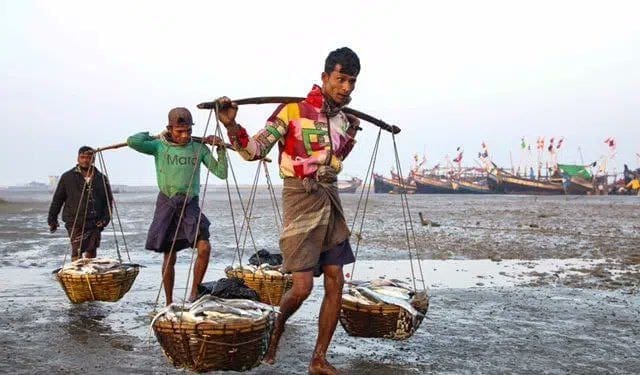
Rohingya fisherman killed by gunfire from Arakan Army soldiers
Local sources in Rakhine State, western Myanmar, reported the death of a Rohingya fisherman from wounds sustained after being shot by Arakan Army (separatist) soldiers in the city of Maungdaw. The sources said the victim, named "U Jouraya" and aged 40, was shot on Sunday without clear reasons while performing the afternoon prayer, after he had gone to carry out his daily fishing work in a waterway between the villages of "Habi" and "Kona", and that he died in hospital from a severe head injury.
A local resident said the victim was a simple man seeking to meet his family's needs through fishing, adding that he had given Arakan Army soldiers items they had requested, including (chilli powder), and expressed his astonishment that they had opened fire on him.
The fisherman belonged to Kona village in Maungdaw city and had 5 children, and lived with his family in Habi village, to which they had been forced to flee since last August due to violence and fighting, according to the sources.

Two Rohingya refugees rescued after being abducted by armed men in Bangladesh
Police in Bangladesh announced the rescue of two Rohingya refugees who had been abducted in the Cox's Bazar area, stating that three suspects had been arrested in connection with the incident.
The refugees "Mohammed Shamsu" and "Anis Islam", who work selling fish, were abducted on Monday at gunpoint by unknown persons while travelling from Balukhali to Teknaf to buy fish.
The Bangladeshi newspaper "The Business Insider" reported on Wednesday that the kidnappers took the Rohingya refugees to a mountainous area in Teknaf and stole their belongings, but a video footage captured by a local resident of the abduction helped police locate them and identify a number of the perpetrators.
Reports from the Cox's Bazar area in Bangladesh confirm an increase in abductions targeting Rohingya refugees, particularly in Teknaf, and Cox's Bazar police statistics indicate that 145 people were abducted in Teknaf during the past year, including 56 Rohingya refugees.
Bangladesh
Bangladeshi police attacked unarmed protesters outside the office of the Prothom Alo newspaper in Dhaka on Sunday. At least three people were arrested and more than 30 others injured.
The protesters objected to the liberal secularist newspaper's ties to Indian intelligence agencies and its support for the ousted prime minister, Sheikh Hasina.


The "war on terror" waged by the National League has become a pretext for further suppression of Islamic identity.


A Muslim lawyer was assassinated by a Hindu terrorist group called "ISKCON" in the Chittagong area, Bangladesh.
Funeral of Bangladeshi lawyer Saif ul Islam Alif, who was brutally killed by a Hindutva mob in Chittagong, Bangladesh.
Chechnya
More than three months have passed since the Russian regime abducted a citizen from the village of Simylashka (Samashki), Israpilov Kazbek; he is known only to have been taken to a police station in the Grozny area.
Israpilov was among the young men who, on the day Putin arrived in Chechnya, placed on a hill overlooking the highway along which Putin would pass the sentence: "We need Sharia."
It turned out that Kadyrov's forces were able to reach him, and he was arrested 5 days after the event. Security forces told his family: "Do not wait for him, you will not see him again."

After the start of the war in Ukraine, Russian agents launched an unprecedented campaign to abduct innocent people in Chechnya, with the aim of using them in the war as fuel for the cannons. Hundreds and thousands of young men were abducted by Russian officials and then forced to sign contracts.
Each department and structure began competing in innovation, and they abducted people by creating complex schemes to ensnare them: female agents, drugs, photos on phones. To justify their actions and blackmail innocent people, they devised many different ways to lure them "as bait".
Sources reported that abductions, searches and raids in the villages near the city of Khasavyurt continued until Friday. Such activities were occurring particularly in Noradilov, Botashurt, and Buragangchuv.
It was not enough for the occupiers to abduct Chechens in occupied Chechnya, so they had already moved to neighbouring areas and abducted Chechens there.
More on the website: What lies behind the abductions of Muslims in Chechnya
A message received from one of our followers in Chechnya:
India
Three young Muslim men killed in police gunfire during survey of mosque in Sambhal city
Tensions escalated on Sunday morning when a crowd opposed to the survey of a mosque clashed with police, resulting in the deaths of three young Muslim men and injuries to a number of people. The martyrs are Bilal Ansari, Naeem Ahmed, and Nadeem Ghazi, as we reckon them.

Violence erupted when a commissioner appointed by the court and his six-member team, accompanied by an extremist Hindu crowd, attempted to enter the mosque to conduct a second survey at around 7 a.m. This second survey of the mosque is part of ongoing legal disputes over its ownership and use.
"There is no place for the Waqf Act in the constitution": Prime Minister Modi stirs controversy over religious endowments
Modi's statement, in which he declared that "there is no place for the Waqf Act in the Constitution," has sparked a national debate over religious endowments. Speaking at the headquarters of the Bharatiya Janata Party (BJP), Modi pointed out that the legal framework governing waqf properties conflicts with the principles of equality and secularism enshrined in the Indian Constitution.
Accusing the Congress party of appeasement politics, Prime Minister Narendra Modi said on Saturday that there is no place for the Waqf Act in the Constitution. Modi said: "The Congress party enacted laws to promote appeasement politics, and the Waqf Board is one example of this. There is no place for the Waqf Act in the Constitution that was given to us by Baba Sahib Ambedkar, but the Congress party supported it to increase its vote base."
A young Muslim man was beaten and forced to chant "Jai Shri Ram"
The family of a young Muslim man said that their son was beaten, stripped of his clothes and forced to chant "Jai Shri Ram" in the city of Meerut, according to their complaint filed on Monday. However, police claimed the allegations were false, noting that the incident appears, prima facie, to have resulted from a personal enmity.
The incident occurred at around 8 p.m. on Saturday, when Javed Sayfi (Jalfam Sayfi), a resident of Sufipur village in the Parabpuram area, was returning home after training at a private shooting range in the Mangal Pandey Nagar area, according to his father, Aftab.
Aftab accused three young men riding a motorcycle of taking Jalfam to Victoria Park, where they beat him, stripped him of his clothes and forced him to chant "Jai Shri Ram." He also claimed that they seized his mobile phone.
Family members added that the victim lost consciousness after being beaten and stripped. Jalfam is currently receiving treatment at a private hospital, and he is preparing to take part in the national shooting championship, according to his family.
An elderly Muslim man was brutally attacked by an extremist Hindutva group for carrying meat in the state of Maharashtra, India.
Controversy over the omission of Islam and Muslims from the "Indian History Companion"
The recent publication of the book "Indian History Companion," edited by Lavanya Vemsani and published by Springer, has sparked considerable controversy over its neglect of Islam and Muslims in its account of India's history. The 507-page book contains only five references to Islam and nine references to Muslims, and it omits a dedicated chapter on their contributions, despite the profound influence of more than a thousand years of Islamic rule on India's history.
Brannon D. Ingram, associate professor of religious studies at Northwestern University, highlighted this issue in a post widely discussed on the social media platform X. Brannon wrote: "Springer recently published a companion to Indian history. It does not contain a chapter on Islam or Muslims. The word Islam appears 5 times in the 507-page book, and the word Muslim appears 9 times. Is this an oversight, or does it color the study of South Asia with a Hindu hue? Whatever the case, it is shameful."
Afghanistan
Night attack on a mosque in Baghlan leaves 11 dead
Eleven people were killed in a night-time shooting carried out by unidentified individuals in the Nahrin district of Baghlan province on Friday night (20 Jumada al-Ula). According to reports, the victims were killed while praying in a mosque in the Shahr Kahna area of the district. Local sources said the death toll reached 11, but the Baghlan Security Command said in a statement that the number is ten.
The Baghlan Security Command also said that security forces arrested a number of suspects linked to the incident, and the incident is under investigation. Shir Ahmad Burhani, spokesman for the Baghlan Province Security Command, said: "Unidentified individuals attacked a mosque in Kahna village in the Nahrin district of Baghlan province. In this mysterious attack, ten residents of Nahrin, who were engaged in worship in the mosque, were martyred. It is worth noting that these individuals spent their days working to earn a living and came to the mosque and khanqah to worship at night when they were attacked."
Meanwhile, a number of Baghlan residents have urged the forces of the Islamic Emirate to make efforts to ensure the security of citizens and bring the perpetrators of this incident to justice. Zahid Allah, a resident of Baghlan province, said: "Innocent people were martyred last night in Nahrin at the hands of unidentified individuals. We demand that the leadership of the Islamic Emirate hand over the perpetrators of this incident to the courts and the law." No party or group has so far claimed responsibility for the incident, according to Tolo News.
174 refugee families returned to Afghanistan through the provinces of Kandahar, Nangarhar, Nimruz and Herat.
Pakistan expels Afghan citizens who lack a no-objection certificate from Islamabad
Pakistan's Interior Minister Mohsin Naqvi announced that Afghan citizens who do not hold legal documents will not be permitted to reside in Islamabad after the end of this year.
He explained that the deadline for obtaining these documents was set at 31 December 2024, stressing that after this date all Afghan residents in Islamabad must obtain a No Objection Certificate (NOC).
The minister affirmed: "No Afghan will be allowed to reside in Islamabad after 31 December. If they wish to stay, they must obtain a residence permit from the Commissioner's office. We will announce more details in the coming days, and we will inform them by all possible means, but after 31 December no Afghan will be allowed to reside without a permit."
Meanwhile, some Afghan citizens residing in Pakistan expressed concern over this decision, noting that, although they had not taken part in any protests against the Pakistani government, they find themselves facing harsher living conditions.
Atiqullah Mansour, an Afghan migrant in Pakistan, said: "Afghans residing in Pakistan have not participated in any political demonstrations against the host country, but the recent statement by the Pakistani Interior Minister reflects emotion and does not reflect an understanding of the reality." For their part, some migrant rights activists stressed the importance of forming a joint committee between Afghanistan and Pakistan to address the challenges faced by Afghan migrants.
The United Nations High Commissioner for Refugees (UNHCR) had previously reported the forced deportation of nearly 36,000 Afghan migrants from Pakistan.
Pakistan
Clashes between Sunnis and Shiites began on Friday evening when an armed group attacked the Baghan market, a predominantly Sunni area. Officials reported that the attackers used light and heavy weapons, resulting in the destruction of hundreds of shops and homes.
A local resident said that the market and its surroundings were completely destroyed, saying: "Nothing worth saving remains in Baghan, neither shops nor homes."
A senior police officer told the French news agency AFP: "Enraged Shiites attacked the Baghan market in the evening, which is largely associated with Sunnis," adding that "the attackers, armed with light and machine guns and mortars, opened fire" for three hours and that "Sunnis responded" to them.
Hundreds flee sectarian violence in northwest Pakistan
Around 300 families fled sectarian violence in northwest Pakistan after new clashes killed 32 people. Intermittent battles between Sunnis and Shiites in the mountainous Khyber Pakhtunkhwa province, bordering Afghanistan, have killed about 150 people in recent months.
A senior official said that "around 300 families have moved to Hangu and Peshawar since this morning seeking safety," adding that more families are preparing to leave the Kurram area of the province. Rehan Mohammad, a 33-year-old journalist from the predominantly Sunni Baghan area of Kurram, said he was forced to flee his home as the clashes intensified.
Ongoing sectarian violence in northwest Pakistan has killed at least 82 people and wounded 156 others, a local official reported on Sunday. The local official in the Kurram district of Khyber Pakhtunkhwa, who asked not to be named, said that "the dead are 16 Sunnis, while 66 belong to the Shiite sect."
Security tightened and arrests carried out against a march by supporters of Imran Khan in Pakistan
A march of supporters of former Pakistani Prime Minister Imran Khan reached the outskirts of the capital, Islamabad, on Monday to demand his release. Imran Khan has been in prison for more than a year and faces more than 150 criminal cases. His political party, the Pakistan Tehreek-e-Insaf (PTI), maintains that the cases against him are politically motivated.
Authorities imposed a security lockdown over the past two days. Highways leading to Islamabad were closed with barriers, and the government used shipping containers to block main roads and streets in Islamabad. Patrols including large numbers of police and paramilitary forces equipped with riot gear were deployed in the area.
Officials announced the arrest of around 4,000 protesters in Punjab, including five parliamentarians.
PTI accused the government of using violent methods to obstruct the protesters. Shaukat Yousafzai, one of Khan's aides, told Geo News TV: "They are even firing live bullets."
Local reports spoke of mutual firing of tear gas between police and PTI supporters on the highway separating Punjab and Khyber Pakhtunkhwa.
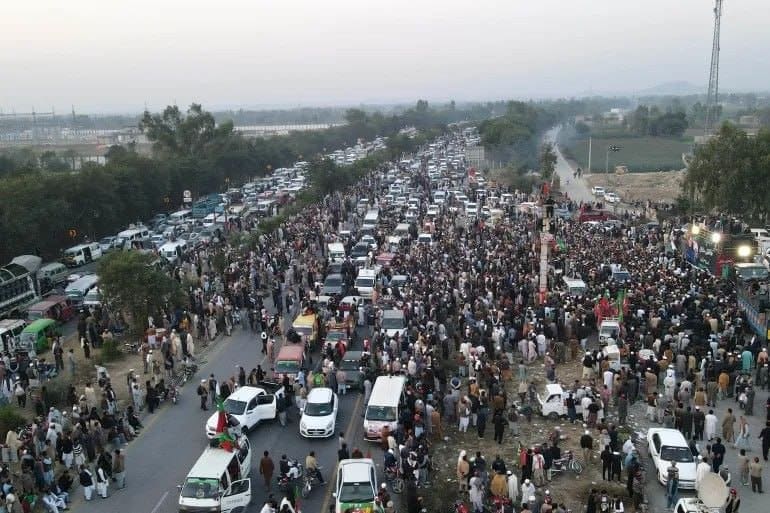
Demonstrations in Pakistan are heading to the capital, Islamabad, in response to the latest call issued by PTI leader and former Prime Minister Imran Khan from prison.
Security forces closed all roads leading to the capital to prevent the protesters from arriving, but party leadership said they would enter Islamabad at any cost. The demonstrations are led by Imran's wife, Bushra Bibi Khan, who was released from prison a month ago.
Thousands of Pakistanis took to the streets to demand that the charges against former Prime Minister Imran Khan be dropped and that he be released.
Six of Pakistan's ten largest cities — Islamabad, Faisalabad, Lahore, Rawalpindi, Multan and Sialkot — saw massive gatherings of protesters.
Pakistani Frontier Corps forces opened fire on an unarmed civilian who was praying from a container during the protests demanding the release of former Prime Minister Imran Khan. Reports indicated that the civilian later died from a neck wound.
Indonesia
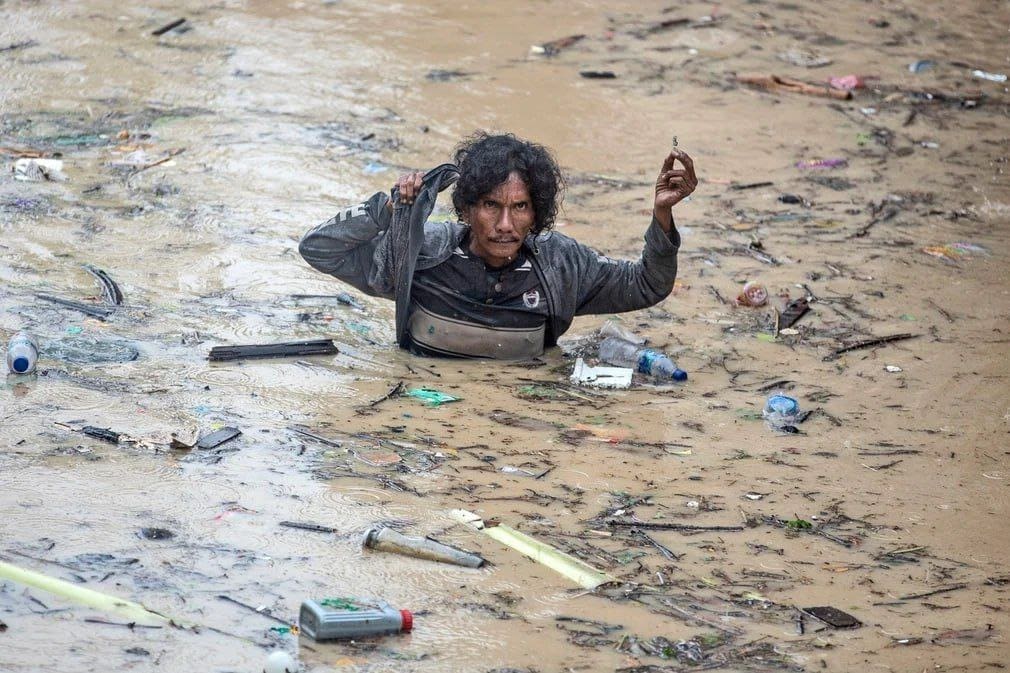
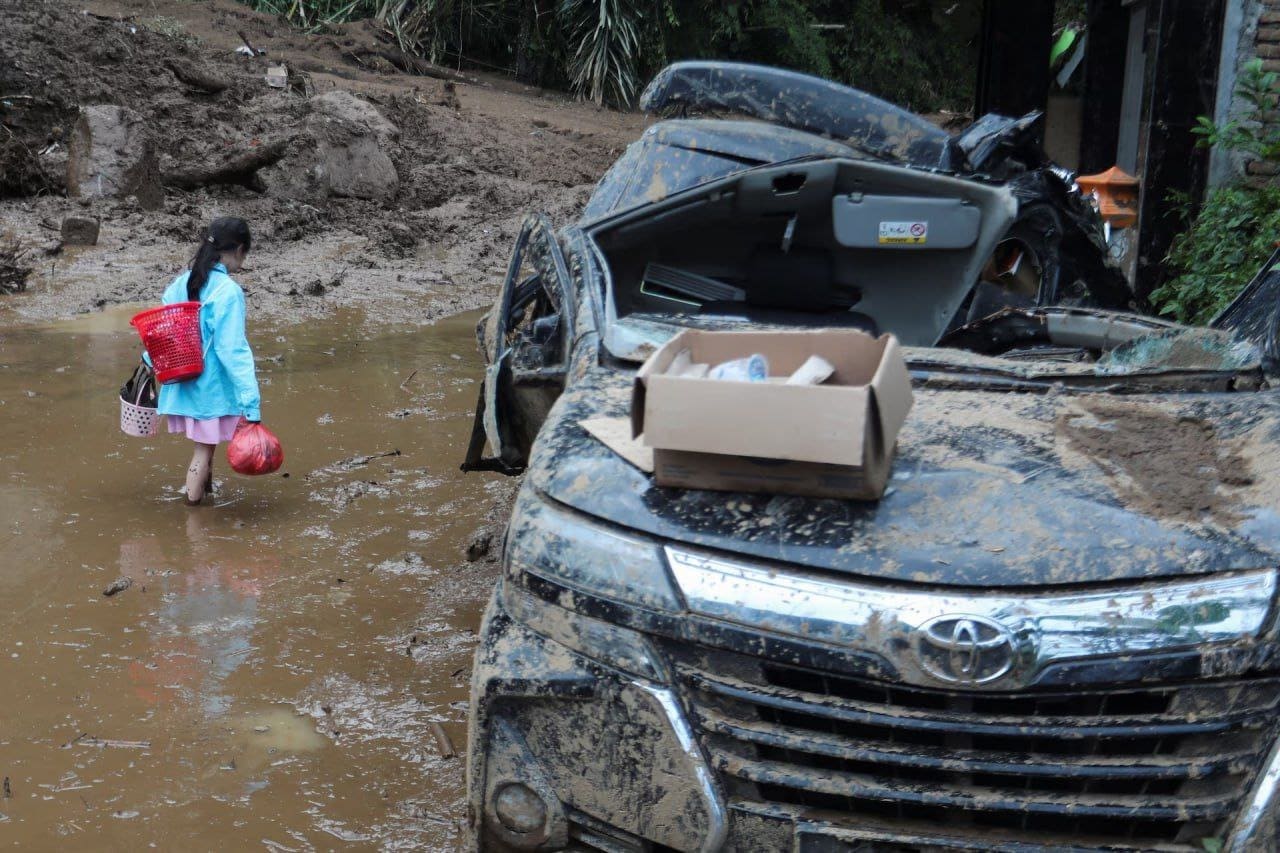
An Indonesian official reported that 16 people were killed and seven others are missing due to floods in Indonesia's Sumatra.
Rescuers recovered 16 bodies from beneath tons of mud and rocks that floodwaters had swept through mountain villages on the island of Sumatra, according to officials on Monday.
These officials told the Associated Press that six people remain missing.
Senegal
Senegalese President Bassirou Diomaye Faye said: "France must close all military bases in Senegal, as their presence conflicts with the country's sovereignty."
Mali
A group of Russian Wagner forces fell into an ambush in Mali, resulting in a number of deaths among their ranks. The Group for the Support of Islam and Muslims (JNIM) claimed the attack.
Sunnis in Iran
The well-known Baloch preacher critical of the policies of the Iranian regime, Sheikh Fathi Mohammad Naqshbandi, imam and preacher of the Grand Mosque in the city of Rask in Iranian Balochistan, was arrested. He was sentenced to five years in prison for his explicit opposition to the regime's domestic and foreign policies.

Muslim minorities
Security forces in Khabarovsk, a city in the Russian Far East, carried out a raid on the Northern Mosque.
In Russia, repression extends east to Khabarovsk and west to Kaliningrad, where repressive measures are taken against Muslims.
Hundreds of students fled Sweden because of the social services (sosial).


