

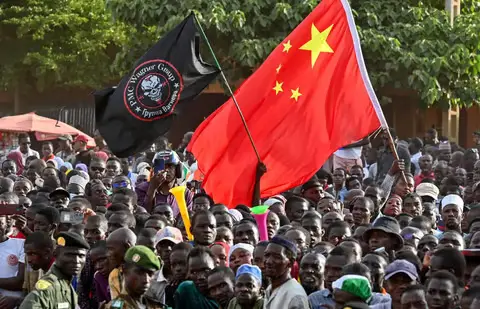
Withdrawal of France and the United States from Niger gives China an opportunity to expand its influence in the region
The withdrawal of US military forces, which will be completed by mid-September next year, and the withdrawal of French military forces in Jumada al-Akhirah 1445 AH (December 2023) from Niger have left a major vacuum in the Sahel region of Africa.
This offers vast opportunities for actors such as China, whose influence in Niger has been steadily growing.
The military withdrawal from Niger by US and French forces opens up a multifaceted opportunity for China to invest in Niger, rather than being limited to economic cooperation, and to move toward potential bilateral military cooperation efforts in the future.
On 8 Muharram 1445 AH (26 July 2023), several factions of the Nigerien armed forces seized power through a coup, detained then-President Mohamed Bazoum, and installed General Abdourahamane Tiani, commander of Niger's Presidential Guard, as the new head of state.
While the United States, France and several other countries condemned the event, China avoided any "controversial" statements, refused to describe what happened as a "coup," and expressed its hope for a "political solution."
China's commitment to a policy of non-interference in this situation enabled it to expand its influence in the region.
China has also played a significant role in developing Niger's infrastructure, focusing heavily on extracting the country's natural resources, chief among them oil and uranium.
The strength of Niger's oil industry and petroleum refining sectors is due to investments in infrastructure by PetroChina, the commercial arm of the state-owned China National Petroleum Corporation (CNPC).
PetroChina also invested in the SORAZ refinery, which was inaugurated in 1432 AH (2011).
PetroChina's long history in Niger dates back to 1429 AH (2008), when the company strengthened its partnerships in the region at a time when most others had withdrawn due to increasing armed conflict in the country.
It is worth noting that Niger is home to large uranium deposits that account for approximately 5% of global mining output.
Chinese state-owned companies — the China National Nuclear Corporation (CNNC), China Nuclear International Uranium Corporation (SinoU), as well as SOMINA — are among the largest, if not the largest, non-Nigerien companies currently operating in the country's uranium industry.
The Chinese state-owned Export-Import Bank (Eximbank) also provided a loan of more than $90 million to the Nigerien government to develop the Azelik uranium mine project in 1430 AH (2009), strengthening China's ability to secure uranium stocks in Niger.
In Dhu al-Hijjah 1445 AH (June 2024), the French state-owned mining company Orano (formerly Areva) was expelled from Niger.
Orano had previously held a de facto monopoly on uranium extraction in the region until 1428 AH (2007).
China was also behind other large-scale infrastructure projects in Niger, including the railway line between Maradi in Niger and Kano in Nigeria, valued at $1.3 billion, and the Kandadji dam hydroelectric project, valued at $800 million.
Withdrawal of US and French forces from Niger causes major change in the regional security landscape
China now has a greater opportunity to expand its military presence in Niger.
Although China is unlikely to directly replace the Western military presence, it may provide security assistance in the form of equipment sales.
A precedent for this already exists, as Niger uses Chinese WZ551 armoured personnel carriers, among other types of equipment.
China can also increase its military engagement with the Nigerien army through bilateral exercises and military exchanges with the Nigerien army.
China has already used such policies in — to name but a few — strengthening bilateral cooperation with Niger's neighbours, participating in joint exercises with the Nigerian Navy, and maintaining a continuous presence of what are known as Chinese peacekeeping forces in Mali.
There are also other countries in West Africa that may follow Niger's example, such as neighbouring Chad, which has threatened to expel US forces from its territory.
The expansion of China's military presence in Niger and Africa is something that must be closely monitored in the coming years, according to American observers. This is precisely what the United States intends to do.
American watchfulness
In an interview given to Fox News Digital, the commander of US forces in Africa (AFRICOM), Michael Langley, expressed American concern about Chinese movements in Africa.
Michael said that "sometimes they have aspirations related to military capabilities and potential."
"They already have a base in Djibouti. Over time it will become clear how far their aspirations go... We are monitoring at all times what the overall global intentions of the People's Republic of China are in the strategic domain."


