

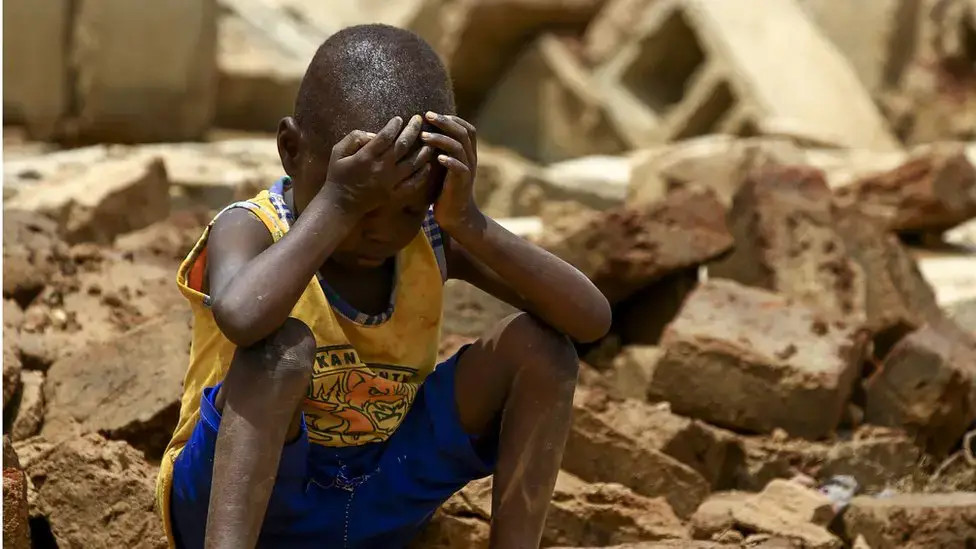
WHO: Lean season in Sudan could lead to catastrophic hunger
The World Health Organization says the coming lean season in Sudan could lead to catastrophic levels of hunger, the spread of disease and deaths from infectious diseases among populations already suffering from malnutrition and hunger.
Peter Graaff, acting WHO representative in Sudan, said: "Ten months have passed since the conflict erupted in Sudan, plunging the country into a humanitarian crisis of enormous proportions."
Graaff told journalists in Geneva on Tuesday, speaking from Cairo, that some 25 million people, more than half of Sudan's population, need humanitarian assistance. He said 18 million of them face acute hunger, including five million experiencing emergency levels of hunger and just one step away from famine.
He added: "There is concern that the coming lean season could lead to catastrophic levels of hunger in the most affected areas."
"In Darfur alone, 200,000 children are expected to suffer from hunger that threatens their lives this year." He said hunger weakens the body's defences, opens the door to disease and increases rates of illness and death.
The WHO warns that time is critical, as the lean season is only six weeks away. This is the period of the year when food stocks are at their lowest before the next harvest.
Between Shawwal and Muharram (April and July), Graaff warned that Sudan's already poor food security situation will worsen amid escalating fighting and months of deprivation, as hunger will weaken the ability to ward off the harmful effects of disease.
He said: "The people of Sudan face a situation of life or death due to continued violence, insecurity and limited access to essential health services and supplies."
"People suffering from malnutrition, especially pregnant women and children, have worse outcomes from disease." He added that malnourished children are increasingly at risk of dying from diseases such as diarrhoea, pneumonia and measles, especially in an environment where they lack life-saving health services.
3.5 million children with severe acute malnutrition this year, including more than 700,000 children expected to suffer from severe acute malnutrition, the deadliest form of the condition.
It says more than 70 per cent of health facilities in conflict-affected areas no longer function, and two-thirds of the population lacks access to health care.
Graaff noted that "the situation in Sudan is therefore a perfect storm because the health system is not working well."
He added that "the child immunisation programme is collapsing, and infectious diseases are spreading", pointing to thousands of recorded cases of cholera and dengue fever, as well as more than 1.2 million cases of malaria and other infectious diseases.
The seizure of power between two rival generals, from the Sudanese Armed Forces and the paramilitary Rapid Support Forces, on 6 Shawwal (15 April) plunged Sudan into a deadly conflict.
Since then, the United Nations Office for the Coordination of Humanitarian Affairs (OCHA) has reported that nearly eight million people have been displaced, 6.1 million within the country and 1.8 million to neighbouring countries, making Sudan the largest displacement crisis in the world.
The Norwegian Refugee Council says Chad has received the largest number of Sudanese refugees, nearly 700,000, placing "unbearable pressure on one of the poorest countries in the world."
In a statement issued on Wednesday, Jan Egeland, Secretary General of the Norwegian Refugee Council, who this week visited camps and the Adré informal settlement in eastern Chad, said the world appears to have forgotten the survivors of the brutal war in Sudan.
"Here in Chad, I heard horrific testimonies of violence and deliberate atrocities. Families fleeing neighbouring Darfur have witnessed executions, rape, indiscriminate bombing, burning of camps and massacres, simply because of their ethnic identity. Yet many survivors have been completely abandoned."
"They are forced to live in desperate and undignified conditions, under temporary tents, and lack even basic assistance. How have these survivors been forgotten to this extent?" he asked.
He warned that "the war is tearing apart an entire region in the heart of Africa. There must be a more effective international diplomatic and humanitarian response."
Martin Griffiths, United Nations Under-Secretary-General for Humanitarian Affairs and Emergency Relief Coordinator, raised similar questions when the United Nations launched an appeal last week to raise $4.1 billion for Sudan.
He warned that states' disregard for the conflict in Sudan puts them at risk.
He said: "Sudan geographically poses a threat to the destabilised parts of Africa… and it is something we cannot allow to continue as it is now."
"We must invest in political diplomacy. We must invest in humanitarian efforts. We must also invest in the region."
Unfortunately, WHO representative Peter Graaff said: "There appears to be little hope of a political solution on the horizon," and there is little capacity to reach the areas most affected by the conflict, such as Darfur and Kordofan, with the humanitarian aid they urgently need.
"We are ready to provide life-saving health services and supplies. But to do so, we need safe and unhindered access."
"There is much more that can be done than is being done now. That is why we need the commitment of the international community."
Voice of America


