

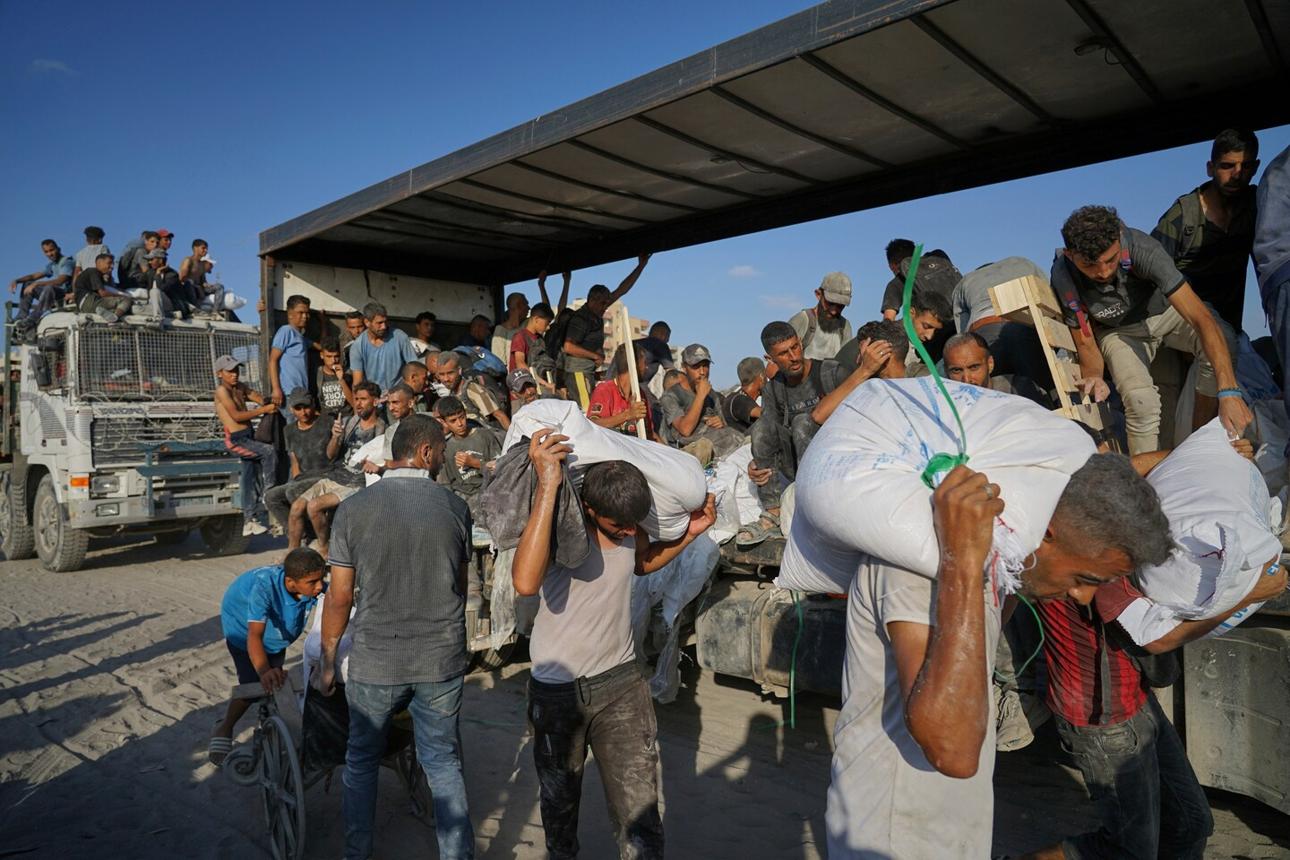
From the seizure of four tonnes of hoarded vegetables in Rafah to gangs robbing relief trucks, tracing the food crisis in the Gaza Strip reveals a complex network of Israeli restrictions, armed groups, black-market traders, weak oversight and collapsing purchasing power. Who seizes the aid? Where do the stolen goods end up? And how are the displaced paying the price of this chaos?
Four tonnes in Rafah: an incident that opens a wider file
On 28 October 2026, the Supply Police in Rafah governorate, southern Gaza Strip, announced the seizure of 4,030 kilograms of potatoes and onions, which it said were stored by a number of traders for the purpose of hoarding, during an inspection tour carried out in cooperation with the Ministry of National Economy.
According to the official statement, legal measures were taken against the traders, and the competent authorities supervised the sale of the seized quantities to citizens at the place of seizure, at the approved prices. The statement did not name the violators or the scale of any potential profits from hoarding, nor did it specify the source of the goods or how long they had been stored.
The incident may appear limited compared with the scale of the humanitarian catastrophe in Gaza, but it raises a broader question: how do food supplies reach warehouses and markets while many displaced families are unable to buy their basic needs? Where does the real shortage end and hoarding and exploitation begin?
A distinction must be made from the outset: according to the published information, the vegetables seized in Rafah are not stolen humanitarian aid. The statement refers to the hoarding of commercial goods and provides no evidence linking the detained traders to gangs that loot aid convoys.
Nevertheless, the incident serves as an entry point for understanding a wider crisis in which the theft of aid, hoarding, speculation and restrictions on the entry of goods intersect, all of which are reflected in the lives of civilians.
When aid becomes spoils: how the looting crisis began
The crisis of aid looting in Gaza did not arise from a single incident. It developed with the Israeli war that broke out in October 2023, and the wide-scale destruction of infrastructure, the displacement of residents, the restriction of supplies and the weakening of protection and oversight institutions that accompanied it.
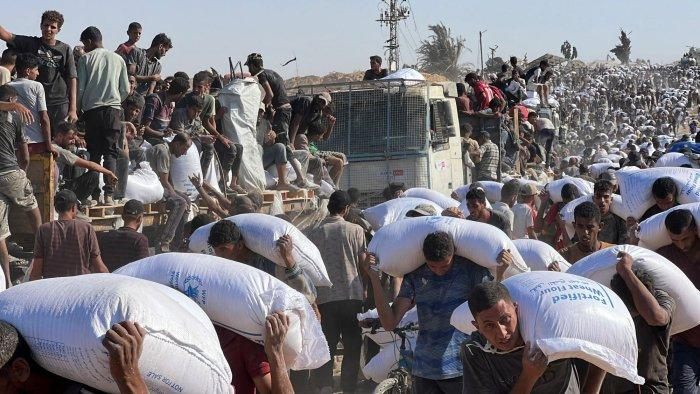
United Nations reports reveal that the crisis reached dangerous stages during 2025, when aid convoys faced two intertwined threats: attacks by armed gangs on the one hand, and crowds of hungry people rushing toward the trucks to obtain food on the other.
In a report covering the period from 3 to 16 August 2025, the United Nations Office for the Coordination of Humanitarian Affairs (OCHA) reported that more than 12,000 tonnes of flour, food parcels and community kitchen supplies had entered, but more than 95% of it was unloaded from the trucks by hungry crowds or seized by armed gangs before reaching organised distribution points.
As a result, during the period in question, humanitarian partners were unable to carry out the planned household distributions for the most vulnerable groups.
A fundamental problem in interpreting these figures emerges here: not everything unloaded from a truck outside the official distribution system was stolen by a gang. There is a difference between an armed man who seizes a shipment in order to sell it and a hungry displaced person who rushes toward a truck because he fears he will not receive his share of food.
Nevertheless, both cases disrupt the distribution system that is supposed to ensure that aid reaches the elderly, the sick, persons with disabilities and families unable to reach the trucks.
Hunger therefore does not explain all the looting, but it creates the environment in which gangs can exploit the chaos and turn food into a source of profit and influence.
Where does the seized aid go?
No comprehensive independent tally exists showing the final destination of all the aid lost during the war. However, tracking patterns of loss reveals different routes.
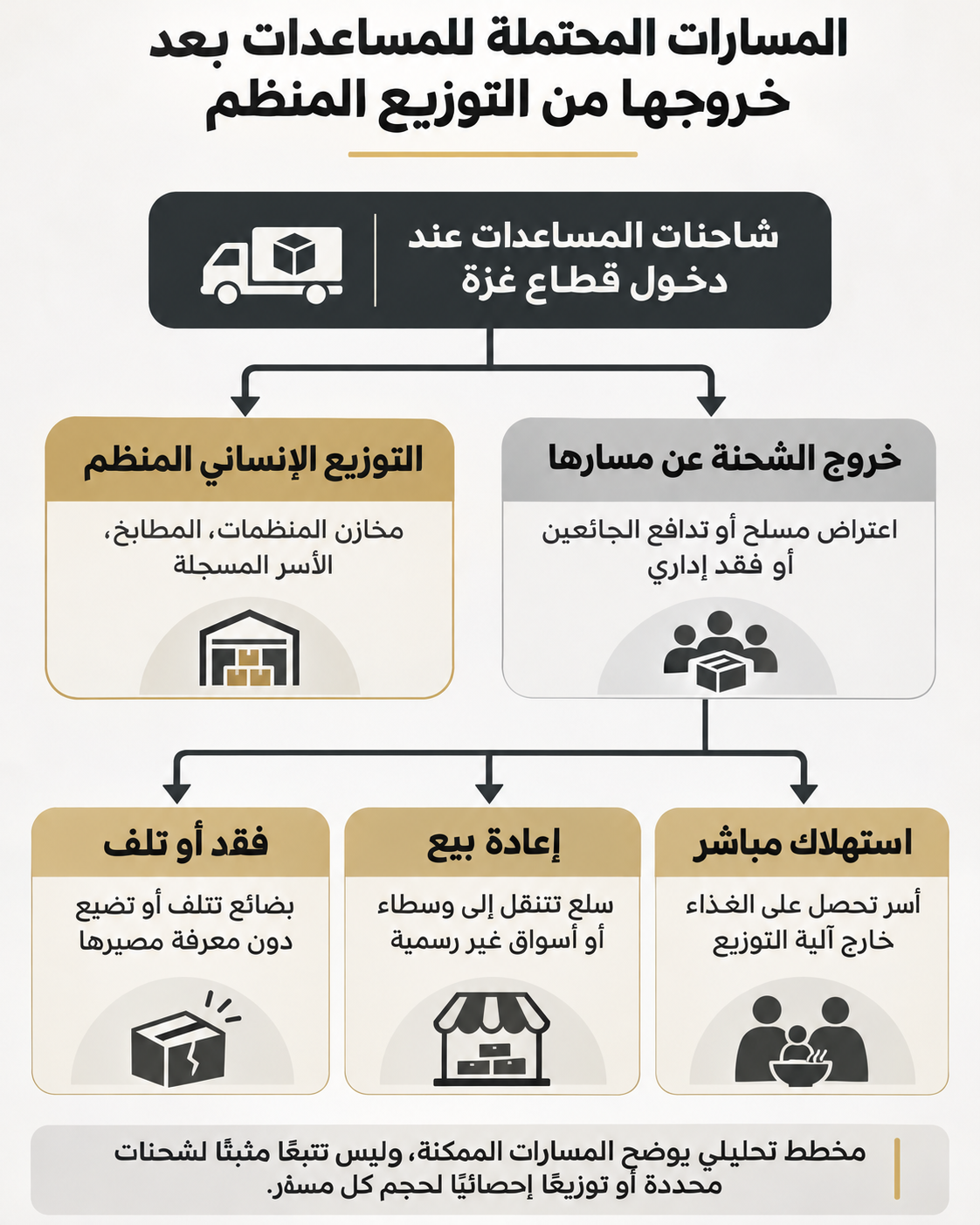
When relief goods enter the commercial market, they may appear before the consumer as flour or food items offered for sale instead of being given free of charge to those entitled to them. But proving that a particular commodity is stolen requires tracing its source, shipping documents and the party that received it, not merely noting its presence in the market.
The Strip also receives legitimate commercial imports, and not every food item on sale is part of stolen aid.
In the case of Rafah, the Supply Police did not specify the source of the seized potatoes and onions, so there are no published findings that allow the seized quantity to be linked to relief shipments.
Who is accused? Gangs, armed groups and local authorities
Armed groups operating outside the aid distribution system are among the actors named in investigations into the looting of trucks.
Among the most prominent of these groups are the "Popular Forces" led by Yasser Abu Shabab in the Rafah area, whose name appeared in investigations by the Associated Press during 2025.
The agency quoted aid workers and truck drivers accusing members of the group of repeatedly seizing aid convoys, in some cases near areas where Israeli forces were deployed, while the group denied responsibility for the major looting operations and said it secures food distribution centres.
The Gaza Humanitarian Foundation also denied cooperating with the group, despite statements by the latter about its relationship with distribution sites linked to the Foundation.
These accounts show that some looting groups were not merely thieves exploiting the absence of security, but had turned into armed formations competing for control of roads, resources and local influence.
On the other side, security agencies under the de facto authorities in Gaza took measures against suspects accused of looting trucks. In May 2025, Reuters quoted informed sources as saying that Hamas-led groups executed four men on charges of stealing aid and involvement in incidents that resulted in the deaths of personnel tasked with protecting the convoys.
These measures in turn raise serious human rights questions about trials and guarantees of justice, as combating looting does not justify execution outside due judicial process.
Armed gangs and war profiteers: from looting aid to selling it at exorbitant prices
The crisis of aid looting in the Gaza Strip is not limited to seizing trucks and disrupting their delivery to the entitled; investigative reporting has revealed the involvement of armed gangs in stealing relief shipments, then moving them to warehouses or selling them to traders and intermediaries who put them back on the market at exorbitant prices, although they are intended for free distribution to residents. Among the most prominent of these formations is the group of Yasser Abu Shabab, whose name appeared in investigations into looting operations near the Kerem Shalom crossing. In July 2025, a former member of the group told the Australian Broadcasting Corporation (ABC) that members of the group seized flour, sugar and other aid, then sold quantities of it to traders. These testimonies are especially significant after Israeli Prime Minister Benjamin Netanyahu acknowledged support for Palestinian armed groups opposed to Hamas in Gaza.
An investigation by The Washington Post also revealed that gangs were operating in areas under Israeli control and moving entire trucks to warehouses to resell their contents at high prices. The Associated Press documented the price of a kilogram of flour reaching 60 dollars and lentils reaching 35 dollars during July 2025, in a picture that reveals the scale of exploitation to which residents were subjected. Thus, food that entered the Strip to save the hungry becomes a commodity for speculation, passing through the hands of armed men, intermediaries and traders before reaching the displaced person, who is forced to buy it at a price he does not actually have.
What about the Israeli occupation's accusations that Hamas stole aid?
The Israeli authorities have repeatedly accused Hamas of seizing aid and diverting it to its members or selling it in markets, and have used these accusations to justify tightening oversight of aid and changing its distribution mechanisms.
However, an investigation published by Reuters on 25 July 2025 revealed that an internal analysis conducted by the United States Agency for International Development found no evidence of systematic theft of US-funded aid by Hamas.
The analysis covered 156 incidents of aid theft or loss reported by relief organisations between October 2023 and May 2025, none of which included a documented accusation that Hamas benefited from the missing shipments.
By contrast, 44 incidents were directly or indirectly linked to Israeli military operations, according to the findings reviewed by Reuters.
The US State Department objected to the analysis's conclusions, while Tel Aviv maintained its accusations. The authors of the analysis acknowledged that the findings do not rule out the possibility of aid diversion that was not detected or reported.
Accordingly, it cannot be said that all looting was carried out by groups opposed to Hamas, nor can the Israeli accusation of systematic theft be accepted as an established fact.
Responsibility for each incident must be determined by the evidence relating to it, not by the political affiliation of the accused party.
The role of the Israeli occupation: from restricting food to supporting armed groups
The food economy in Gaza cannot be understood apart from the Israeli occupation's control of crossings and supply routes, and the restrictions imposed on the movement of aid and commercial goods.
During the war, the Israeli authorities imposed severe restrictions on the entry of humanitarian and commercial shipments, including a total closure lasting 78 days during 2025, according to OCHA documentation.
This led to shrinking stocks and the disruption of kitchens and bakeries, at a time when residents were losing their homes and sources of livelihood.
The link between restrictions and rising prices is clearly visible in United Nations data for 2026.
In the week ending 20 September, OCHA reported that inflation in Gaza remained about 207% higher than pre-October 2023 levels, while the price of a 25-kilogram bag of flour fell by about 18% compared with the previous week after commercial imports and humanitarian distributions increased.
This is an example of how the regularity of supplies affects not only the availability of food, but also the ability of traders to control prices.
Support for groups opposed to Hamas
On 5 June 2025, Israeli Prime Minister Benjamin Netanyahu acknowledged the use of Palestinian groups and clans opposed to Hamas inside the Gaza Strip, and said this step serves to protect Israeli soldiers.
Israeli and American reports stated that the group of Yasser Abu Shabab was among the most prominent groups associated with this policy, with reports of it being supplied with weapons.
This information is especially significant given the accusations made by aid workers and truck drivers against members of the group regarding the looting of aid.
A responsibility that merits investigation arises here: did support for armed groups operating in areas under Israeli control help strengthen the parties accused of looting food? And did the new military influence enable them to control aid routes or distribution outlets?
The published facts support the existence of links between Israeli support for some armed groups and the looting accusations directed at members of those groups, but they do not establish that all aid thefts were directed by Israeli orders.
The distinction here is important: between a documented policy of supporting armed groups, and a specific accusation that every looting operation was directed.
When looting becomes part of the war economy
War does not only destroy markets; it sometimes reshapes their rules.
When goods become scarce, transport routes become dangerous and oversight is weak, opportunities arise to make large profits from controlling food, fuel, water and means of transport.
In such conditions, some actors may shift from normal trade to speculation and hoarding, while groups emerge that obtain their resources by imposing levies, seizing goods or controlling roads.
The war economy in Gaza can be understood through three interconnected links.
The first is scarcity, which makes any food shipment of high economic value.
The second is weak protection and oversight, which allows armed groups or exploiters to seize resources or manipulate their distribution.
The third is weak purchasing power: markets may be full of some products, while displaced people are unable to buy them because they have lost their income and savings.
UNICEF data confirms this last aspect: monitoring of cash assistance in 2026 showed that improved availability of goods was not sufficient to ensure that vulnerable households could buy them. According to June monitoring, cash assistance was the main source of income or support for 72% of the beneficiary households covered by the monitoring.
Household spending is also not limited to food, but extends to treatment, transport, fuel, hygiene and debt repayment.
Thus onions or flour may be available in a shop near a displaced persons' camp, but their presence does not mean that a hungry family can obtain them.
Residents' testimonies: between waiting for trucks and the helplessness of markets
Testimonies from residents gathered by international organisations help clarify the gap between food reaching Gaza and food actually reaching family tables.
In a World Food Programme follow-up during the first half of September 2026, 44% of the households covered by the survey said they had gone to bed hungry at least once during the previous thirty days, while 45% reported that they had completely run out of food at least once during the same period.
These findings indicate that supplies do not reach residents in sufficient quantity or on a regular basis, and that increasing the number of trucks alone does not necessarily solve the problem of access to food.
In the OCHA report issued in October 2026, community kitchens produced about 614,000 meals per day, a decline of nearly 12% from late September, amid shortages of funding and supplies.
At the same time, food parcels and flour distributed to households were sufficient to cover only about half of the minimum caloric needs of the families, while nearly 90% of the population relied on humanitarian food assistance.
These are documented testimonies and survey results, but they alone do not allow the amount of food each family lost specifically through theft to be determined.
Who bears the heaviest burden? The displaced, children and the most vulnerable
A person who is able to move may find a way to a aid truck or a distant market, but this does not apply to everyone.
Elderly people, the sick, persons with disabilities, children and families who have lost their breadwinner face multiplied obstacles in obtaining food, especially when the organised distribution system collapses and access to food depends on the ability to travel, push through crowds or pay high prices.
OCHA reported in its October 2026 report that one child out of every large group of children receiving nutrition services remains at risk of malnutrition; more than 2,800 children entered malnutrition treatment programmes during September, including more than 360 cases of severe acute malnutrition.
The Integrated Food Security Phase Classification released in July 2026 showed that more than 1.2 million people, or about 59% of the population, faced crisis-level food insecurity or worse between mid-April and the end of June, with the number expected to rise to more than 1.4 million during the second half of the year if the conditions of the announced scenario materialise.
This explains why the loss of a food shipment or the hoarding of a basic commodity has a greater impact in a society in which most members have lost the ability to compensate for shortages from other sources.
The problem is not merely rising prices; it is a matter of families' ability to survive, given the overlap of food insecurity with displacement and the deterioration of shelter and health services.
Who is responsible for the crisis? Overlapping levels, no single culprit
The evidence shows that the food crisis in Gaza cannot be explained by a single party or a single type of practice.
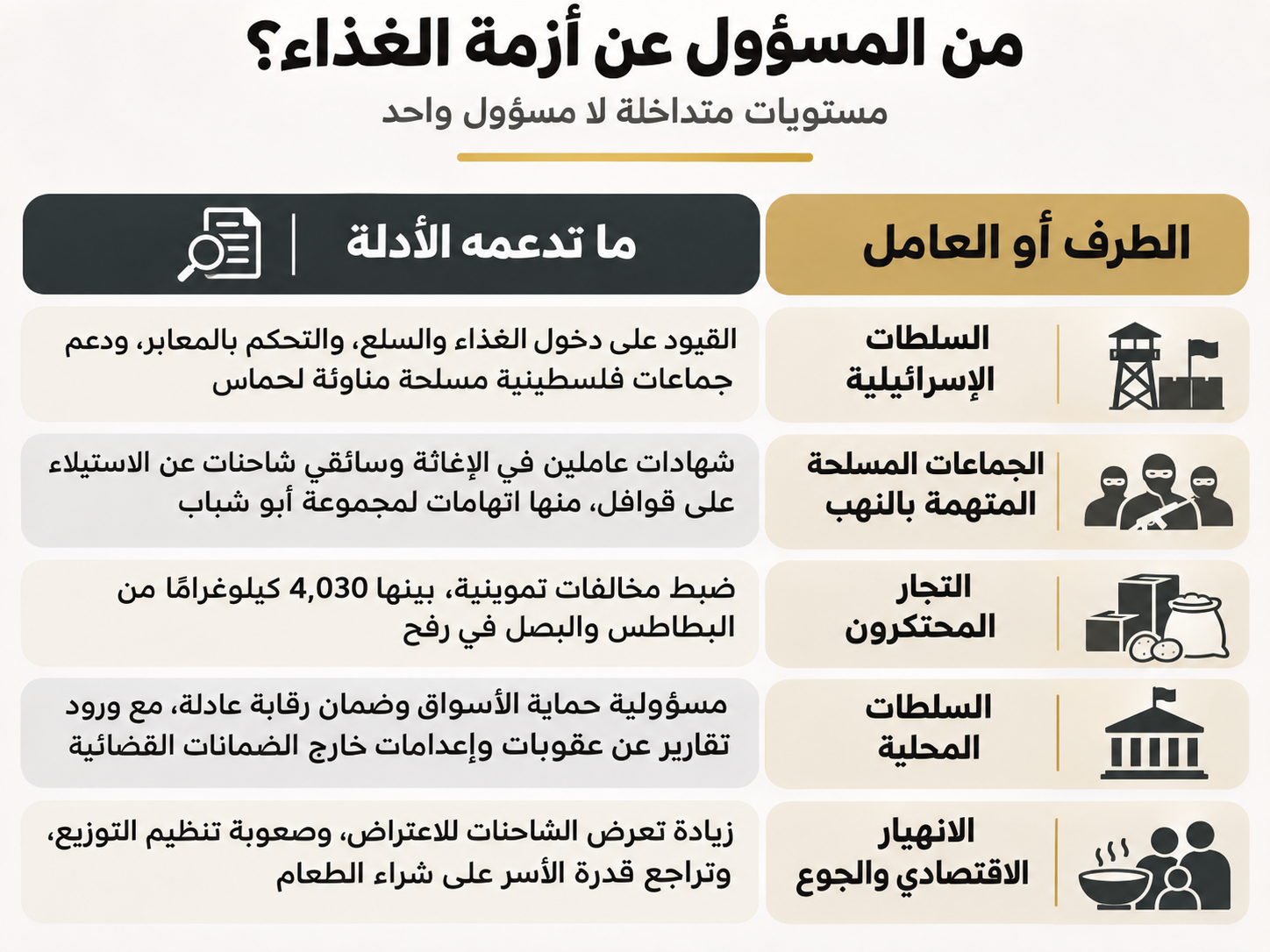
The convergence of these factors does not mean that responsibility is shared equally. Israeli control over the crossings and the restrictions imposed on the entry of goods are a fundamental structural factor, while acts of looting, hoarding and corruption are factors that add to the complexity of the crisis and aggravate civilian losses.
It is also necessary that discussion of Israeli responsibility not turn into an exemption for every merchant, local official or armed actor proven to be involved in looting food or exploiting the hungry from being held to account.
How can the cycle of looting and hoarding be broken?
Addressing it begins with ensuring a sufficient and regular flow of food through the crossings, and opening safe routes to deliver aid to the warehouses of organisations and distribution points without interference from armed groups.
It also requires the publication of clear data on the quantities entering, the quantities reaching the warehouses, and what is actually distributed to families, and the documentation of losses at every stage in a way that allows independent verification.
On the commercial side, market oversight must be strengthened and hoarding prevented, approved prices published, violations investigated, and the rights of the accused and fair judicial procedures guaranteed.
As for displaced families, they need distribution mechanisms that take into account the situation of those who cannot stand in queues or travel long distances, and cash and food assistance that preserves their dignity and does not make access to food dependent on physical strength or influence.
These measures cannot succeed without protecting aid workers and humanitarian routes, and enabling independent investigation of incidents of seizing trucks and attacks on civilians.
Conclusion: Whoever controls the food controls the power to extort the hungry
The seizure of four tonnes of potatoes and onions in Rafah was not merely an ordinary commercial violation, in a context of a population suffering hunger, displacement and the loss of sources of income. But it is also not evidence of a wider looting network without an investigation linking it to one.
Monitoring the past years reveals that food in Gaza has become more than a livelihood need; in some cases it has turned into a source of influence and profit, a tool of bargaining, and a commodity whose value multiplies when supply routes narrow and the authority of the law weakens.
At the heart of this crisis stands the Palestinian civilian who has lost his home and his work, and who must search for food amid the dangers of shelling, looting, hoarding and rising prices.
The question that should be directed at all parties is not only: who stole the aid? But also: who made access to food so difficult, who benefited from the continuation of this situation, and who has the power to change it?
Holding to account those who steal aid and hoard goods is a necessity, but it will not be sufficient as long as the causes of scarcity, insecurity and the disruption of supply chains persist.
Saving Gaza from the hunger trade begins with ensuring that food reaches people, and ends only when obtaining it becomes a safe right rather than a daily gamble, and no longer a means of enriching the powerful at the expense of the weak.


