

Genocides do not usually begin with missiles and bombs, and major crimes do not begin with bullets and munitions. They begin with words that adorn the truth, redefine the victim, and present injustice in the guise of necessity, until the killing of civilians, their displacement and the destruction of their lives become something that can be defended before the public. Here the danger of what the Holy Quran describes as "the whispers of the devils" becomes apparent, when misleading words collude with desires and interests to fashion a narrative that justifies falsehood and dresses it up. God Almighty says: ﴿And thus We have made for every prophet an enemy – devils from among mankind and jinn, inspiring one another with decorative speech as deception﴾ – Al-An'am: 112.
From this embellishment that clothes crimes in a legitimate garb, the narratives of the war on terror and the suppression of insurgency keep recurring, becoming a justificatory umbrella under which massacres are carried out. These are narratives that deserve to be dismantled and held to account, from the tragedy of the Rohingya in Myanmar to what the Palestinians are facing in Gaza.
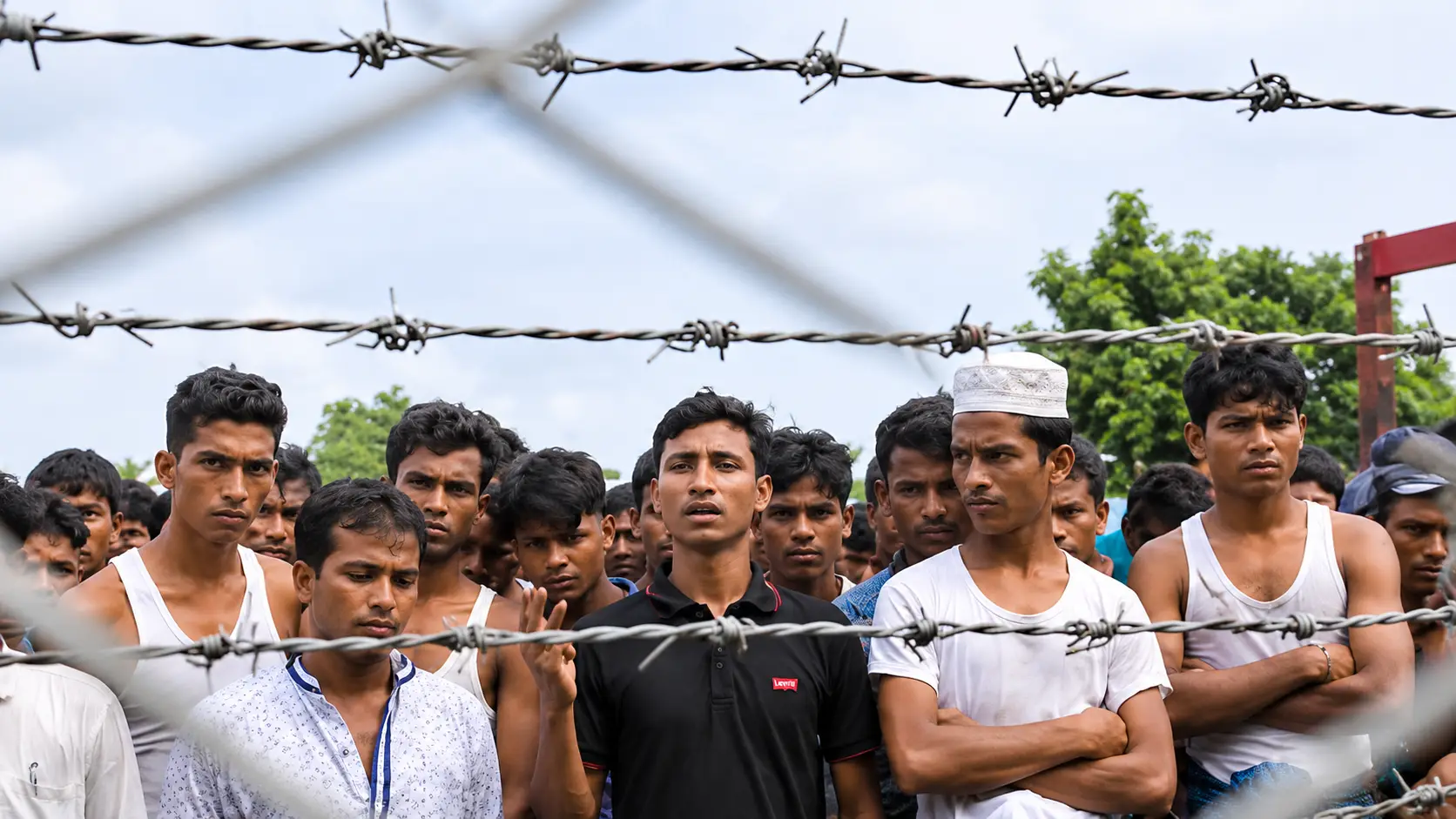
On 19 November of this year, the International Court of Justice ruling on the genocide against the Rohingya returned the case to the centre of international debate, after the Court concluded that Myanmar bears responsibility for committing genocide during the military campaign that targeted the Muslim minority in 2017. The ruling again spotlights one of the most dangerous arguments states use to justify large-scale military operations: that targeting the group is not targeting the group, but rather the armed elements active within it.
This argument, which the authorities of Myanmar relied on in defending their military operations against the Rohingya, intersects with the narrative put forward by Israel regarding its crimes in Gaza, as it insists that its operations target the Hamas movement and not the Palestinians as a group.
The Rohingya: When "counter-insurgency" no longer explains what happened
For years, the Rohingya in Rakhine State in Myanmar suffered discrimination, deprivation, and restrictions on movement, education and work, within a long context of policies that made this Muslim minority one of the most persecuted groups in the region.
In August 2017, the Myanmar military launched a wide-scale military campaign in Rakhine State. These operations drove more than 730,000 people to flee to Bangladesh, according to United Nations data, while international reports documented killings, rape, the burning of villages and large-scale forced displacement.
International investigations did not confine themselves to recording the numbers of displaced people or documenting the damage. They focused on the pattern of military operations, the nature of the violations, and the statements issued by officials, and on whether the facts revealed an intent to destroy the Rohingya as a religious and ethnic group.
In the report of the United Nations Independent International Fact-Finding Mission on Myanmar, investigators concluded that there was sufficient information and evidence to justify investigating and prosecuting senior military officials on charges of genocide, considering that genocidal intent can be inferred from a pattern of conduct, not necessarily from a written order explicitly declaring an intention to destroy a particular group.
In its 2019 report, the mission went further, concluding that genocidal intent could be inferred from a set of indicators, including the pattern of military operations, widespread destruction, sexual violence, displacement, and policies targeting the Rohingya, alongside the context of discrimination that preceded the military operations.
On 19 November 2026, the International Court of Justice ruled that Myanmar had committed genocide against the Rohingya, a judicial milestone of great importance in the path toward accountability for the crimes committed against the Muslim minority.
The same argument: "We are not targeting the group, but the fighters"
Among the most prominent points of intersection between the cases of the Rohingya and Gaza is that the authorities of Myanmar argued that the military operations targeted an insurgent movement and not the Rohingya as a group, while Israel says its war targets Hamas and not the Palestinians.
Yet this kind of justification is refuted by the nature of the acts, their scale, their repetition, the conditions imposed on the population, and the evidence that can reveal the intent behind them.
Since 7 October 2023, Israel has presented its war on Gaza as a war against the Hamas movement. But the scale of destruction that has struck the Strip, the widespread killing of civilians, the repeated displacement, and the destruction of the health sector and essential services have prompted international institutions to examine whether the acts committed went beyond war crimes to the crime of genocide.
On 16 September 2025, the Independent International Commission of Inquiry established by the United Nations on the Occupied Palestinian Territory, including East Jerusalem, and Israel, concluded that the occupation had committed genocide against the Palestinians in the Gaza Strip.
The Commission said it had concluded that four of the five acts defined in the Genocide Convention had been committed: killing members of the group; causing serious bodily or mental harm to them; imposing living conditions calculated to bring about their destruction in whole or in part; and imposing measures intended to prevent births within the group.
The Commission based its findings on a legal analysis and an assessment of evidence that included field facts, statements, the pattern of military operations, and what it considered to be the targeting of the conditions that ensure the survival of Palestinians in Gaza. Israel rejected the report's findings, described the genocide accusations as untrue, and affirmed that its war targets Hamas and that it acts in accordance with international law.
Dehumanising rhetoric: When a population becomes an extension of the enemy
In genocide cases, the investigation does not stop at the number of victims or the scale of destruction. It also covers the rhetoric that precedes or accompanies the operations, the way the targeted group is described, and whether statements contribute to stripping its members of their humanity or holding them collectively responsible.
In its report issued in May 2024, the United Nations Commission of Inquiry documented statements by Israeli officials that described Palestinians in dehumanising terms, linked the population of Gaza as a whole to Hamas, or spoke of their displacement and the reshaping of their presence in the Strip.
The Commission also concluded that Israel had used starvation as a method of warfare, and that restrictions on food, water, electricity, fuel and humanitarian aid had produced far-reaching effects on the civilian population.
In September 2025, the report of the United Nations Commission of Inquiry on the genocide in Gaza added a more detailed analysis of the relationship between field actions and intent, drawing on a set of indicators, including killing, bodily and mental harm, the destruction of the means of life, and measures affecting the capacity to procreate, within a legal assessment of genocidal intent.
This evidence is significant in confronting the narrative that makes targeting Hamas a sufficient explanation for everything that happened in Gaza. The international law to which they appeal does not accept that the existence of an armed group becomes a justification for destroying an entire society or inflicting collective harm on it, nor does it allow the identity of the population or its geographic proximity to fighters to serve as the basis for targeting it.
The Rohingya and Gaza: What does the comparison reveal?
In Myanmar, the authorities said the operations targeted the armed insurgency among the Rohingya, not the Muslim minority itself. In Gaza, Israel says the war targets Hamas, not the Palestinians.
Investigations into the Rohingya showed that the burning of villages, killing, sexual violence, displacement and widespread destruction were not isolated incidents, but elements within a pattern that was assessed in the context of genocidal intent.
In Gaza, international investigations address the destruction of homes, health facilities and basic infrastructure, repeated displacement, and restrictions on food, water and aid, as acts and facts that must be assessed collectively within the legal framework, not each considered an incident separate from the other operations.
When political or military discourse rests on characterising an entire community as part of the adversary, this raises grave risks, as it weakens the distinction between fighters and civilians and creates an environment in which collective punishment, displacement or the targeting of civilian structures can be justified.
United Nations reports on Gaza indicate that some statements by Israeli officials generalised responsibility to the population and employed dehumanising language.
The law does not deal with declared intentions alone
Genocidal intent is one of the most difficult elements to prove in international law, but courts can infer it from a pattern of conduct where the evidence is sufficient, from statements, orders and operational context. Officials are not required to acknowledge an intention to destroy a group in order for a court to assess it.
Media reports highlighted this aspect in explaining how genocide is proven, drawing on the judicial developments concerning the Rohingya and on the comparison with the case brought by South Africa against Israel.
Reports addressed the legal points of comparison between the two cases, including the use of the counter-insurgency argument, the assessment of statements and historical context, and military operations that affect civilians.
How is the security narrative used to soften the impact of crimes?
A set of words recurs in the rhetoric justifying major military operations that appear defensive on the surface: counter-terrorism, protecting security, eliminating insurgency, freeing detainees, preventing further attacks. The problem arises when the security objective ceases to be the justification for a specific operation and becomes a comprehensive framework that explains every violation, prevents officials from being held accountable, places victims in the position of the accused, and turns images of destruction, massacres and displacement into mere details within a larger story about security.
In the Rohingya case, Myanmar relied on the presence of an armed group to explain its military campaign, but international investigations concluded that the pattern of acts went beyond what could be explained by pursuing fighters, and was linked to evidence of an intent to destroy the group.
In Gaza, the matter remains before the International Court of Justice within the case brought by South Africa, while the independent international Commission of Inquiry established by the United Nations concluded that genocide had occurred, a conclusion that Israel has rejected.
Genocide does not always begin with a declaration, and it may be wrapped in justifying narratives
The experience of the Rohingya and what is happening in Gaza show that the gravest challenge facing international law is not the absence of texts, but the capacity of political discourse to build broad justifications for military operations, to turn the exception into the rule, and to weaken the distinction between civilians and fighters.
At the moment when an entire community is accused because armed men are among its members, the protection that international law affords civilians is eroded. When destruction, displacement and starvation become recurring facts, questions of intent and responsibility become more urgent, not less.
The ruling issued on the Rohingya on 19 November 2026 has returned the question of genocide to the forefront of international justice, and has affirmed that a military justification alone does not settle the nature of the acts or responsibility for them. In Gaza, the evidence, facts, investigations and the judicial file before the International Court of Justice remain part of a process that has not yet reached a final ruling.


