

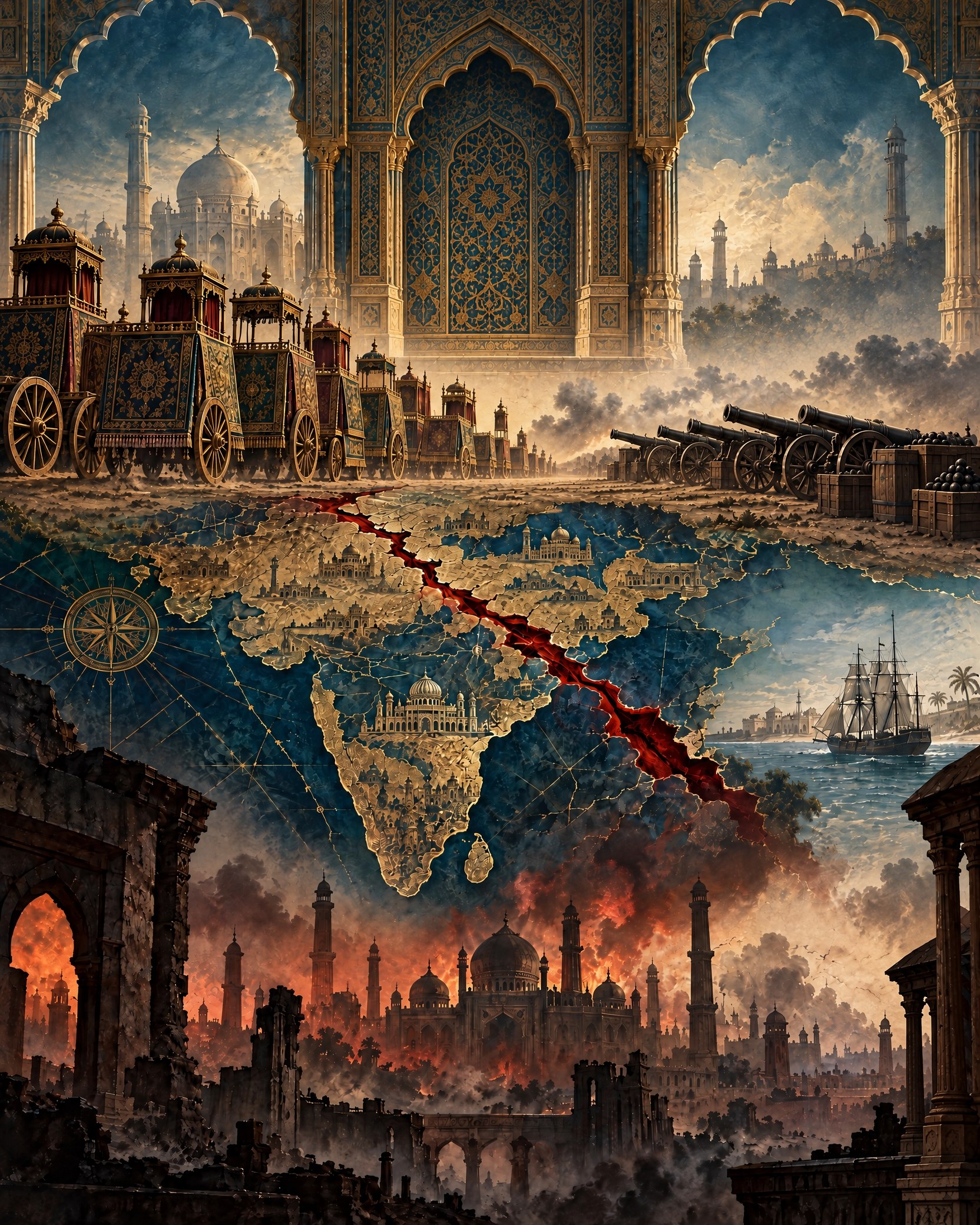
In the late 11th century AH, corresponding to the late 17th century CE, Mughal India was one of the greatest powers in the world. Its empire extended over vast parts of the Indian subcontinent, including India and Sindh, now Pakistan, the Bengal region, now Bangladesh, and parts of Afghanistan and Nepal. Its standing did not rest only on the breadth of its territory: it was also a center of enormous economic wealth and considerable military strength, before it entered a period of conflict and division that paved the way for the decline of its influence and the rise of European powers.
India's economic weight was evident in the size and variety of its production. According to the estimates cited, it produced about a quarter of the world's output of commercial goods, handicrafts and foodstuffs, including food, spices, cotton, silk and gold. Its trade reach was such that silver, used to buy Indian goods, at one stage rose in value to the point of exceeding gold.
India's commercial appeal was clear in the spread of European companies bearing the name "East India". British, Dutch, Danish, Portuguese, French and Swedish companies were established, alongside others, and the number of European trading companies that drew their name from India reached some 12. This naming reflected the position India held in world trade at the time.
In a striking comparison, India was described as economically representing what China, the United States and India together represent today, while the European powers, with their empires and kings, did not rival it at that time.
A tax clash with the East India Company
In Rabi al-Akhir 1091 AH, corresponding to May 1680, Emperor Aurangzeb issued a farman amending customs duties on foreign merchants in India, raising them from 3.5% to 5%. By contrast, the duty on local Muslim merchants was 2.5%. The change angered the English East India Company, which was making large profits from its trade in India.
The company was not merely a commercial institution: it owned land, employees, soldiers, a fleet, weapons and cannons, which made it resemble a political and military entity. Its governor, Sir Josiah Child, demanded a comprehensive tax exemption, but his request was rejected. In response, the company's military fleet was dispatched, bombarded Indian ports and captured merchants and sailors, and it intercepted a caravan of Muslims bound for Mecca.
The Indian response was strong: the Indian fleet crushed the company's warships and merchant vessels, its licenses were withdrawn, its markets were closed and its goods confiscated, and its officials and merchants were taken prisoner. The confrontation ended in a humiliating defeat for the English, who accepted the emperor's terms: that Child come seeking pardon, that he be removed from the company's management, and that the company pay higher taxes and a fine as compensation for the damage of the war. Child submitted before the emperor, in a scene that reflected how unequal the balance of power between the two sides was at that stage.
Aurangzeb's death and the beginning of disintegration
The scene changed after Aurangzeb's death during the years 1118–1119 AH, corresponding to 1707. His sons quarrelled over the throne, the ruling family fell into conflicts and civil wars, the lands were divided among its factions, and the empire and the army began to lose their unity. Although India remained rich in its resources, central authority began to weaken, and divisions appeared in leadership and the army.
By contrast, the Afsharid state in Persia was suffering financial hardship and a famine threatening the country, but Nader Shah possessed a strong army. Nader took advantage of Mughal weakness and began to interfere in border affairs. He made the presence of the Hotaki Afghans in Mughal territory a pretext for demanding their handover, but the Mughal emperor Muhammad Shah refused.
Nader advanced eastward and seized major cities and regions, including Kandahar, Peshawar, Lahore and Kabul. After Kandahar fell, the city was destroyed, its inhabitants were displaced and its walls were demolished to prevent its use as a center of rebellion, and a new city named Nadirabad was established nearby.
The Battle of Karnal: three hours that changed the balance of power
The Mughal and Persian armies met at the Battle of Karnal. The Mughal army, according to the account of the battle, was greater in number and better armed, and included artillery and elephants. The Persian army was less than half the Mughal number and had less than half their armament. No total figure is given for either army.
Nader Shah relied on studying the battlefield and the supply lines. He intercepted the supply convoy heading to the Mughal camp, then feigned retreat, so the Mughal forces rushed to pursue him until they reached a plain the Persians had chosen as the battleground. There the Persian forces surprised the Mughals, while the heavy Mughal guns remained far from the forces that had pursued the Persians, and the Persian forces used their mobile cannons.
The elephants also contributed to disorder in the Mughal ranks after they were frightened by the columns of fire; they fled and trampled soldiers in their path. Mughal losses worsened because of the lack of coordination between their commanders and units.
According to the account, the decisive fighting lasted only three hours, from the midday call to prayer to the afternoon call to prayer. Persian dead numbered 2,500 soldiers, against at least 30,000 Mughal dead. After the battle, Nader Shah besieged the main camp, and in Dhu al-Qa'dah 1151 AH, corresponding to February 1739, Emperor Muhammad Shah announced unconditional surrender.
Entry into Delhi and resistance by the inhabitants
The surrender opened the way for Nader Shah to Delhi, the Mughal capital, famed for its wealth and treasures. The Persian army was suffering from unpaid wages, so its soldiers were allowed to collect money by imposing taxes in the areas under their control instead of plundering them. But the taxes were severe, and Delhi's merchants refused to pay the sums demanded, which ignited clashes that turned into street fighting.
Civilian resistance took shape in the city and intensified after a rumour spread that Nader Shah had been assassinated. According to the account, the inhabitants of Delhi killed some 3,000 Persian soldiers during the disturbances, a number exceeding the Persian dead at the Battle of Karnal, which was 2,500.
Nader Shah himself appeared in the city's streets, and one inhabitant fired at him but the bullet missed its target. Nader then proceeded to the Roshan al-Dawla Mosque, known today as the Sunehri Masjid, and raised his sword toward the city, signalling the start of revenge.
The Delhi massacre: 30,000 dead in six hours
The city's entrances and exits were closed, and Persian forces began a broad campaign of killing inside Delhi. Soldiers stormed houses, climbed onto rooftops and opened fire; residents were beheaded, others were hanged or thrown from buildings and walls. The killing was not confined to any one group but included men, women, children and the elderly.
Accounts speak of neighbourhoods set on fire with their residents trapped inside, of smoke covering the city's sky and blood flooding the markets and streets. Testimonies also describe families who chose suicide out of fear of being taken captive, and people who burned inside their homes.
According to the figure given, 30,000 inhabitants of Delhi were killed in six hours. Nader Shah's silence continued, as he issued his orders by signals, and Emperor Muhammad Shah was present and witnessed what was happening to his subjects.
Muhammad Shah knelt before Nader and asked for mercy for the city's inhabitants, saying: "If you want vengeance, take my life, but have mercy on my innocent subjects." He then offered him Delhi's wealth and treasures in exchange for an end to the killing. Nader Shah agreed, and an immediate order was issued to end the massacre.
The spoils and the wealth of Delhi
The spoils, according to the account, included enormous quantities of gold, diamonds, rubies and artifacts. Among the most notable were the Koh-i-Noor diamond, known as the "Mountain of Light", and the Darya-ye Noor diamond, alongside the Peacock Throne, which was among the most splendid artistic treasures of its age.
The gold used in the Peacock Throne was estimated at about one and a half tons of pure gold and a quarter ton of precious stones, and its canopy rested on 12 golden pillars. According to the comparisons cited, its construction cost twice that of the Taj Mahal.
Transporting the spoils required a huge procession comprising 700 war elephants, 4,000 camels and 12,000 horses. It is also recorded that Nader Shah paid his army's wages with an increase, and exempted Persia from taxes for three years, indicating the scale of the wealth he seized. The spoils were described as among the largest any victor had obtained in war.
From Mughal decline to the rise of the English
After the defeat at Karnal, the massacre in Delhi and the plundering of much of its wealth, Mughal central authority weakened, the emperor lost his army and his prestige, and his power was confined to the capital. Various powers and regions began to demand independence or effectively separated, among them the Marathas, Bengal, Hyderabad and the Carnatic, along with other forces such as the Hindus, the Sikhs and the Rohillas.
The English and the French exploited this division to return to India. The English established themselves in Bengal, while the French focused their activity in the Carnatic region. In the Battle of Adyar during the years 1159–1160 AH, corresponding to 1746, the forces of the Carnatic were defeated by the French.
Rivalry between Britain and France then escalated in parallel with the Seven Years' War, which began during the years 1169–1170 AH, corresponding to 1756. The English armed their trading posts in Bengal, despite the refusal of the province's ruler, Siraj ud-Daulah, to allow them heavy weapons, fearing that they would turn into a military force threatening the region.
The account mentions the "Black Hole" incident, in which 146 Englishmen were confined in a room of 23 square metres. The space available to each person was estimated at about 0.16 square metres, or roughly 40 × 40 centimetres, and it stated that 123 of the 146 died of suffocation.
The English then sent a force of 3,100 soldiers, including 750 Englishmen, while the rest were Indian fighters recruited by the English. In the Battle of Plassey during the years 1171–1172 AH, corresponding to 1758 CE, the Bengal forces suffered a major defeat, Siraj ud-Daulah was executed, and the English then extended their control over Bengal and turned their trading posts into colonies.
With their seizure of Bengal's wealth, English resources were strengthened, while the French faced financial distress. English control later expanded, and French forces were expelled from the Indian subcontinent, leaving the divided Indian regions facing a growing European power.
Thus internal and external factors converged in this course of transformation: the division of Mughal authority and the disintegration of the army, the defeat at Karnal, the massacre in Delhi and the plundering of its wealth, and then the exploitation by the English and the French of rivalry among the regions. Nader Shah was one of the factors that strongly contributed to weakening Mughal India, while control over Bengal and its wealth later helped entrench British influence.


