

"Morocco Introduces New Reforms to the Family Code Aimed at Strengthening Women's Rights" — under this headline, the French press addressed the updates the Moroccan government has introduced to the country's family code, focusing on what it describes as "women's rights."
When the French press speaks of women's rights, we must recall this press's positions on the insult to the Prophet, peace be upon him, to Islam and its rites, and the racist campaign that it, along with Western states, waged against the headscarf and face veil of Muslim women, where Muslim women were treated with utmost tyranny and oppression and were denied their right to modesty, while disbelieving women practise the profession of nudity without the slightest restriction! This sums up the concept of women's freedom in these countries, which guarantee only that which demeans women and violates their dignity.
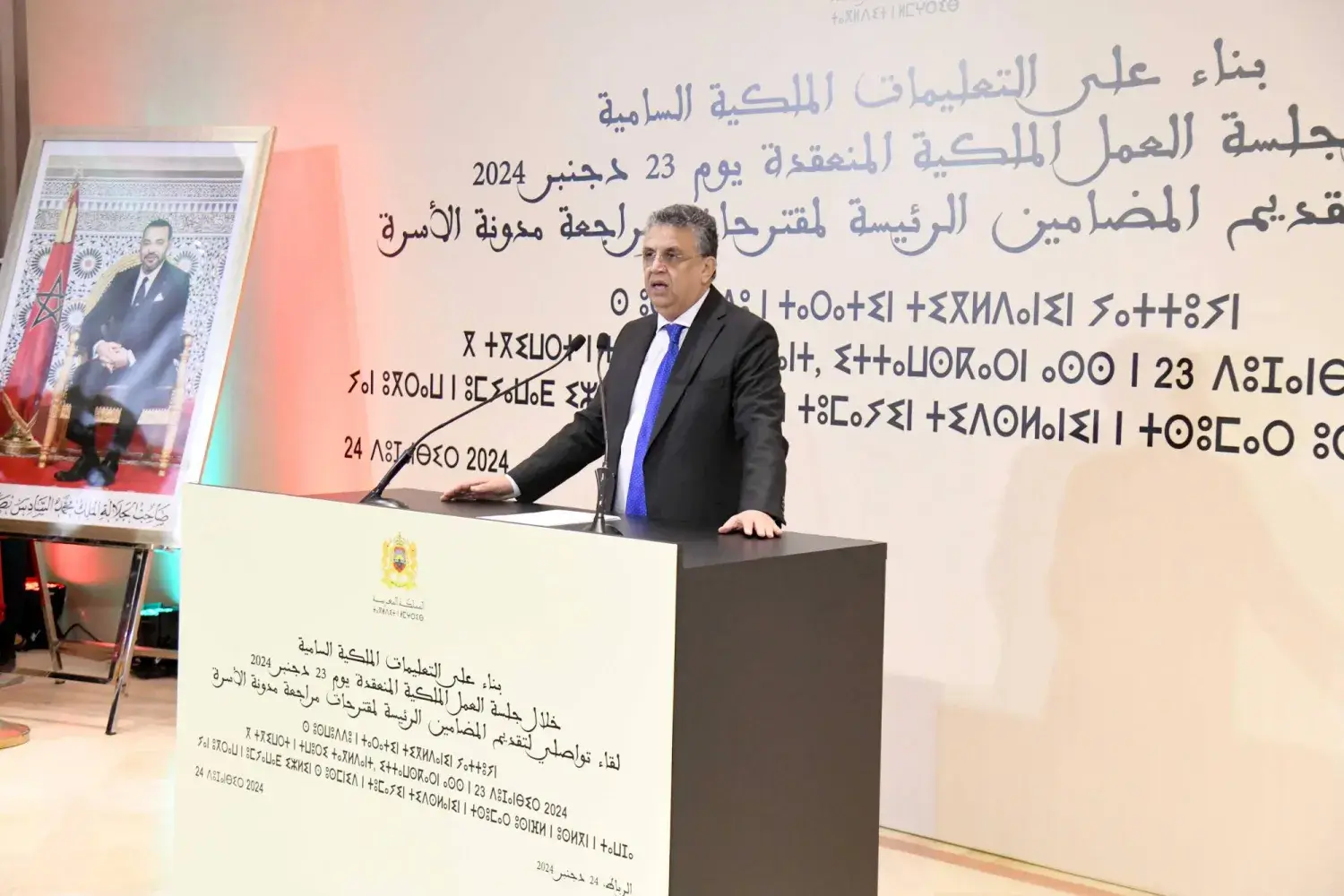
Moroccan Minister of Justice Abdellatif Ouahbi revealed the most prominent proposed amendments as part of the review of the family code in Morocco at an outreach meeting in Rabat.
Ouahbi said during the outreach meeting, which was attended by ministers and government officials, heads of constitutional bodies, the two chairs of the parliament chambers, and members of the Supreme Scientific Council, that "among what has been adopted, based on the proposals of the mandated body and the legal opinion of the Supreme Scientific Council, the body presented 139 proposed amendments covering all seven books of the code."
Ouahbi added, explaining, that the contents of the family code review "aim to overcome some shortcomings and imbalances that emerged in its judicial application, to align its provisions with the development and dynamism of Moroccan society and the requirements of sustainable development, as well as to harmonise them with legislative developments, including the international conventions that our country has ratified."
What does the new family law contain?
The most prominent proposed amendments concern polygamy, stipulating "the mandatory consultation of the wife at the time of marriage registration on whether she stipulates that her husband may not take another wife, and stipulating this in the marriage contract. If the condition that he not take another wife is stipulated, the husband has no right to polygamy in fulfilment of the condition."
Where this condition is absent, "the exceptional objective justification for polygamy will be confined to the first wife's infertility, or an illness preventing marital relations, or other cases assessed by the judge according to specific legal criteria, of the same degree of objectivity and exceptionality."
The most prominent proposed amendments also stipulate "making legal guardianship a shared right between spouses during the marital relationship and after its dissolution. In the event of a dispute over the exercise of legal guardianship, the matter is referred to the family judge for a decision, according to clear legal controls and criteria." Regarding custody, "custody has been considered a shared right between the spouses during the marital relationship, with the possibility of extending this right after divorce if both parties agree."
Furthermore, "the divorced mother's right to custody of her children has been strengthened, even if she remarries, and the right of the child to housing is guaranteed," and "new controls have been organised for visiting the child or travelling with them, to ensure the child's interest," according to the Minister of Justice.
Regarding inheritance, "the Supreme Scientific Council's proposal concerning daughters' inheritance has been adopted, which allows the transfer of money to female heirs during their lifetime, with constructive possession considered sufficient." Among the most notable new developments is also the opening of the way for wills and gifts between spouses of different religions.
On the marriage of minors, the marriage age has been set at 18 full solar years, with an exception allowing marriage at 17 if strict conditions are met to ensure protection. It was also decided to "strengthen judicial oversight to ensure the exception remains within the scope of necessary cases only." In this regard, Minister Ouahbi said that setting the marriage eligibility age for boys and girls at 18 full solar years, with an exception to this rule setting the minor's age at 17, framed by several conditions ensuring that, in application, it remains within the scope of the exception.
It was also permitted "to conclude marriage for Moroccans residing abroad, without the presence of two Muslim witnesses if this is impossible."
The most prominent amendments also included reducing the period for deciding divorce and dissolution cases to a maximum of six months, with the adoption of electronic means for documenting contracts and notifying judicial decisions. According to the Minister of Justice, in his capacity as a member of the body tasked with amending the code, it was approved that the new code include "the establishment of mediation and reconciliation bodies to address family disputes before resorting to the courts."
Why the amendments?
In the statements of the Moroccan Minister of Justice, when discussing the content of the family code review, the real motives for these amendments are stated: "They aim to overcome some shortcomings and imbalances that emerged in its judicial application, to align its provisions with the development and dynamism of Moroccan society and the requirements of sustainable development, as well as to harmonise them with legislative developments, including the international conventions that our country has ratified."
King Mohammed VI of Morocco had also directed the government to reconsider the Moroccan personal status law, known as the Family Code, in response to demands from women's associations for reforms in line with social and human rights developments.
This means that the amendments came in response to dictates from abroad and to please disbelieving, non-Islamic organisations that do not represent Muslim societies; rather, on the contrary, they are organisations and states that wage war on Islam and demonise it, and the alternative they offer to Islam is licentiousness, vice and war on human nature.
Where the new amendments stand within Islamic law
It is well known that family law in Muslim societies is bound to the teachings of Islam and adheres to the rulings of Islamic Shari'ah. The obligations brought by the Moroccan government in submission to the dictates of foreign and Western organisations are not found in God's law. Islam permitted polygamy without the Moroccan conditions that go to excess; preventing a man from polygamy is in essence preventing women from the right to polygamy. Polygamy is not a right for men only; it is also a right for women, and societies demand and impose it because of their need for it. The principle is to help the polygamist fulfil his role as a maintaining husband, not to fight a means that secures women and their rights and prevents spinsterhood in societies. This law in reality came to wrong women, not to grant them rights as it claims.
The hostile Western reading of Islam makes the good aspects of the family system in Islam appear hostile and oppressive, whereas what oppresses women most is the Western system, whose corruption is reflected in high divorce rates, large numbers of unwed mothers, domestic violence, contagious sexual diseases, and the prevalence of adultery with mistresses in societies, even with young girls!
As for preventing a man from polygamy because a woman stipulates that he not take another wife over her, this is also unsound, because a woman may stipulate this, as the scholars who investigated the matter concluded; but breaching this condition does not mean preventing the man from polygamy. It means that his wife has the right to annul the marriage and take her rights in full. Ibn Qudamah, may God have mercy on him, said: "If he stipulates for her that he will not remove her from her home or city, or will not travel with her, or will not take another wife over her, then he is bound to fulfil it; if he does not, she has the right to annul the marriage. This was related from Umar, Sa'd ibn Abi Waqqas, and Amr ibn al-As, may God be pleased with them." [1] Therefore, it should be known that if the husband breaches this condition, his wife is not divorced merely by that; rather, she acquires the right to annul the marriage, and she may either annul it or waive the condition and accept what the husband has done and remain his wife. As for preventing him from marriage, God has sent down no authority for it.
As for custody, it has its rulings in Islam, and no authority has the right to change them. The institutions suffering from high rates of foundlings will not be the ones dictating to Muslims how to raise their children! Moreover, there are women who, of their own full will, wish to leave their children with the father so that they may marry and build a new family. Is it not unjust for them to be forced to raise their children against their wishes, since the talk continues about the pretext of women's rights?
Islam has set fixed and known rulings for divorce, which any Shari'ah judge can decide upon at the time, with no need to keep the spouses for six months bearing the weight of psychological repercussions in a relationship that is not dissolved until after months of long waiting!
Moreover, the new project demolishes the pillars of marriage in Islam by making engagement, without meeting the conditions of the contract, a legal instrument and charter and a principal means of proving marriage. This has no value in Shari'ah: anyone who has not concluded a valid contract meeting the conditions of the marriage contract in Islam cannot treat any arrangement as a marriage contract that makes the marital relationship lawful. Indeed, if the relationship occurs without a valid Shari'ah contract, it is fornication that incurs the prescribed penalty!
The new law also removed the condition of witnesses for marriage, permitting Moroccans residing abroad to contract marriage without the need for the presence of two Muslim witnesses. This is in no way binding for anyone who wishes to follow Shari'ah in this matter. The jurists agree that calling witnesses to a marriage is a condition for its validity, but they differ on the time of the obligation, and most of them held that it is at the contract. Ibn Qudamah said in al-Mughni, as a Hanbali: "Marriage is not concluded except with two witnesses; this is the well-known position of Ahmad, and it was related from Umar and Ali, and it is the view of Ibn Abbas, Sa'id ibn al-Musayyab, Jabir ibn Zayd, al-Nakha'i, Qatadah, al-Thawri, al-Awza'i, al-Shafi'i, and the companions of opinion." End of quote.
The author of al-Minhaj, a Shafi'i, said: "It is not valid except in the presence of two witnesses." Its commentator al-Sharbini said: "Note: he used the term presence so as to make clear that there is no difference whether they are present intentionally or by chance; if they were present and heard the contract, it is valid even if they did not hear the dowry."
The Hanafi al-Sarakhsi said in al-Mabsut: "It has reached us from the Messenger of God, peace be upon him, that he said: there is no marriage except with witnesses. Our scholars, may God have mercy on them, adopted this."
Some scholars held that the presence of witnesses at the marriage contract is only recommended and not obligatory except upon consummation; this was the view of the Malikis. Al-Dusuqi said in his commentary on al-Sharh al-Kabir: "Calling witnesses to a marriage is obligatory; that it be at the contract is a recommended addition beyond the obligation. If the witnessing takes place at the contract, the obligation and the recommendation are both fulfilled; if it does not take place at the contract, it becomes obligatory at consummation."
From the foregoing, it becomes clear to us that most scholars require witnessing at the contract for its validity, while others held that it is only recommended at the contract, but made it obligatory at consummation if it did not occur at the contract.
Accordingly, if among the family present at the contract there is no just witness other than the guardian of the marriage, the contract is considered void according to the majority view.
Who would gamble with such covenants and make their religion subject to doubts and to the dictates of disbelieving international institutions! Moreover, witnesses are in the wife's interest, because they reinforce the marriage contract and honour her; neglecting them neglects the standing of the contract and therefore works against the woman rather than for her, as the advocates of women's liberation claim. It is strange that the conditions of marriage, which are part of the dignity of this solemn covenant, should be discarded under the pretext of women's freedom, when in reality this is an insult to her! They seek to turn wives into mistresses without lawful rights!
As for inheritance, the law of inheritance in Islam is clear, complete and explicit, and does not need foreign hands to determine the fate of inheritance. A Muslim may not oppose it by resorting to man-made law and abandoning God's law, may He be exalted. Islam is a complete religion that admits no deficiency, and its law of inheritance is the most just and complete for every family; whoever opposes it wrongs himself and others, and loses and is deprived.
Likewise, the new law set the marriage age at 18 full solar years, with an exception allowing marriage at 17 if strict conditions are met to ensure protection. Yet Western governments impose this age while permitting fornication, which in most countries actually begins at age 9, and legally at age 12. Why should a boy and girl who have reached maturity be forbidden the lawful? God's Shari'ah grants them this right. This law is not binding in Shari'ah and creates injustice against women, for many girls turn to unlawful relationships before the age of 18 and cannot marry, so corruption spreads in the country and vice and licentiousness proliferate. The principle is to protect the adult's freedom in family life and not to restrict him with imported man-made laws from states that legalise and encourage fornication.
How do Moroccan Muslims deal with the new family law?
There is no obedience to a creature in disobedience to the Creator, and no power in the world can compel a Muslim to submit to man-made law and abide by it so long as he adheres to his Lord's Shari'ah. This means that Moroccans should boycott these systems and be keen to apply their Lord's Shari'ah in their whole lives, including family life, and the people of knowledge and virtue should provide independent Shari'ah courts that rule by the provisions of Shari'ah.
Spouses must also be alerted that any marriage must clearly rest on the condition of adherence to the provisions of Shari'ah, and that resorting to these laws that wage war on Shari'ah is a betrayal of every Muslim man and woman and an open act of disobedience to God, may He be exalted. Spouses may deal with one another according to Shari'ah, apart from the government's obligations: matters of custody, divorce and inheritance, and everything in the new law that contravenes Shari'ah, are all matters that spouses can agree upon according to the guidance of Shari'ah, and the government cannot prevent this, since both parties agree to act by their own freedom. This is what befits a Muslim family: to submit to the Shari'ah of God without hesitation or cowardice. Whoever rejects the rulings of Shari'ah, it is not wise to enter into marriage with him from the outset; placing these conditions at the start of the contract is important for Moroccan spouses, so that the home is founded on piety from the first day, its constitution the Qur'an and the Sunnah, even if all people are displeased.
I know that political struggle in a country that has signed a normalisation and alliance agreement with the Israeli occupation cannot be expected to produce solutions or change, but surrender to these laws on the pretext that they are prevalent and available does not befit a Muslim who believes in God and the Last Day.
We have the right to ask why Muslims are not permitted to intervene by criticising the family law in the West and foreign countries. Why must we change our religion, culture and identity to suit the whims of disbelievers, while at the same time we have no right to interfere in their unjust and oppressive laws that target human dignity?
This is yet another proof of the nature of Western domination and occupation in our age, which does not respect the religion and beliefs of peoples and insists on depriving them of their freedom to worship their Lord. This is an occupation that must be repelled, its shackles broken, and its cunning and wicked methods confronted. Those working for Islam must also build awareness of this aggression, which places the family in the crosshairs in order to deprive the nation of the factories of pious Muslim men and women, the makers of glory and renaissance; breaking this nucleus of the nation is breaking the sources of strength and aborting the efforts toward independence and sovereignty.
It is a defeatist position that leads to dependence and humiliation, to counsel one another toward laws that wage war on God's Shari'ah, imposed on Muslims by one who does not believe in God and wages war on His religion. Here the importance emerges of counselling one another to truth and working for the independence of Muslim peoples with their identity and their Lord's Shari'ah, no matter how long the time or how great the cost.
May God grant success to the people of knowledge and virtue and to the fields of resistance in Morocco to meet the needs of Muslims and guide them to the path of right guidance and salvation in this world and the next.
[1] Abridged from "al-Mughni" (9/483)


