

Western Fears That Islam Will Overcome Efforts to Contain It and Return to Leadership After the War on Gaza
An article published by the British newspaper The Economist, dated 15 Jumada al-Awwal (29 November), contained clear indications of the goals of Western hegemony over the Muslim world in its analysis of developments accompanying the Al-Aqsa Flood in occupied Palestine, which undermine the results the West had reached.
According to the newspaper, old stereotypes are haunting the Middle East once again. America, which financed, armed and defended the Israeli occupation, has once again become the object of anger, as have its Western allies. Both are blamed together for facilitating the bombing of Gaza and the displacement of its population.
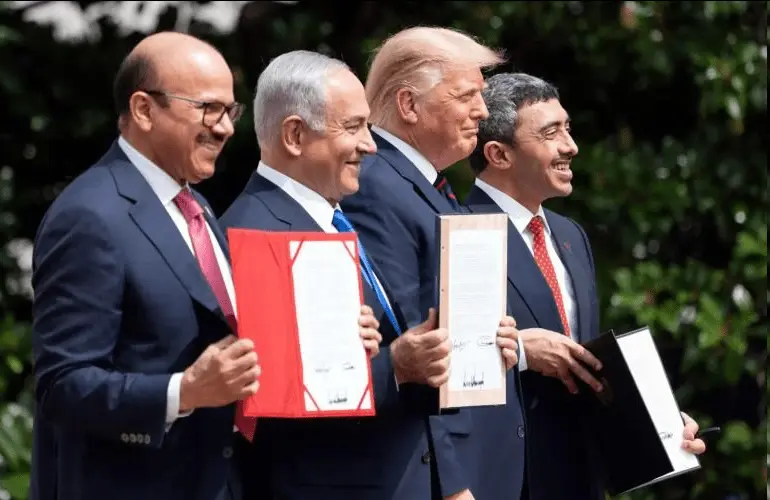
The violence has obstructed recent efforts to improve relations in the region, at a time when the standard-bearers of Islam, Sunni Saudi Arabia and Shia Iran (in the newspaper's words), had begun to bridge their sectarian divisions. In addition to accepting one another, Muslim states have also begun to accept Jews. Since 1441 AH (2020 CE), four Arab states have joined the Abraham Accords to normalise their relations with the Israeli occupation, and more states were on the verge of following suit.
Now the war in Gaza is leading to what the newspaper described as the "radicalisation and terrorising of the Muslim world", as the world's attention focuses on the Palestinians and their plight after years of neglect.
The newspaper said: "The repercussions show that Muslims stand at a critical juncture in the development of their faith. Huge religious, political and social transformations are reshaping the Middle East and its population of 400 million. The question now is whether Hamas's attack is capable of reversing the direction of this revolution by fanning the flames of political Islam. Anti-Israeli and anti-Western fervour could rouse its supporters once again."
The newspaper added: "To understand why such an outcome would be so harmful, consider how much Muslims' attitudes towards religion have shifted in the years before the attacks of 7 October. Religious practice has changed from political mobilisation for communal salvation, as espoused by Islamists, to a more individualistic quest for spirituality. As a result, for many Muslims, Islam has increasingly become depoliticised."
The newspaper cited the situation in Iran, noting that since the revolution of 1979, it has been led by a Shia cleric. Iran calls itself an Islamic republic, and officially 99.5% of its population of 89 million are Shia. But in 2021, an online survey conducted by the Dutch research group GAMAAN found that about half of the 50,000 Iranian participants said they had left or changed their religion. Fewer than a third identified as Shia, in line with the ruling sect. Despite the country's ban on proselytising, interest in non-Islamic religions in the country, such as Zoroastrianism and the Baháʼí Faith, is rising. Evangelicals in Iran say Christianity is growing there faster than in any other country. Iran is the "first post-Islamic society", according to the Iranian critic Shahriar Ahy, as reported by the newspaper.
The newspaper gave examples from other countries, saying: "Across the Muslim world, clerics (sheikhs and preachers), who were once shunned, have in recent years been mocked for greed and hypocrisy. Tax exemptions, land allocations and sex tapes of homosexuals in countries such as Iran, Iraq and Pakistan have caused outrage. Some theologians (preachers and sheikhs) have tried to adapt, either out of conviction or in an attempt to remain relevant (by finding interpretations that suit them). In Morocco, Abdelrahman Taha, arguably the most influential philosopher in the Muslim world, has combined humanism with the ethical principles of Islam." This is in the newspaper's words.
The newspaper believes that Saudi Arabia has ended the 250-year alliance of the ruling family with the followers of Sheikh Muhammad ibn Abd al-Wahhab, dating to the eighteenth century, and announced a renewal of religion in 2018. In a survey conducted last year by James Zogby, an American polling expert, more than two-thirds of young people in the Middle East said they want religious institutions to be "modernised".
The newspaper said: "Religious tolerance has increased widely among Muslim countries. Over the past decade, more than twelve countries have hosted Pope Francis. Egypt, the UAE and Morocco have renovated Jewish synagogues or built new ones. In Iraq, a centre for interfaith dialogue has been opened opposite the gates of the holiest Shia shrine in Najaf."
The newspaper believes that what it described as "social reform" has caused the fervour of Islamists to decline. In Saudi Arabia, the pressure came from above, but many citizens welcomed it. Mosques there now compete with star-studded concerts, film festivals and sporting events to attract public interest. Men and women are no longer separated in universities, offices and restaurants. Economic necessity has also pushed women into jobs traditionally held by men, from herding livestock to driving taxis. At the same time, the Tunisian parliament abolished the Sharia-based ban on marriage between Muslim women and non-Muslim men in 1438 AH (2017 CE). Other changes are being promoted by ordinary Muslims, if not by elites.
The newspaper drew attention to the rising divorce rates among conservatives as a positive indicator of desired changes in the Muslim world, as the Gulf now surpasses its counterpart in many Western countries. Since economic difficulties have forced couples to delay marriage, sex before marriage has become more widespread in the region, the newspaper reported, citing sociologists.
The newspaper pointed to what it described as the faltering of political Islam during the decade in which social and cultural norms became increasingly globalised. While in 1432 AH (2011 CE) it flourished during the Arab Spring, by 1440 AH (2019 CE) protesters in Algeria, Iran, Iraq, Lebanon and Sudan were demanding a civil state. In 1442 AH (2021 CE), Moroccans voted for an Islamist prime minister and his party.
This rejection of political Islam reflects how little its adherents achieved in addressing the deep economic distress in countries where they took power, according to the newspaper. In Egypt, Gaza and Tunisia, incomes fell under their rule. Unemployment spread, and foreign investment declined. Idlib, the stronghold of jihadists in north-west Syria, is among the poorest provinces in the country. The hardship was not always the making of the Islamists, but they promised that "Islam is the solution". It was not. This is in the newspaper's words.
In countries such as Egypt, military force removed Islamists from power. (Popular disillusionment did not always mean they were out of the picture.) In Saudi Arabia and the UAE, the Muslim Brotherhood, the oldest Islamist movement in the world, has been banned. Last year, Tunisia jailed Rached Ghannouchi, the Islamist who served as the country's parliament speaker. Public religiosity has also provoked governments' anger. In September, Egypt banned the niqab, or face veil, in schools, according to the newspaper.
The newspaper said: "Violent jihadist movements have receded as political Islam has declined. Since 1422 AH (2001 CE), Western governments have waged a 'war on terror'. Two decades on, 'spectacular displays' have become a thing of the past in most parts of the world. In Syria and Iraq, the US-led coalition destroyed the caliphate of the Islamic State, a territory the size of Britain that once harboured and trained tens of thousands of fighters. Since 1440 AH (2019 CE), jihadist attacks in Syria have fallen from more than 1,000 a year to around 100."
According to the newspaper, other Islamist movements have restrained their behaviour in order to survive. The Syrian branch of al-Qaeda was one such example. For years, Hamas, at least outwardly, appeared to be part of this club. It halted its suicide bombings in Israel and, in 1438 AH (2017 CE), issued a new charter stripped of the overt anti-Semitism found in the original text. Many women in Gaza City took off the hijab. Ironically, Israel, in its attempt to divide the Palestinians, actually supported one of the last Islamist strongholds in the region and learned to coexist with its rule. But Hamas's incursion into southern Israel dispelled any illusion of peaceful coexistence. This is in the newspaper's words.
The newspaper asked: how will political Islam evolve in response to the war in Gaza?
It answered its own question by saying that a new generation of "extremists" could emerge. Economic problems, mismanagement and malignant authoritarianism all provide fertile ground for a comeback. Libya, Lebanon and Yemen are already failed states. Moreover, the two most populous countries in the Middle East, Egypt and Iran, are economically unstable.
According to the newspaper, Ahmed Abou Doh, the Egyptian analyst at Chatham House, a British research centre, says the Gaza war "could be a lifeline for the Muslim Brotherhood". Hamas, outside government, could cause further devastation. In the Islamic world, ideological fires keep burning without ever going out. Jihadists thrive in Afghanistan and eastern Syria when the Kurds retreat to their barracks. They control a large part of the Sahel and are encroaching on other parts of Africa. Rajan Basra of the Department of War Studies in London says: "It is premature to celebrate the end of the jihadist movement."
The newspaper said: "Governments in the Middle East are trying to suppress any resurgence. Many Muslim rulers see the revival of political Islam as a threat to themselves as much as to the West. They may even support Israel's goal of destroying Hamas, if not its methods. No country that has recently normalised relations with Israel has severed ties, or asked America to leave its regional bases. Most Gulf states have banned protests and sermons in solidarity with the Palestinians. Even Qatar, the protector of Hamas and other Islamic causes, has offered to expel Islamists if its ally America requests it. Iran and its 'axis of resistance' have also kept out of the fighting and left the group to fight alone."
Nevertheless, the newspaper cautions that "it would be a mistake to confuse silence with acceptance", citing Ali Bakeer, an expert on political Islam at the Atlantic Council, an American think tank: "Beware the calm. It can herald the next explosion. Islamism has a habit of rebounding." Many rejoiced at the demise of the jihadist movement after Osama bin Laden was killed in 1432 AH (2011 CE), but two years later it swept across the Middle East.
According to the newspaper, the overthrow of Hamas in Gaza may bring a short-lived calm, but over time it could scatter its ideas and fighters across the Middle East. Political Islam itself may evolve into something less sectarian as it spreads, and may bring Sunni and Shia followers together, but its militant tendency could intensify. "The world is dreaming if it thinks it has seen the end of this," says Andrew Hammond of the University of Oxford. "The moment of calm has passed." To keep political Islam reasonably quiet, the rift between Israel and the Palestinians must be mended. Islamic regimes across the region must urgently address the social and economic ills on which Islamists feed. The oil-rich states of the Middle East can afford a decade that offers individual but not political freedom. But the poor cannot afford the social safety net they guarantee. Yet jailing Islamists will do nothing to compensate for that. Islam has often flourished in a multi-faith world. It can do so again, the newspaper concluded.


