

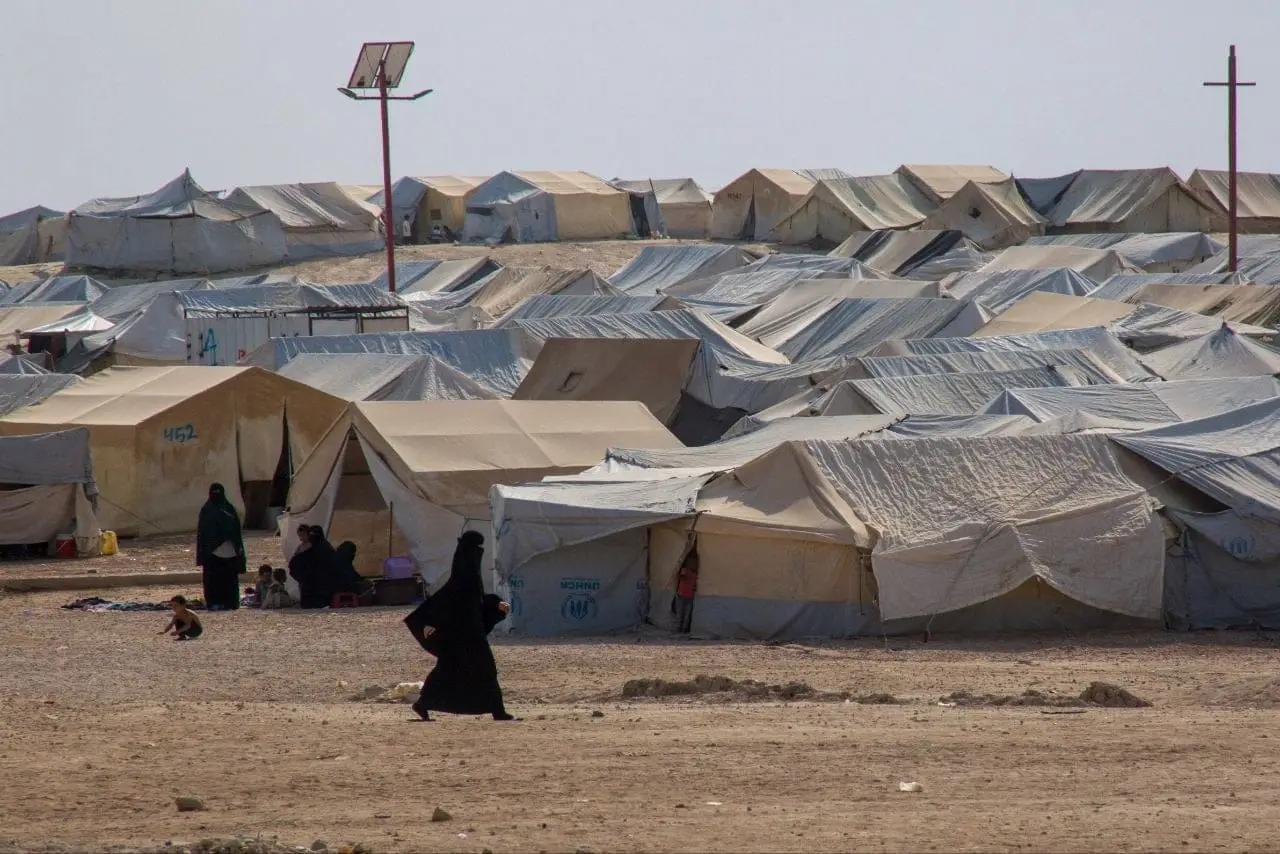
Wasl conducted an interview with one of the women held in al-Hol camp, located in the Hasakah Governorate in northeastern Syria, in an area controlled by the Syrian Democratic Forces (SDF). The SDF is the most important military ally of the United States of America in Syria.
Wasl: To begin, to clarify the picture for readers: there are two camps for women and children, al-Hol and al-Roj. What is the difference between them?
- The detainee: The number of detainees in al-Hol is larger, so the security grip is lighter, and there are no restrictions on the type of clothing, unlike al-Roj, where even medical masks are prohibited.
Wasl: How does a day pass in the camp?
- The detainee: A day passes over us while we are in a state of anxiety, tension and fear.
Wasl: What services does the camp administration provide to you?
- The detainee: In al-Hol there is no electricity, but it exists in al-Roj, and there is water there.
Wasl: How does the market in the camp work, and where do the sisters get the money to buy products and sell them there?
- The detainee: The market is run by the camp administration. Some of the sisters receive money from their relatives, and some of them bake bread or do sewing to earn a living from these. Those who have no one to send them money work at any job available in the camp.
Wasl: There are many children in the camp. Are they required to attend lessons or activities organised by the camp administration?
- The detainee: Yes, there are activities. Whoever wants to go can go, and whoever does not want to is not forced.
Wasl: Are the detainees able to communicate with their families or relatives outside?
- The detainee: Some of the sisters buy mobile phones, but if the camp administration discovers one, the sister is sent to prison for five or six months. As for the phone belonging to the camp administration, it can only be used for calls related to transfers.
Wasl: Many credible reports have documented the abduction of boys before puberty and their forced recruitment or their detention in prison with adult men. What can you tell us about this, and are the attempts at "rehabilitation" limited to boys only, or are women and girls also subjected to some of it, but through other methods?
- The detainee: Yes, this happens often. Every year they take children, not girls, only boys, and put them in a prison, then afterwards they place them in a centre, and a mother cannot communicate with her son or ask about his condition, and this is extremely hard on mothers and children.
- Some of these children are sick... a very difficult situation...
Wasl: In cases of illness, is treatment at your own expense? Have there been deaths because the patient could not provide the money needed for treatment?
- The detainee: Yes, we cover 90 or 100% of the cost of treatment ourselves. Yes, some sisters have died, and there is a cemetery at the site.
Wasl: How do you spend religious seasons such as Ramadan and the Eids in the camp? Are the sisters able to gather, or is any performance of religious rites or Islamic celebrations prohibited?
- The detainee: There is no call to prayer in the camp, nor anything else, nor any religious rites. We only know that Ramadan or the Eids have arrived from the calendar.
Wasl: What are the most prominent difficulties faced by the sister responsible for caring for an elderly mother or siblings and children?
- The detainee: The hardest thing is when they take one of your children; the mothers do not sleep from fear.
Wasl: Have representatives from your countries visited you?
- The detainee: Some countries have sent representatives, but not every country.
Wasl: Has the camp administration's treatment of you changed over time?
- The detainee: Yes, it has become worse. Any problem that occurs with them outside the camp, they deal with us harshly. They take revenge on us.
Wasl: How does the camp administration treat women of different nationalities? Does their treatment of Western women and women arriving from other Arab countries differ from their treatment of Syrians?
- The detainee: Yes, the treatment differs.
Wasl: Have some of the sisters tried to escape from the camp?
- The detainee: There are many stories of sisters who tried to escape, and yes, there are smugglers who work with the SDF. The sums sometimes range between 25,000 and 50,000 dollars. Many of these attempts were not successful and were foiled by the SDF.
Wasl: Describe for us the visits by relief organisations. What is their frequency, what kind of aid do they provide, and does it meet your needs or is it merely enough to keep you alive? Do relief workers speak with you?
- The detainee: When they visit us they give us a food basket and a cleaning-products basket, but this is never enough for us. They do talk with us when they visit the camp.
Wasl: Have press teams visited you before? How did they treat you, did you see their reports about you, and how would you describe them in terms of credibility and framing?
- The detainee: They do not represent the press. They only come to produce reports that suit them. They only talk, and there are no real actions or credibility.
Wasl: What kinds of questions were they focused on asking? What are your impressions of the correspondents specifically who visited the camp? Did they show any sympathy towards you?
- The detainee: The questions are repetitive: how did you enter Syria, who helped you, and questions in the style of informants. We do not see sympathy.
Wasl: Was there a difference between the Arab and Western crews in how they treated you and in the type of questions they asked?
- The detainee: No, the treatment is the same and they ask the same questions.
Wasl: Were SDF security personnel present with the sisters who spoke to the media?
- The detainee: Yes, always.
Wasl: Has a sister ever been punished because of something she said to the media?
- The detainee: I do not know.
Wasl: What are the sisters' positions on speaking to the media in general, and has this changed over time?
- The detainee: No, there has been no change.
Wasl: Have there been incidents of harassment or rape by camp security or others?
- The detainee: Honestly, I cannot be certain, as the camp is very large and many incidents occur, and we hear many things!
Wasl: Can you teach the children without interference from the camp administration?
- The detainee: Yes, thank God.
Wasl: There are press reports that exaggerated the description of the women's role in the camp in security and military activity. How do you describe these reports, and what do you think their purpose is?
- The detainee: Certainly they are lying, but I do not know why they do that!
Wasl: What is your message to the Islamic nation?
- The detainee:
We are at your mercy; this long wait is enough… We want our prisoners freed!


