

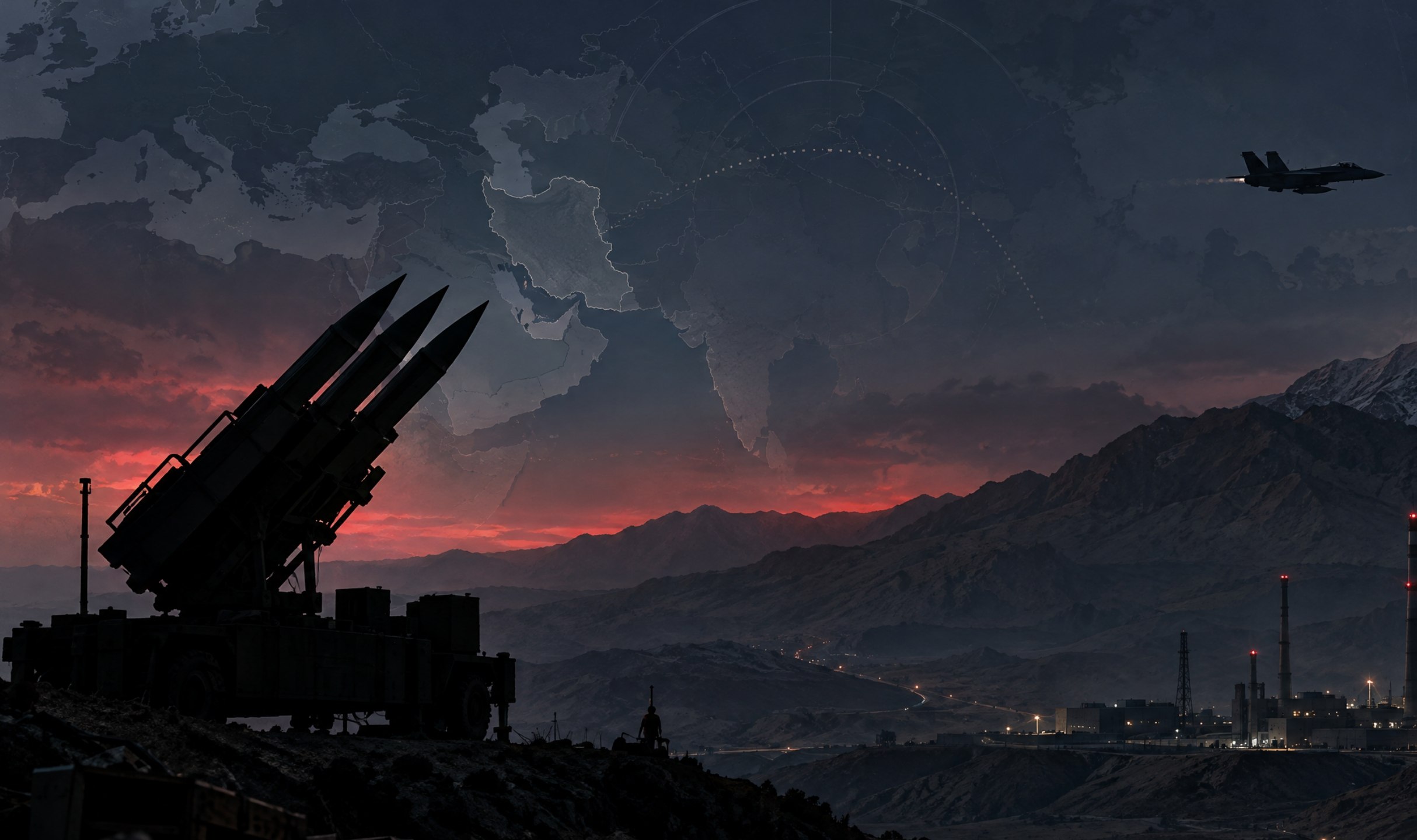
Warnings issued by American media figure Tucker Carlson about the possibility of a US nuclear strike on Iran have raised fears of an unprecedented escalation in the region, coinciding with reports that Washington is preparing for a "short and intense" military campaign against Tehran, new US military movements in the Gulf, and the stalling of mediation efforts aimed at ending the war.
In early November 2026, Carlson warned that the administration of President Donald Trump could be days away from launching a nuclear strike against Iran, saying that Israeli Prime Minister Benjamin Netanyahu is pressuring Washington to carry it out.
Carlson identified an underground facility in Pickaxe Mountain, near the Natanz nuclear facility in central Iran, as the potential target, noting that Israeli intelligence believes Tehran has resumed uranium enrichment activities at the site, information that could not be independently verified.
However, Carlson's warnings did not include evidence proving that a US decision to use nuclear weapons has been made, and the White House has not announced any plan of this kind.
A Fortified Facility Raises Questions About Military Options
The Pickaxe facility is of particular significance due to its geographic nature and the depth of the fortifications surrounding it, as it lies within granite rock formations and is believed to contain a network of tunnels and fortified underground facilities.
The Center for Strategic and International Studies (CSIS) in Washington had published an analysis of satellite imagery indicating an increase in construction activity at the site during 2026, noting that open-source estimates place the depth of the facility between 80 and 100 meters, while the true depth or internal design is difficult to determine precisely.
According to the analysis, targeting a facility with this level of fortification presents a major challenge for conventional weapons, including heavy US bunker-buster bombs.
However, the limited ability of these weapons to destroy a deep facility does not necessarily mean that Washington would resort to nuclear weapons, as that remains a fundamentally different option from both a military and political standpoint, in addition to its humanitarian and environmental risks.
In contrast to Carlson's warnings, Trump had publicly ruled out using nuclear weapons against Iran during an interview with NewsMax on October 15, 2026, affirming that the United States does not need to resort to them.
Speaking about the possible use of a massive conventional bomb known as the "Mother of All Bombs," Trump said it is not a nuclear weapon, stressing that he does not intend to use nuclear weapons against Iran.
This discrepancy between the statements of the US president and Carlson's warnings highlights the importance of distinguishing between the scenarios put forward by political commentators and official military decisions.
Washington Warns Gulf States of a New Military Campaign
Alongside the debate over the possible use of nuclear weapons, The Wall Street Journal reported on October 28 that the United States had informed several Gulf states that they should prepare for a short and intense military campaign against Iran following the US midterm elections held on November 3.
The newspaper, citing sources familiar with the communications, said the warnings were conveyed through diplomatic and military channels, amid indications that the United States and Israel are preparing for a new round of combat operations aimed at weakening Iranian capabilities and pressuring Tehran to return to negotiations.
US moves included reinforcing Israeli air defenses with an additional Patriot system, repositioning some forces away from bases exposed to attacks, replenishing munitions stocks, and preparing for the possible resumption of airstrikes.
However, the newspaper noted that Trump had not yet made a final decision on carrying out the campaign, and that a negotiated settlement remains one of the options on the table.
The published information contained nothing indicating that the potential operation would involve nuclear weapons.
Limited US Strikes Target Qeshm Island
In a field development that heightens fears of a wider confrontation, US forces carried out limited airstrikes on Monday, November 2, targeting the Iranian island of Qeshm at the entrance to the Strait of Hormuz.
ABC News, citing US officials, reported that the strikes were a response to an Iranian attack on an American aircraft, which the officials described as defensive measures to protect US forces and interests in the region.
CNN reported that the operation was not part of the broader military campaign being discussed in preparation, while American reports indicated other limited strikes carried out in preceding weeks without being announced.
These operations reflect the continuation of military confrontation, despite the broader campaign described in the leaks not having begun, and raise questions about the ability of both sides to keep mutual strikes within a limited scope.
Stalled Negotiations Narrow Prospects for De-escalation
On the diplomatic track, regional mediation efforts continue to prevent a new confrontation, but disagreements over the terms of a settlement still hinder the reaching of an agreement.
Reuters reported on October 28 that Qatari mediators had presented Iran with a draft new agreement to end the war with the United States and "Israel," including reciprocal confidence-building steps over seven days, with the participation of guarantor states.
However, a senior Iranian official described the Qatari ideas as unacceptable and not rising to the level of a proposed agreement, affirming Tehran's adherence to its position on the nuclear file.
The disagreements center on the sequencing of settlement steps: Washington wants the Iranian nuclear program addressed from the outset of the agreement, while Tehran demands the lifting of the US blockade imposed on its ports and the sanctions targeting its oil exports.
As this impasse continues, the likelihood that Washington will return to the military option to pressure Iran increases, although this does not necessarily mean that all chances of a diplomatic solution have collapsed.
US Arms Stockpiles Face a New Test
US military preparations face questions about the quantity of munitions available after months of confrontation with Iran, particularly long-range air defense missiles, precision munitions, and bunker-buster bombs.
Military estimates indicate that replacing certain types of complex munitions requires long manufacturing periods, making the sustainability of large-scale military operations a factor influencing Washington's calculations.
The importance of this issue is highlighted by the need to protect US forces and bases, reinforce Israeli defenses, and secure navigation in the Gulf, at the same time as preparing for the possibility of new strikes.
Nevertheless, the depletion of conventional weapons stocks is not evidence of a move toward using nuclear weapons, and the limitations of certain military capabilities cannot be regarded as a sufficient indicator of the nature of the next US decision.
Fears the Confrontation Could Spread to the Gulf and Oil Markets
The repercussions of any new escalation are not confined to Iranian territory, as fears are rising that the confrontation could extend to Gulf states, energy facilities, and vital maritime routes.
Kharg Island is among the most important centers for Iranian oil exports, so extensive strikes on its facilities could threaten Tehran's ability to export oil and cause further disruption in global markets, depending on the scale of damage and the duration of the shutdown.
On the other side, Tehran has previously warned that it would respond to any new American or Israeli attacks, amid concerns about the targeting of economic facilities or infrastructure in the region, which could push the confrontation to levels that are difficult to contain.
These risks are compounded by continued disruption in the Strait of Hormuz, one of the most important sea lanes for oil transport, and by the decline of the US Strategic Petroleum Reserve to about 282 million barrels in October 2026.
Any broad disruption to oil exports or tanker traffic could raise prices, increase shipping and insurance costs, and cause disruptions extending beyond the region to the global economy.
A Nuclear Risk Beyond the Limits of Military Confrontation
The most dangerous scenario, the use of a nuclear weapon against an underground fortified facility, raises concerns entirely different from those associated with conventional strikes.
In addition to the direct destruction, an underground nuclear explosion could release radioactive material into the environment if explosion products break through to the surface, with the possibility of contaminating inhabited areas or water sources, depending on the yield and depth of the blast, the nature of the rock, and surrounding conditions.
The use of a nuclear weapon in a military confrontation of this kind could also open the door to regional and international reactions that are difficult to predict, and would constitute a grave precedent in the use of nuclear weapons since the Second World War.
However, estimating the extent of contamination or the number of those affected requires specialized scientific studies, and media warnings alone cannot be relied upon to determine the scale of the potential catastrophe.
In conclusion, the developments reveal two different levels of risk: documented journalistic reports of US preparations for a possible resumption of large-scale military operations against Iran, and warnings of a possible use of nuclear weapons for which no independent evidence has been established, and which contradict an earlier public position of the US president.
Between the pressures of military escalation and the stalling of diplomatic mediation, the region faces the risk of sliding into a new round of war, which may not remain confined to Washington and Tehran, but whose effects could extend to the security of Gulf states, civilian safety, and global energy supplies.


