

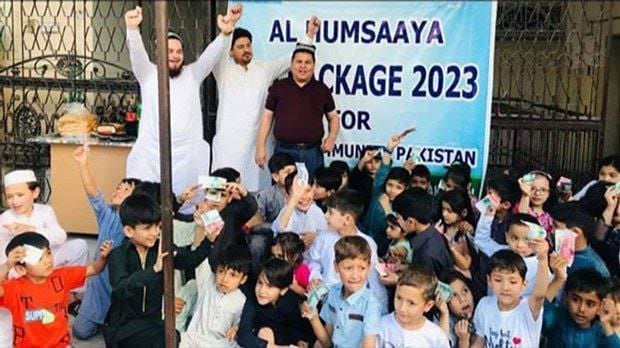
Uyghur refugees in Pakistan face deportation on 21 Shawwal
About 100 Uyghur refugees in Pakistan face deportation in Shawwal (April), after the end of the month of Ramadan, according to a new government directive obtained by Radio Free Asia.
The 18 refugee families, who have lived in Pakistan for several years, fear being deported to Afghanistan or to China, which is controlled by the Taliban movement, where they may face persecution.
The Uyghurs make up a small part of a much larger group of 1.7 million Afghan refugees in the country, whom the Pakistani government announced in Rabi al-Thani (October) it would deport after a series of suicide bombings that were blamed on Afghan groups.
In Jumada al-Ula 1445 AH (November 2023), the Pakistani government decided to extend the stay of the Uyghurs by six months after intervention by the United Nations refugee agency on their behalf.
In Shaban (February), the Ministry of Interior held a meeting to review the repatriation plan, which sets out three phases, beginning with undocumented Afghan citizens, followed by holders of Afghan citizen cards and holders of proof of registration.
The Uyghur families are registered as Afghan refugees and hold Afghan citizen cards, but otherwise they have no passports or legal identity documents.
The new Pakistani directive calls for collecting information on Afghan migrants before efforts to deport them are renewed after Eid al-Fitr, which falls at the end of the blessed month of Ramadan on Ramadan (9 April).
Torgunjan Mohammed Torson, a 32-year-old Uyghur born in Afghanistan whose parents fled to Pakistan after the outbreak of the Soviet-Afghan War in 1399 AH (1979 CE), said: "Since they consider us Afghans, they intend to include us in this expulsion process. This has left us in a state of deep grief."
A legal dilemma
Most Uyghurs are descended from individuals who migrated decades ago from East Turkestan to Afghanistan, and later fled to Pakistan because of war and other problems they faced in Afghanistan.
Despite their long residence in Pakistan, the government has not granted Uyghurs citizenship, passports or residency. For this reason, they face restrictions on access to jobs, education for their children, and freedom of movement within the country.
An official from the Office of the United Nations High Commissioner for Refugees, who is monitoring the situation, expressed hope that the new directive would not adversely affect Uyghur families. The official said in a text message, requesting anonymity: "We are aware of this, but the government has not formally moved on this matter."
An official of the United Nations Human Rights Council stressed that the likelihood of Uyghurs being deported is low, but neither his office nor the Pakistani authorities have been able to provide clear and reliable information regarding their fate. Radio Free Asia was unable to reach the Afghan refugee office at the Pakistani Ministry of Interior for comment.
Omar Khan, founder of the Pakistan-based Omar Uyghur Trust, which assists the families, told Radio Free Asia that the Pakistani Ministry of Foreign Affairs issued orders to the country's border management and law enforcement authorities on 13 Ramadan (23 March) to carry out an urgent operation to deport those holding Afghan citizen cards at the end of Ramadan.
Omar said: "This has caused concern within the Uyghur community. Previously, the UNHCR in Pakistan told us not to worry, but now they do not answer the phone when we try to contact them."
Radio Free Asia


