

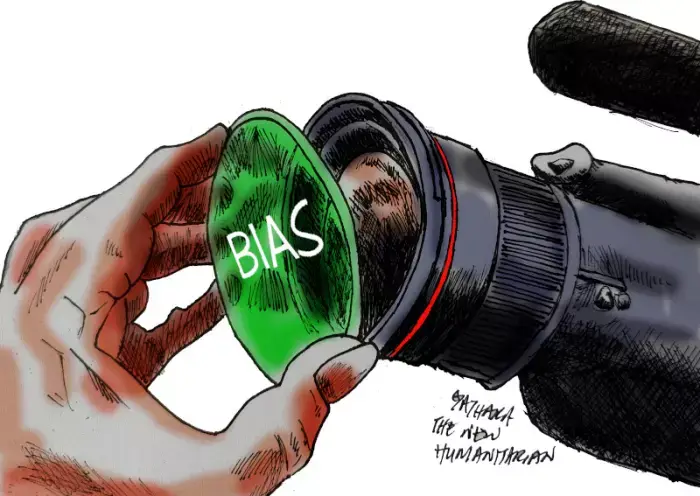
Towards Media Liberated from the Occupation's Imprint in Covering the News of the Oppressed
From time to time, an event arises that captures the attention of all media outlets, and indeed of the entire world.
Ordinary people assume that when a genocide occurs somewhere, it is one of those events that warrants this sharp media attention, with the momentum that follows, and urgent and decisive international measures to address the situation.
Reality bears witness to the contrary.
Merely describing a situation as a genocide, or a potential genocide, does not guarantee that international action will be taken to halt it.
Evidence from Reality
Since Rabi' al-Thani 1445 AH (October 2023 CE), Alice Wairimu Nderitu, the United Nations Special Adviser on the Prevention of Genocide, has warned of the possibility of genocide in the conflicts ongoing in Ethiopia and Sudan.
Likewise, thirty-six independent UN experts described the actions of "Israel" in the occupied Palestinian territories as "genocide in the making."
Nevertheless, little coordinated international action has been taken to prevent escalation. Apart from the bombing of Gaza, the warnings or the conflicts mentioned have received only a relatively small degree of international media attention.
Lessons from the History of Media Work
The record of global journalism in covering genocides as they occur is not commendable.
For example, Western media coverage came under heavy criticism for failing to describe the atrocities in Rwanda and Bosnia accurately in a manner that would mobilise and move global public opinion.
Many lessons can be learned from Rwanda in particular; the book The Media and The Rwandan Genocide, written by a group of journalists and academics, addresses many of them.
One of these lessons is the necessity for correspondents to have a good grasp of the history and context of the conflict, and to work to transfer this understanding to the public.
In Rwanda, when the violence began, the number of international correspondents on the ground was small.
Those few needed a long time to identify the reality of what was happening, to comprehend the events and to reflect upon them.
Linda Melvern, an investigative journalist and author of two books on the Rwandan genocide, says that Western journalism initially mischaracterised what was happening as "ancient tribal hatreds... uncontrollable tribal savagery, and nothing can be done about it."
The value of local expertise, and the necessity of benefiting from it, is a point on which coverage of genocide on the African continent resembles Western coverage in that it has been largely marked by indifference.
However, a comparison between Western press coverage and the coverage of two major African newspapers, one Kenyan and the other Nigerian, revealed a key difference between them.
Dr Emmanuel C. Alozie, professor of media communications at Governors State University in Illinois, found that "the reports in both newspapers sought to explore the background of the crisis and its repercussions."
This is an important observation, especially considering that global journalism is frequently accused of failing to do so.
Overcoming the Barriers of the Western Media Machine
The emergence of the internet has brought about radical changes in the media landscape over the past thirty years, yet these lessons remain relevant to the coverage of genocide today.
International journalism has faced criticism in its reporting on the brutal bombardment of Gaza similar to that levelled at its coverage of Rwanda, namely its use of expressions that strip the people of Gaza of their humanity, its disregard of the historical context of events, and its portrayal of the killing of Palestinians as tragic but acceptable.
But unlike in Rwanda, this time the rules of the game have changed: Palestinian journalists and activists have been able to bypass the barriers of media gatekeepers and reach audiences directly online with images and testimonies that convey the terrifying reality on the ground without "embellishment."
In addition to the growing capacity of internet audiences to exert pressure on the media, the courageous work carried out by Palestinian journalists, dozens of whom have been killed, has led to limited but tangible changes in the tone of Western coverage.
For example, there is now less insistence that Palestinians and their supporters "condemn Hamas" before they are allowed to speak.
There is also greater readiness to question the narrative of Israeli officials.
This was reflected in the criticism by BBC journalists of "double standards in how civilians are seen," and in the signing by nearly 300 Australian journalists of a letter urging "newsroom leaders to be clear in their coverage."
This recalls the appeals of Mark Doyle, a BBC correspondent who spent more time in Rwanda during the genocide than any other foreign journalist, to his editors that "simply describing the killings as 'a massacre of civilians' or 'mass killings' without clarifying who is killing whom was a deeply serious distortion."
Reporting Alone Is Not Enough
The journalist's responsibility is greater than merely informing that a genocide is taking place.
Professor of media studies Lauren Kogen says that "presenting the story in a way that causes the audience to disregard the distant victim" is a harmful journalistic practice.
Kogen says that media reports should "encourage the viewer to see the one suffering in a distant place as deserving of help," and stress that providing help to end the suffering is an obligation.
When the context of media coverage is the stage at which it is discovered that a genocide is taking place, there is no room to hide behind a false veil of "objectivity."
The media trend that portrays killings as incomprehensible, necessary or unavoidable must be combated.
Stories must also be deliberately told that encourage audiences to empathise with the victims and urge action to stop the atrocities.
Landmarks on the Path to Media Liberation
The occupation's imprint on media coverage can be defined through the following markers:
Starting from the Western view of events and covering them in the way that interests the Western audience rather than the communities affected by the events, and adopting the professional values of Western journalism.
Things Are Defined by Their Opposites
In practical terms, coverage liberated from the occupation's imprint can be defined as coverage that is keen to ensure that the published reports and news serve the causes being covered, and gives the proponents of these causes the opportunity to contribute to the coverage.
Free coverage also does not sanctify neutrality as an abstract supreme value, as the Western school does, at least in theory; therefore it does not blur facts in the name of objectivity, but calls things by their names.
Conclusion
Media concerned with the issues of Muslims from the East to the West of the earth are the most deserving of liberation from the grip of Western hegemony, and breaking those intangible constraints is a great good for the oppressed of the Ummah.
Negligence in plugging this gap is very dangerous, and its consequence is that our causes are slaughtered and emptied of their Islamic content under the banner of supporting them, while we are unaware.
Muslim journalist, sound the call, and the duty to deliver the message rests with God!


