

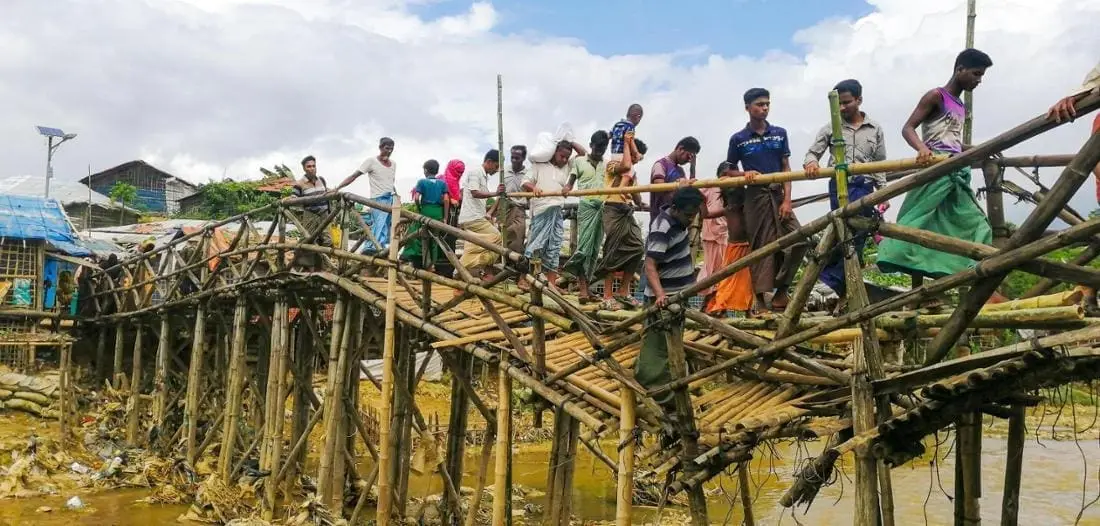
The world's largest refugee camp is in Bangladesh: refugees from Myanmar want to make their dangerous daily lives visible.
The opening lines of Ro Anamul Hasan's poem, which is perhaps his best-known to date, read as follows: "Under this designated protection; I live as ants live in a burrow; I pass my day; through a deep longing for homeland and shelter; my dark night will never turn into the dawn of day." Elsewhere in this 39-line poem, he addresses the forgotten sense of smiling, fear, the long queues in front of the toilets, and hopes that have become blurred. The title: "My Life as a Refugee."
Ro Anamul Hasan, who is 26 years old, belongs primarily to the Muslim Rohingya minority. He was born and raised in Myanmar. However, people like him have been displaced from their homeland since 1438 AH (2017 CE), and he now lives in neighbouring Bangladesh.
As with nearly one million other Rohingya refugees, Ro Anamul Hasan lives in the Kutupalong camp, an area close to the city of Cox's Bazar, which, through the merging of several settlements, has become one of the largest refugee camps in the world. As the first lines of "My Life as a Refugee" indicate, daily life there is as fragile and dangerous as in any other camp. Many suffer from a lack of employment opportunities and privacy, as well as a shortage of food, clean water and security.
Conditions have recently become even more dangerous. The Rohingya have been subjected to discrimination for decades. While Myanmar was under a nationalist Buddhist military dictatorship lasting around half a century, a law passed in 1403 AH (1982 CE) effectively rendered the Rohingya stateless. Their access to hospitals, educational institutions, and even roads has faced numerous obstacles.
In 1438 AH (2017 CE), a "clearance operation" began, which US officials and the United Nations classified as genocide. Although Myanmar officially became a democratic state a few years earlier, the army expelled three-quarters of a million Rohingya. Perpetrators of the genocide have since been on trial in The Hague. In Bangladesh, where the state received international financial support to host refugees, the Rohingya refugees, now numbering more than 900,000 people, have only a slight prospect of returning home.
Ro Anamul Hasan still remembers his escape clearly: "At the end of August 2017, I was working in the health sector in malaria prevention when I was beaten to death by the army." When he went to the hospital, he was disappointed: "A doctor told me that I could get treatment in Bangladesh." In Myanmar's media, Rohingya like Hasan were referred to as "Bengalis." "This upsets us because we are from Myanmar!"
The non-governmental organisation Human Rights Watch summarised the situation of the Rohingya in 1444 AH (2023 CE) as follows: "Rohingya stripped of their nationality live in appalling conditions on both sides of the border between Myanmar and Bangladesh. They are deprived of basic rights and are waiting for justice and the chance to return home." They lack citizenship rights, the right to vote, freedom of movement, and security. The democratically elected government, formally led by Nobel Peace Prize laureate Aung San Suu Kyi, supported systematic discrimination.
Since 1438 AH, it has become particularly clear that those with influence in Myanmar, a Buddhist-majority country, did not want the Muslim-majority Rohingya to be present in the country. The army relied on expulsion. "On my way to my village I heard gunshots. Everywhere. Then I fled with my father and brothers," Ro Anamul Hasan recalls. After several hours of walking, they reached the border with Bangladesh.
In many ways, the escape was a move from the frying pan into the fire. This is also known because Ro Anamul Hasan has now become one of the many cultural workers who provide information about the camp on the ground. The slender man, who wrote poetry as a teenager when he was barred from attending university in his homeland, has already published entire volumes of poetry. His work is supported by a non-governmental organisation called "Fortify Rights," which also works to establish contacts with foreign publishers.
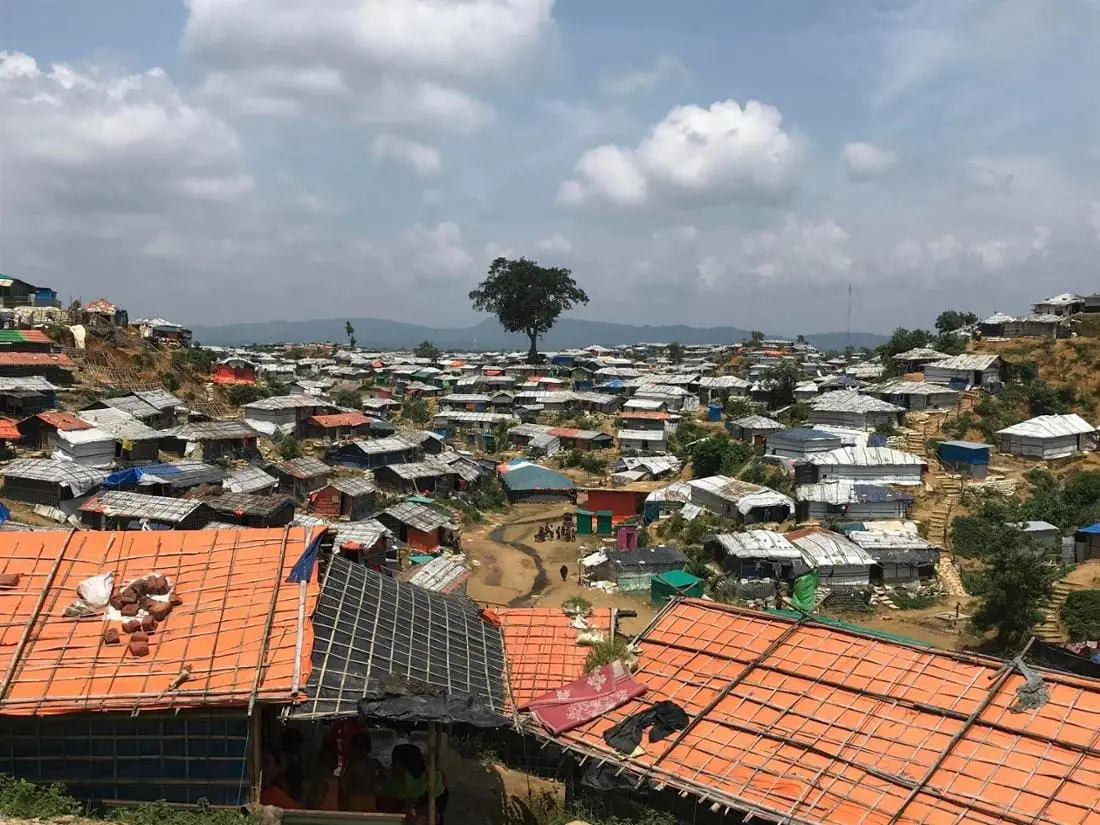
Hasan's poems document how infectious diseases spread in the camp due to flooded toilets, and how bamboo huts are often built so primitively that they cannot withstand rain or landslides. What Ro Anamul Hasan expresses in words has been captured by camp residents who were trained as photographers by Fortify Rights. The people's dependence on international aid payments is evident everywhere.
For example, when a man carries gas canisters suspended from a pole over his shoulders, as water carriers did in Europe centuries ago. Or the helplessness after a fire has destroyed a settlement and a girl begins searching among the ashes for remnants of her home. "Sounds that break sleep," another poem by Hasan, tells of a typical night: "A deep mark on the soul; this is the sound that comes out; from the screams of a widow; who has lost her husband; at the hands of the monsters of war. Does it seem utterly hopeless?"
The poet sees the matter in a more precise way. "We want to return to our homeland." But the chances of success for this endeavour will only increase if all those concerned recognise the need for resettlement. Also because the Cox's Bazar camp has become a hotspot. The majority of the population here has lived for seven years but is still excluded from the Bangladeshi labour market. Since the Russian attack on Ukraine in 1443 AH (February 2022 CE), people have also suffered from a decline in donations.
Since then, incidents of theft and shootings have become more frequent. Over the past two years, dozens of deaths have resulted from gang crimes. This in turn makes the situation of the Rohingya more difficult throughout Bangladesh. "In the society here, the Rohingya often have a reputation for violence and criminality," says Yusuf Saadat of the Centre for Policy Dialogue, an independent research centre in Dhaka. "Politicians increasingly view them as a burden." The Bangladeshi government wants to get rid of them again.
But since the military coup in 1442 AH (1 February 2021 CE), about four years ago, Myanmar has once again slid into chaos, which has now culminated in a civil war. According to the Assistance Association for Political Prisoners (Burma), a non-governmental organisation, more than 6,200 people have been killed by the military council, and nearly 30,000 people have been arrested. The army carries out airstrikes on gatherings of those who prefer to live under democracy, and has even fired on hospitals.
The resettlement of the Rohingya, whom the enraged army previously wanted to expel from the country, has since become less likely, especially as the army in Myanmar is now also forcibly recruiting Rohingya. Popular support for the army has fallen sharply. The military junta is trying to counter this with force, as it has done before.
When Ro Anamul Hasan was asked about the future, he said, like everyone else in the camp: "I want nothing more than to be able to return home." But then he shrugs his shoulders. The poet has the impression that the Rohingya will only be able to return to Myanmar once the pro-democracy groups there have defeated the military council. And after all this, contrary to what has happened before, he has already begun to receive approaches from such groups in Myanmar asking for cooperation.
The pro-democracy shadow government, which relies heavily on the results of the last election before the military coup, but has long been fighting the army together with several ethnic groups, wants to support the Rohingya. The poet wants to believe it: "All people suffer under the army's rule in Myanmar. We should all stand together against the army. The democracy movement has at least promised to protect the Rohingya."
To make a small contribution, Ro Anamul Hasan writes his poems from the refugee camp not only in the Rohingya language, but also in Burmese, the language of the ethnic majority in Myanmar, the country from which he was expelled, just like everyone else in the Cox's Bazar camp.
Frankfurter Rundschau


