


As the Assad regime collapsed in Syria, a global campaign began to search for the billions of dollars in funds and assets the family hid over half a century of authoritarian rule. According to the Wall Street Journal.
The pursuit is expected to be long-running, similar to the years-long efforts to recover wealth smuggled out by Saddam Hussein and Muammar Gaddafi.
The Assad family built a wide network of investments and business interests in the decades following Hafez al-Assad's seizure of power in 1970, and includes some international purchases made by the circle close to his son, Bashar al-Assad, who was recently ousted, including luxury properties in Russia, boutique hotels in Vienna, and a private jet in Dubai, according to former US officials, lawyers and research organisations that have investigated the wealth of the former ruling family.
Human rights lawyers say they plan to trace more assets, in the hope of recovering them for the Syrian people.
Andrew Tabler, a former White House official who worked to identify Assad family assets through US sanctions, said: "There will be an international hunt for the regime's assets," and added: "They had a long time before the revolution to launder their money.. They always had a backup plan and are now well equipped to live in exile."
Assad fled Syria to Russia on 8 December, as opposition rebels advanced rapidly toward the capital, Damascus, ending his 24-year dictatorship, which followed roughly three decades of rule by his father. Both leaders used relatives to hide wealth abroad in a system that enriched the family but also caused tensions within the Assad clan.
The exact size of the Assad family's wealth is not known, nor who controls any of the assets. The US State Department said in a 2022 report that pinning down a precise figure was difficult, but estimated that the value of businesses and assets linked to the Assad family ranges between $1 billion and $12 billion.
The report noted that these funds were often obtained through government monopolies and drug trafficking, especially the amphetamine known as captagon, and that part of them was reinvested in jurisdictions beyond the reach of international law.
While the wealth of the Assad clan grew, ordinary Syrians suffered the effects of the civil war that began in 2011. According to the World Bank, around 70% of the population was living in poverty by 2022.
Many of the regime's most powerful figures were keen on business, particularly Asma al-Assad, Bashar's British-born wife, who previously worked as a banker at JPMorgan.
Toby Cadman, a human rights lawyer based in London with Guernica 37 International Justice Chambers, who has investigated Assad assets, said: "The ruling family was as expert in criminal violence as it was in financial crimes."
Finding and freezing the assets will likely be a difficult task. The United States led a long sanctions campaign against the Assad regime, which forced its financiers to hide their wealth outside the West and in tax havens.
The investigators who led the hunt for the billions hidden by Hussein and Gaddafi spent years pursuing people linked to the tyrants, dealing with shell companies, and filing international lawsuits to recover the funds, with limited success.
Of the $54 billion in assets gathered by the former Libyan regime, only a small portion has been recovered, including a property worth $12 million in London and $100 million in cash in Malta, according to a Libyan official last year.
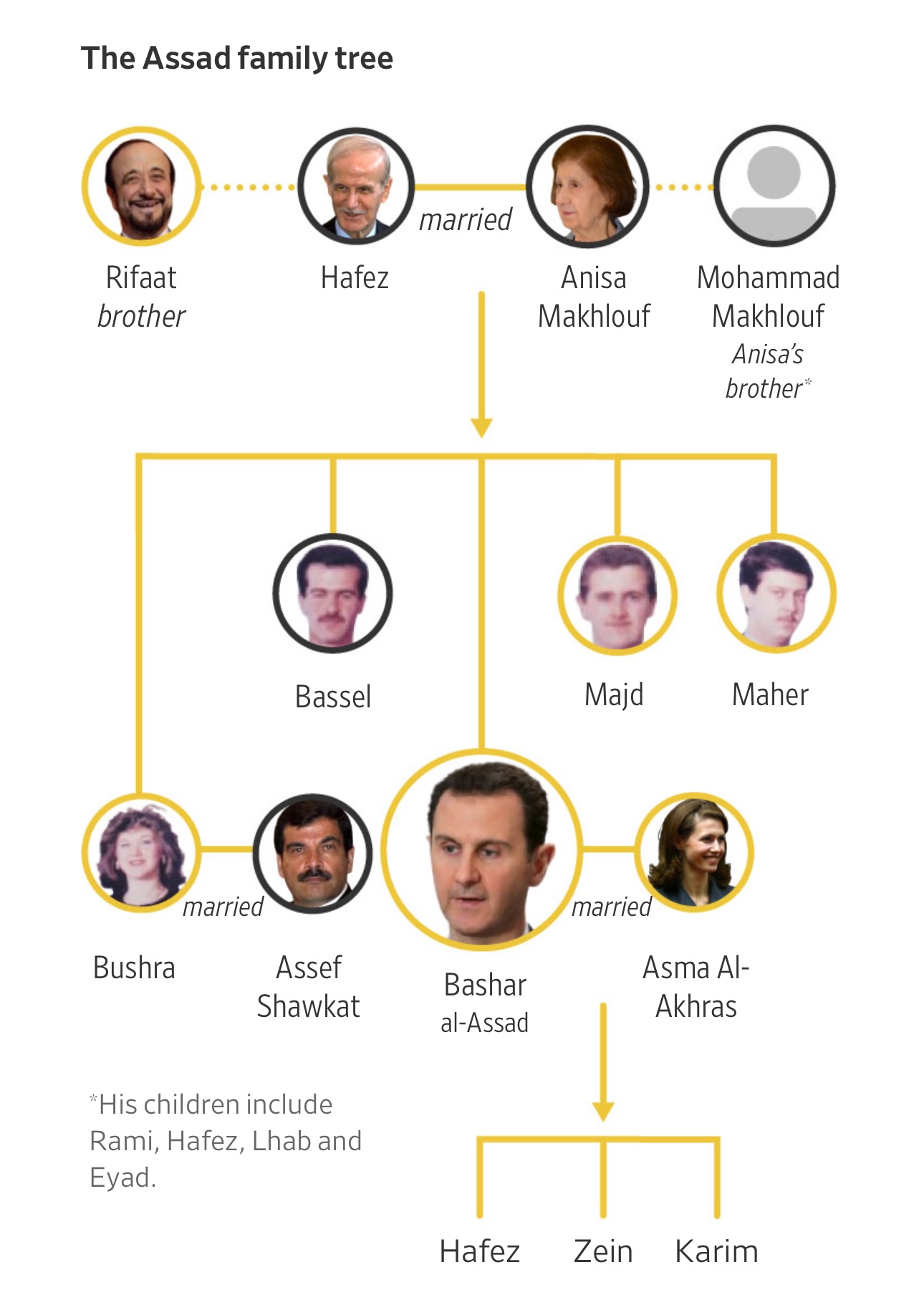
Legal teams have already managed to secure some asset freezing orders related to Assad wealth. A court in Paris froze property worth €90 million ($95 million) owned by Rifaat al-Assad, Bashar al-Assad's uncle, who oversaw a brutal crackdown on the opposition in 1982.
Human rights lawyer William Bourdon, who brought the case in Paris, explained that funds in tax havens such as Dubai and Russia would be much harder to recover.
Investigators need to seek court orders to freeze the assets and then enforce their recovery. It is also unclear to whom the funds would ultimately go.
The Assad clan began accumulating wealth as soon as Hafez al-Assad seized power in what was described as a "white coup." Hafez appointed his brother-in-law Mohammad Makhlouf, then a junior employee at the airline, to be in charge of a lucrative monopoly on importing tobacco into the country.
Mohammad Makhlouf collected large commissions from the booming construction sector, and later passed on his commercial empire to his son Rami when Bashar al-Assad succeeded his father as leader in 2000. Rami became the regime's main financier, with a fortune of $10 billion, according to the US State Department.
The Syrian civil war began in 2011, bringing new opportunities for the Assad family. Maher al-Assad, Bashar's younger brother, took command of the Fourth Armoured Division in Syria, which was involved in smuggling captagon to the rest of the Middle East, providing the regime with $2.4 billion annually between 2020 and 2022.
Industrial quantities of captagon were displayed at sites controlled by the Fourth Division after the regime fell. Maher had invested abroad before the war, including a farm in Argentina. The Makhlouf family also invested abroad, buying property in Dubai and luxury holdings in Moscow and Vienna.
Tensions within the regime rose in 2020 when Bashar al-Assad sidelined Rami Makhlouf from the spotlight and placed him under house arrest. His family's excessive wealth, which was openly displayed on social media, increased the pressure on the regime.
Meanwhile, Asma al-Assad took control of assets inside Syria, and sanctions against her continued due to benefiting from an illegal network in Europe and the Gulf.
Bourdon said: "We have a duty to recover the funds for the Syrian people."
Wall Street Journal, translated by Zaid Benjamin, with adaptations.


