

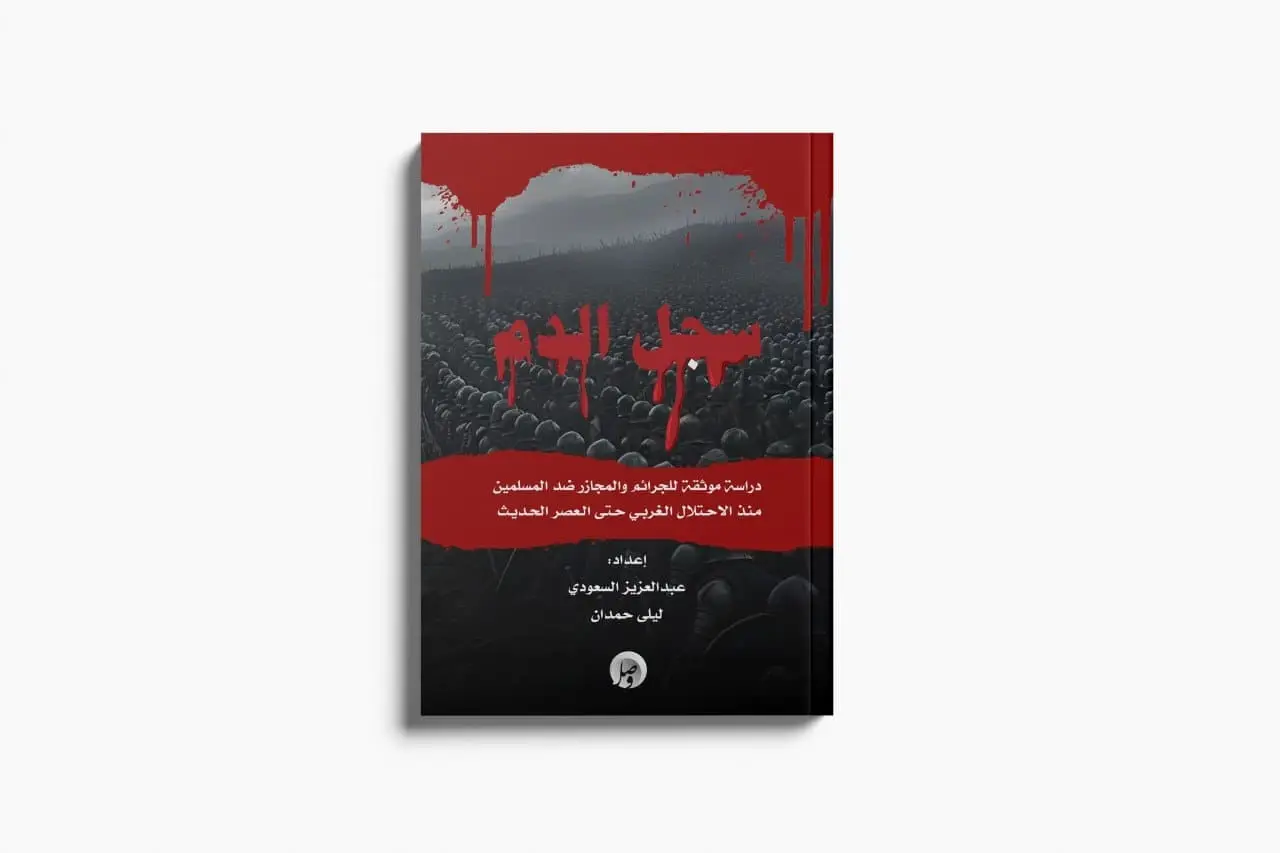
Authors' Foreword
This study seeks to gather as large a body of massacres as the history and present of the Muslim world have recorded, from the invasion of Muslim lands by Western and Eastern occupation armies until today. We know well that compiling every massacre is an impossible task, but we also recognise that giving a general picture of the bloody reality facing Muslims is very important for understanding the movement of history and of the future. It is a matter of trust and loyalty to the victims of Muslims and their grieving families, and to every Muslim who bears affection and compassion for his Muslim brothers, that we document, as far as possible, the record of the crimes this Muslim nation has suffered in an age when nations have gathered against it.
We have tried, to the extent we are able, to collect the most prominent massacres and genocides that targeted Muslims and afflicted them. The massacres presented in each geographical region are a record, not an exhaustive account, of the massacres and crimes witnessed there. What remains hidden is undoubtedly greater. We therefore apologise to the Muslim victims in the regions, periods and circumstances for which we were unable to obtain information about their suffering and tragedies, or for which the available information did not allow us to include them in this study, or even where we fell short in providing the detail that would do them justice. Yet although they are absent from us, they are not absent from the Lord of the heavens and the earth. God is sufficient for us and for them, and He is the best Disposer of affairs.
Description
Before us is a comprehensive historical and analytical research study aiming to document and chronicle the major crimes and massacres that targeted Muslims in various parts of the Muslim world from the beginning of the expansion of Western occupation in the eighteenth century until today. The study relies on a rigorous research methodology based on reliable and diverse sources, including historical books, official archives, international and local human rights reports, peer-reviewed academic articles, and testimonies of survivors and victims. The study seeks to present a clear and documented picture of these tragic events, to analyse the causes and contexts that led to them, and to reveal the recurring patterns in the targeting of Muslims, with the aim of preserving historical memory, countering distortion, and contributing to the defence of Muslim rights and the prevention of the repetition of these crimes.
Introduction
1. Definition of massacres and crimes against Muslims
In the context of this study, it is necessary to begin by defining the basic terms that form the core of our research.
Massacre: is defined as the deliberate and brutal mass killing of a large number of defenceless people, usually unarmed civilians, within a specific temporal and spatial framework. Massacres are often carried out in a deliberate and organised manner, and aim to produce shock and terror in the targeted community.
As for crimes against humanity, according to the Rome Statute of the International Criminal Court, they are broader in scope and include a series of systematic or widespread inhumane acts directed against civilian populations. These acts include, but are not limited to, murder, extermination, enslavement, forcible transfer, torture, rape, and persecution on grounds of identity.
To these terms is added ethnic cleansing, which refers to policies and practices aimed at forcibly removing a particular population group from a specific geographical area, often accompanied by violence and massacres.
At the extreme end of collective violence comes the term genocide, an international crime defined as acts committed with the intent to destroy, in whole or in part, a national, ethnic, racial or religious group.
A clear distinction must be drawn between these collective crimes and systematic violence, which refers to a recurring and organised pattern of violence targeting a particular group, which may not reach the level of a massacre or genocide, but which creates an atmosphere of fear, terror and persecution.
It is important in this study to distinguish between individual crimes, which may be committed by individuals in isolation and without prior planning, and collective crimes and organised massacres, which are carried out with the planning and direction of authorities or organised groups, and which are often part of a broader policy. This study focuses in particular on crimes and massacres that targeted Muslims as a religious and cultural community. This targeting may be explicit, where Muslims are directly targeted because of their religion, or implicit, where Muslim communities are the main victims in conflict or colonial contexts. In this study we will seek to define the criteria that distinguish these crimes as "against Muslims", whether through the identity of the victims, the nature of the discourse that justifies the violence, or the broader context of oppression and discrimination suffered by Muslim communities.
2. The importance of documenting these events to preserve historical memory
Documenting the crimes and massacres that targeted Muslims is not merely an academic exercise; it is an urgent necessity for preserving historical memory and preventing the repetition of tragedies. Accurate and detailed documentation prevents forgetting and historical distortion. Denial or minimisation of these events is an insult to the victims and a disregard of their suffering, and opens the door to the repetition of violence and injustice. Selective or distorted memory of history can be used to justify hatred and violence in the future. Through documenting historical facts, we seek to build an impregnable wall against attempts to obliterate or falsify the truth.
The shared historical memory of these massacres plays a vital role in building collective identity and strengthening resilience among Muslims. Remembering these events connects Muslim generations to a common heritage of suffering and resistance, and strengthens the sense of belonging and solidarity across geographical and cultural boundaries. This collective memory becomes a source of strength and inspiration, helping Muslim communities understand their shared experiences and enhancing their capacity to endure in the face of ongoing challenges and injustice. Moreover, historical memory is essential for addressing collective trauma. Massacres leave deep wounds in the souls of individuals and communities, and their effects pass down through generations. Public acknowledgement and documentation of massacres represent an essential step towards addressing this trauma and enabling affected communities to recover and reconcile. Silence and denial only deepen the wounds and hinder the process of healing.
Furthermore, documenting these crimes contributes to countering contemporary Islamophobia and discrimination. By revealing the historical pattern of targeting Muslims, we show that Islamophobia is not a new or marginal phenomenon, but part of a long history of prejudice and violence against Muslims. Understanding the historical roots of Islamophobia helps in analysing its contemporary manifestations and combating them effectively. Documenting these crimes also represents a contribution to achieving justice and accountability. Even though decades or centuries have passed since some of these events, their documentation remains important for demanding recognition of historical injustice, pressing for symbolic or practical measures to correct wrongs, and supporting transitional justice movements. Even in cases where criminal justice cannot be fully achieved, documentation ensures that crimes do not vanish from memory and preserves the victims' right to acknowledgement and redress.
3. Research methodology and sources used
To ensure credibility and accuracy, this study relies on the comparative analytical historical method. We apply the historical method to understand each massacre or crime in its specific temporal and geographical context, while analysing the political, social, economic and cultural conditions that led to it. The analytical method enables us to go beyond merely descriptive narration of events, to delve into analysing causes, motives and outcomes, and to reveal recurring patterns in the targeting of Muslims. As for the comparative method, we use it to compare massacres across time and place, in order to identify points of similarity and difference, and to draw lessons regarding the nature of violence against Muslims and the mechanisms of resisting it.
This study relies on a diverse range of primary and secondary sources:
Primary sources include official archival documents (such as government reports, diplomatic correspondence and military records), living testimonies of survivors and eyewitnesses (personal interviews, memoirs and letters), photographs and video recordings documenting the events, and contemporary reports from human rights organisations and newspapers.
Secondary sources include specialised historical and academic books, peer-reviewed articles in scientific journals, and analytical reports from international organisations and reputable research centres. We pay particular attention to assessing the credibility of sources, taking into account the context of their production, the potential biases of their authors or the parties behind them, and comparing information from multiple sources to verify its accuracy. We rely on clear criteria for evaluating reliable sources, such as the reputation of the publisher or institution, the presence of peer review (in the case of academic articles), and the consistency of information with other reliable sources.
In addition, we use quantitative and qualitative methods in an integrated manner.
The quantitative method enables us to analyse numerical data and statistics related to the number of victims, material losses, and the geographical distribution of events, using official statistics and estimates from reliable organisations.
The qualitative method focuses on analysing texts, discourses, and cultural and social contexts, and on understanding human experiences and individual and collective suffering through testimonies and narratives. Combining the quantitative and qualitative methods provides us with a comprehensive and balanced picture of events, combining depth, detail and breadth.
Nevertheless, we recognise that we face methodological challenges, such as:
The difficulty of accessing some sources, especially secret archival documents or those held in remote locations, which may limit the scope of research in some cases.
Potential biases in sources, whether intentional or unintentional, which require caution and critical analysis of each source.
Conflicting narratives about the same event are to be expected, and require additional efforts of comparison, analysis and weighing between different accounts.
The difficulty of verifying information in some cases, especially for events that are old, that took place in remote areas, or under difficult conditions, which may make it impossible to obtain definitive confirmation of every detail. We address these challenges by using diverse sources as far as possible, comparing different accounts, and acknowledging methodological limitations in cases where full certainty cannot be reached. Our aim is to present a study that is documented as far as possible, while acknowledging the difficulties and challenges facing research in this sensitive and complex field.
Introduction to the Study
Since the early days of the age of geographical exploration and commercial expansion in the fifteenth century, the Muslim world has undergone radical transformations due to the rise of Western powers and the expansion of their influence and dominance. This expansion was not merely cultural interaction or commercial exchange; it was a comprehensive colonial conquest, which aimed to seize lands and resources, subjugate peoples, and impose foreign systems of rule and cultures. For Muslims, this era marked the beginning of a new period of challenges and persecution, characterised by systematic violence and brutal massacres that targeted their religious and cultural identity and their basic human rights.
The roots of this study reach deep into history, covering a broad period beginning in the fifteenth century CE, with the early Spanish and Portuguese colonialism, and extending to the modern era with its regional and international conflicts that target Muslims in particular in various parts of the world. The study does not limit itself to the classical colonial period of the eighteenth and nineteenth centuries, but extends beyond it to the post-colonial era, including the crimes and massacres witnessed in the Balkans, Bosnia and Herzegovina, Palestine, Kashmir, Chechnya, Myanmar, China, Africa and other regions.
This study aims to document and chronicle these crimes and massacres in a scientific and detailed manner, relying on reliable and diverse sources, and to provide an in-depth historical analysis of the causes, motives and contexts that led to their occurrence. The study also seeks to reveal the recurring patterns in the targeting of Muslims throughout history, to identify the actors involved in committing these crimes, and to analyse the devastating effects they left on Muslim communities.
In a world teeming with conflicts and tensions, where waves of Islamophobia and racist violence are escalating, the importance of documenting these historical events and preserving the collective memory of massacres and crimes against Muslims grows. Accurate and detailed documentation is the sharpest weapon against forgetting and historical distortion, and in building an impregnable wall against the repetition of tragedies and atrocities. Shared historical memory of the massacres also represents a source of strength and inspiration for Muslim communities, and strengthens their resilience in the face of ongoing challenges and injustice.
This study hopes to be a valuable addition to the Arabic and Islamic library, to enrich scientific research in the fields of history and human rights, and to open new horizons for further specialised studies and research in this vital and important field. The study also aspires to be an effective tool in raising global public awareness of the suffering of Muslims throughout history, and in urging leaders and centres of influence to bear their responsibilities in protecting Muslim rights and preventing the repetition of crimes and massacres against them.
A Message of Hope, Optimism and Determination
Despite the challenges, difficulties, dangers and threats facing the oppressed in the modern age, the certainty of the believer is never defeated. The determination and insistence on continuing the struggle and effort to achieve justice and fairness for Muslims and to combat massacres and crimes against the oppressed remain ever present with strength, steadfastness, endurance, resolve and optimism, and without surrendering to despair, frustration, weakness, lethargy or collapse. Rather, we will continue to work, struggle and strive with certainty and good trust in God Almighty, for a better future of respect and security for the Muslim nation throughout the world.
The first step in this direction is to safeguard awareness and identity through independent Islamic study and monitoring centres, rather than total and defeated dependence on the West. Even at the level of counting the tragedies and victims of Muslims, we find that the West leads the authority of statistics, monitoring and assessment; and at the level of terms and designations, it is the West that decides who is a terrorist and who is a criminal, and all criminal acts committed against Muslims by the West and its allies are classified as the consequences of "noble" wars for the liberation of peoples, rather than organised terrorism, as is the documented reality witnessed in occupied Palestine, with shameless bias towards the side of the occupying killer and the genocide he continues to carry out to this moment. If this indicates anything, it indicates the degree of weakness that the Muslim nation is living through and the degree of dependence and impotence.
We hope that this effort will be a first brick in a plan to provide independent studies that address the causes of the Muslim nation, away from political exploitation and the interests of funders and supporters, which read the reality of Muslims through an Islamic identity rather than an imported one, and convey the truth as it is rather than as dictated by the dominant power and the occupier. In this there is some measure of justice for the victims of massacres and aggression against Muslims. We are fully confident that the causes whose people we were unable to vindicate in this world, God Almighty will vindicate them in this world and the next: "And your Lord is not ever forgetful" [Maryam: 64]. "And whoever relies upon God, then He is sufficient for him. Indeed, God will accomplish His purpose. Certainly, God has set for everything a decree" [At-Talaq: 3].
All praise is due to God, Lord of the worlds, and prayers and peace be upon the most noble of the messengers, and upon his family and companions, all of them.
To download the study, click here


