

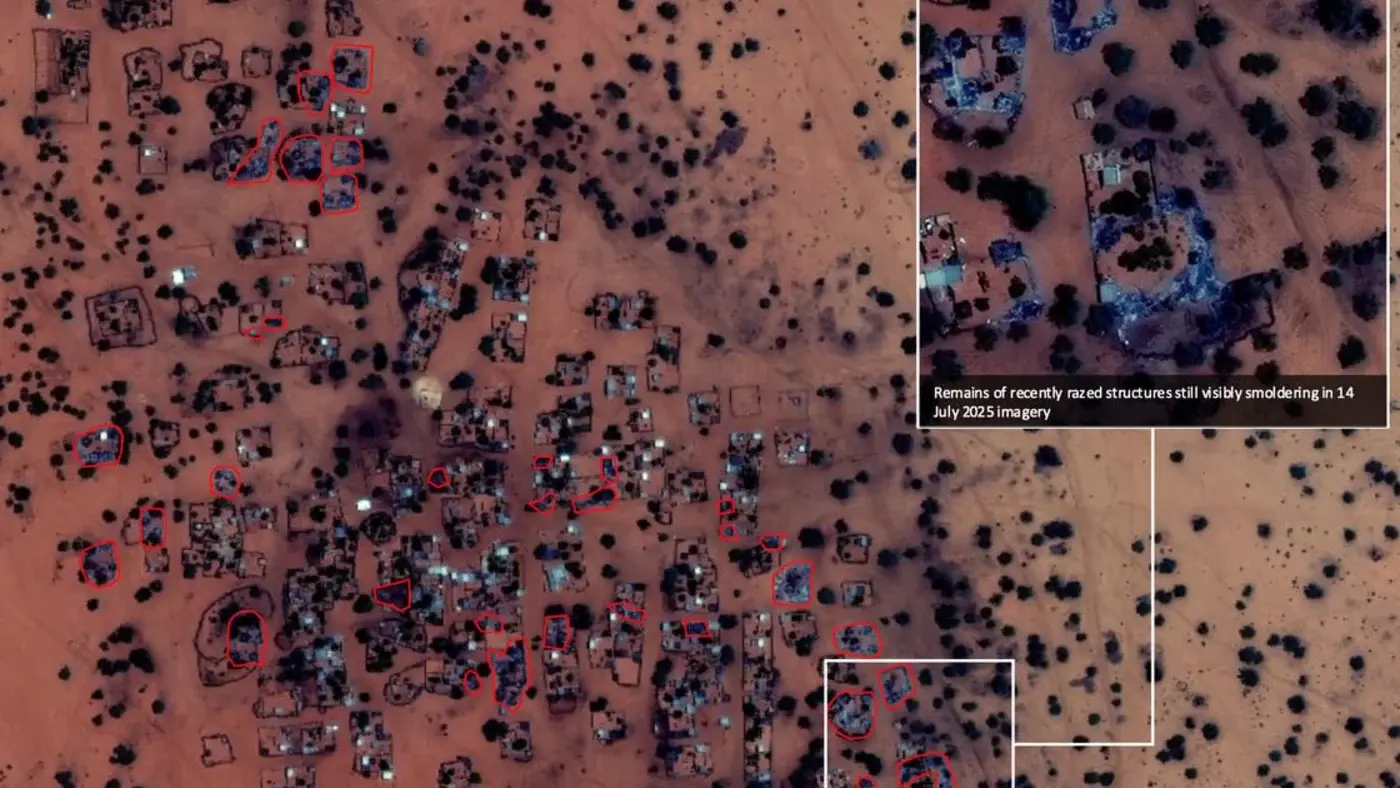
The Sudanese war is no longer confined to ground battles for control of cities, roads and military sites. It has entered a more complex phase in which long-range drone attacks are intertwined, control lines are shifting in Kordofan and Darfur, tensions with neighbouring countries are rising, and drought and hunger are compounding the collapse of humanitarian conditions. Although the Sudanese army has made progress on some fronts, a decisive end to the war remains out of reach, according to a recent research study that warns the conflict is turning into a prolonged war of attrition with growing regional repercussions.
In a policy brief titled "The Third Phase of Sudan's War", published by International Affairs Watch on Thursday, 12 November 2026, researcher Ezekiel Emmanuel offers an assessment of the course of the war between the Sudanese army and the Rapid Support Forces, drawing on field, human rights and humanitarian data, including reports from the United Nations, ACLED and the Critical Threats Project (CTP).
The five-page study, based on information up to 11 November, concludes that the war is now moving in three simultaneous directions: a shifting ground conflict in Kordofan, Darfur and Blue Nile; an escalating air war that reaches civilian areas and infrastructure; and border tensions that threaten to draw neighbouring countries into confrontation.
First: Kordofan becomes the centre of the military conflict
The study considers Kordofan to have become the central knot in the Sudanese military balance, after the army succeeded in breaking the siege imposed by the Rapid Support Forces on the city of El Obeid, capital of North Kordofan, and began expanding its operations westward.
In August, analysts at ACLED described this shift as the beginning of a third phase of the war, following a ground stalemate around the city that lasted more than 18 months.
El Obeid's importance lies in its strategic position as a hub linking army-controlled areas in central and western Sudan, and as a launching point for operations towards Rapid Support Forces positions in Kordofan and Darfur.
The study points to the army's advance towards West Kordofan, following its seizure of sites and weapons and drone depots in the Jabrat al-Sheikh area, and its recapture of other areas during September, October and November.
Yet this progress does not mean the war is nearing its end.
The Rapid Support Forces have retained most of West Kordofan state, including the city of En Nahud and the Heglig oil field, in addition to their broad control of Darfur, while continuing attacks in Blue Nile state in cooperation with the Sudan People's Liberation Movement-North, led by Abdelaziz al-Hilu.
In the most recent development after the study's publication, military sources told Anadolu Agency on Friday, 13 November, that the army and its allied forces had advanced in areas near the city of El Khuwei in West Kordofan, including Surief Ankoush, without confirming control of the city itself.
Thus, the real change on the ground lies not in the collapse of the Rapid Support Forces, but in the army's move from defending its positions in North Kordofan to attempting to expand its control, while the opposing forces seek to relieve pressure on their fronts by opening new axes and expanding long-range attacks.
Second: Drones change the nature of the war and erase the notion of safe areas
The study identifies the escalating use of drones as the most dangerous of the shifts it tracks.
Whereas the Sudanese army relied mainly on its manned combat aircraft in earlier phases, drones have become a central combat tool used by both sides to carry out strikes over distances far from the front lines.
According to an analysis the centre prepared on ACLED data, the share of air-attack incidents whose reports mention drones rose from 18% in the first six months of the period studied to 60% in the last six months, between May 2024 and October 2025.
This proportion reflects the growing presence of drones among documented incidents, while noting that conflict data is affected by the extent of access to information and the ability to verify it.
On 23 October, United Nations High Commissioner for Human Rights Volker Türk announced that his office had documented the killing of at least 306 civilians and the injury of hundreds more in drone attacks during the first three weeks of the month.
The United Nations described strikes attributed to both sides that hit homes, markets, medical facilities, shelters, power stations and water sources.
These figures reveal an extremely dangerous shift: areas distant from the lines of confrontation are no longer protected by distance, as drones are now able to reach cities and facilities whose residents considered themselves relatively remote from direct fighting.
Third: Targeting electricity and water becomes a weapon of attrition
The study highlights the shift of the air war from targeting military sites alone to striking energy facilities and essential services.
In an analysis published by the Critical Threats Project on 5 November, researchers recorded 21 waves of Rapid Support Forces attacks on fuel facilities and power stations in army-controlled areas since 22 October, including sites in Ed Damazin, Wad Madani, Rabak, Sinja, Omdurman and Khartoum.
The project also documented ten groups of strikes attributed to the Sudanese army that targeted markets and commercial areas in territories controlled by the Rapid Support Forces since mid-October, including areas in Nyala, Ad Du'ain and El Fasher.
The danger of these operations extends beyond direct losses.
In Sudan, electricity is closely tied to the provision of water, the operation and treatment of pumps, as well as the continuity of health services and irrigation.
In a statement on 11 November, UNICEF warned that as many as 15 power stations were shelled during October, and that the attacks disrupt access to clean water, increase reliance on unsafe sources, and raise the risk of disease outbreaks.
Herein lies one of the most dangerous features of the new phase: the destruction of infrastructure does not only weaken the opponent militarily, but extends to disabling the means of life for millions of civilians.
Protecting civilians becomes even harder when attacks are launched from long distances or when the party responsible cannot be independently identified.
Fourth: The war crosses Sudan's borders
The report warns that the conflict is gradually shifting from an internal war into a regional security crisis, driven by the extension of military supply routes, recurring border incidents and mounting mutual accusations.
Ethiopia stands out among the countries with which tensions with Sudan are escalating.
Khartoum has accused Addis Ababa of allowing its territory to be used for drone attacks in support of the Rapid Support Forces, and has filed a complaint on this matter with the United Nations Security Council and the African Union.
According to documents submitted by the Sudanese authorities, they accuse groups linked to the Rapid Support Forces of carrying out 70 attacks launched from Ethiopian territory between February and October 2026.
These accusations, however, have not been subject to comprehensive independent verification. Ethiopia has rejected accusations that it supports the Rapid Support Forces, and has in turn accused Sudan of backing fighters from the Tigray region.
On 4 November, the two countries closed their consulates near the shared border, in a development reflecting the deterioration of diplomatic relations.
Abyei and Chad: violence spreading to neighbouring countries
The regional repercussions have not been limited to Ethiopia.
On 19 October, the Amiet market in the disputed Abyei area between Sudan and South Sudan was struck by a drone, killing at least 153 people, according to a toll announced by local officials.
Officials in Abyei accused the Sudanese army of carrying out the strike, but responsibility for it has not been independently established.
The attack prompted an official protest from South Sudan, which summoned the Sudanese ambassador, amid fears that Abyei could become an additional arena for the conflict.
The report also noted a drone strike in eastern Chad that killed four people during October, within the context of growing concern over the spread of violence across borders.
These events indicate that the risk of war is no longer confined to the movement of refugees and weapons across borders, but now includes the possibility of direct confrontations or military incidents between states in the region.
Nevertheless, these scenarios remain possibilities and research warnings, not evidence of the outbreak of a comprehensive regional war.
Fifth: Drought joins the war in threatening millions of Sudanese
As military operations escalate, the country faces another factor that heightens the fragility of the humanitarian situation: deteriorating climatic and agricultural conditions.
The study warns that weak rainfall and declining vegetation cover are compounding crop losses and the deterioration of food security in Darfur and Kordofan, two of the regions most affected by war and displacement.
It points out that indicators of weak plant growth covered about 64% of agricultural land in North Darfur, and large proportions of land in South Darfur, West Kordofan and South Kordofan.
Weak vegetation cover does not necessarily mean that all crops are lost, but it signals heightened risks of declining production in areas where broad segments of the population depend on agriculture and livestock.
The Integrated Food Security Phase Classification, in its analysis issued in May 2026, estimated that about 19.5 million Sudanese face high levels of acute food insecurity, and identified 14 areas at risk of famine if conditions worsen.
UNICEF projected that about 825,000 children under five would suffer severe acute malnutrition during 2026.
Three factors thus converge to threaten the population's lives: declining food production, the disruption of services and water due to attacks, and the difficulty of delivering aid to besieged areas or areas damaged by fighting.
These factors do not operate separately; each amplifies the effect of the others.
Sixth: A funding crisis hampers efforts to save millions
The study places the humanitarian crisis at the heart of its assessment of the war's future.
According to the United Nations humanitarian response plan, 33.7 million people in Sudan need humanitarian assistance during 2026.
Although the response plan requires approximately $2.9 billion, available funding had not exceeded 47% by early November, according to the United Nations Refugee Agency and the International Organization for Migration.
In a joint statement on 6 November, the two agencies warned that the funding shortfall threatens the ability of humanitarian institutions to provide shelter and essential supplies to millions of displaced people.
Fighting and drone attacks compound the difficulty of transporting and storing supplies, while humanitarian organisations face growing pressure due to damaged roads and facilities and the absence of security.
One of the most serious consequences of this situation is that the decline in funding may coincide with a period in which food and health needs are rising, making a belated response less capable of preventing deaths and further displacement.
Seventh: Why have efforts to halt the war not advanced?
The report argues that the stalling of international mediation is not due to all parties outright rejecting the principle of a truce, but to a dispute over the conditions that must be implemented first.
The initiative led by the United States, Saudi Arabia, Egypt and the United Arab Emirates proposes a 90-day humanitarian truce, paving the way for a more durable ceasefire and a political transition process.
However, the Sudanese army insists that the Rapid Support Forces must withdraw from the cities and sites they control before moving to broader arrangements for ending the fighting and disarmament.
For its part, the Rapid Support Forces are pushing for a truce subject to international monitoring, without conditioning it on their prior withdrawal from their positions.
This disagreement makes reaching a practical agreement more complicated, particularly as fighting continues and each side seeks to improve its battlefield position before any settlement.
The study points to an additional challenge: any truce focused solely on fixing ground lines of contact may fail to protect civilians unless it includes mechanisms to monitor air attacks, drones and their launch sites.
Eighth: Three scenarios for Sudan's future
The study sets out three possible paths through mid-2027, presented as qualitative estimates rather than firm predictions.
Scenario one: continued war of attrition.
This rests on the army continuing its slow advance in Kordofan, the Rapid Support Forces retaining broad areas of Darfur, and both sides continuing to strike infrastructure and army-controlled areas with drones.
The study warns that continuation of this path will entrench the de facto division of areas of administration and influence, and increase the risks of famine and displacement.
Scenario two: a conditional humanitarian truce.
This assumes external pressure leads to a temporary agreement on halting fighting, with arrangements to monitor violations and deliver aid, even if the core political and military disputes remain unresolved.
This path could improve aid access to Kordofan and Darfur, but would not guarantee a final settlement of the war.
Scenario three: regional escalation.
This is linked to the possibility of a major military incident on the Ethiopian border or in Abyei, which could push neighbouring states into direct confrontation or reciprocal military responses.
Although the report considers this scenario less likely than continued attrition, it warns that its consequences would be far more severe.
Conclusion: Sudan faces a war that battlefield victories alone cannot resolve
The study shows that the most dangerous shift in Sudan's war lies not in the transfer of control of a city or military site from one side to the other, but in a change in the nature of the conflict itself.
The army can achieve ground gains in Kordofan without ending the Rapid Support Forces' capacity to conduct long-range air attacks, and the latter can inflict widespread damage on infrastructure without thereby regaining the initiative on the ground.
At the same time, civilians become more exposed to danger as drones reach cities, markets, power stations and water sources, while drought and declining humanitarian funding reduce the population's capacity to endure.
Tensions with Ethiopia, South Sudan and Chad add a new dimension, as the continuation of the war now threatens regional stability, not Sudan's future alone.
Herein lies the danger of the third phase: control maps may change without the war drawing closer to an end, and the number of areas subjected to shelling, hunger and displacement may grow even as ground fighting recedes in some places.
The most important question is therefore no longer which side will control the next city, but whether Sudan can avoid a prolonged war of attrition in which military fronts intertwine with economic collapse, famine and regional tensions, leaving millions of civilians to pay the heaviest price.


