

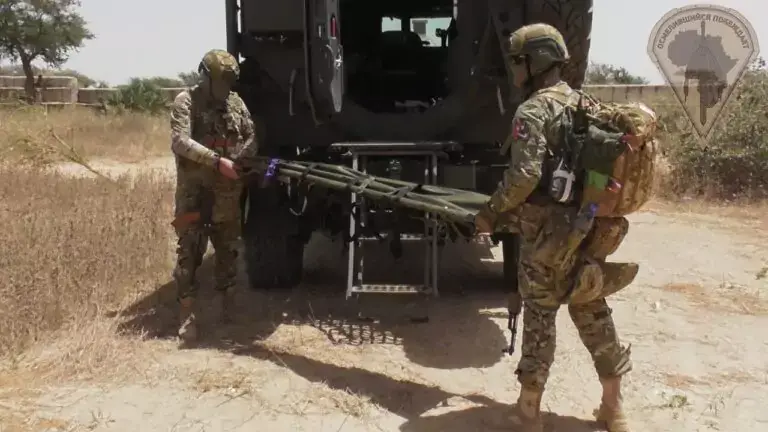
A recent research study reveals that Russian forces operating in Mali within the "Africa Corps" formation intensified their use of ZALA Lancet kamikaze drones over the past months, in parallel with a sharp rise in the frequency of air strikes and the number of deaths. It warns that the escalating civilian losses could strengthen the recruitment capacity of armed groups rather than weaken them.
The study, prepared by the US-based Conflict Insights Group (CIG), and whose findings were published by Reuters on Thursday, 19 November 2026, found that the average number of recorded air strikes and drone attacks in Mali rose from fewer than seven per week during the 52 weeks preceding the armed groups' attack in April 2026, to around 16 per week after that attack.
According to data from the Armed Conflict Location & Event Data Project (ACLED), on which the study relied, the average recorded deaths linked to these strikes rose from fewer than 25 per week to more than 60, an increase of nearly 150%.
This toll includes deaths recorded in strikes in general, and cannot be fully attributed to Russian forces alone.
Kamikaze Drones Enter the Battle
The study explained that the "Africa Corps," which is subordinate to the Russian Ministry of Defence, expanded its use of one-way attack drones, known as kamikaze drones, in military operations against armed groups in Mali.
Among the most notable developments is the use of Russian Lancet drones, manufactured by the company ZALA Aero, alongside reconnaissance drones that operate with them to identify targets and monitor operations.
The researchers were able to identify at least ten strikes carried out by the "Africa Corps" since April in which Lancet drones were used in coordination with reconnaissance drones.
Their analysis also concluded that one of these drones had targeted, with a high degree of confidence, a vehicle carrying civilians. The study notes that a strike near Tidermene is highly likely to be the one that occurred on 26 June, in which media reports said eight civilians were killed.
These findings point to a shift in Russian combat methods within Mali, through the expanded use of drones in reconnaissance and attack operations, in parallel with conventional air strikes.
Why Did Russia Escalate Its Operations?
This shift came after coordinated attacks launched on 25 April by Azawadi separatist armed groups and others linked to al-Qaeda (the Group for Support of Islam and Muslims), which targeted military positions, towns and security centres in various parts of Mali.
The attacking groups succeeded in seizing some areas and inflicting losses on government forces and their Russian allies, prompting the Malian army and the "Africa Corps" to intensify their operations to regain the initiative.
The "Africa Corps" comprises some 2,500 personnel who operate alongside the Malian army. Over the past year it has taken over a large part of the role previously played by the Russian Wagner Group, as Russia's military presence shifted to a formation more closely tied to the Ministry of Defence in Moscow.
Although government forces and their allies have regained control of some of the areas they had lost, the Group for Support of Islam and Muslims and its Azawadi allies still retain wide influence in parts of the country.
Civilians Pay the Price of Escalation
The new findings coincide with human rights reports that documented civilian deaths in operations carried out by Malian government forces and their Russian allies.
In a report issued by Human Rights Watch on 19 October, the organisation cited ACLED data showing that Malian forces and the "Africa Corps" carried out 49 air strikes between April and August 2026, killing 89 civilians, compared with 22 strikes that killed 44 civilians during the same period in 2025.
The organisation documented a drone attack on a livestock market in the village of Tombonkouri in the Bandiagara region on 19 August, which killed six civilians and injured at least 20 others, as well as another strike on 29 July on the village of Talahadak in the Kidal region, which damaged a health facility. The organisation described the two attacks as appearing indiscriminate.
These incidents point to the growing risks facing residents in populated areas, where military operations intersect with the daily lives of the population.
Conversely, human rights organisations have also documented serious abuses committed by armed groups opposed to the government, including the torture and execution of soldiers who had been captured.
Could the Strikes Become a Means of Recruiting More Fighters?
The researchers at Conflict Insights Group warned that rising civilian casualties could undermine the long-term objectives of the Russian military campaign.
The researchers believe that the harm inflicted on the population by the strikes may fuel anger and increase the susceptibility of some local communities to recruitment efforts carried out by armed groups.
The study thus raises a question about the strategic utility of military escalation. Increasing the capacity to carry out strikes and recapture some areas does not necessarily achieve lasting security stability, especially when operations are accompanied by civilian casualties and declining trust between the population and government forces.
The group's executive director, Justin Lynch, considered that Russia has turned Mali into an arena for promoting the capabilities of its kamikaze drones, while civilians pay the price of these operations.
This characterisation reflects the researcher's assessment and does not, on its own, prove the existence of an official Russian programme to test or market weapons in Mali.
A Widening War and Questions About the Future of Russian Involvement
Since the military coups in Mali in 2020 and 2021, the ruling authorities have moved to strengthen military cooperation with Moscow, following the decline of the French military presence and the withdrawal of UN peacekeeping forces.
This shift was presented as a step towards strengthening the Malian army's ability to confront armed groups and regain control of territories beyond the state's authority.
However, the continuation of attacks, the expanded use of drones and the rise in casualties raise questions about the outcome of this cooperation and the extent to which military force alone can address the protracted conflict in the country.
The study reveals that the war in Mali is entering a phase in which unmanned aerial means are becoming increasingly important, while protecting civilians remains one of the greatest challenges facing all parties to the conflict.
The decisive criterion for the success of military operations is not limited to the number of strikes or the positions recaptured, but extends to their capacity to reduce violence and protect the population, and to prevent civilian losses from becoming a factor that fuels a new cycle of recruitment and fighting.


