

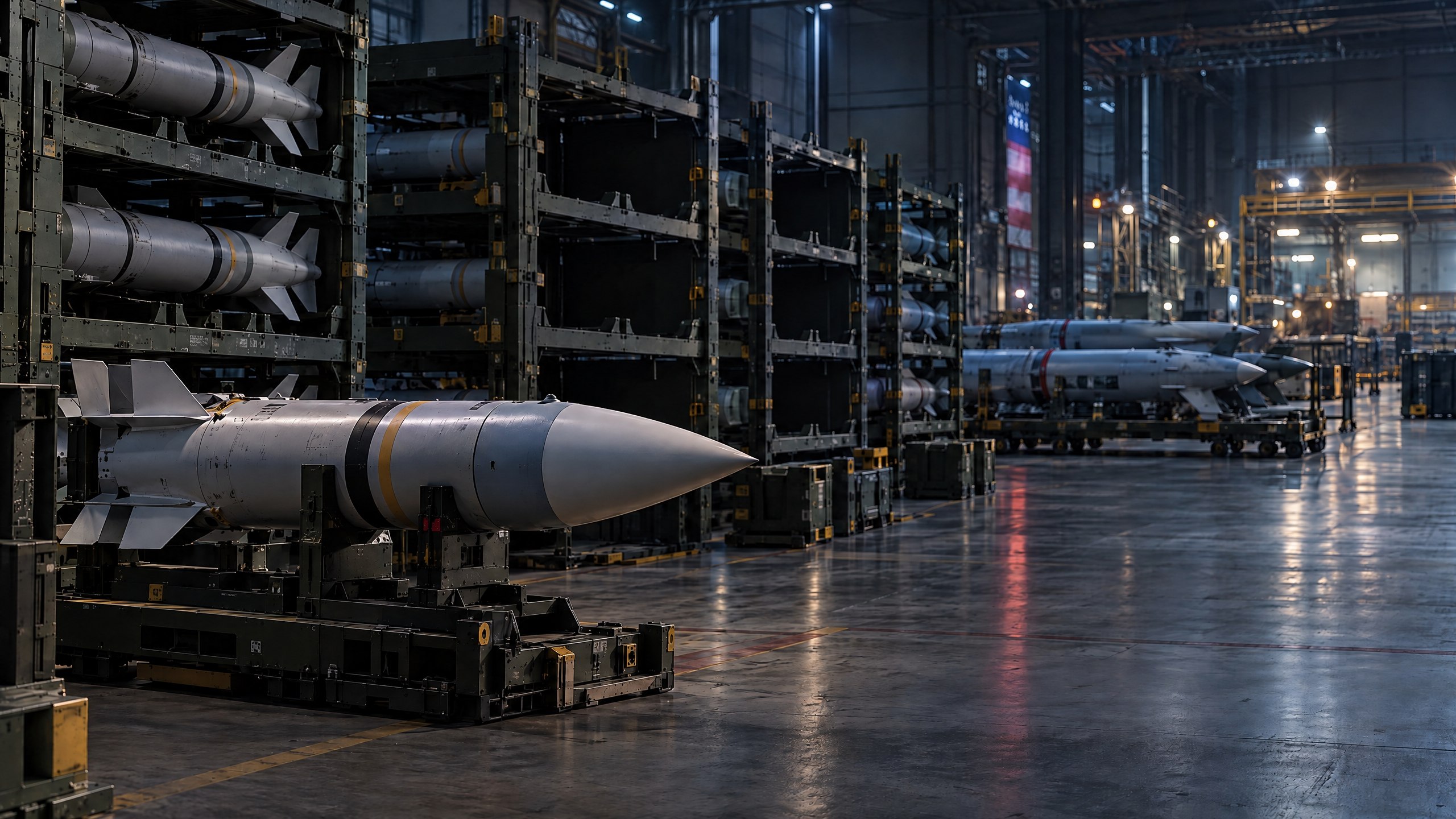
The United States faces a growing challenge in rebuilding its stocks of advanced weapons after months of military confrontation with Iran, amid estimates that the cost of the war has risen to more than $47 billion, most of it spent on munitions and interceptor missiles. Military reports reveal a widening gap between the speed at which weapons are consumed in combat and the capacity of American factories to replace them, at a time when the likelihood of a new confrontation with Tehran is increasing.
According to estimates prepared by US Central Command and reviewed by American media in late October 2026, the cost of the war reached about $47.1 billion by mid-October, including nearly $29 billion to replace expended munitions, $11.9 billion in operational expenses, and about $6.1 billion to replace lost equipment and military platforms.
These estimates do not include the full cost of repairing US bases damaged by Iranian attacks, meaning the actual financial burden may be greater than the announced figures.
The most pressing challenge, however, relates not only to the scale of spending but to the time needed to reproduce the consumed weapons, particularly air defence systems and long-range missiles, whose manufacture requires years of planning, contracting and production.
Patriot: Nearly Two-Thirds of Stocks Depleted
Patriot missiles are among the weapons whose stocks were most heavily depleted during the war, as they were used to intercept Iranian ballistic missiles and to protect US forces and bases and their allies in the region.
According to an analysis published by the Center for Strategic and International Studies (CSIS) in July 2026, US forces had used about 65% of their estimated pre-war stock of interceptor missiles, leaving fewer than 1,000 missiles.
The PAC-3 MSE interceptor is priced at about $3.7 million, whereas some drones that air defences deal with may cost only tens of thousands of dollars.
Although the threats the system faces vary in type, this disparity highlights the high economic cost of intercepting low-cost targets with advanced missiles, especially in long-running confrontations.
In an effort to bolster stocks, the United States awarded Lockheed Martin a $9.8 billion contract in September 2025 to produce 1,970 PAC-3 MSE interceptor missiles, along with related equipment.
However, increased orders do not mean immediate replenishment of stocks, as production and delivery depend on factory capacity and supply chains, as well as prior commitments to the US Army and to contracting states that have purchased the system.
THAAD: Limited Stocks and Production Not Keeping Pace with Consumption
The THAAD system, which specialises in intercepting ballistic missiles at high altitudes, faces a similar challenge, after US forces consumed large numbers of its interceptor missiles during military operations.
The Center for Strategic and International Studies estimated that US stocks of these missiles had declined by about 38% by July 2026, with between 234 and 278 missiles remaining, according to the data then available to the Center.
The cost of a single missile ranges between $12 million and $15 million, making replacement of depleted stocks an expensive process, in addition to manufacturing difficulties.
The Center's data indicate that the United States has not received new interceptors of this type since August 2023, with deliveries expected to resume by April 2027.
The announced current production capacity is about 96 missiles per year, with plans announced by Lockheed Martin to raise production capacity to 400 missiles per year.
Reaching the target capacity, however, requires expanding manufacturing lines and securing components and specialised labour, making the increase in production a gradual process that offers no immediate solution to the depletion.
Tomahawk: More Than a Thousand Missiles Used in the War
Tomahawk missiles, launched from US ships and submarines to strike long-range land targets, have also been used extensively in operations against Iran.
According to estimates by the Center for Strategic and International Studies, US forces launched more than a thousand missiles of this type during the first phase of the war, equivalent to about a third of the estimated pre-operation stock.
The difficulty of replacement is evident in the fact that annual production rates are far lower than the number of missiles used during a short period of fighting.
Estimates suggest that rebuilding the Tomahawk stock could take several years, even with increased production funding, especially as demand for these missiles continues to meet the needs of US forces in other regions of the world.
This raises questions about Washington's ability to continue using long-range missiles at a high rate should a new war break out, without affecting its stocks earmarked for possible military operations outside the Middle East.
Bunker-Buster Bombs: Another Challenge for Washington
Depletion is not limited to interceptor and offensive missiles, as questions arise about the number of heavy American bunker-buster bombs, designed to target military facilities buried deep underground.
The United States used 14 GBU-57 bombs, known as the "Massive Ordnance Penetrator," during its strikes on Iran's nuclear facilities in June 2025.
These bombs are capable of penetrating thick layers of soil, rock and concrete before detonating, but they are specialised munitions whose production requires particular industrial capabilities and components.
With renewed talk of possibly targeting heavily fortified Iranian facilities under mountains, knowing the size of the remaining American stock of these bombs and the capacity of the defence industries to produce alternatives becomes increasingly important.
The actual number available, however, is not public, and the published information is not sufficient to determine the size of the remaining stock precisely or to state with certainty when it will be replenished.
Pentagon Acknowledges Shortages in Strategic Stocks
Concerns about the depletion of munitions are no longer limited to the estimates of research centres. The Office of the Inspector General of the US Department of Defense noted that the use of munitions during Operation "Epic Fury" against Iran caused shortages in strategic stocks and revealed bottlenecks in the US defence industrial base that hamper the speed of resupply.
In an updated report dated 5 October 2026, the Congressional Research Service stated that the Congressional Budget Office estimated that at least five years would be needed to replace some of the consumed interceptor missiles, even if production rates were increased.
These estimates show that the United States having the financial capacity to buy new weapons does not necessarily mean having the ability to obtain them at the required speed.
Interceptor missiles and precision munitions require electronic components, engines and advanced guidance systems, and their manufacture is tied to supply chains and delivery schedules that may extend for years.
Meanwhile, the US administration affirms that its forces possess sufficient munitions to continue military operations, while researchers warn that continued depletion could pose challenges for preparedness for other confrontations in the future.
Repercussions Beyond the War with Iran
These challenges gain added importance given US military commitments outside the Middle East, particularly in the Indo-Pacific region, where Washington considers preparedness for any possible confrontation with China a strategic priority.
Researchers at the Center for Strategic and International Studies believe that continued high-rate consumption of interceptor missiles could reduce US military flexibility should simultaneous crises erupt in more than one region.
Moreover, allocating a larger share of production to replacing what was consumed during the war could affect delivery schedules of weapons to allied states, which in turn rely on US air defence systems.
Thus, the repercussions are not limited to the volume of remaining munitions, but extend to the distribution of military resources among theatres of operation, the capacity of factories to meet growing demand, and the time needed to rebuild strategic reserves.
These findings reveal a paradox facing American military power: missiles consumed within hours or days of fighting may require years of manufacturing to replace, despite the vast financial resources and industrial capabilities the United States possesses.
As leaks about the possibility of renewed military operations against Iran intensify, Washington's ability to replenish its munitions becomes an important factor in assessing the cost and sustainability of any new confrontation.
These indicators do not mean that the American arsenal is incapable of waging war, but they reveal the limits of industrial capacity to keep pace with high military consumption, and that continued fighting may leave effects extending beyond the current theatre of confrontation to the readiness of US forces for years to come.


