

RSF attacks El Fasher in Darfur as fighting intensifies in Khartoum
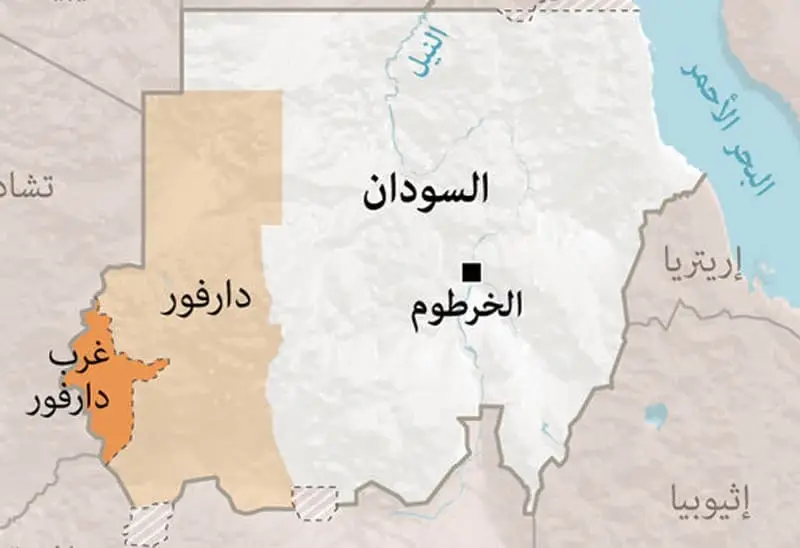
The Sudanese Rapid Support Forces (RSF) launched an attack on El Fasher after the expiry of an ultimatum it had issued to the Sudanese army and the joint forces allied with it to withdraw from the capital of North Darfur State on Thursday. According to Middle East Eye.
The RSF, which has been at war with the Sudanese Armed Forces since Shawwal 1444 AH (April 2023), has besieged the city of El Fasher since May, amid widespread fears that it will kill civilians on the basis of their ethnicity, as it has done in other parts of Darfur.
Two days ago, the RSF gave the army and its allies 48 hours to leave El Fasher. The ultimatum expired on Thursday, and local sources told Middle East Eye that the paramilitary group launched its "final assault" on the city, where Abdel Rahim Dagalo, brother and deputy of RSF leader Mohamed Hamdan Dagalo, is believed to be in command.
Since then, the RSF has been shelling the Abu Shouk camp for internally displaced persons, located on the northern outskirts of El Fasher, as well as neighbourhoods within the city. The army and its allied forces have opposed this.
An activist in the city said the RSF had rained artillery fire on an emergency hospital since Wednesday, before the ultimatum expired.
The activist, who asked not to be named for security reasons, said: "All hospitals in El Fasher have been attacked by drones and artillery shelling, and they are out of service."
Previously, the only functioning hospital in the southern part of the city, Al-Fasher Southern Hospital, was looted and forced to close after repeated attacks by the RSF. Other health facilities have also suffered severe damage in the fighting.
Local sources told Middle East Eye that at least four civilians were killed on Thursday, including Mohamed Ishaq, who died after a Reporters Without Borders mortar bomb fell on his home.
'Fear and terror'
Israa Mohamed Nour, an adviser at the El Fasher office of the Strategic Initiative for Women in the Horn of Africa (SIHA), said the expiry of the ultimatum had caused "fear and terror among the city's residents and the displaced in displacement camps."
Israa Mohamed Nour told Middle East Eye that on Thursday "there were violent clashes between the army, the joint forces and the RSF to the south and east of the city, and heavy artillery exchanges during the day."
She said the army carried out airstrikes on RSF positions, as it has done across Darfur. Reports indicated that airstrikes in Nyala, in South Darfur, caused civilian casualties.
She said that "the situation is under the control of the army and its allied forces," as the RSF had not been able to break the command lines of the army's Sixth Infantry Division. She added that the RSF had fired rockets at military positions and appeared to be preparing a larger attack.
"They usually use a two-pronged attack: a smaller attack first to exhaust the defences of the Sudanese Armed Forces and the joint forces, followed by a larger one," said Khulood Khair, Sudanese analyst and founder of the Confluence Advisory research centre.
Israa Mohamed Nour, who was communicating via internet connection through Starlink because no other form of communication was available, said that the RSF's artillery raids on the Abu Shouk camp had killed "a number of displaced people" and that "many traders were killed in attacks on the livestock market."
Trump's impact
The escalation of fighting in El Fasher is accompanied by violent clashes in northern Khartoum, also known as Bahri. An ongoing battle around the Jaili oil refinery north of the capital caused a fire.
The fire, fed by toxic gases and volatile petroleum materials, produced large black plumes across the area, according to footage circulating online.
Suleiman Baldo, a Sudanese conflict expert, said there was "fierce street fighting in northern Khartoum, where the Sudanese Armed Forces have recorded progress in a residential building, a street and a high-rise building each time."
Suleiman Baldo said that for the army, "the main problem is RSF sniper fire from well-protected positions, which has caused heavy losses to the advancing Sudanese Armed Forces."
Khulood Khair said the shared presence of Abdel Rahim Dagalo in Darfur and his brother, the RSF leader known as Hemedti, in Khartoum shows how seriously the paramilitary forces, and their enemy, are treating the current fighting.
"Both the Sudanese Armed Forces and the RSF are working effectively toward an unknown but imminent deadline brought by the new US administration. They are aware that Sudan will be at the top of the Trump administration's agenda in its attempt to divert attention from its ally Israel."
On 16 Rajab (16 January), the new US Secretary of State Marco Rubio downplayed accusations that Israel is committing genocide in Gaza, saying that "in an era in which the term genocide has been misappropriated," the RSF massacres in Sudan were "a real genocide."
Rubio went on to point to the UAE's "open" support for the RSF, which the United States and human rights groups have accused of committing genocide.
Khulood Khair said that both the Sudanese army and the RSF are looking to achieve breakthroughs on the battlefield now because they "know they will soon have to negotiate, and both want to do so from a position of strength."
Khulood Khair said: "The Sudanese Armed Forces appear set to take control of Khartoum and Al-Jazirah states, as their ally Egypt will help them secure that. The RSF will continue to contest El Fasher even as it tries to seize the whole of Khartoum city."
Egyptian Foreign Minister Abdelatty recently said in televised remarks that his country supports the Sudanese army.


