

Rohingya Trapped in the Middle of Escalating Conflict in Myanmar
The Muslim Rohingya minority, long persecuted in Buddhist-majority Myanmar, faces renewed threats of violence from both the military council and armed opposition groups as it becomes trapped in the middle of an escalating conflict, under mounting pressure from both sides.
Last November, the Arakan Army, an armed opposition group formed in 2009 to seek a confederal Arakan state for Buddhist Arakanese, broke an informal ceasefire by attacking the military council's outposts across Rakhine State, formerly known as Arakan.
Since then, the army has surrendered control of several towns in Rakhine, including Buthidaung, Minbya, Maungdaw, Kyauktaw, Mrauk-U and Thongpyo, along with the town of Paletwa in neighbouring Chin State.
The territorial gains made by the self-administration and a coalition of armed groups known as the Three Brotherhood Alliance have led hundreds of military council soldiers to surrender or flee to Thailand, Bangladesh and India. In response to these defections and desertions, and while trying to offset broader battlefield losses, the army has launched a conscription programme that is due to begin next month.
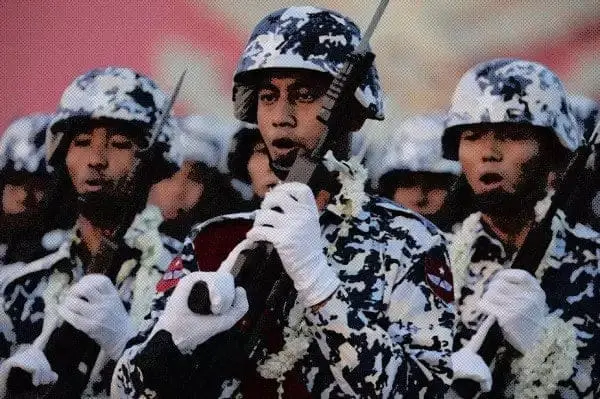
The mandatory scheme, based on the People's Military Service Law of 2010 enacted by a previous government, will see all men aged 18 to 35 and all women aged 18 to 27 face prison sentences of up to five years if they refuse to serve two years of military service.
The plan includes the Rohingya, despite the fact that they have been stripped of Myanmar citizenship for decades: more than 600,000 Rohingya remain confined to displacement camps and segregated villages under what rights groups have called an apartheid system.
A 25-year-old Rohingya man living in a camp in the town of Sittwe in Rakhine told The New Humanitarian: "I was contacted, but I did not agree because the military has never done anything positive for the Rohingya. They have oppressed us throughout history, and it has been a decade since we have been detained, as in this detention camp." He asked not to be named, fearing retaliation from the army.
Around 100 Rohingya are said to have been arrested by the military council in Rajab (February) for refusing conscription, which was already happening to some extent before the official launch of the new programme in mid-Ramadan (April).
With border monitoring to neighbouring countries and increased fighting in various parts of Myanmar, draft evasion has not been easy.
Media reports say that in some areas where the military council conducts intensive patrols, young people rarely venture out for fear of being spotted by potential recruiters. Others try to flee the area, if not the country.
Pressure from both sides, and rising ethnic tensions
But the pressure on and threats against the Rohingya do not come only from the military council. There have also been accusations of extortion and targeted killings of Rohingya by the self-administration's forces. The self-administration has denied accusations of killing Rohingya civilians, but reports that Rohingya and other ethnic groups are being forced to assist the armed opposition groups are widespread.
Self-administration fighters also often enter Rohingya villages, which are then attacked by the military council. One villager told Human Rights Watch in a February report: "We Rohingya are dying, stuck between the two sides." Another villager said: "If we talk to the army, the Arakan Army will suspect us, but if the army or the government finds any link between us and the Arakan Army, I am sure the army will kill the Rohingya."
The forced conscription of Rohingya men and women risks aggravating tensions and turning entire ethnic groups against one another, particularly as most Burmese oppose the State Administration Council led by the army, or military council, which has ruled the country since the 2021 coup.
Ethnic tensions, fuelled by government propaganda portraying the Rohingya as foreign immigrants, have erupted several times in Rakhine over the past decade, often leading to violence and property destruction targeting the Rohingya.
In a recent interview with Radio Free Asia, Nay San Lwin, a Rohingya activist, said the military council hopes that renewed tensions between the Rohingya and Arakanese, caused partly by conscription, will divert attention from their military losses.
Military officials have wasted no time compiling lists of residents of military service age in the displacement camps in the towns of Kyaukphyu, Sittwe, Mongdaw and Buthidaung. They have also been accused of abducting young men and arranging a two-week military training regime for Rohingya Muslims.
An elderly resident of the Sittwe camp told The New Humanitarian that the army said: "Our country is in danger, and we need civilian support to protect it." In order to influence the Rohingya, he said, the army offered a promise no other government has made: "We will guarantee your rights and recognise you as a citizen."
This may be propaganda, but on the other hand, the self-administration has taken no steps to indicate that it would recognise the Rohingya if it were to control all of Rakhine State, even if it managed to persuade some Rohingya to join its efforts. It has also been accused of killing newly conscripted Rohingya soldiers and imposing its own taxes in areas of Rakhine where it has a presence.
Some activists have accused the self-administration of deliberately placing its forces in civilian areas and using villages and villagers as human shields, an accusation that has also been levelled at the military council.
By the end of the first spring month (January), the Rohingya Arakan National Alliance, a group of Rohingya organisations and activists, was already warning that "both the regime and the self-administration have become a serious threat to the safety of lives and property of Rohingya Muslims."
No good options
Since 1982, the Rohingya have not been counted among the official 135 ethnic groups of Myanmar. Each subsequent government has accused them of being Bengali immigrants who crossed into Myanmar illegally during British colonial rule, depriving them of citizenship and effectively rendering them stateless in their own country.
The International Criminal Court accused the former Myanmar government, led by Aung San Suu Kyi, now imprisoned, of carrying out an ethnic cleansing campaign against the Rohingya in 2017. The military campaign drove around a million Rohingya into overcrowded refugee camps in Bangladesh, where fires and insecurity make life increasingly difficult.
Mohammed Salem, 28, living in a displacement camp in Sittwe, told The New Humanitarian that he holds little hope that any armed group could defeat the military council, and does not believe those groups would grant him proper citizenship rights even if they emerged victorious. "It is better to support the government, otherwise they will never give us our rights," he said, speaking via WhatsApp.
Others said they fear being exploited by both the military council and the self-administration.
Hok, 32, told The New Humanitarian: "If I support the self-administration, the military council will target me, and if I support the military council, the self-administration will target me. Where can I go?" He said: "Both sides keep warning us, and we have no place to hide or flee."
He added: "You can never be sure when a clash will happen around your village … We live here in constant fear of death. If there were any way to escape, no one would remain."
For now, mostly uneducated young men are choosing to join the military council largely because they see no other employment prospects or hopes for economic and geographic mobility. They join the army in the false hope that it will guarantee their freedom and allow them to support their families, but in reality, they are only forced to engage in tactics of violence and intimidation against their own people.
More educated young people support the self-administration because of their awareness of the historical repression by the current military council and previous Myanmar governments. Mohammed Salem said they also recognise the need to coexist with the Rakhine community and oppose division.
Now that the military council no longer holds a monopoly on control and power across the country, there is a fear that Myanmar may ultimately fragment into increasingly self-governing regions, rather than a centrally governed state.
With many armed groups, many of them united on ethnic and geographic lines, the Rohingya minority fears that their dreams of citizenship may slip away from them once again, or worse still, that they may face persecution anew.
The New Humanitarian


