

Review of "On the Shadow Tracks" by Claire Hammond: A Train into the Dark Heart of Myanmar
Claire Hammond began her career as a journalist covering financial markets in Hong Kong, before moving to Myanmar.
From 2014 to 2020, she worked independently for several media outlets and as digital editor of Frontier, an investigative magazine based in Yangon.
Her work covering the country's many civil conflicts and exposing corruption in the management of its natural resources led her to travel to parts of the country that are closed to tourists.
She discovered the map of the "Shadow Tracks," the railway lines built by the military council of Than Shwe between 1992 and 2011 using forced labour, under laws laid down by the British colonisers.
Although some of them were less than 20 years old, many of the tracks were already in poor condition. "The crumbling railway lines of the country began to catch my attention," she wrote of her first months in the country. "Within a year, I found myself setting out on a 3,000-mile train journey to the furthest reaches of Myanmar, to discover how the country was shaped by these tracks." For Hammond, these rarely used railway lines became a symbol of Myanmar's history of arbitrary and corrupt government, and provided her with a narrative framework for beginning to understand its history.
"In a country where rumours routinely acquire the force of facts, the railways were a rare historical text that could not easily be erased."
Under Than Shwe there were two phases of railway construction. "The first, in the 1990s, saw brutal work and widespread use of forced labour.
The second phase, which began in the early 2000s, after international scrutiny had largely ended the practice of forced labour, was marked by corruption." She meets families whose relatives were killed during the first phase (one tells her: "Forced labour was a common scenario for all the people of Myanmar"), and others whose fields and livelihoods were destroyed by floods caused by poor engineering. She was told: "Over the past hundred years, there was a flood only one foot high each year." "Last year, the floods reached six or seven feet." The embankments and foundations were poorly built, preventing the flow of water into the Irrawaddy Delta, and the poverty of local residents often meant that the sleepers and rubble were stolen.
The period covered by "On the Shadow Tracks" was one of the country's turbulent periods of change. In 2010, Aung San Suu Kyi was released from house arrest, and by 2015, when Hammond's journey began, she was in power.
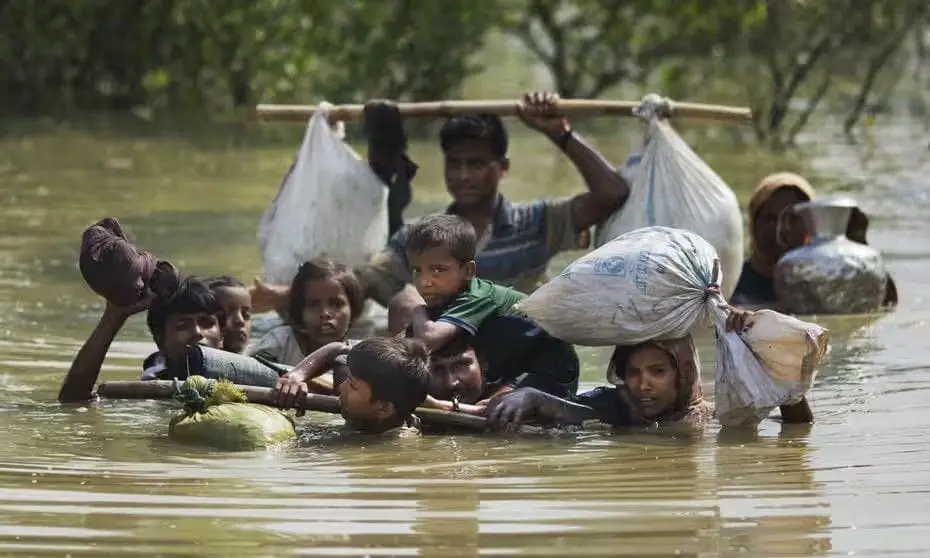
Only two-thirds of Myanmar's population of 55 million are ethnic Burmese, and Hammond meets many other ethnic groups: the Pa-O in Shan State, the Dawei on the Andaman Sea, the Karenni on the border with Thailand, and the Kachin in the border areas with China. Diverse peoples united in their disillusionment with the failures of Aung San Suu Kyi's government. In Rakhine, on the border with Bangladesh, a Burmese man corrects her when she asks about the brutal repression faced by the Rohingya people. Than Myint spat out: "The Rohingya is not their name."
"Until recent years, they called themselves Bengalis. There are Pakistan-backed terrorists in Bangladesh who use these Bengalis as their tools." The Muslim guide, Anwar, accompanies her on a tour of the refugee camps. "Can you imagine?" he tells her. "Before 2012, we all lived together."
He adds about Aung San Suu Kyi: "She said many good things in her speeches, and I thought she would reach a lasting solution for our Rohingya people. After she won the elections, she accepted a lot of money from foreign governments, so what did she do with it? She supported her father's army, bought more weapons, and killed her own people."
Hammond does not go deeply into the reasons why the army maintains such a grip on Myanmar, but she is content to give a voice to the people most affected by decades of brutality and mismanagement. It is an old story, of elites securing immunity from accountability at the expense of national prosperity, but Hammond's book gives the story a new context. She writes: "But the truth is that Than Shwe was not exceptional." He and his generals were corrupt and incompetent, and committed atrocities with shocking cruelty, but there was no ambiguity about what they did."
"On the Shadow Tracks" takes the reader into a part of the world that is often veiled. Hammond presents Myanmar as another conflict zone like Kashmir, Sudan and Palestine, where the roots of today's violence lie in the way Britain administered its empire, and then abandoned it hastily.
In one tourist resort, approved by the generals and frequented by Europeans, Hammond describes "the dreamy world of temple bells and floating monasteries." However, the reality her journey revealed is quite different: ongoing conflict and a struggle that is intensifying over control of the country's future.
Hammond concludes: "But with the international community abandoning them, the people across Myanmar continue to fight." "There is nothing easy about their struggle: Myanmar is a psychologically traumatised society, once again dominated by fear."
According to the United Nations, since the latest military coup in February 2021, Myanmar's rulers have spent one billion dollars on imports of weapons and equipment to be used against their own people.


