

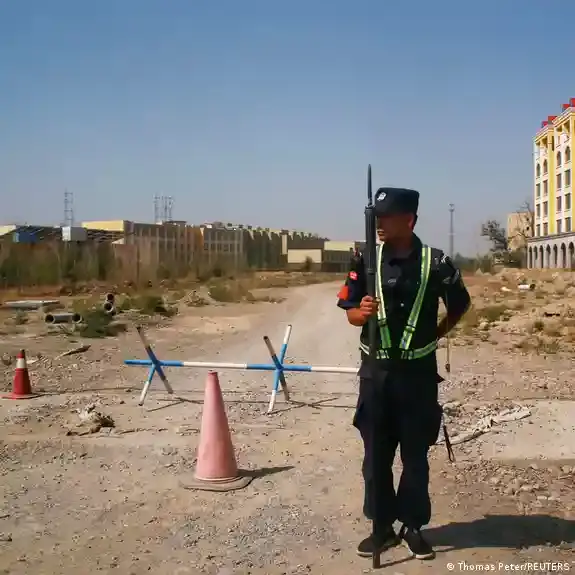
Report: China changing names of Uyghur villages
A report issued by Human Rights Watch states that Chinese authorities in the Xinjiang region are changing the names of villages inhabited by Uyghurs and other ethnic minorities to reflect the ideology of the ruling Chinese Communist Party. The study was conducted in cooperation with Uyghur Hope, an organisation headquartered in Norway.
The organisation compared the names of 25,000 villages in East Turkistan, according to lists it compiled from 1430 AH to 1445 AH (2009 to 2023 CE) in the National Bureau of Statistics. Among these villages, about 3,600 names were changed, the vast majority of them for reasons the organisation described as "ordinary." However, the report identified about 630 villages in the region whose names were changed to refer to Islam or Uyghur culture and history, according to Human Rights Watch.
Words such as "dutar," a traditional Uyghur musical instrument, or "mazar," meaning a shrine, have been replaced with names meaning "happiness," "unity" and "harmony." These terms are frequently found in documents of the ruling party.
Other terms that have been removed include "hoja," a title for a Sufi religious teacher, and "khanqah," a type of Sufi religious building, or terms such as "baxshi," meaning shaman.
The report also stated that historical references related to the Uyghurs prior to the founding of the People's Republic of China in 1368 AH (1949 CE) have likewise been removed.
Maya Wang, acting China director at Human Rights Watch, said: "Chinese authorities have changed the names of hundreds of villages in East Turkistan from names rich in meaning for Uyghurs to names that reflect government propaganda. These name changes appear to be part of the Chinese government's efforts to erase Uyghur cultural and religious expression."
The Associated Press said the Chinese Ministry of Foreign Affairs did not immediately respond to these allegations.
The East Turkistan region lies in western China on the border with Kazakhstan and is home to around 11 million Uyghurs and other ethnic minorities.
Abdulwali Ayub, founder of Uyghur Hope, said: "The governments concerned and the Office of the United Nations High Commissioner for Human Rights should intensify their efforts to hold the Chinese government accountable for its violations in the Uyghur region."
The "Strike Hard Campaign Against Violent Terrorism" was launched in 1435 AH (2014 CE) in the Uyghur Autonomous Region of East Turkistan. Since 1438 AH (2017 CE), the Chinese government has carried out a campaign of assimilation that has been accused of mass arbitrary detention, political indoctrination, forced labour and the separation of families.
According to estimates by human rights groups, more than one million Uyghurs and members of other ethnic minorities have been held in detention camps that the authorities call "vocational training centres."
In 1443 AH (2022 CE), a report issued by the Office of the United Nations High Commissioner for Human Rights concluded that the discriminatory detention practised by the Chinese government against Uyghurs in Xinjiang may constitute "crimes against humanity."
DW.


