

Questions Surround the Sudden Death of an Uyghur Woman
She died after being interrogated and collapsed in tears over the body of her husband, who had died
A 29-year-old Uyghur woman died of a suspected heart attack after collapsing in tears over the body of her imprisoned husband, and was then interrogated by police in Xinjiang Uyghur Autonomous Region (Eastern Turkestan) in northwest China, according to a source familiar with the situation who spoke to Radio Free Asia.
A police officer who confirmed the death of Nurimangul Hashim suggested that she may have died after being fatally struck by another police officer, rather than from a heart attack.
The accounts offer a glimpse into the suffering endured by the mostly Muslim Uyghurs, of whom some 1.8 million have reportedly been taken to detention camps set up by China across Xinjiang, under the pretext of countering religious extremism and terrorism.
Nurimangul's husband, Metursun Emin, 32, died in prison while serving a sentence for circumventing China's "Great Firewall" internet censorship and visiting foreign websites. The circumstances of his death were unclear.
When four officials brought Metursun's body, she collapsed in tears and accused them of being murderers, said the source, who comes from the same village of Zanirik in Kashgar Yengisar County in Kashgar Prefecture. The source insisted on anonymity for security reasons.
After Metursun was buried, police took Nurimangul to the county police station for interrogation, and shortly afterward she died of a heart attack, the source said.
Police confirm the deaths
A local police officer contacted by Radio Free Asia, which was a significant achievement in itself, confirmed the deaths of both Nurimangul and Metursun, but said Nurimangul lost consciousness during the interrogation and died before reaching the hospital.
He told Radio Free Asia: "I heard that she may have been beaten with a police baton or punched," which fueled speculation that police sought to cover up the true cause of her death by claiming she had suffered a heart attack.
He added: "Others told me that she threw herself over her husband's body and wept," saying that he was not there when the incident occurred.
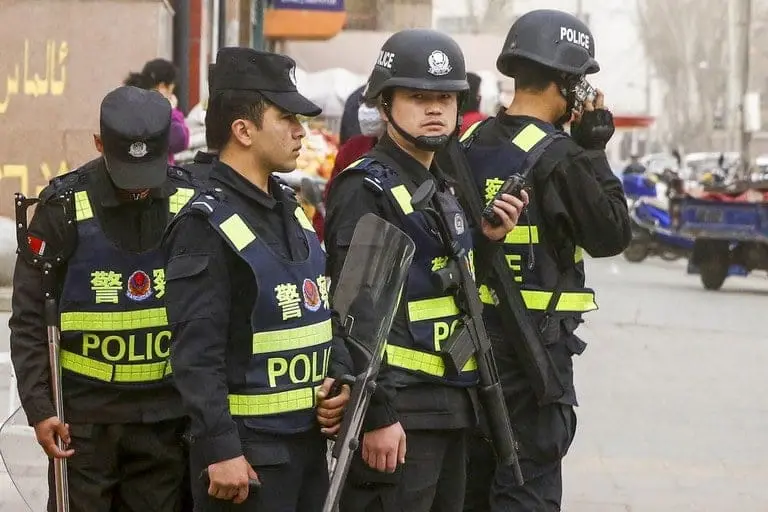
Armed police monitor a street in Kashgar in the northwestern Xinjiang Uyghur Autonomous Region of China, 25 Jumada al-Akhirah 1438 AH (March 24, 2017)
Regional police told Radio Free Asia that Metursun, the husband, was one of six Uyghur prisoners from Zanirik village whose bodies were released to family members after they died in prison.
Authorities detained some 120 people from the Tewakchi community in the village when mass arrests of Uyghurs and members of other Muslim groups in Xinjiang began in 1439 AH (2017 CE).
Radio Free Asia had earlier reported the release of another prisoner, Mahmudjan Muqeddem, 46, the only villager released alive from prison. Authorities said he served a seven-year prison sentence for advising friends not to drink alcohol, which is prohibited under Islam.
A second police officer familiar with the situation gave the names of the four other residents who died while in prison: Yusup Musa, Memet Emin, Memet Abdulla, and Hashim Qurban, the father of Nurimangul Hashim.
A third police officer working in Zanirik confirmed the names of the men, adding Tursun Abdukerim to the list.
The officer said that he and others were "doing ideological work with the families of the deceased to help calm them" by visiting them daily.
However, Uyghurs understand that the main purpose of this monitoring by local law enforcement officers is to prevent rumors about the deaths from spreading within their communities.
Whenever a body is released from prison, authorities remind residents of notices advising them not to accept calls from outside the area and to avoid spreading gossip, said Uyghurs from Zanirik who declined to be identified.
The Hashim family
A police officer also confirmed that Nurimangul Hashim's father had been detained on suspicion of "religious extremism."
The officer said authorities often detain elderly residents of Tewakchi village for listening to religious recitations at events such as gatherings, weddings and funerals.
He added that they had arrested young Uyghurs and sentenced them over "problems" related to their mobile phones.
The officer said Nurimangul's mother, Gulkiz Helihem, refused to accept money from the government granted to low-income families, saying it was haram.
"She also refused to distribute salt to farmers, for the same reason," he said. "Their family held those beliefs, and [Nurimangul Hashim] was a daughter of such a family."
He said Nurimangul's father died in prison three years ago, while her mother remains in prison.
Radio Free Asia


