

Possible Repercussions of the Defence Agreement Between Somalia and Egypt
On Sunday, 3 November of this year, the Halane Central Military Base in Mogadishu, which hosts officials from the African Union, the United Nations and other international agencies, was attacked with mortar shells.
At least two people were killed and many of those present were injured.
Al-Shabaab, the jihadist group seeking to overthrow the Somali government, quickly announced its responsibility for the attack, in a clear signal that its campaign to topple the government and take control of Somalia across the country is continuing.
The group still controls vast areas of central and southern parts of the country, despite some progress made by the federal government's military campaign against al-Shabaab in recent years, under which it has been unable to impose its control.
Given the internal fighting within the anti-al-Shabaab coalition, which includes federal, state and international partners, this area may soon expand.
Possible Repercussions of the Somalia-Egypt Agreement
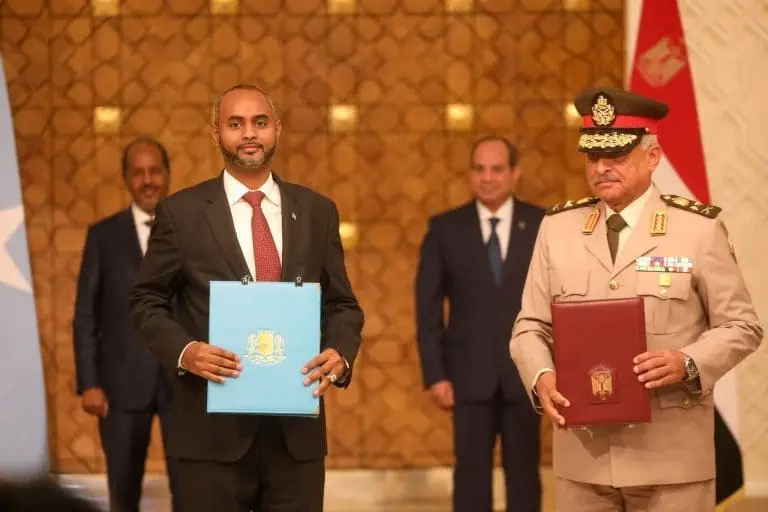
The new defence agreement between Mogadishu and Cairo may threaten efforts to adopt a cohesive political and military response, by increasing tensions in relations with Ethiopia.
These tensions are also likely to undermine the future of the African Union mission in the country, of which Ethiopia is the main contributor.
In addition, the agreement could incite the Somali federal government against its states, thereby expanding the power vacuum that al-Shabaab and other armed groups in the country are preparing to exploit.
The Security Quagmire in Somalia
Since 2007, African Union missions have led combat operations against al-Shabaab on the ground, in cooperation with US and Turkish air support, to help hold on to the territories that fall under its control.
But at the end of this year, the mandate of the African Union mission will expire.
Diplomats are working around the clock to ensure that a new African Union mission takes up its duties in 2025, but issues related to funding and personnel are casting a shadow over the security landscape in Somalia in the foreseeable future.
Ethiopia forms the backbone of military efforts against al-Shabaab.
Primarily through the ATMIS system, and secondarily through bilateral agreements with the Somali federal government, Ethiopia deploys between 8,000 and 10,000 soldiers in central and southern Somalia.
These efforts are also of great importance to Ethiopia in protecting its borders from al-Shabaab raids.
But now, there are concerns that the defence agreement between Egypt and Somalia could damage the fragile political and military balance by openly challenging Addis Ababa.
Relations between Egypt and Somalia and Ethiopia have become strained in recent years, leading to a rapprochement in security cooperation between them.
For Egypt, the rivalry between it and Addis Ababa stems from the crisis of the Great Ethiopian Renaissance Dam on the Nile River, which threatens Egypt's water security.
For Mogadishu, Ethiopia's signing of a memorandum of understanding with the authorities of the separatist region of Somaliland is seen as undermining Somalia's sovereignty.
In response, Somalia publicly called on the Ethiopian army to leave the country.
To fill this vacuum and exert more pressure on their common adversary, Ethiopia, the defence agreement calls on Egypt to deploy some 10,000 soldiers in Somalia — half through the upcoming African Union mission, and the other half bilaterally.
However, Cairo is unlikely to deploy such a large number of troops.
It has not sent troops to foreign soil for decades, has little knowledge of the Somali context, and is facing a deep financial crisis.
Besides this, the African Union will not endorse a plan that blatantly antagonises Addis Ababa.
Nevertheless, Egypt has sent two shipments of weapons to Somalia, which has raised concern in neighbouring Ethiopia.
The Consequences of Brinkmanship
The deterioration of relations between Egypt, Somalia and Ethiopia could have serious consequences for the war against al-Shabaab.
Somali attempts to marginalise Ethiopian forces and replace them with Egyptian troops are obstructing planning for the new African peacekeeping force's mandate.
This is because Addis Ababa remains the main contributor of military forces to the current mission, with no realistic alternative, and Ethiopia has deep security interests in Somalia that it does not want to abandon.
If the next African Union mission does not materialise, the resulting security vacuum could create conditions favourable for al-Shabaab to seize key areas of the country and destabilise the entire region.
Regarding political stability in Somalia, the fraught state-building process in Somalia is already suffering from division between the federal government and state governments.
Now, tensions between Egypt and Ethiopia are leading to further division in the country.
In June, senior officials from Jubaland and South West State opposed the federal government's call for Ethiopian forces to withdraw, because this would have left parts of their states unprotected.
South West State, where there is a strong Ethiopian military presence and influence, also criticised the agreement with Egypt.
These frictions among Somalis may be the final blow to the country's state-building process, further fragmenting political and military action, which al-Shabaab will seek to exploit.
The risk of this could be compounded if Ethiopian or Egyptian forces, once deployed, support opposition Somali clans.
Either scenario — obstructing the African Union mission or dividing the Somali state — could pave the way for a new expansion of al-Shabaab, with overwhelming consequences.
As a result of that expansion, Ethiopia would be drawn into a deeper conflict with the armed group along its borders, which would destabilise its fragile balance.
It would also endanger the lives of European military personnel stationed in Somalia.
Kenya, a key Western ally and investment partner of Europe, may suffer indirect effects, as al-Shabaab already has a strong foothold in the north-east of the country.
Finally, increased al-Shabaab strength would encourage other armed groups and arms-smuggling networks, creating a state of chaos that pirate groups could exploit, as has recently happened during Houthi attacks in the Red Sea.
Such instability would pose another serious threat to sea lanes in the western Indian Ocean, which are vital for Europe.
A Possible European Response
Corrado Coco, a visiting fellow at the European Council on Foreign Relations, says: "Stepping away from Somalia now would undermine years of EU financial and security commitments. The EU and its member states have poured billions into Somalia's security over the years."
"The EU has deployed two military political missions to assist with security training, led an anti-piracy operation, and was the main financial contributor to the African Union missions."
"Minimal progress has exhausted European donors, but stepping away now would undermine years of financial and security commitments."
"Given its investments and presence in Somalia, the EU is well placed to help curb tensions by initiating mediation efforts."
"Italy could lead the bloc in this effort, given its influential role in the country, stemming from historical relations and major contributions to EU missions."
"The United Kingdom leads Somali diplomatic efforts at the United Nations and actively supports the Somali security sector, making it an important partner for the EU and Italy."
"The EU, Italy and the United Kingdom together will need to secure Washington's support for this initiative, because the United States remains a decisive player in Somalia."
"While the prospect of immediate mediation between Cairo and Addis Ababa is very slim given failed attempts over the Nile dam crisis, the EU and its partners can work with influential allies, most notably Turkey and the United Arab Emirates, which seek to deepen their relations and their own influence through security initiatives in Somalia."
"Ankara and Abu Dhabi not only run large training and financial support programmes for Somali security bodies, but also enjoy close relations with the Somali federal government and state governments, respectively."
They also have influence over Cairo and Addis Ababa through major investments and cooperation initiatives, and they do not support the defence agreement.
"These factors may encourage Europeans to coordinate better with Turkey and the United Arab Emirates, to press Egypt and Ethiopia to avoid tearing Somalia apart."
"At the same time, the EU and its partners should throw their weight behind the ongoing Turkish mediation between Somalia and Ethiopia, which recently began in Ankara to help ease tensions between the two countries."
"The EU, together with Italy and the United Kingdom, could also look to foster greater coordination and reconciliation between the EU's various security initiatives and those of the United Arab Emirates and Turkey."
"This is essential to enhance the effectiveness of international security efforts and to reduce the space available to regional players, or to Somali actors themselves, to exploit international divisions for their own benefit."
"The immediate focus of this approach should be to establish coordination frameworks between European diplomatic and military representatives and their Turkish and Emirati counterparts."
"This could include holding regular meetings in Mogadishu and in the capitals concerned to build common ground between Europeans and their partners, cooperating on political and military initiatives in Somalia, and pooling efforts to help fund the upcoming African Union mission."
"The coordination frameworks could aim to gradually align messaging with other local and regional actors, especially Egypt and Ethiopia, and possibly establish joint coordination structures with the Somali army."
"Finally, the EU has enormous leverage it can rely on; the funding it provides to the Somali security apparatus is the only thing that enables it to withstand al-Shabaab."
"No party in the Horn of Africa or Middle East region wants to see an Afghanistan scenario repeat itself in Somalia, so the EU's threat to withdraw support may be the only thing that could compel all capitals to mediate."
"Without swift action, al-Shabaab, together with the Islamic State's Somalia branch and arms smugglers, may exploit domestic and international divisions, exposing the country to a major security failure in a state of vital importance to the stability of the Horn of Africa and the Red Sea region."


