

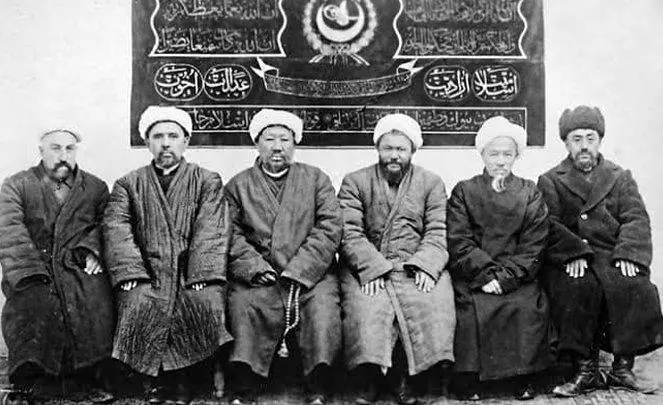
On 12 November 1933, corresponding to 24 Rajab 1352 AH, the historic city of Kashgar, in the heart of East Turkestan, witnessed a pivotal event in the history of the Uyghurs and the Muslim Turkic peoples, when the Islamic Republic of East Turkestan was proclaimed. The move was an attempt to establish an independent state that would preserve religion, identity and culture, and put an end to decades of conflict and political turmoil that the region had experienced.
The newborn republic was not merely a new authority declared amid conflict. It embodied an aspiration to free itself from external domination and to establish a political system based on the Islamic and Turkic identity of the region's people, a region known today to China as the Xinjiang Uyghur Autonomous Region.
Although the republic survived only a few months, its proclamation has remained present in the historical memory of the Uyghurs, and 12 November has become an occasion on which many of them recall the experience of independence and the hopes and sacrifices associated with it.
The road to the proclamation: uprisings against the ruling order
The proclamation was not a sudden event. It was the outcome of years of unrest and uprisings in the region, amid the weakness of the central Chinese authority and the struggle of local military leaders for influence.
In the early 1930s, several areas of East Turkestan witnessed uprisings in which groups of Uyghurs and other Muslims took part, in protest against the policies of local authorities and the political, economic and social conditions.
Khotan was one of the most prominent centres of these movements. In 1933 a movement led by Muhammad Amin Bughra and his brothers emerged there, seeking to establish an independent government based on Islamic and Turkic identity.
Contacts between the leaders of the various movements soon extended to Kashgar, where the scholar and reformer Sabit Damolla Abdulbaqi came to the fore, playing a central role in preparing the proclamation of the republic and formulating its political project.
In September 1933, the East Turkestan Independence Society was founded in Kashgar, one of the frameworks that paved the way for the proclamation of the republic a few weeks later.
12 November 1933: the day the republic was proclaimed in Kashgar
On 12 November 1933, thousands of residents and fighters gathered in Kashgar to proclaim the new republic, which bore the name "the Turkic Islamic Republic of East Turkestan", also known as the First Islamic Republic of East Turkestan.
Historical sources state that tens of thousands took part in the proclamation celebrations, among them thousands of Uyghur fighters and other members of the Turkic peoples.
Khoja Niyaz Hajji was chosen as president of the republic, while Sabit Damolla Abdulbaqi assumed the premiership of the government, although Khoja Niyaz was not present at the proclamation ceremony, and his relationship with the new political project was complicated by his alliances and contacts with regional authorities.
On that occasion the institutions and symbols of the republic were announced, and a constitution of thirty articles was drawn up, which affirmed the Islamic identity of the state and organised its powers.
The leaders also sought to combine Islamic reference with reform in education, administration and the economy, within a movement also influenced by the reformist ideas that spread among Muslims and the Turkic peoples at that time.
The blue flag: a symbol that outlasted the state
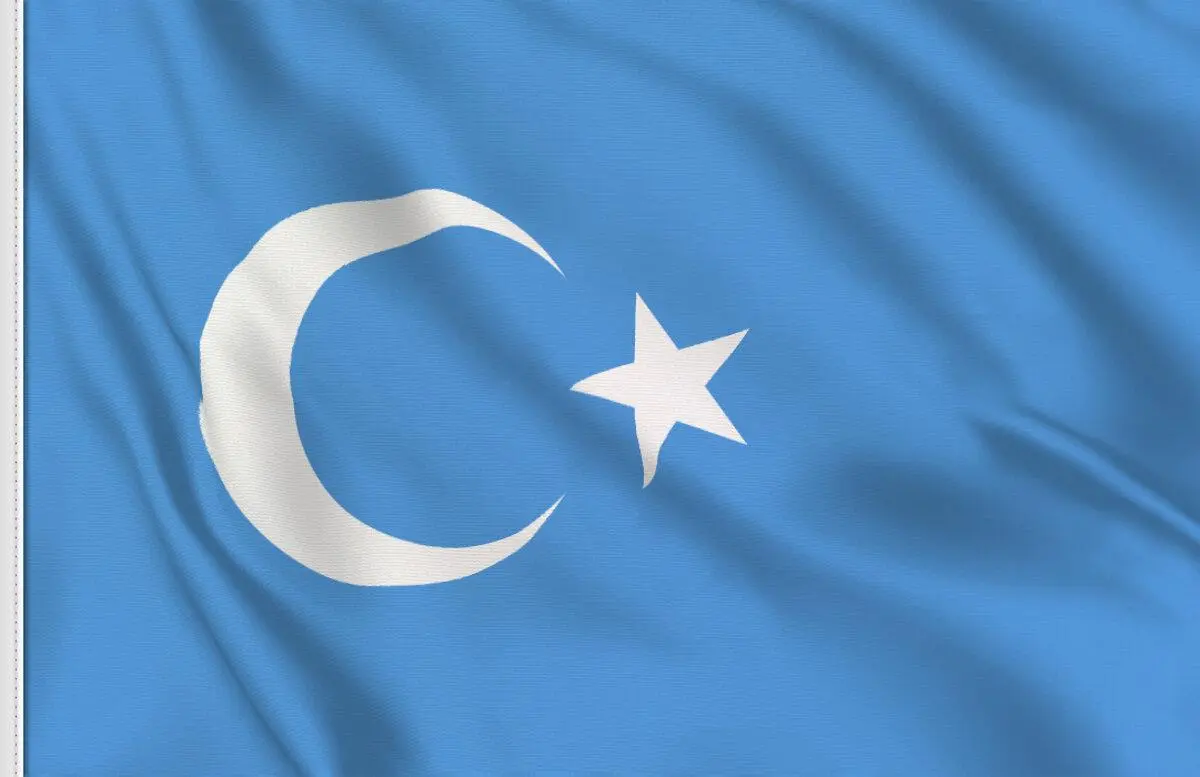
Among the most prominent symbols associated with the proclamation of the republic is its blue flag, bearing a white crescent and star.
This flag acquired a special place in the national memory of the Uyghurs, as it became associated with the attempt at independence and with the affirmation of the region's historical and religious identity.
The symbol did not disappear with the end of the republic. Its presence continued among Uyghur movements in exile, and it became an expression of adherence to identity and political memory.
The importance of this symbol lies in the fact that it is no longer merely a flag associated with a short-lived state. For many Uyghurs it has become a witness to a historical period in which their forebears tried to establish an independent political entity.
Why did the republic fall after a few months?
Despite the momentum that accompanied its proclamation, the Islamic Republic of East Turkestan faced major military and political challenges from the outset.
The region was the stage of a complex struggle between the forces of Chinese regional rulers, Chinese-speaking Muslim Hui military formations, multiple local movements, and the influence of Soviet interests on the balance of power.
In early 1934, the republic's forces were attacked militarily, especially by forces linked to the military commander Ma Zhongying, which led to the collapse of its positions in Kashgar and other areas.
Some of its leaders were forced to flee, and the experiment of independent rule came to an end during 1934, before the republic could build stable institutions or obtain wide international recognition.
Historical studies indicate that the fall of the republic was not the result of a single factor, but of the weakness of its resources, the divergence of its leaders' positions, the military superiority of its opponents, and regional interventions that made its survival extremely difficult.
Nevertheless, the 1933 experience was not the last attempt to establish an independent entity in the region. On 12 November 1944, another republic named East Turkestan was proclaimed in the Ili area in the north-west of the province, in different political circumstances.
Where "the Second East Turkestan Republic was established after the destruction of the first, following the outbreak of a revolt in three northern provinces (Ili, Tarbagatai, Altai), and the fighters soon gained control of the three regions and seized Yining. Then the Islamic scholar Elihan Tore, or Ali Khan Shakir Jan, announced himself as head of the government of Islamic Turkestan, and in the proclamation statement said:
"Praise be to God, and prayers and peace be upon the Messenger of God. By God's grace the heroes have overthrown the unjust government. But even if we free ourselves, there are brothers of ours in Islam who remain under the brutal bloody rule and the black policy of the unjust Chinese government! God is with us, and we will not lay down our arms until we free all Muslims from the tyranny of the bloody government, and until we uproot the roots of the oppressive government from the lands of East Turkestan, which we inherited as our original homeland from our fathers and grandfathers."
Thus the history itself was linked to two outstanding milestones in the history of the Uyghur political movement, despite the difference in the nature of the two republics and their historical contexts.
From the 1933 republic to the reality of the Uyghurs today
Ninety-three years after the proclamation of the first republic, the question of the religious and cultural identity of the Uyghurs remains strongly present in international debate on the situation of Muslims in China.
Since 2016, the policies of the Chinese authorities in Xinjiang have drawn wide human rights criticism, over arbitrary detention, mass surveillance, and restrictions on religious and cultural practices.
On 27 August 2026, Human Rights Watch stated that the severe repression faced by the Uyghurs and other Turkic-speaking Muslims continues, despite changes in some of the methods used to carry it out.
The organisation said the abuses include the continued arbitrary imprisonment, extensive surveillance, restrictions on travel and communication, policies affecting cultural and religious identity, and pressure on Uyghurs living outside China.
It noted that hundreds of thousands remain in prisons, based on the official data available, while no tangible progress has been made in addressing the abuses previously documented by the United Nations.
For its part, the Chinese government rejects accusations of systematic repression, and says its policies in Xinjiang aim to combat extremism and terrorism, promote development and stability, and protect rights in accordance with Chinese law.
International human rights organisations, however, maintain that security measures do not justify arbitrary detention or broad restrictions on fundamental freedoms, and they call for the fate of detainees to be disclosed and for freedom of religion, culture and movement to be guaranteed.
This reality gives the memory of the 1933 republic particular significance for the Uyghurs, as many of them recall the experience of their forebears in defending their identity, at a time when international demands continue for the protection of their religious, cultural and human rights.
A memory that does not fade with the fall of states
The Islamic Republic of East Turkestan may have lived for little more than a year, and it failed to consolidate its political or military presence, but it left a legacy that outlasted its short life.
In Kashgar, the proclamation of 12 November was not merely a response to the conflicts of that era, but an attempt to shape a different future, in which the aspirations of a people to govern themselves and to preserve their religion, language and culture would be embodied.
The republic ended, the forces that governed the region changed, and generations succeeded one another, but its memory has remained part of the historical narrative of the Uyghurs, whose cause remains present in international human rights forums.
States may fall, and borders and systems may change, but the memory of peoples is not erased merely by the collapse of governing institutions. As long as a person preserves his history, language, religion and his forebears' heritage, his identity remains alive in the consciousness of generations.
Between Kashgar in 1933 and the reality of the Uyghurs in 2026 stretches the story of a people who still face questions of freedom, identity and the future, while the memory of the Islamic Republic of East Turkestan remains a witness to an important chapter of their modern history.
Sources of the article
- Encyclopaedia Iranica: History of Khotan in the Islamic period, for the context of the Khotan uprising and the proclamation and fall of the republic.
- Warlords and Muslims in Chinese Central Asia by the historian Andrew Forbes, an academic reference for the events of 1933–1934.
- History of the First East Turkestan Republic, for the account of the proclamation of the republic, its symbols and the formation of its government.
- Human Rights Watch, 27 August 2026, for documentation of the contemporary human rights situation of the Uyghurs.


