


Wasl News | Opinion | Netanyahu and the Jewish State: What If Muslims Declared an Islamic State?
When Netanyahu insists on describing the occupied Palestinian territories (Israel) as "the nation-state of the Jewish people," Muslims should not pass over this discourse lightly; the matter is bigger than merely the name of a state or a political slogan. It clearly reveals a whole system of standards that are applied differently depending on the identity of the one speaking in its name.
Here a Muslim has the right to ask the question that troubles many:
What if a Muslim leader came out and said clearly: this is an Islamic state, this is Islamic land, this is our Islamic identity, and we have the right to govern it according to what we believe and to protect our faith and civilisation within it?
Would the speech be met with the same applause?
Would it be seen as a natural expression of identity?
Or would the dictionary of accusations be opened immediately: "extremism," "fundamentalism," "radicalism," "terrorism," "threat," and "rejection of the other"?
Here, precisely, the mask falls.
When Jewish identity is a "right" and Islam is "fundamentalism"
The problem is not that Jews take pride in their religious and historical identity, [as claimed].
The problem is that Muslims are asked to give up their right to their identity, while at the same time being asked to treat the Jewish identity of the state as something natural that may not be objected to.
If a people has the right to say: this is my identity, this is my religion, this is my history, why are Muslims asked to feel embarrassed when they say the same thing?
Why does pride in Jewish identity become a legitimate nationalism, while pride in Islamic identity turns into a ready-made accusation?
Why is it permitted to invoke religion and history, and their distortion, and memory when this serves the Zionist narrative, yet Muslims are asked to bury their religious and civilisational memory when it comes to Palestine, Jerusalem and al-Aqsa?
This is an exposed double standard.
If Muslims said: we want an Islamic state
This is land in which we have history, civilisation and sanctities; this is our Islamic identity, and we have the right for our state to express our faith and values, and for its legislation to derive from our Sharia.
What would have happened?
Many would have hurried to portray the matter as a project to return to the "Middle Ages," the word "Sharia" would have been turned into a scarecrow, and merely speaking of an Islamic state would have become alleged proof of rejecting civilisation and pluralism, and of terrorism and extremism that must be eradicated.
But when it comes to Judaism, the language changes.
- Religion becomes "identity."
- Belief becomes "heritage."
- Religious affiliation becomes "a national right."
- And a distorted religious narrative becomes "historical memory."
And here a Muslim does not need much philosophy to grasp the extent of the hypocrisy.
Palestine is not a land without memory
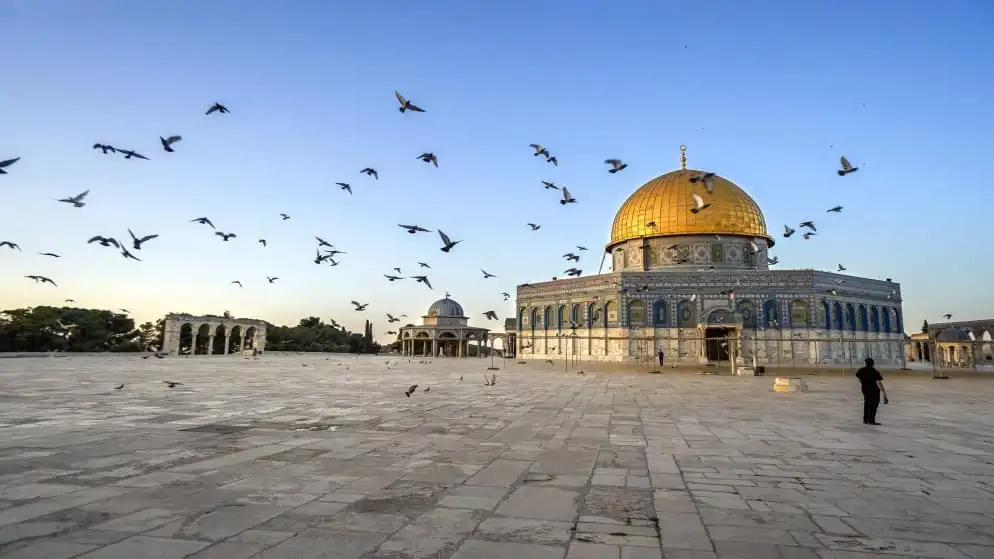
In the Islamic consciousness, Palestine is not a name on a map.
It is the land of al-Masjid al-Aqsa, the first of the two qiblas, the third of the mosques to which journeys are undertaken, and the land linked to the Isra and Mi'raj.
Jerusalem is not an ordinary city in the conscience of the Muslim, and al-Masjid al-Aqsa is not a building that can be reduced to a passing dispute; it is part of the faith of a nation, of its memory, and of its history.
For this reason, attempting to uproot Palestine from Islamic memory is not merely a change in maps; it is an attempt to uproot a meaning deeply rooted in the conscience of Muslims.
But the problem is that Muslims are expected to treat all of this as if it were mere "religious nostalgia" of no value, while religious and historical memory is invoked with full force when it comes to Jews.
What justice is this?
The Constitution of Medina (Sahifat al-Madina) is not a project of exclusion
Contemporary readings of Islamic political thought face a sharp wave of reduction and distortion, in which ready-made judgments and stereotypes are imposed without fair consideration of the legislative foundations or historical facts.
Among the most prominent evidence that dismantles these narratives is the experience of Medina al-Munawwara; it is naive to reduce the Islamic conception of the state to the image crafted by the enemies of Islam and then to put Islam on trial on that basis.
The Prophet, peace be upon him, established in Medina a political Islamic community that included multiple groups, and the Constitution of Medina (Sahifat al-Madina) organised the relationship between the components of society within a framework of covenant, responsibility and rights.
In the Islamic conception, a human being does not lose dignity merely because of a difference in religion; justice is a principle, and the preservation of life, property, honour and religion are among the objectives of the Sharia.
And Islamic history, with all its successes, failures and human experiences, cannot be reduced to the caricature that makes every presence of Islam in the public sphere synonymous with persecution and exclusion.
As for demanding that Muslims abandon their identity in order to prove they are "tolerant," while others are granted the right to build their political identity on a religious and national basis, this is not tolerance; it is intellectual blackmail.
Who holds the right to invoke history? The most troubling question is: who said history belongs to one party?
If a group has the right to invoke thousands of years of religious memory to prove its attachment to the land, then a Palestinian has the right to invoke successive generations who lived on his land.
And if a Jew has the right to speak of Jerusalem as part of his faith, then a Muslim has the right to speak of occupied Jerusalem and al-Aqsa as part of his faith.
And if religious memory is deemed valid when it serves a particular narrative, it is not permissible to turn Islamic memory into something its adherents must be ashamed of.
No one can demand that an entire nation forget its religion so that Jews may feel at ease.
Where have all the slogans gone?
Years of political and media discourse have made the world hear words such as "tolerance," "pluralism," "coexistence," and "human rights."
But when it comes to Palestine, these words seem to lose much of their lustre.
Then the Palestinian is expected to forget, the Muslim to remain silent, and the owner of the land to justify his existence, while everyone is asked to respect the Jewish narrative as if it were the only possible truth.
The question here must be direct:
Are principles truly principles, or do they become beautiful slogans only when they serve the powerful?
If identity is a right, it is a right for everyone; if history matters, it matters for everyone; if sanctities deserve respect, then al-Aqsa deserves respect; and if a human being deserves dignity, then the Palestinian deserves it. Right cannot be a privilege granted to Jews and denied to Muslims.
We do not need permission to take pride in Islam
Western discourse has succeeded in persuading many Muslims that merely speaking of Islam as a source of identity, legislation and civilisation is something one should apologise for.
This is one of the most dangerous intellectual defeats. A Muslim does not need anyone's permission to love his religion, does not need anyone's testimony to take pride in his civilisation, and does not need anyone's approval to regard Jerusalem and al-Aqsa as part of his faith and memory.
The truth that political discourse cannot bury
Names can be changed, slogans can be changed, borders can be drawn, laws can be enacted, and media can fall silent; but the memory of an entire nation cannot easily be erased.
Palestine remains in the conscience of Muslims, Jerusalem remains, al-Aqsa remains, and the doctrinal and historical attachment to this land cannot be wiped out by a political decision or a media discourse.
The most dangerous aspect of double standards is not only that they reveal political bias; they also try to convince the wronged party that the problem lies in its attachment to its identity.
But the problem is not that the Muslim knows who he is. The problem is that he is asked to forget who he is in order to be accepted in a world that raises no objection to the identities of others.
Here the real battle begins: the battle of consciousness, the battle of memory, and the battle against applying double standards.
Palestine is not a page that can be erased, Jerusalem is not a passing detail, and al-Masjid al-Aqsa is not a cause Muslims can abandon so that Jews and the hypocritical world might be pleased with them.
Whoever demands that we respect the identity of others should first learn to respect ours. Whoever raises the banner of justice should apply it to everyone. To make identity a right for others and an accusation against us is not justice; it is the very essence of hypocrisy and double standards.
Conclusion and enduring truth
History confirms that states built on racial discrimination and doctrinal exclusion of the people of the land cannot endure, however great their military strength or the scale of international support they receive.
The "Jewish state" that Netanyahu boasts of is not a sign of strength; it is an expression of an existential crisis and a constant fear of the historical and doctrinal right of Muslims and the Islamic nation. Palestine and Jerusalem will remain an integral part of the faith and identity of the nation, and no international recognition or legislation will change this truth.
The only real alternative to Zionist tyranny is the return of rights to their people, and the establishment of a system based on Islamic Sharia as this blessed land knew it under Islamic civilisation, where rights are preserved and the injustices of usurpers are redressed.
This is our faith, these are our sanctities, this is our memory, and we will not abandon them because someone has decided that his identity matters more than ours.
Dear followers, to receive all the latest, follow us on Telegram


