

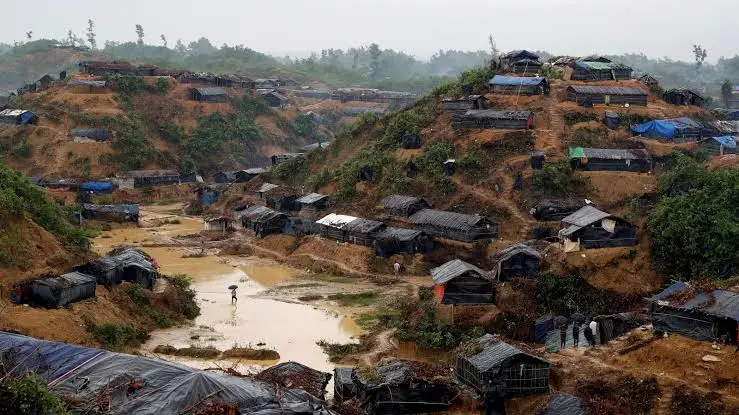
Myanmar: Rohingya in Rakhine caught in the crossfire as fighting between the military council and rebels escalates
Reports from the United Nations and aid organisations indicate that as violence escalates between a powerful ethnic army and the military council ruling the country in western Rakhine State, the Muslim Rohingya community in Myanmar is once again at risk of attacks and displacement.
Since mid-Dhu al-Qadah (May), it is believed that tens of thousands of Rohingya have fled to neighbouring Bangladesh in search of safety, which does not wish to receive more refugees. Many Rohingya who remain in Rakhine are in urgent need of humanitarian relief.
Following the battle in which the ethnic army was tasked with selecting members of the Rohingya community, the Arakan Army announced that it had seized the town of Buthidaung earlier in May. AA denies these accusations.
With the military council in Myanmar possibly attempting to hold Maungdaw, a border town with a large Rohingya population that is under attack from the Arakan Army, there is a risk of further severe massacre.
A spokesperson for the UN High Commissioner for Human Rights said: "We see clear and present risks of a dangerous expansion of violence as the battle begins for the neighbouring town of Mongdaw - where the army holds settlement sites and where a large Rohingya community lives."
The Rohingya have faced decades of persecution, and after a crackdown by the army in 1438 AH (2017 CE), nearly one million people fled to Bangladesh, where many now live in crowded refugee camps.
Mohammad Taher, a Rohingya refugee in Bangladesh, said he had recently spoken to a friend in Maungdaw, who described a community living in fear.
Mohammad said: "Many want to flee Rakhine, but Bangladesh is not opening its doors to the Rohingya." Recent fighting forced some 45,000 Rohingya to flee to an area along the Naf River on the border, according to UN estimates. A senior Bangladesh Border Guard official told Reuters last week: "None of the Rohingya will be allowed to enter Bangladesh."
Myanmar has been in turmoil since the military coup in 1442 AH (2021 CE), which sparked a popular armed resistance fighting the military council alongside long-standing ethnic minority rebel groups.
Fighting in Rakhine erupted last November when the ceasefire between the Arakan Army and the military council collapsed, leading to a series of battlefield successes for the rebels.
Morgan Michaels of the International Institute for Strategic Studies said in a report issued in Dhu al-Qadah (May): "Faced with mounting losses in Rakhine, the regime resorted to arming members of the Rohingya ethnic minority to confront the advance of the Arakan Army." "The Arakan Army responded with inflammatory rhetoric and violence directed against the Rohingya."
The United Nations Office for the Coordination of Humanitarian Affairs (OCHA) said in its latest report last week that, amid renewed conflict, Rohingya civilians "are increasingly caught in the middle."
The UN Office of the High Commissioner estimates that more than 350,000 people have been displaced across Rakhine after years of conflict, and many cannot access basic services.
The medical charity Médecins Sans Frontières said: "We are witnessing an almost complete absence of humanitarian assistance for the communities that depend on it," adding that hospitals in Buthidaung and Maungdaw are closed.
The AA, which aims to form a self-governing state, warned that more battles are coming, and called on civilians in Buthidaung, Maungdaw and Thandwe to dig bomb shelters or evacuate to safer areas.
The group denied that it had targeted the Rohingya, and also requested international aid for some 200,000 internally displaced people whom it says are sheltering in the areas under its control in Buthidaung and Maungdaw.
Scot Marciel, former US ambassador to Myanmar, said: "The situation is very precarious and dangerous."
"In some ways, this is an early test of whether post-military-rule Rakhine State can successfully enjoy significant self-governance."
Firstpost.


