

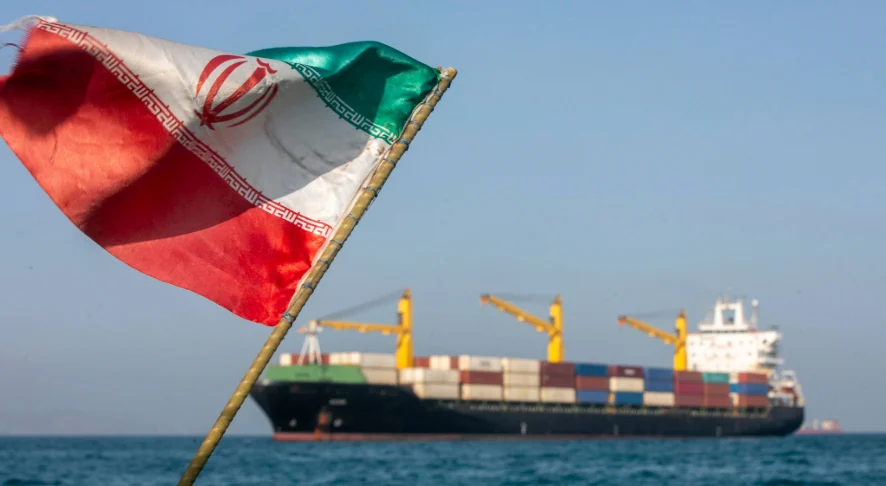
A recent study by the International Institute for Strategic Studies (IISS) reveals a notable shift in the methods the Islamic Revolutionary Guard Corps (IRGC) uses to target commercial vessels transiting the Strait of Hormuz, as it increasingly relies on one-way attack drones, following US strikes that targeted its naval bases, radars and surveillance systems.
The study indicates that the IRGC, despite the decline in its conventional military capabilities, has developed a method to continue tracking, monitoring and targeting ships, drawing on drones and small boats, reflecting a growing shift toward asymmetric warfare in one of the world's most important maritime trade routes.
The institute published the study on 4 November 2026, under the title "Ship-hunting from above: the IRGC's OWA UAVs." It was prepared by military researcher Sasha Bruchmann, who specialises in defence and military affairs in the Middle East and North Africa.
The researcher relied on data from the International Maritime Organization, the UK Maritime Trade Operations centre, and the Washington Institute for Near East Policy, in addition to analysing images, video footage and field reports on attacks against ships.
96 Maritime Incidents: A Sharp Shift After Mid-July
The report documents 96 maritime incidents that occurred between 1 March and 4 October 2026, in the context of the military confrontation between Iran and the United States and the resulting disruption to navigation through the Strait of Hormuz.
The researcher identified two distinct phases in the nature of the attacks, separated by 15 July.
In the first phase, Iranian forces used a mix of means, including armed boats with portable rocket launchers, ship seizures, unmanned surface boats, anti-ship missiles and one-way attack drones.
However, after mid-July, attacks attributed to anti-ship missiles declined considerably, and ship seizures and attacks by unmanned surface boats disappeared from the datasets analysed by the researcher, while the use of aerial drones rose markedly.
Share of Attacks That the Study Identified or Considered Likely to Have Been Carried Out with One-Way Attack Drones

Source: IISS analysis published on 4 November 2026. The percentages combine confirmed cases and probable cases, and do not represent the success rate of strikes.
This means that the share of attacks the report identified, or considered likely to have been carried out with one-way attack drones, rose by more than four times.
The researcher identified 18 attacks in which these drones were used, and considered their use probable in 17 other incidents, based on descriptions of the attacks, damage patterns and the available photographic evidence.
The study, however, stressed the limitations of open-source data and the impossibility of definitively determining the type of weapon used in all incidents.
US Strikes Did Not End Iran's Ability to Target Ships
This finding is among the study's most significant conclusions. US forces repeatedly struck military facilities belonging to the Iranian navy and the IRGC naval force in the vicinity of the Strait of Hormuz.
The strikes targeted military bases and ports, observation towers, radar sites and sensors, with the aim of weakening Iranian forces' ability to detect ships, track their movements and direct weapons against them.
IRGC facilities were subjected to particularly intensive strikes during the US escalation in July.
However, the destruction of part of the military infrastructure did not halt attacks on commercial vessels.
Instead of relying mainly on conventional naval targeting systems, the IRGC, according to the researcher's analysis, shifted to more flexible methods that allow attacks to continue despite damage to its military capabilities.
This finding reveals a feature of modern warfare: destroying advanced military capabilities may weaken an adversary without ending its ability to fight, if it can shift to less costly and more widely dispersed means.
This is an analytical reading based on what the study documented, and does not mean that Iranian capabilities have returned to their previous level or that the US strikes had no military effect.
From Boats to Drones: How the Nature of the Attacks Changed
The researcher observed that most attacks attributed to Iran after mid-July were concentrated near the narrowest parts of the Strait of Hormuz, where commercial ships pass along specific sea lanes.
The study points to the IRGC's use of small boats to monitor ships and relay information on their positions, speed and direction of movement, within a system that helps direct aerial attacks.
The report drew on video footage published in mid-October that showed small boats belonging to the IRGC naval force in areas where attacks occurred.
It also considered the probable use of small groups of attack drones, possibly including versions of the "Shahed 136" and the more recent "Shahed 238" model equipped with a jet engine, according to indications and information reported by Iranian media.
The study, however, was unable to definitively determine the composition of each attack group, or to prove the model used in all cases.
This method reflects the combination of traditional maritime surveillance with aerial drones, rather than exclusive reliance on warships or coastal missiles.
Have Iranian Drones Become Capable of Identifying Ships?
The nature of the damage sustained by some ships raises an important technical question about the guidance systems used by Iranian drones.
The researcher noted that a number of attacks struck the sides or sterns of ships, particularly the areas near exhaust stacks and engine rooms.
In several cases, the strikes caused limited fires that were brought under control within hours, without causing major structural damage to the ships.
The researcher argues that the concentration of hits near the hottest areas may indicate the use of guidance systems based on infrared, which can detect thermal differences.
This hypothesis rests in part on earlier evidence revealed by Ukrainian defence intelligence in June 2025, when it displayed components of an Iranian-made "Shahed 136" drone that included an infrared camera and a computing board from Nvidia's "Jetson" series.
Such components can support image processing and target recognition, but their presence in one drone does not necessarily prove their use in all the drones that targeted ships in the Strait of Hormuz.
Nor is hitting ships near engine rooms alone sufficient to prove the use of an advanced thermal guidance system.
The study acknowledges that other technical explanations are possible, ranging from simpler guidance means to control systems relying on a link to an operator.
The development the study identifies is therefore a clear change in targeting patterns, not conclusive proof that all Iranian drones possess an independent and advanced capability to identify ships.
Asymmetric Warfare: Attrition of the Greater Force
The significance of the findings extends beyond the type of weapon used to the nature of the confrontation between Iran and the United States.
US forces have broad superiority in naval, aerial and intelligence capabilities, while key Iranian military facilities around the strait have sustained significant damage.
Nevertheless, the continuation of drone attacks indicates that conventional military superiority alone does not guarantee the security of commercial navigation.
Civilian vessels typically lack the air defence systems found on military ships, and the density of maritime traffic and the nature of the sea lane make it difficult to provide full protection for every ship.
Small-scale attacks can thus have effects beyond the direct damage to the targeted vessel.
The mere persistence of the threat may push shipping companies to change their routes, postpone voyages, or bear additional costs for insurance and protection, even when strikes do not sink ships.
In this context, navigation safety shifts from a purely military matter into an international economic issue.
This does not mean that all attacks achieved their objectives. The institute stresses that the available data do not allow an accurate calculation of the success rate of Iranian drones in hitting their targets.
Hormuz: A Battleground for Trade and Energy
The danger of these developments stems from the strategic location of the Strait of Hormuz, which links the Gulf with the Gulf of Oman and the Arabian Sea, and is one of the world's most important maritime routes for the transport of oil and gas.
Before the war that began in February 2026, the strait handled roughly one fifth of global oil and liquefied natural gas shipments, making its security directly linked to energy markets and international trade.
Reuters reported on 14 October, citing Iranian and US officials, that Tehran had moved to intensify attacks and change its methods, at a time when shipping was facing major disruption as a result of Iranian restrictions and US military operations.
A Wall Street Journal report published in November also noted that the number of attacks on commercial ships rose in October to the highest monthly level since the start of the war, with oil flows through the strait declining and shipping costs rising.
The strategic importance of drones, therefore, is measured not only by the number of ships they hit, but also by their ability to sustain uncertainty about safe passage through the strait.
The risks grow when drone attacks overlap with other threats, such as naval mines, explosive devices and attacks by small boats.
In this context, the International Maritime Organization tracks incidents affecting commercial ships and has stressed that continued instability in the region poses a risk to seafarers and global shipping.
November Developments: The Maritime Threat Has Not Ended
Maritime incidents did not stop at the period covered by the institute's study, which ended on 4 October.
During the first days of November, reports continued of commercial vessels being hit by explosions and unidentified projectiles in the Strait of Hormuz and its surroundings.
On 7 November, Reuters reported that the IRGC announced that two oil tankers had caught fire after striking naval mines, according to its account, while transiting a route it described as unauthorised.
The details of the Iranian account could not be independently verified in full, nor could the causes of the incidents be determined conclusively.
On 9 November, Reuters quoted an IRGC naval force official as saying that navigation aid systems in the southern part of the strait had been destroyed, and that unauthorised ships had not crossed during the night.
The statement, however, did not specify who was responsible for destroying those systems or when the incident occurred, and sufficient independent information was not available to determine its actual effect on ship movements.
These developments point to continued security disruption in the sea lane, although they do not establish that all new incidents were carried out with aerial drones or in the manner described in the institute's study.
What the Study Reveals About the Future of Naval Warfare
The study offers an important indication of the changes taking place in modern naval warfare, in which the ability to threaten ship movement is no longer tied exclusively to possessing large fleets or advanced missile systems.
One-way attack drones, when combined with dispersed surveillance and monitoring means, may allow a force that has suffered major strikes to continue exerting military and economic pressure on its adversaries.
However, this shift does not negate the importance of conventional naval capabilities, nor does it prove that drones have become a full substitute for missiles and warships.
Nor does the continuation of attacks mean they have succeeded in achieving long-term strategic objectives, as these methods may themselves face challenges in accuracy, guidance, jamming and defensive countermeasures.
One of the study's most prominent conclusions is that the greater military force may succeed in destroying a large part of its adversary's infrastructure, but this does not guarantee an end to the adversary's ability to threaten vital commercial routes, especially when it possesses less costly and more flexible means.
In the Strait of Hormuz, this equation is highly sensitive, because the continued targeting of commercial ships carries direct risks for civilian seafarers and threatens energy and trade flows and supply chains in a region linked to the global economy as a whole.
The challenge, therefore, lies not only in the ability of US forces to reduce Iranian capabilities, or of the IRGC to continue its attacks, but in the possibility of restoring safe navigation and preventing the strait from becoming an open-ended arena of attrition.
The most important result revealed by the institute's study is that destroying the means of war does not necessarily end the capacity to wage it; weapons and targeting methods may change, while the risks of the conflict to civilians and the global economy continue.
Primary Study
- International Institute for Strategic Studies (IISS), researcher Sasha Bruchmann, 4 November 2026: Ship-hunting from above: the IRGC's OWA UAVs


