

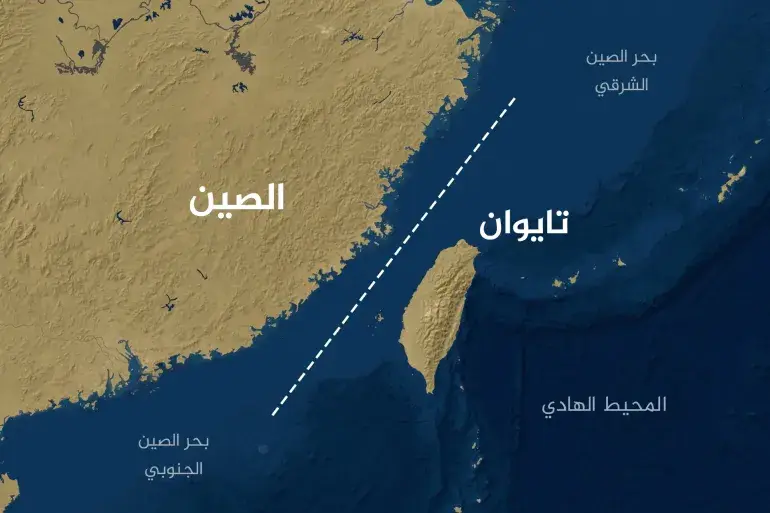
Chinese military manoeuvres around Taiwan are no longer limited to a show of force near the island's coasts or simulations of a naval blockade. The movements of Chinese fleets in the western Pacific reveal a more complex shift, one that involves training to isolate Taiwan militarily from its allies and to obstruct the arrival of US forces in the region in the event of a confrontation. A recent US military assessment indicates that Beijing is testing its ability to keep large naval formations at sea for extended periods, allowing it to sustain denial and isolation operations rather than relying on short manoeuvres around the island.
In an assessment published by the US Institute for the Study of War (ISW) on Friday, 13 November 2026, in cooperation with researchers from the American Enterprise Institute, the researchers concluded that China is likely continuing a large-scale military manoeuvre that it has not officially announced, one that simulates isolating Taiwan from external intervention during a prolonged military crisis.
The assessment is based on naval and air movements recorded by Taiwanese and Japanese authorities in recent weeks, including the Chinese aircraft carrier Liaoning task group, formations from the Eastern, Northern and Southern Theatre Commands of the Chinese military, and the deployment of warships between Taiwan and the US island of Guam.
The institute believes that the size of the forces involved, the length of time they have remained at sea and the nature of the movements of supply vessels indicate that China is testing a scenario that goes beyond a conventional blockade and aims to prevent the United States and its allies from intervening on Taiwan's behalf in the event of a conflict.
However, this conclusion represents an open-source intelligence assessment, not a Chinese announcement of preparations for an imminent invasion.
First: More than 100 Chinese ships in an undeclared military deployment
Signs of escalation became clear at the beginning of November, when Taiwan's National Security Council Secretary-General Joseph Wu revealed the deployment of more than 100 vessels belonging to the Chinese navy and coast guard in areas extending from the waters around Taiwan and the South China Sea to the western Pacific.
Not all the ships were positioned directly around the island; they were distributed among multiple naval groupings, some close to Taiwan's coasts and others moving in deeper areas towards Guam.
On 2 November, Taiwan's Ministry of National Defence recorded 49 sorties by Chinese military aircraft around the island, including 36 in the southern areas, and the institute considered that some of these movements were likely linked to supporting the naval formations deployed in the area.
In a previous report issued on 6 November, the institute identified four naval operation groups working between Taiwan and Guam, including the Liaoning carrier task group, in addition to another grouping of navy and coast guard vessels encircling the island from closer distances.
According to the assessment, these formations suggest an attempt to coordinate the operations of forces belonging to three different regional commands within a broad naval activity.
This differs from limited manoeuvres carried out by a single command close to China's coasts.
On 13 November, Reuters quoted Taiwanese security officials as saying that the number of Chinese ships had fallen to around 70, but that large naval formations remained active in the area, including the Liaoning group and forces from the Eastern, Northern and Southern commands.
The decline in numbers means the deployment did not remain at its peak level, but it does not confirm that the manoeuvres have ended or that all formations have returned to their bases.
Second: What is the difference between blockading Taiwan and isolating it militarily?
This is the most important point distinguishing the new study.
A conventional naval blockade usually aims to restrict the movement of commercial vessels and prevent goods, energy and essential materials from reaching ports, thereby exerting economic and political pressure on the blockaded party.
What the institute calls "maritime isolation" is a broader operation that may include pushing back or intercepting hostile naval forces and preventing them from reaching the conflict zone.
In Taiwan's case, this means that in a confrontation scenario China would not limit itself to preventing commercial ships from reaching the island, but might also seek to prevent US, Japanese and other forces from entering the theatre of operations or providing military support to Taipei.
Here, the competition shifts from controlling the waters around Taiwan to the ability to operate across large areas of the western Pacific.
Rather than asking whether China can blockade Taiwan, the question becomes whether it can isolate the battlefield and prevent an external military force from reaching it.
This concept implies significantly different military requirements.
A commercial blockade may rely on warships, coast guard vessels and control over ports and sea lanes, whereas sustained military isolation requires a greater capacity to operate on the high seas and to maintain, supply and protect combat formations over long periods.
Moreover, the success of any isolation campaign depends not only on the deployment of Chinese ships but also on their ability to confront forces that might try to pass through the denial zone.
Therefore, the current manoeuvres, whatever their scale, do not prove that China is already capable of carrying out a tight military isolation under real wartime conditions.
Third: Why are Chinese ships deployed between Taiwan and Guam?
Guam is one of the most important points of US military presence in the western Pacific and hosts air and naval facilities used by US forces in the region.
The deployment of Chinese formations between Taiwan and Guam lies in a strategically significant area, as it covers one of the possible directions of US forces' movement towards the island should Washington decide to intervene in a military confrontation.
According to the Institute for the Study of War, the presence of large Chinese forces in these waters suggests simulated operations aimed at preventing external forces from reaching Taiwan or complicating their ability to move and operate nearby.
These movements are of added importance because they take place east of the island, while China's main territory lies to the west.
Conventional manoeuvres in the Taiwan Strait allow China to operate close to its land bases, but deployment east of the island and deep into the ocean places its forces before different challenges relating to distance, supply, coordination and the sustainability of operations.
The movement into the western Pacific therefore represents not merely a geographic expansion of the training area, but a test of the Chinese forces' ability to operate far from their shores.
Nevertheless, deploying forces to distant areas in peacetime does not necessarily prove their ability to hold the same positions during a confrontation with US and allied forces.
That ability also depends on air and naval superiority, the security of supply lines and each side's capacity to withstand the other.
Fourth: The Liaoning at sea for a month: What does sustained deployment mean?
The institute's report notes that the Liaoning carrier task group had spent about a month at sea as of 13 November, while other naval formations had been operating alongside it in the western Pacific for at least two weeks.
The significance of this duration lies in its testing of a different aspect of naval power, one related not only to the number of ships or their combat capabilities but to the fleet's ability to keep operating.
Warships need fuel, provisions, spare parts and technical support, and their crews must maintain readiness during prolonged operations.
The ability to remain at sea depends on an effective supply system that can keep pace with the forces, rather than requiring repeated returns to coastal bases.
Here, Japanese Ministry of Defence observations in the Miyako Strait, between the main island of Okinawa and Miyakojima, are relevant.
According to the Japanese data on which the report relies, the movements of Chinese ships on 2 and 12 November suggest that the Chinese navy may have been training to escort large supply vessels through the strait towards the Pacific.
The researchers believe these movements may reflect preparations to sustain the operations of naval formations belonging to multiple military commands beyond what is known as the "First Island Chain".
This term refers to the geographic arc of islands near the eastern coast of Asia, including parts of Japan, Taiwan and the Philippines.
The military lesson here is that the ability to prevent US intervention requires not only advanced warships but also the ability to keep those ships in their positions for long periods.
A naval force may succeed in a short manoeuvre, yet face greater difficulties if the mission turns into an isolation campaign lasting weeks or months.
This is what makes supply operations an important element in reading the movements of the Chinese fleet.
Fifth: Three military commands training to work as a single force
Among the notable findings in the Institute for the Study of War's assessment is the participation of formations belonging to the Eastern, Northern and Southern Theatre Commands of the Chinese military.
Each command has its own areas of responsibility and dedicated units and formations, but large-scale military scenarios may require bringing together forces from several commands in a single joint operation.
In its assessment issued on 6 November, the institute noted that the scope of the movements may represent an attempt to integrate the combat ships of the three coastal commands into a single long-range naval operation.
This capability is particularly important if any conflict over Taiwan develops into a wider confrontation in the western Pacific.
China would then face not only the challenge of controlling the waters around the island, but also the challenge of managing geographically dispersed forces, coordinating their naval and air operations and sustaining their activity within a wide theatre of military operations.
However, monitoring the deployment of formations is not sufficient to judge the actual level of coordination between them; it is difficult to assess the effectiveness of communications, command and control during manoeuvres from open sources.
For this reason, the institute's conclusion that these movements represent training for large-scale joint operations remains an assessment based on deployment patterns, not a proven outcome of a real combat test.
Sixth: Why has China not announced these manoeuvres?
In recent years Beijing has regularly announced large-scale military exercises bearing official names, particularly when they are linked to political developments in Taiwan or to US-China relations.
The recent movements, however, differ from this pattern.
Despite the scale of the naval and air deployment, China has not announced a comprehensive manoeuvre by name and details of the kind that appeared in earlier drills around the island.
The Institute for the Study of War considers that the lack of an announcement may be deliberate, aimed at turning China's large military presence around Taiwan from an exceptional event into an activity that appears routine and recurring.
When many warships move without prior announcement, and the same movements are then repeated at different times, large-scale deployments may become part of the normal picture in the region.
According to this interpretation, Beijing is seeking not only to test its military capabilities but also to change how Taiwan and its allies perceive what the Chinese military can do on a regular basis.
The institute notes that this course may narrow the distance between routine military activity and preparation for an actual operation, making it more difficult for other parties to distinguish between the two.
This remains, however, an interpretation of the purposes of the movements, not conclusive evidence of a declared Chinese plan to carry out a blockade or an invasion.
Seventh: Beijing rejects the accusations and describes the movements as routine
For its part, China rejects portrayals of its naval movements as a secret manoeuvre aimed at preparing a military operation against Taiwan.
In October, China's Ministry of National Defence announced that the activity of the Liaoning group in the western Pacific was part of an annual routine training programme, aimed at testing long-range combat capabilities on the high seas and not directed against any specific country or target.
In an editorial published by the Chinese newspaper Global Times on 11 November, the paper criticised reports describing the deployment as a large undeclared military manoeuvre.
The newspaper, which is close to the Chinese Communist Party, considered that the activities of the navy and coast guard fall within what Beijing regards as a legitimate exercise of its sovereignty.
At the same time, however, the editorial acknowledged that China's military presence around Taiwan is moving from focused periodic operations towards a regular presence extending throughout the year.
The Institute for the Study of War considers that this rhetoric supports its hypothesis that China is seeking to entrench a new level of military activity as normal.
Beijing, for its part, presents the matter as legitimate exercises and a deterrent against what it calls separatist tendencies in Taiwan, and accuses Taiwan's authorities of exaggerating the military movements in order to stoke fears.
This dispute reflects a fundamental difference in interpreting the same facts: Taipei sees them as military pressure on the island's security, while Beijing presents them as legitimate training activity.
Eighth: Psychological pressure without a war
The Institute for the Study of War discusses another aspect of the manoeuvres related to what it calls "cognitive warfare", that is, influencing the perceptions of adversaries, decision-makers and the public regarding the balance of power and the likelihood of confrontation.
From the institute's perspective, repeated deployments around Taiwan and to its east may entrench the belief among some Taiwanese that China can isolate the island whenever it wishes, and that foreign intervention to help it may be extremely difficult.
Such operations may also put pressure on Washington and its allies to re-evaluate their capacity for a rapid response in the event of a crisis.
On 13 November, Reuters quoted a Taiwanese security official describing the manoeuvres as a form of "silent intimidation", a reference to the use of military force to exert political pressure without announcing a major exercise that might prompt broader diplomatic responses.
This escalation comes ahead of the summit of the Asia-Pacific Economic Cooperation (APEC) forum, scheduled to be held in the Chinese city of Shenzhen, amid expectations of a meeting between US President Donald Trump and Chinese President Xi Jinping.
However, linking the timing of the manoeuvres to these meetings remains a possible political explanation, not a cause confirmed by Chinese authorities.
The same applies to the hypothesis that Beijing deliberately keeps most of its training without official announcement in order to increase uncertainty among its adversaries.
Ninth: Has an invasion of Taiwan become closer?
Despite the scale of the movements, the study offers no evidence that China has decided to invade Taiwan in the near term.
Simulating isolation operations and the prevention of external intervention does not automatically mean preparation to carry out a landing on the island.
An amphibious and land invasion of Taiwan requires extensive preparations that differ from training fleets to deploy and resupply on the high seas, and it involves challenges of transporting and protecting forces and sustaining their supply lines.
A blockade or isolation, meanwhile, may be used in different contexts of military and political pressure without necessarily developing into a full-scale invasion.
Some analysts who spoke to Reuters view the recent movements as a deterrent message and a display of capabilities rather than an indicator of an imminent attack.
On the other hand, the absence of evidence of a decision to invade does not diminish the significance of the training, because acquiring the capacity to carry out isolation operations may give China additional options in future crises.
Here, a distinction must be made between three matters: possessing the military capability, training to use it, and taking the political decision to actually use it.
The first two can be partly observed through indicators from force movements and exercises, whereas the third cannot be conclusively inferred from naval deployment alone.
Tenth: What does this expansion mean for regional security?
The repercussions of the exercises go beyond Taiwan to reach Japan, the Philippines, the United States and other countries that depend on the stability of the sea lanes in the western Pacific.
Any broad conflict in this region could affect commercial shipping, energy supplies and global supply chains, particularly industries linked to semiconductors.
Taiwan occupies an important position in the advanced electronics chip industry, which makes any prolonged blockade or military confrontation around it carry economic consequences that extend beyond the island and China.
At the same time, the expansion of China's deployments may push the United States and its allies to increase military coordination and prepare for scenarios of access denial in the area.
This interaction may lead to a rise in the tempo of reciprocal exercises and a growing likelihood of military friction, even without any party wishing for a full-scale confrontation.
As naval and air forces of the different parties operate in closer areas and at a higher tempo, the importance of crisis management rules and the avoidance of miscalculation increases.
Conclusion: China is not only training to blockade the island, but to prevent its rescue
The new military study reveals that the most notable shift in China's exercises concerns not only the number of ships involved, but the nature of the missions it appears to be training to carry out.
The deployment of large naval groups between Taiwan and Guam, the participation of formations from three military commands, the long time the aircraft carrier Liaoning remained at sea, and the indications of training for supply ships are all elements that support the premise that Beijing is testing its ability to sustain broad naval operations beyond the waters close to its coasts.
The study considers that these capabilities could be used in the future to isolate Taiwan and prevent US and allied forces from reaching it during a military confrontation.
However, it does not prove that China is able to carry out a successful blockade under actual wartime conditions, nor that it has decided to attack the island.
Between the Chinese interpretation, which presents the deployments as routine training, and the American assessment, which sees them as a simulation of an extended military blockade, a broader strategic reality becomes clear: competition over Taiwan is no longer confined to the strait separating it from China, but extends across wide areas of the Pacific Ocean, where the extent of any external party's ability to intervene in the conflict may be determined.
This is the most important shift highlighted by the Institute for the Study of War: in any potential confrontation over Taiwan, the decisive competition may not begin at the island's shores, but well before that, in each party's attempt to ensure its forces reach the battlefield or to prevent its adversary's forces from reaching it.


