


When Islam in Europe is mentioned, attention often turns to the immigrant communities in France, Germany and Britain. Yet the southeastern part of the European continent presents a completely different picture: in the Balkans there are European Muslim communities rooted in the region for centuries, and some of them form the majority of the population of entire countries.
From Sarajevo and Pristina to Tirana and Skopje, and from the Sandžak in Serbia and Montenegro to the Rhodope region in Bulgaria and Western Thrace in Greece, stretches a highly diverse Islamic map, comprising the Bosniaks, Albanians, Turks, Pomaks, Gorani, Torbeši and others.
How was the Islamic map of the Balkans formed?
The wide spread of Islam in the Balkans is mainly linked to the Ottoman presence, which extended across large parts of the region for centuries. During that period, cities such as Sarajevo, Skopje, Prizren and Novi Pazar became centres of Islamic life, and mosques, madrasas, markets and waqfs were built in them.
But the collapse of Ottoman rule did not end the Islamic presence.
Large Muslim peoples and communities remained within the states that emerged in the region, and then went through highly varied experiences during the twentieth century: monarchy, communist regimes, Yugoslavia, nationalist wars, and finally the present-day Balkan states.
Therefore, speaking of "Balkan Muslims" does not mean a single people or a single nationality, but rather a mosaic of peoples united by Islam despite differences in language, identity and political history.
Kosovo: the greatest concentration of Muslims
Kosovo represents the clearest case on the contemporary map, as Muslims form the overwhelming majority of the population.
Kosovo's 2024 census data show that Islam remains the dominant religion by a wide margin, alongside Orthodox and Catholic Christian communities. When reading the census figures, attention should be paid to the low participation in four northern municipalities with a Serb majority, which led the statistics agency to make its own estimates. Ask Data
Most Muslims are Albanians, alongside Bosniaks, Turks, Gorani and other communities.
Albania: Islam and identity after decades of official atheism
The Albanian experience is radically different.
Albania is one of the European countries in which Muslims constitute the largest religious component, but society is characterised by a high degree of secularism, and Islamic affiliation itself is distributed mainly between Sunni and Bektashi Muslims.
This is an important point on the map: the old percentages that placed Muslims at around 80% of the population should not be relied upon to describe present-day Albania; the religious composition revealed by recent censuses is more complex, with a rise in the number of those who declare no religious affiliation or do not answer the question.
Bosnia and Herzegovina: the Bosniaks and the heart of Balkan Islam
Bosnia and Herzegovina holds a special place in European Islamic history.
Bosniak Muslims constitute one of the three main national components of the country, alongside Serbs and Croats, and Sarajevo is one of the best-known Islamic centres in Europe.
According to the 2013 census, the last comprehensive census of the country, around 50.7% of the population identified themselves as Muslims.
The contemporary history of Bosnian Muslims cannot be separated from the 1992–1995 war and the ethnic cleansing, displacement and mass killing that accompanied it, culminating in the genocide in Srebrenica.
But reducing the Bosniaks to the memory of war alone would be a mistake; they are a European Muslim community with extensive religious, educational and cultural institutions, and Islam has a visible presence in the identity of many cities and towns across the country.
North Macedonia: around a third of the population
North Macedonia has one of the relatively largest Muslim blocs in the Balkans.
The 2021 census showed that around 32% of the resident population identified themselves as Muslims.
The Muslim community consists mainly of Albanians, alongside Turks, Bosniaks, Muslim Roma and Slavic-speaking groups.
Muslim density is concentrated especially in the west and northwest of the country, and in Skopje and towns such as Tetovo and Gostivar.
Montenegro: Muslims between Bosniaks and Albanians
Muslims make up nearly a fifth of Montenegro's population according to the most recent census-based data in circulation.
They are concentrated particularly in the northern and eastern regions, and among their most prominent communities are Rožaje, Plav, Gusinje and Ulcinj.
They consist mainly of Bosniaks, Muslims with a Muslim national identity, and Albanians.
Here one of the most important features of the Balkans becomes apparent: political borders do not coincide with the boundaries of Muslim communities; Bosniaks, for example, live in Bosnia and Herzegovina, Serbia, Montenegro, Kosovo and elsewhere.
Serbia: the Sandžak as the heart of Muslim presence
Muslims are a minority across Serbia as a whole, but the national figure conceals a very clear geographical concentration.
Their most important area is the Sandžak in the southwest of the country, especially Novi Pazar, Tutin and Sjenica, where Bosniak Muslims constitute a large part or a majority of the local population.
There are also Albanian Muslim communities in southern Serbia, especially in the Preševo valley.
Bulgaria: Turks, Pomaks and Muslim Roma
Bulgaria has a long-established Muslim community whose composition differs from that of the western Balkans.
According to the 2021 census, the number of those who identified as Muslims reached around 639 thousand, or nearly 10% of the population, with the need to take into account a considerable proportion who did not state their religion. Wikipedia
Muslims consist mainly of Bulgarian Turks, alongside Bulgarian-speaking Muslims, many of whom are known as Pomaks, in addition to Muslim Roma.
Muslim communities are concentrated in parts of the northeast and in the Rhodope Mountains, among other areas.
Greece: Western Thrace as a special case
Muslims are a small minority at the national level in Greece, but Western Thrace, near the Turkish and Bulgarian borders, represents a different case.
There lives a historic Muslim community comprising Turks, Pomaks and Muslim Roma.
This minority has a special legal status dating back to the Treaty of Lausanne of 1923, so its affairs are tied to questions of religious education, waqfs, muftis, identity and minority rights.
Romania: the Muslims of Dobruja
Romania has a small but historic Muslim community, concentrated mainly in the Dobruja region overlooking the Black Sea.
Traditionally it consists of Turks and Tatars, and its roots are tied to the region's Ottoman history and the Crimean Tatars.
This community is far smaller numerically than the Muslim populations in Bosnia and Herzegovina, Kosovo, Albania and Bulgaria, but it represents one of the oldest forms of continuous Islamic presence within Romania.
Croatia and Slovenia: smaller minorities
There are also Muslim minorities in Croatia and Slovenia, including Bosniaks, Albanians and others, to which migration from outside the Balkans has been added in recent decades.
In Croatia, the 2021 census recorded around 51 thousand Muslims, or roughly 1.3% of the population.
Slovenia has a smaller Muslim community, a large part of which is linked to the internal migration that took place during the Yugoslav era.
Not an "immigrant community"
This is perhaps the most important fact that the map of the Balkans' Muslims should convey.
When a Muslim lives in Sarajevo, Prizren, Novi Pazar or a village in the Rhodope Mountains, in many cases he does not belong to a "migrant community" in the sense commonly understood in Western Europe.
He is the child of a community that has lived on that land for many generations.
Demographic studies confirm this distinctiveness: the Pew Research Center explicitly distinguishes between the long-established Muslim communities of Eastern and Southeastern Europe and the majority of Muslim communities in Western Europe, which were formed or expanded as a result of recent migration.
Therefore, the map of Islam in Europe looks entirely different when we move eastward.
There are countries with a Muslim majority or a huge Muslim bloc, such as Kosovo, Albania and Bosnia and Herzegovina; a country where Muslims approach a third of the population, such as North Macedonia; others where they form a large community, such as Montenegro and Bulgaria; and regions with a high Muslim density within countries where non-Muslims predominate, such as the Sandžak and Western Thrace.
It is a map that reveals that Islam is not merely a recent chapter in European history, but an authentic part of the history of the Balkans themselves, of its peoples, cities, languages and political and cultural memory. Broader Pew estimates indicate that most Muslims in Russia, Albania, Kosovo, Bosnia and Herzegovina and Bulgaria descend from Islamic communities that have existed in Europe for centuries.
Wasl's map
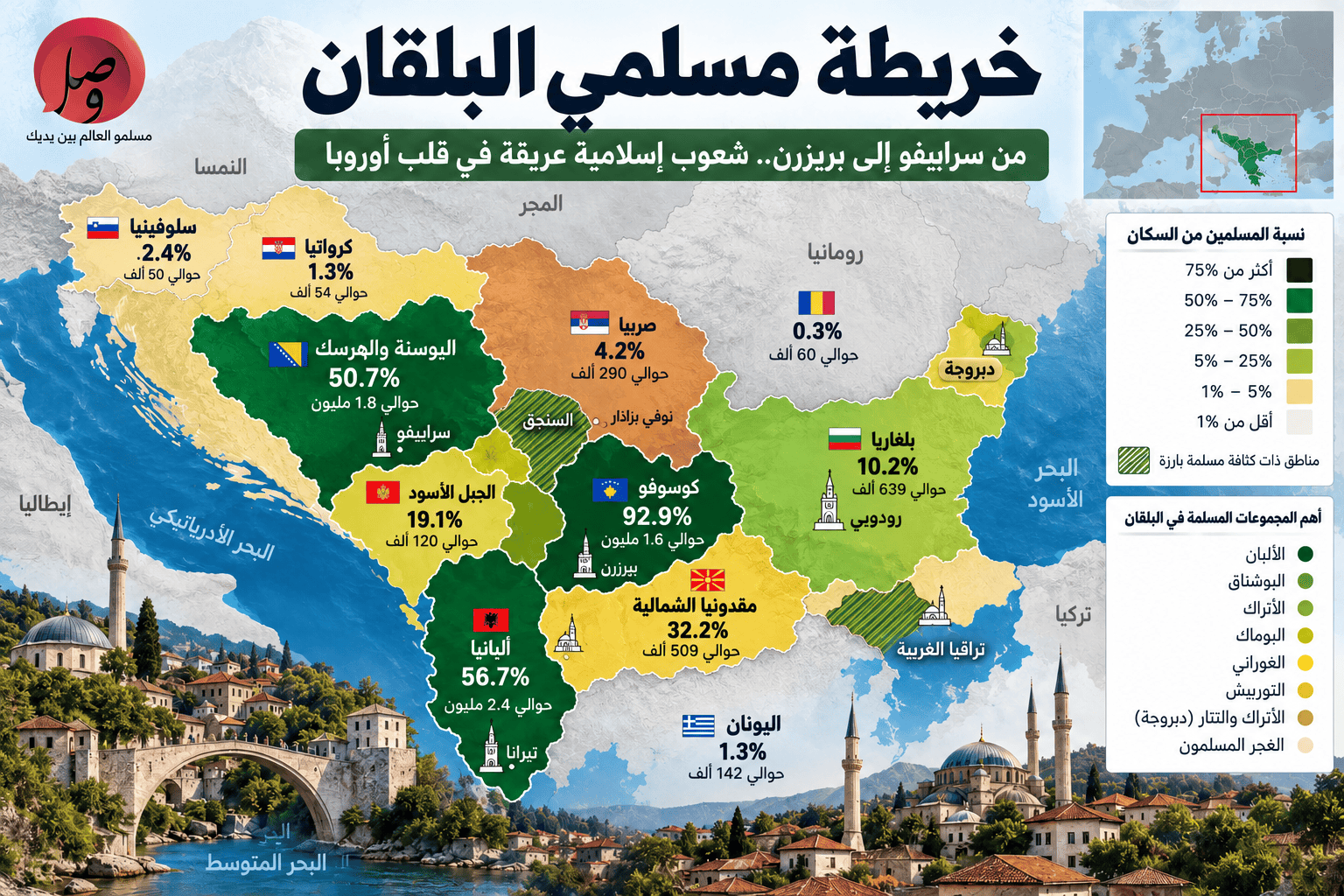
Map of the Balkans' Muslims
From Sarajevo to Brezerne... ancient Islamic peoples at the heart of Europe


