

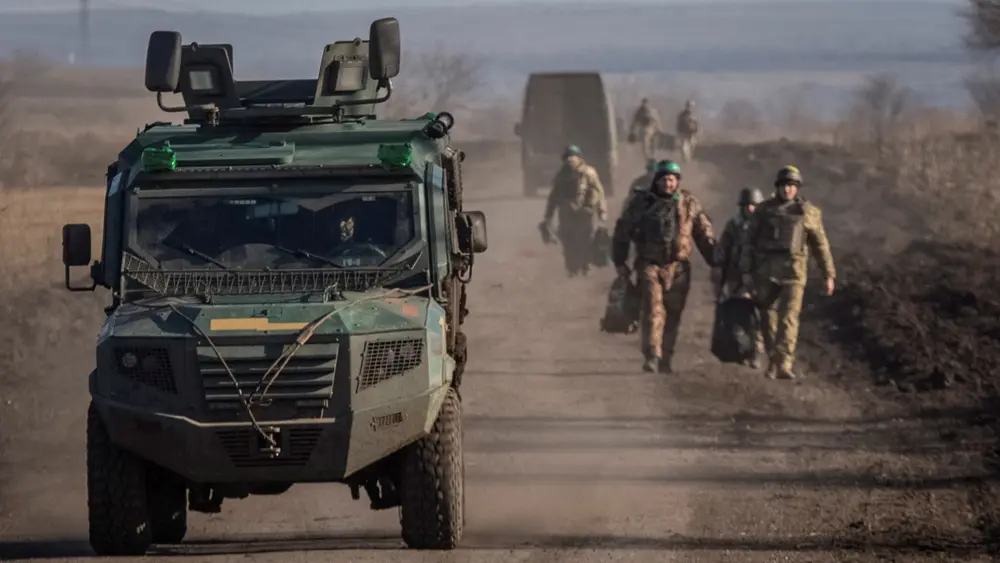
From Ukraine to NATO member states, prolonged wars are reopening a question that goes beyond the size of armies and their technological superiority: what happens when munitions run out, equipment is destroyed and human losses mount, while the war is still in its early stages? A new analysis by a British military institute warns that superiority in the first battle does not guarantee victory in a long war, and calls for rebuilding defence strategies around the capacity to endure, to replace losses and to sustain military production, rather than relying on short, decisive wars that may not materialise.
Western armies face a growing strategic challenge. Modern wars have exposed the gap between preparing for a major military engagement and the ability to keep fighting for months or years, amid the continuous attrition of forces, munitions, equipment and economic resources.
A new analysis published by the Royal United Services Institute (RUSI) warns that defence strategies focused on fighting a quick and decisive first confrontation are no longer sufficient to deal with conflicts that may last far longer than political and military leaderships expect.
The analysis argues that preparing for long wars does not depend on possessing advanced weapons alone, but requires building an integrated system that includes human reserves, military training, the defence industry, strategic stockpiles, economic capacity, political will and societal support.
This was set out in a video commentary published by the institute on 5 November 2026, titled "The Long War: Rethinking Defence Strategy during Protracted Conflicts", presented by Hamish Mundell, Associate Fellow in the institute's Military Sciences department.
The commentary is part of a broader research programme titled "The Long War", which seeks to examine the ability of Britain and its allies to prepare for protracted military conflicts and to keep fighting after the resources and capabilities available at the outbreak of war have been exhausted.
The myth of the short war: the problem facing Western strategies
One of the central ideas of the analysis is that military institutions tend to prepare for the first battle more than for the entire war.
Modern armies invest huge sums in developing combat aircraft, warships, tanks and precision missiles, and work to raise the readiness of units capable of rapid deployment and of carrying out initial operations.
Yet this readiness does not necessarily answer more complex questions: how will forces that are lost be replaced? Where will new munitions come from? How long does it take to train replacement soldiers? Can factories sustain production in a war that continuously drains resources?
In an earlier study published by Mundell in October 2025, titled "The Long War: Fighting after the First Battle", he described this imbalance as an institutional bias towards the first battle.
Defence institutions, in his analysis, tend to favour capabilities that can be quickly displayed and tested, while less visible elements, such as reserve forces, deep stockpiles and industrial mobilisation plans, receive less attention.
He warns that this orientation may produce a sophisticated military force capable of carrying out effective initial operations, but lacking the depth needed to continue when it suffers heavy losses.
Here lies the basic paradox: a state may possess an army ready for combat, yet not possess a system ready to sustain a war.
Ukraine: the war that revived the concept of attrition
The Russian-Ukrainian war is among the most prominent examples on which the institute's programme draws to understand the nature of protracted conflicts.
When Russia launched its full-scale invasion of Ukraine in February 2022, the political and military expectations of the various parties did not match the course the war later took.
Instead of ending within a short period, the confrontation became a prolonged war of attrition, forcing both sides to replace repeated losses in personnel, vehicles and munitions, and to reorganise units and develop methods of fighting.
The war also revealed the importance of drones, precision artillery, electronic warfare and reconnaissance, but it showed at the same time that military innovation does not eliminate the need for soldiers, munitions, equipment and industrial capacity.
The speed of producing munitions, repairing vehicles, training forces and renewing units became factors influencing the continuation of military operations.
Researchers at the institute see this experience as challenging the belief that major conflicts can be decided by technological superiority alone.
An army that achieves significant results in the initial phase may find itself facing a strategic dilemma if the war continues and its capacity to replace consumed resources declines.
This does not mean that long wars are decided by numbers alone, but that military superiority requires a continuous ability to regenerate force and to maintain the cohesion of forces and institutions.
The 20-40-40 formula: an army that accepts losing part of its equipment
Among the most significant shifts discussed by the institute is the model presented by the British Army's chief, General Roly Walker, at the 2025 Land Warfare Conference, under the title "20-40-40".
The model proposes dividing military force systems into three categories according to their ability to withstand attrition.
The first category, which makes up 20% of the proposed concept, comprises capabilities that must be preserved for as long as possible, such as tanks, air defence systems, command and control systems and personnel.
The second category, making up 40%, includes equipment whose loss can be accepted, although retaining it remains desirable.
The third category, representing another 40%, comprises systems designed from the outset for consumption or limited use, such as some drones, loitering munitions and single-use weapons.
This concept reflects an attempt to adapt to battlefields in which large numbers of low-cost systems are consumed, rather than relying on expensive equipment that is difficult to replace quickly.
Mundell, however, raises a question that goes beyond this model: what happens when the category that is supposed to be preserved is destroyed or drained?
Even the best-protected systems are not immune to losses, and trained soldiers cannot be replaced at the same speed at which small drones can be produced.
The researcher concludes that redistributing types of equipment is not enough on its own; realistic plans must exist to rebuild units that lose their combat capability.
It is important to note that the 20-40-40 model is a concept for organising military capabilities, not an accurate description of the current proportions of British Army equipment.
The second and third armies: who will fight after the first forces are depleted?
The institute's analyses place reserve forces at the heart of the debate on long wars.
Regular forces that enter the war in its first phase may suffer human and material losses that require periods of reorganisation and replacement.
In such a case, mobilising additional individuals on their own is not enough. The state needs military formations capable of undertaking complete combat missions, with the leadership, training, equipment and logistical support that this requires.
Mundell points to the importance of preparing subsequent levels of forces, known militarily as second and third formations or echelons, so that the state can continue when the readiness of its first units declines.
In April 2026, the institute published another study titled "Mobilisation and Training for War: Preparing for the Moment of Necessity", prepared by researchers Nick Reynolds and Paul O'Neill, which dealt in detail with the challenges facing Britain in expanding its forces in the event of a major war.
The study warned of the limited capacity of the current mobilisation and training system to absorb large numbers of soldiers and prepare them within a short period.
It recommended more detailed plans for using volunteer and strategic reserve forces, drawing on the experience of former military personnel, expanding training centres, and developing simulation and collective training methods.
These recommendations show that counting the number of people liable for military service is not sufficient to determine the effective strength the state can mobilise.
A soldier who has not received adequate training and equipment does not necessarily represent ready combat capability, however many individuals are registered on reserve lists.
Military training: a resource that cannot be produced instantly
The study draws attention to a problem often overlooked in assessments of military strength: the time needed to turn individuals into effective combat units.
A state may be able to call up thousands of people within a limited period, but preparing them for combat requires instructors, facilities, equipment and opportunities for collective training.
The problem is not limited to training an individual to use his weapon; it also concerns his ability to operate within an integrated military unit and to coordinate with infantry, artillery, engineering, medical and logistical support units.
This difficulty increases with the complexity of modern weapons, which require technical skills and practical experience that cannot be acquired in a few days.
The British mobilisation study indicates that expanding training capacity requires advance planning and investment in infrastructure and specialised cadres, alongside the use of virtual technologies and military simulation.
It also stresses the importance of drawing on civilian skills that can be transferred into the military environment, rather than starting from zero in every field.
From this perspective, a state's stock of trained soldiers, and of trainers capable of preparing others, may become a strategic resource no less important than its stock of munitions.
Factories are part of the war: who produces faster and who replaces losses?
The equation of long wars does not end with the number of soldiers and vehicles present at the start of fighting; it extends to the capacity of the industrial economy to continue supplying armies with what they need.
A protracted war may consume munitions, spare parts and equipment at rates exceeding the usual production capacity of peacetime.
Supply chains may also be disrupted by shortages of raw materials, transport disruption, rising energy costs or damage to industrial facilities.
For this reason, the "Long War" programme calls for treating industrial capacity as part of military readiness, not merely as an economic activity that can be expanded when needed.
This includes maintaining appropriate stockpiles, plans for increasing production, and the ability to adjust manufacturing lines according to the requirements of military operations.
The institute also addresses the concept of "asymmetric rearmament", which rests on the possibility of replacing some lost capabilities with simpler, cheaper and faster-to-produce systems, rather than insisting on replacing every lost piece with an identical copy.
Some complex equipment may be highly effective at the beginning of a war but require months or years to produce replacements.
Conversely, some less complex systems may provide suitable capabilities for particular conditions, if they can be produced in sufficient numbers.
This approach does not mean that cheaper equipment can substitute for all advanced weapons; rather, it concerns finding a balance between quality, cost, speed of replacement and the requirements of the battlefield.
Wounded and human losses: the link that threatens the readiness of armies
Mundell raises an issue that does not always receive the same attention as weapons procurement programmes: the armed forces' capacity to deal with large-scale human losses.
High-intensity wars consume not only vehicles and munitions but also require medical systems capable of treating large numbers of casualties, evacuating them and rehabilitating those who can return to service.
Armies also need to replace personnel who are killed or who suffer disabilities that prevent them from continuing to fight.
In his earlier analysis, the researcher warns that British military planning has not shown sufficient readiness to rebuild human and material capabilities once they have been depleted.
He considers sending reserve forces or inadequately trained recruits into a high-intensity war a risk that is not limited to weak military effectiveness, but also represents a failure of moral responsibility towards the individuals whom the state asks to take part in combat.
This point makes clear that preparing for a long war cannot be reduced to buying weapons or raising budgets; it also includes protecting personnel, training them and securing the care they need.
Political will: can governments sustain a war that stretches over years?
The new analysis goes beyond the limits of military organisation to the relationship between war, politics and society.
A government may be able to mobilise large forces at the start of a military confrontation, drawing on popular support or a sense of direct threat.
However, sustaining combat poses different challenges, as losses, economic costs and social pressures rise.
At this point, the capacity of political leadership to explain the objectives, costs and limits of the war becomes an important factor in sustaining public backing.
The institute's programme indicates that preparing for long wars requires consensus among political, military and economic institutions, as well as the ability to maintain the trust of the population.
This question is particularly pronounced in democracies, where governments face parliamentary oversight, elections and public debate over defence spending and human losses.
However, society's capacity to bear the burden of war should not be understood as a call to ignore public objections or reduce oversight of military decisions.
Politically, the absence of clear objectives or a widening gap between promises and outcomes may lead to declining trust in the government, even when the state possesses substantial military resources.
This means that the political sustainability of war is also linked to the legitimacy of decisions, clarity of objectives and public accountability, not merely to the ability to mobilise resources.
Deterrence does not rest on the first strike alone
Mundell's analyses reach a central idea concerning deterrence.
The traditional concept of deterrence focuses on persuading an adversary that starting a war will expose it to severe losses as a result of the force of the response.
The researcher extends this concept to include a state's ability to continue after receiving heavy blows.
If an adversary believes that opposing forces will exhaust their munitions and capabilities within weeks, it may judge that it can absorb initial losses and then keep fighting until the other side's capacity to resist declines.
If, however, a state possesses a system capable of replacing equipment, training new forces and increasing production, the adversary's calculations become considerably more complicated.
In his earlier analysis, Mundell suggests that Russia does not necessarily need to outmatch NATO in every domain of military power, provided it can prolong the confrontation until the alliance's capacity to continue declines.
This is a strategic assessment put forward by the researcher, not a confirmed conclusion about Russia's actual ability to win a future war against NATO.
The core idea is that the capacity to absorb the first blow and rebuild military power may itself be part of deterrence, not merely a readiness to respond after deterrence has failed.
Can increased defence spending solve the problem?
Although raising military budgets can contribute to enhancing readiness, the analysis warns that money alone does not address all shortcomings.
Industrial expansion requires factories, skilled workers and supply chains, while training additional soldiers requires instructors, facilities and equipment.
It is not possible to build all of these capabilities immediately simply by taking a political decision to increase funding.
Likewise, spending on advanced equipment does not automatically increase the capacity to sustain operations if sufficient resources are not allocated to spare parts, munitions, maintenance, training and reserve forces.
For this reason, the institute calls for a review of how defence resources are distributed, so that preparation for the first operations does not overshadow the building of the capabilities required for the months and years that follow.
This approach reflects a shift from assessing military power according to what a state possesses today to assessing its ability to sustain and renew that power in the future.
A Forthcoming Conference to Test the Ability of Britain and Its Allies to Fight a Long War
The publication of the video commentary comes ahead of a conference organised by the Royal United Services Institute on 24 November 2026, titled "Long War Conference", with the participation of military and political officials and experts in the defence industries.
The conference is scheduled to discuss three interconnected challenges: mobilising personnel; mobilising industry and accelerating adaptation to the requirements of combat; and sustaining political and societal support during prolonged conflicts.
Its programme also includes sessions on the changing nature of war, transferring lessons from battlefields to factories, managing the human reserve, and the challenges facing democratic systems in long wars.
The holding of the conference reflects the continuing debate within British research and military institutions over the extent to which the country and its allies can confront a broad conflict that does not end within days or weeks.
However, the forthcoming conference does not mean that a decision has been taken to fight a new war; it is part of a strategic discussion on preparedness and deterrence.
What This Study Means for the Armies of the Rest of the World
Although the analysis focuses on Britain and NATO, the questions it raises extend beyond Europe.
Armies that rely on high-cost equipment and foreign military imports may face serious difficulties if wars continue and supply chains are disrupted.
Likewise, states that possess large numbers of troops but lack collective training, industrial capacity and maintenance may find that numerical superiority alone is insufficient.
In contrast, smaller states may be able to sustain their defensive capabilities for longer if they succeed in organising reserves, securing supplies, protecting their infrastructure, and developing production and replacement capacities.
These issues carry greater weight in regions that have witnessed prolonged wars, such as Sudan, Yemen and Ukraine, where conflicts have shown that the continuation of operations depends on factors broader than the outcomes of direct battles.
However, applying the study's findings to these conflicts requires taking into account the considerable differences in the nature of armies, resources, political objectives and economic environments.
This is an analytical extension of the study's idea, not a field assessment carried out by the institute of each of those wars.
Conclusion: Winning the First Battle Is Not Necessarily Winning Through to the End
The "Long War" programme being developed by the Royal United Services Institute reveals a shift in strategic thinking, based on questioning the adequacy of military preparedness built on expectations of short, decisive confrontations.
Modern military power is not measured only by the number of aircraft, tanks, ships and missiles, but also by the ability to replace what is lost, train those who replace depleted soldiers, and sustain supply, production and political decision-making during a prolonged crisis.
The analyses published by the institute consider that preparing for the first war without building the capacity to fight its subsequent phases may leave advanced forces vulnerable to attrition and weaken their deterrent capacity.
However, increasing the capacity to continue fighting a war does not mean that war has become inevitable, or that the best strategy is to prolong conflicts.
Rather, the logic of deterrence advanced by the researcher holds that persuading an adversary that a quick victory is difficult may reduce its incentives to enter the confrontation in the first place.
Thus, the question the study poses to modern armies is no longer: can they win the first battle? It is: can they keep going when the first battle ends without the war ending?
In a world where the pace of weapons development is accelerating and the capacity of belligerent parties to drain one another is growing, the ability to renew military power and to preserve the cohesion of institutions and society may become a decisive factor in calculations of security and deterrence.
Sources: Royal United Services Institute (RUSI), Jack Watling [name as given: Hamish Mundel], 5 November 2026; Hamish Mundel, 20 October 2025; Nick Reynolds and Paul O'Neill, 22 April 2026.


