

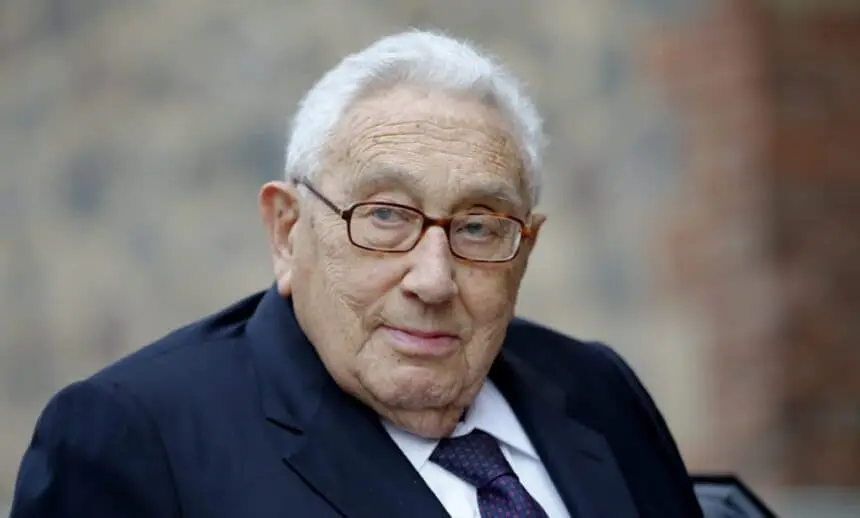
Henry Kissinger was not directly involved in the negotiations or the policy concerning Bosnia and Herzegovina during the war of 1412 - 1415 AH (1992-1995 CE), but shortly before the signing of the Dayton Agreement, he wrote a text in which he expressed his views on this issue. As stated at the beginning of Kissinger's text, published by the American newspaper The Washington Post, the ongoing NATO bombardment in Bosnia may represent, in the words of Winston Churchill, the beginning of the end rather than the end of the beginning.
The agreement reached at the end of last week on the principles for dividing Bosnia is a significant step forward that deserves praise from the Clinton administration. Now that this administration has accepted the proposition that diplomacy needs to be backed by force or the threat of force, it must, in order to end the war, send two messages: to the Serbs, that there is no option other than negotiation; and to the Bosnian-Croat Federation, that the West is able to protect any agreement, but its military strength will not be available for ambitions that exceed the scope of Western proposals.
The appalling behaviour of the Serbs (matched by the behaviour of the other parties at various stages) fits the category of historic ethnic conflict in the Balkans more than the category of aggression. In 1411 AH (1991 CE), Western states recklessly created Bosnia as a multi-ethnic state by recognising the administrative boundaries of the former Yugoslav republics as international borders. But these territorial boundaries had been drawn specifically to prevent the political cohesion of the republics by manipulating ethnic rivalries in order to discourage self-government.
It is no surprise that the Croats and Serbs rejected the emergence of Bosnia as a unified state under Islamic rule, given that together they make up more than half of Bosnia's population. Their kin states supported them in this, and indescribable acts of brutality were committed in the name of ethnic cleansing.
Ethnic conflicts are a phenomenon entirely different from our historical experience. The Cold War restrained the risks and rewards on which great-power policy could be based. Even in regions with intense passions such as the Middle East, the adversaries were clients of the great powers and were therefore somewhat constrained.
By contrast, hatred in ethnic conflicts transcends rational calculation. Each ethnic group listens to a mythical golden age when it was dominant: Muslims remember the Ottoman Empire; Croats remember Habsburg supremacy; Serbs rely on their endless wars for independence. The ideal ethnic map of each conflicts with the ethnic maps of its rivals; each regards the other as a curse on any arrangement that depends on the goodwill of the other side.
Ethnic conflicts inevitably lead to ethnic cleansing. They end either in victory, defeat or exhaustion. Paradoxically, the parties can sometimes be subdued by a superior outside force but not by each other. (This in fact is how Bosnia was governed throughout most of its history, successively by the Ottomans, the Habsburgs, and Marshal Tito.)
Therefore, the conflict in Bosnia is not merely an act of aggression that threatens world peace. The limits of each party's aims are determined primarily on an ethnic basis, but are undoubtedly shaped by sweeping ambition. Not even the most megalomaniacal Serbs aspire to control the world.
It is true that Serbia began the latest round. But one of the causes that certainly contributed to it is the memory of other rounds — some of which have not yet happened in the past — in which the roles were reversed. As the former deputy commander of US European Command, General Charles G. Boyd, noted in the latest issue of Foreign Affairs, the behaviour of the Croats and Muslims was at times no less base than that of the Serbs — although it was overlooked by the media and winked at by the administration.
Some view such an outcome as an appropriate punishment for the evils committed by the Serbs. But the punishment for evil must be balanced — indeed, it is consistently balanced — against other concerns. We tolerated the massacre that took place in Rwanda, which far exceeded the worst atrocities committed in Bosnia. We did no more than issue paper protests against Russian actions in Chechnya.
The risks in each case were deemed too high for the national interest.
The gap between moral convictions and the risks we are prepared to run is reflected in the debate in Congress over the arms embargo. The majority that voted for lifting the embargo insisted on the moral statements of the administration. But it wants to eliminate all risks to American lives; Bosnian Muslims are supposed to win with American supplies. But as long as a Bosnian victory would certainly lead to ethnic cleansing against Bosnian Serbs along the lines of what they suffered in Krajina, Congress's moves lead to the same moral dilemma that paralysed us in the first place.
The vote on the arms embargo served a useful purpose in ending the hesitation of the administration and NATO regarding the use of force, but it is now better for Congress to abandon its override of the president's veto, if only because the embargo issue has been superseded by recent events.
It is therefore of utmost importance to obtain NATO consensus on how the alliance should respond if negotiations stall. Since military pressure will be applied against Serbia but should not be against Bosnia or Croatia, the position of the allies must be considered particularly carefully if the Muslims and Croats — a highly probable scenario — insist on reunifying the country.
Our skilled negotiator, Richard Holbrooke, has identified the most difficult challenge he faces as the formation of ethnically based autonomous regions. In my view, the most intractable question concerns the international status of these regions: whether they should enjoy self-government within a unified Bosnian state or the right to secede and join the kin state. Many insist on a sovereign Bosnia within its original borders, because any other outcome would reward aggression. But now that each of the two communities, using the most brutal methods, has expelled the other groups from the area it controls, it is illogical to attempt to impose a multi-ethnic solution on all of Bosnia and Herzegovina.
If the goal is stability rather than revenge, and if we wish to avoid becoming entangled in an endless conflict, the only responsible outcome is to define Bosnia as a state of the Muslim community within dignified borders and to give the other communities the right of self-determination.
In a state made up of three warring nationalities, the risk of two of them colliding with the third would be enormous. Moreover, if Bosnia's current borders become internationally recognised, the Serbs (or Croats) will be accused of aggression at the international level if they support their compatriots in Bosnia, and of treason, or worse, at home if they acquiesce in their suffocation.
Bosnia's leaders forget that Croatia, in the first phase of the current conflict, pursued a policy parallel to that of Serbia, seeking to expel the Croat ethnic group from Bosnia. Indeed, a few months ago, the Croatian President Franjo Tuđman, who considered himself unofficial at a dinner in London, declared that, despite the opportunistic confederation with the Bosnian Muslims, the most logical outcome would be the partition of Bosnia between Serbia and Croatia.
Demarcating the borders will also be of great importance for East-West relations. Russia has so far remained relatively restrained in the face of the punishment inflicted on the Serbs, its historical allies in the Balkans. This kind of restraint is likely to become a domestic Russian issue if Serbia's humiliation drags on.
So far the Bosnian crisis has been contained, but the prolonged erosion of Serbia could repeat the experience that led to the First World War, when the many Serbian setbacks that Russia swallowed led to a determination not to surrender again. I do not object to challenging Russia when it comes to fundamental American interests, as is the case with the expansion of NATO. But attempting to make the Serb population of Bosnia part of Bosnian sovereignty — which constitutes a violation of the principle of self-determination that we follow and an ignoring of the centuries-long Serb struggle against Islamic rule — runs counter to the national interest. It is a form of domestic politics. It would make Sarajevo, for the second time, the origin of an unnecessary conflict.
Defining the legal status of the autonomous regions will be the process of deploying the peacekeeping force, to which President Clinton eagerly pledged a large American contribution in the early days of his administration, when he still believed that war and peace were separate phases of policy.
I do not support any long-term presence of American forces in the powder keg of the Balkans, where war and peace blur imperceptibly. But if forces are sent, they must protect a meaningful objective. Since they would be positioned along the current international borders, they could not prevent the destruction of the Serb autonomous region by Bosnia or the merger of Bosnia into Croatia — the two most likely outcomes of the next phase of Bosnian politics. The most logical objective for a peacekeeping force is to protect the Muslim area as a separate state.
To navigate this delicate course, the president needs to abandon his timid stance of pretending that American policy simply records international consensus. We have been the driving force behind recent actions, and if we are not moving with the images we broadcast on the evening news, the president must be ready to explain to the American people his objectives, his opportunities, and his risks and their limits.
When this crisis ends, America must pose a deeper question to itself: how far does it wish to push the principle of self-determination?
Bosnia is now divided to a degree that does not allow it to form a government under which the three ethnic groups can live together in harmony. But if applied on a global basis, would the concept of ethnic self-determination not divide the world into uncontrollable chaos? On the contrary, what might it do to the cohesion of our society?
The author is a former Secretary of State and chairman of Kissinger Associates, an international consulting firm with clients who have commercial interests in many countries abroad.
Sarajevo Times


