

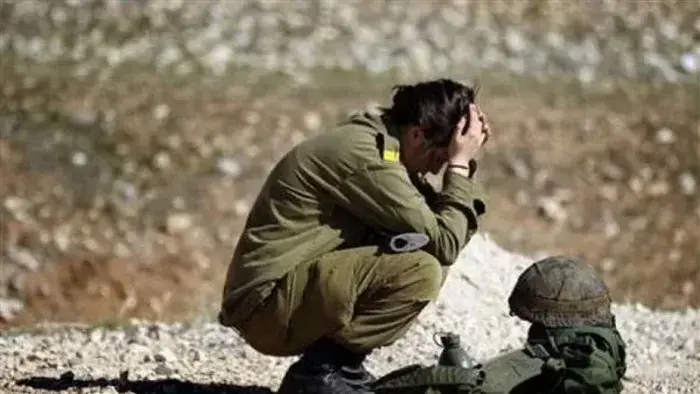
Israeli military analyst: "More than 12,000 wounded soldiers have been accepted as disabled since the start of the war"
The Israeli military analyst Yoav Zeitoun said in his report for the newspaper that "more than 12,000 wounded soldiers have been accepted as disabled since the start of the war; each month of the past year, around 1,000 new disabled persons have been received, which is tearing at the living flesh of the Israeli army's fighting force."
While Zeitoun says the occupation army will publish the data at the end of the year, he adds: "When the end of the fighting is not in sight, according to estimates by senior officials in the rehabilitation department, by the end of next year the number of war-disabled will reach 20,000!"
Describing the condition of Jewish soldiers in the field, the military correspondent says: "Thousands of soldiers and commanders were subjected to atrocities throughout the Gaza envelope (following the Al-Aqsa Flood attack), and after a few weeks they entered the fighting in Gaza, and saw comrades and commanders killed and wounded beside them, and were subjected to devastation."
He adds: "This was not a war lasting one month on average, as most of Israel's wars have been, but a war lasting 14 months."
He goes on to describe the field situation of the soldiers: "In this violent fighting, young men aged between 19 and 20 take part, facing the echoes of explosions, gunfire and the smells of battle, and life in the field, without running water and toilets. The truth is that they barely saw their homes and families over the past year."
He adds: "All this burns in the souls of many soldiers and commanders, even if they come out for rest and refreshments from time to time, and this is a situation Israel has not faced in any of its wars."
Zeitoun also quotes an officer leading Israeli forces in the Gaza Strip describing the situation experienced by the occupation soldiers as follows: "It is a bottomless black hole, because many enthusiastic fighters are ashamed to undergo long and major treatment, and in the meantime hidden scars accumulate that can be expressed in fits of anger or silent repression within a short period."
The officer continues: "On average, a large number of fighters have been discharged for mental reasons. It is true that this is among hundreds of soldiers serving in the battalion, but there are many soldiers who want to leave the fighting and face difficulties with the command and mental health authorities."
The military analyst also quotes experts in the occupation army as saying that "the real impact on the soldiers will become clear after the army returns to partial routine and the fighting largely ends, once the fighting in Gaza calms down."
He reveals a senior military official saying: "We are witnessing the beginning of an increase in the number of soldiers applying for psychological assistance, including at the mental health clinics we have opened. These are thousands of soldiers, most of them fighters, who have only recently been transferred, and we are prepared to deal with larger quantities later. Some of them have already been diagnosed with post-traumatic symptoms."
On the difficult situation experienced by occupation soldiers, this official reveals that "in another case, which is considered extreme and unusual, a young fighting officer ended his life in the combat zone in Gaza, in front of some of his subordinates, in a painful event that still reverberates in the unit."
Yedioth Ahronoth reported that at least six Israeli soldiers have committed suicide in recent months, in a report it prepared on the fragile psychological state of soldiers suffering from post-traumatic stress disorder due to their war in the Gaza Strip and Lebanon.
The newspaper noted that the soldiers who committed suicide were among those who fought for a long time in Gaza and Lebanon, pointing out that the figure does not reflect the full picture in detail, because the Israeli occupation army has refused to publish the full number of soldiers who committed suicide or attempted suicide.
According to various estimates in the Israeli occupation army, around 15% of regular fighters who left Gaza and received mental treatment have not been able to return to fighting because of the difficulties they face, which weighs on the shortage of manpower in the brigades and battalions, because the matter concerns not only the dead and wounded but also the mentally injured.
The report concludes with instructions for those facing psychological crises in the occupation army, saying: "If you or anyone around you is in crisis, and you may have suicidal tendencies, do not stay alone. Contact professionals in the community or national support organisations."
According to Yedioth Ahronoth, the Israeli army promised to publish the data at the end of the year, noting that exposure to atrocities, exhaustion and the harshness of conditions are pushing many soldiers to the brink of collapse.
It said thousands of soldiers have already turned to the private clinics set up by the Israeli army, adding that a third of the officially recognised disabled suffer from post-traumatic stress disorder, before stating that "this is only the beginning, and the extent of the soldiers' mental collapse will become clear if the guns fall silent."
According to many testimonies on which the Israeli newspaper relied, almost every unit that fought in Gaza or Lebanon has had a large number of its fighters discharged for mental reasons.
It added that many soldiers who want to leave the fighting face difficulties with the command and mental health authorities, due to the shortage of soldiers. In one regular infantry battalion, soldiers and their parents discussed whether it was possible to file a lawsuit against commanders on the grounds of failing to account for the mental burdens imposed on soldiers.
Newspapers had previously highlighted the psychological disorders suffered by Israeli soldiers. The Israeli newspaper The Jerusalem Post said more cases of suicide and post-traumatic complications have been recorded among soldiers returning from fighting in Gaza.
The newspaper quoted accounts describing the horror experienced by Israeli soldiers in Gaza, and reported that survivors are fearful of being called up to fight again as the war expands to Lebanon.
According to the reintegration office of the Israeli Ministry of Defence, as relayed by the online outlet The Times of Israel, around 5,200 Israeli soldiers, or 43% of the wounded received at rehabilitation centres, suffer from acute stress disorder, with about 100,000 people expected to be "treated, at least half of whom will suffer from post-traumatic stress disorder by 2030."
Al Jazeera + Yedioth Ahronoth


