


After Mecca, the place of the revelation and the qibla of Muslims, and Medina, the abode of the Hijra and capital of the first Islamic state, the "Islamic Cities Through History" map reaches a city unlike any other. It is a city in which the history of the prophets converged, whose name is tied to the Night Journey, and which was the first qibla of Muslims. Over the centuries it became the stage of a long struggle over land, identity and memory.
Jerusalem: City of the Prophets and Gateway to the Night Journey
Jerusalem lies at the heart of Palestine and holds a special place in Islamic faith and history.
It was to Jerusalem that the Prophet Muhammad ﷺ was taken by night, as the Holy Quran recounts: ﴿Glory be to Him who took His servant by night from al-Masjid al-Haram to al-Masjid al-Aqsa﴾. The journey of the Ascension (al-Mi'raj) is also associated with it in the Islamic collective memory.
For this reason, Jerusalem was not a city that Muslims conquered and then moved on from. It became an integral part of the religious geography of Muslims.
The Islamic Conquest: When Umar ibn al-Khattab Entered Jerusalem
In 15 AH / 636 CE, Muslims achieved a decisive victory over the Byzantines at the Battle of Yarmouk, and a new phase began in the history of the Levant (Bilad al-Sham).
Afterwards, Jerusalem came under the Islamic state, which was administered from Medina, until the city was opened during the caliphate of Umar ibn al-Khattab, may God be pleased with him, in 16 AH / 637 CE or 17 AH / 638 CE, according to differing accounts and chronologies.
In Islamic sources, the conquest is associated with Umar's presence in Jerusalem, where he received the keys of the city from its patriarch, Sophronius.
The entry into Jerusalem was a major turning point, as the city became part of the Islamic state and joined the civilisational sphere then taking shape in the Levant.
The Umayyads: When Jerusalem Became an Islamic Metropolis
Muslims did not limit themselves to preserving Jerusalem; the city witnessed one of its most important building phases in the Umayyad era.
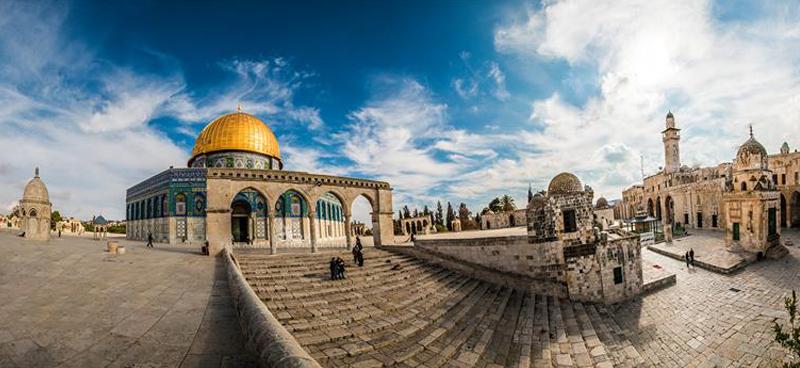
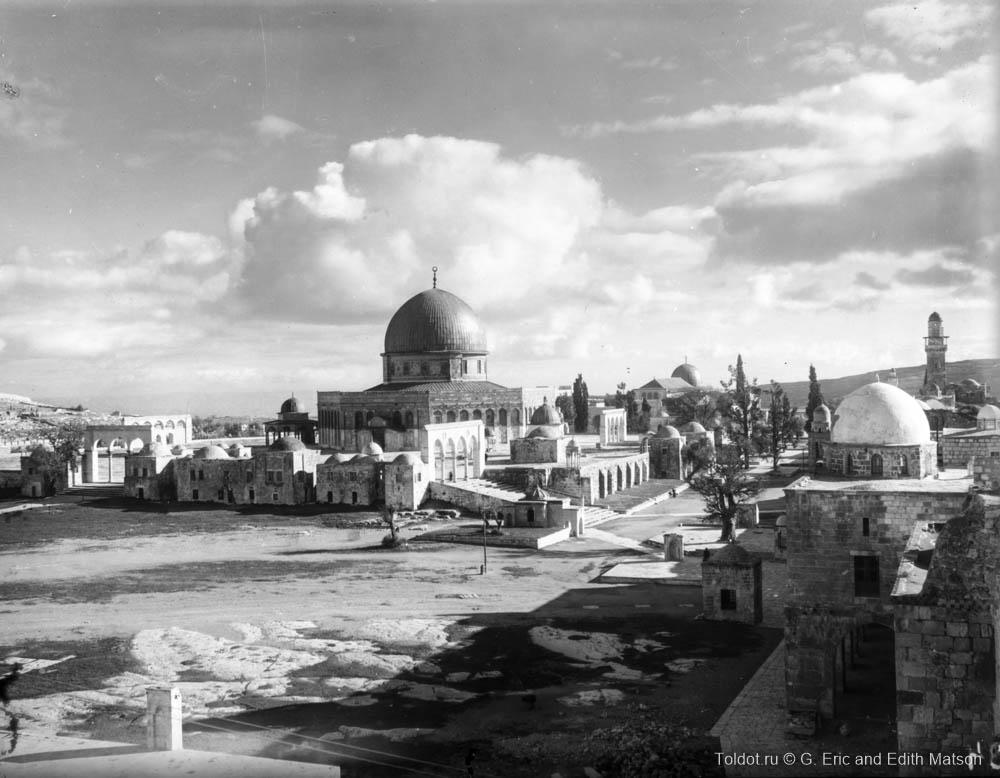
During the caliphate of Abd al-Malik ibn Marwan, the Dome of the Rock was built, and its construction was completed around 72 AH / 691 CE, making it one of the greatest masterpieces of early Islamic architecture.
The Dome of the Rock was not merely an architectural structure; it carried profound religious, political and civilisational significance, and over time it became one of the most renowned symbols of Jerusalem and of the Islamic world. The Jerusalem Awqaf Administration indicates that it was built in the Umayyad period by order of Abd al-Malik ibn Marwan, under the supervision of Raja ibn Haywa and Yazid ibn Salam.
The Al-Aqsa Mosque subsequently underwent expansion and construction during the Umayyad era, so the sacred precinct in Jerusalem became one of the most prominent centres of early Islamic architecture.
It was here that Jerusalem began to take the shape of an Islamic metropolis combining religion, architecture, scholarship and politics.
Jerusalem: City of Knowledge and Ribat
Jerusalem's importance was not tied to the Haram alone. It was a destination for scholars, worshippers and travellers, and it hosted circles of learning and transmission of narrations.
The city also retained its position on the caravan and pilgrimage routes between Egypt, the Levant and the Hijaz, becoming a point of connection between the regions of the Islamic world.
In the later Islamic periods, particularly under the Ayyubids and the Mamluks, scholarly and religious institutions multiplied around al-Masjid al-Aqsa, and madrasas, ribats and zawiyas spread.
The Crusader Occupation: The Fall of the Holy City
After more than four centuries of Islamic rule, Jerusalem entered a phase of severe hardship. In 492 AH / 1099 CE, the city fell to the Crusaders during the First Crusade, after a long military siege.
The fall of Jerusalem was a great shock across the Islamic world, not only because a strategic city had been lost, but because of its religious standing connected to al-Masjid al-Aqsa.
The recovery of Jerusalem became a prominent aim in the discourse of a number of Muslim scholars and leaders, and gradually a political and military project began to reunite Islamic forces against the Crusader principalities.
Nur al-Din Zengi: The Beginning of the Road to Liberation
Before Saladin, there was a project begun by Nur al-Din Mahmud Zengi, who worked to unify large parts of the Levant and confront the Crusader presence. His name is also associated with concern for Jerusalem even before its recovery.
Thus the liberation of Jerusalem was not a sudden decision taken by a commander in a fleeting moment, but the outcome of political, military and intellectual accumulation over many years.
Hattin: The Battle That Opened the Way to Jerusalem
The decisive moment came on 24 Rabi' al-Akhir 583 AH / 4 July 1187 CE, when the army of Saladin (Salah al-Din al-Ayyubi) defeated the Crusader forces at the Battle of Hattin.
The victory was a major turning point: the principal military strength of the Kingdom of Jerusalem collapsed, the Muslims recovered a large number of cities and fortresses, and the road to Jerusalem was opened.
Sources indicate that Saladin moved toward Jerusalem in Rajab 583 AH / 1187 CE, after recovering wide areas of Palestine.
Saladin Recovers Jerusalem
On 27 Rajab 583 AH / 2 October 1187 CE, Muslims entered Jerusalem after a siege and negotiations that ended with the surrender of the city.
The scene was radically different from the Crusaders' entry nearly nine decades earlier. Saladin chose settlement and granted safe conduct to those within the city under terms of ransom, rather than repeating the massacre that had occurred at its fall in 492 AH / 1099 CE.
The return of Jerusalem to Islamic rule was among the most prominent moments of Ayyubid history, and Saladin became associated in the Islamic collective memory with the recovery of the city after decades of Crusader occupation.
Jerusalem in the Ayyubid and Mamluk Eras
After its recovery, Jerusalem entered a new phase of construction and care. Its religious institutions were reorganised, madrasas were established, and the presence of scholars and jurists grew, and the city became an important part of the network of scholarly cities in the Levant.
Later, under the Mamluks, Jerusalem saw an expansion of madrasas and religious establishments, and the city was filled with scholars, students and pilgrims.
In this way, Jerusalem maintained its standing even when the major centres of power moved to other cities such as Damascus and Cairo.
What Makes Jerusalem an Exceptional Islamic Metropolis?
Because Jerusalem combines elements that are not brought together in any other city in this way.
Religious standing: al-Masjid al-Aqsa and the city's connection to the Night Journey.
Historical standing: the conquest under Umar ibn al-Khattab, followed by liberation at the hands of Saladin.
Scholarly standing: the madrasas, circles of learning, and the scholars associated with the city.
Civilisational standing: the Dome of the Rock, al-Masjid al-Aqsa, the madrasas, markets and walls.
Symbolic standing: Jerusalem has become a symbol of a long struggle over land, sacred sites and identity.
For this reason Jerusalem was never merely a city on the map of the Levant; it was always a city that transcends the boundaries of geography.
From Mecca to Medina, and then to Jerusalem, the first three stations of the "Islamic Cities Through History" map are complete: three cities that shaped the great beginnings: Mecca, the cradle of revelation; Medina, the capital of the state; and Jerusalem, the gateway of the Night Journey and the land of sacred sites.


