

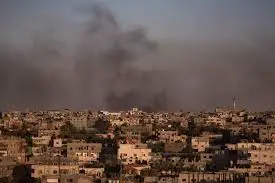
Israel must "immediately halt" its military offensive in Rafah, the southernmost governorate of the Gaza Strip, according to a new order issued by the United Nations' highest court, the International Court of Justice, on 16 Dhu al-Qadah (24 May).
The ruling falls short of the full ceasefire requested by South Africa during hearings last week. The court has no means of enforcing its ruling, which Israeli officials have indicated they will disregard. The order is part of the case brought by South Africa accusing Israel of committing acts of genocide in Gaza.
A final judgment is likely to take years. In the meantime, the court has the power to issue provisional measures. Earlier orders issued in Rajab and Ramadan (January and March) called on Israel to prevent harm to civilians, to halt and punish incitement to genocide, and to enable the urgent provision of humanitarian aid.
The court found that a new order was needed because the situation in Gaza has deteriorated markedly since Israel launched a ground invasion of Rafah on 28 Shawwal (7 May). Since then, more than 800,000 people have been forcibly displaced from the city, which previously hosted around 1.5 million Palestinians, or about 65% of Gaza's population.
Israel ordered people to evacuate parts of Rafah, but the court said it had not taken sufficient steps to ensure their safety or their access to essential services, including water, in the areas they were instructed to move to.
The Israeli offensive also forced the United Nations Relief and Works Agency for Palestine Refugees (UNRWA) to halt food distribution in Rafah due to dwindling supplies and insecurity. As part of the provisional measures issued on 16 Dhu al-Qadah (24 May), the International Court of Justice also ordered Israel to reopen the Rafah crossing.
The two main border crossings used to bring aid and supplies into Gaza are in Rafah. The Rafah crossing with Egypt has been closed since Israel took control of the Palestinian side of the border on 28 Shawwal (7 May). A limited quantity of supplies has entered through the Kerem Shalom crossing with Israel.
The shortage is not limited to food: a lack of fuel is forcing hospitals to shut down and threatens to halt the humanitarian response entirely.
For its part, the US administration threatened the court and announced that it is considering imposing sanctions on it over its decision to halt the offensive on the largest refugee camps in Gaza.
US Secretary of State Antony Blinken announced that he would work with US lawmakers to examine the possibility of imposing sanctions on the International Criminal Court, after the court's prosecutor, Karim Khan, revealed that he is seeking arrest warrants against senior Israeli officials.
Blinken told a US congressional hearing that he was "committed" to taking action against this "deeply wrong decision".
Blinken's remarks come amid a Republican-led campaign to impose sanctions on International Criminal Court officials, a vote on which may take place this week.
The United States has supported previous decisions of the International Criminal Court despite not being a member, including its endorsement of the arrest warrant issued by the court against Russian President Vladimir Putin over the war in Ukraine.
News agencies


