

India: Over 150,000 Homes Demolished and 738,000 People Displaced in Two Years
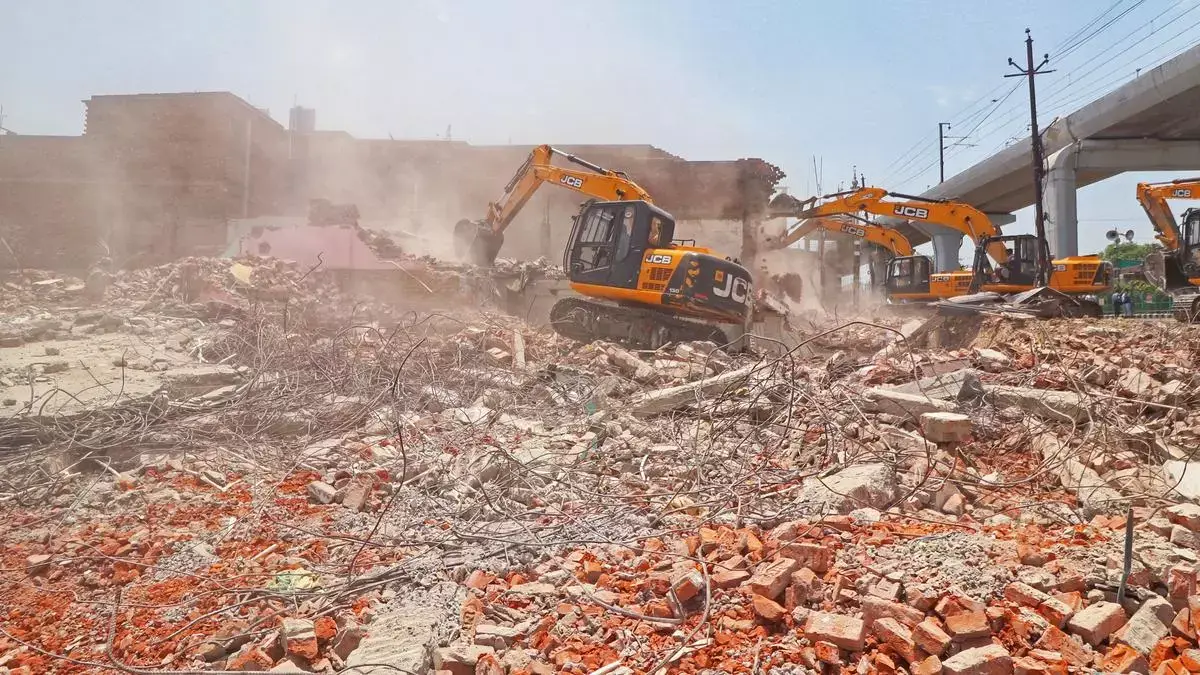
On the thirteenth of Dhul Hijjah (19 June), the state government demolished some 1,800 structures, including 1,169 homes and 101 commercial establishments, in a large-scale eviction drive in Akbarnagar in Lucknow. The government of the Bharatiya Janata Party plans to develop the area into a Gomti River Front, transforming it into a centre for eco-tourism. Many residents have lived there for decades, and some claim they lived there even before the development authority was formed.
Vishnu Kashyap, a resident, told a news website: "Our homes will be demolished, and now the government will build a riverfront here. Tell me, what is more important, a poor man's house or a riverfront?"
The government claims these structures are encroachments. A government spokesperson said the area had been encroached upon, with the river covered, "resulting in the river being filled with illegal constructions carried out by land mafias as well as Rohingya and Bangladeshi infiltrators."
This is not the only recent case of demolition, even after the National Democratic Alliance led by the Bharatiya Janata Party under Narendra Modi won a third term. Both Maharashtra and Madhya Pradesh have recently witnessed similar "bulldozer justice." In Mandla district in Madhya Pradesh, 11 homes owned by Muslims were demolished on 9 Dhul Hijjah (15 June) after police claimed to have found beef in their refrigerators.
On 7 Dhul Qadah (6 May), the Brihanmumbai Municipal Corporation demolished some 600 temporary settlements in Jai Bhim Nagar, a Dalit settlement in the Bhoiwada area of Mumbai, displacing 3,500 people. The demolished site, now reduced to rubble of roofing sheets, remains inaccessible to residents, who have been forced to live on pavements.
Painful Stories
Manoj (44) has lived in Delhi all his life, born and raised in Shahdara. His family first settled in Mansarovar Park, where they lived until the government built an overhead bridge, forcing them to move near Shyam Lal College. Their lives were again upended in 1432 AH (2011 CE) when their homes were demolished to make way for the construction of a tunnel. Recent years have brought further challenges. Their settlement has been demolished twice in two years, affecting more than 32 families. The stated reasons were "removal of encroachments" and "plans to develop a park."
"When they first demolished our settlement in Safar 1444 AH (September 2022), we had nowhere else to go. This place has always been our home," said Manoj, reflecting the sentiments of many people facing similar hardships.
Manoj and his community are constantly being uprooted, and when their homes are demolished in the name of development, they are forced to move across different parts of the area. This repeated relocation has left them in a state of anxiety, and they struggle even to find a place for a simple temporary arrangement.
Rising Evictions
According to estimates for 1445 AH (2024 CE) by the Housing and Land Rights Network (HLRN), local, state and central authorities demolished 153,820 homes in 1444 and 1445 AH (2022 and 2023 CE), resulting in the forced eviction of more than 738,438 people in rural and urban areas across the country. Statistics compiled by the Housing and Land Rights Network from 1436 AH (2017 CE) to 1444 AH (2023 CE) show a growing trend of evictions, affecting more than 1.68 million people. Looking at the annual breakdown of evictions across the country, the figures rose steadily, from 107,625 in 1440 AH (2019 CE) to 222,686 in 1443 AH (2022 CE) and 515,752 in 1444 AH (2023 CE).
The reasons for eviction have changed considerably as the number of cases has grown. Akanksha Padkor, a human rights lawyer, says: "The discourse surrounding displacement has evolved noticeably, moving from covert pretexts such as urban redevelopment to more direct terms such as encroachment-removal drives. In the last six or seven years, we have observed a significant increase in the rigidity of the system towards the poor."
Over the past two years, 59 percent of evictions took place under the guise of slum or land clearance, encroachment removal, or city beautification initiatives, resulting in the forced displacement of at least 290,330 people in 1444 AH (2023 CE) and more than 1,43,034 people in 1443 AH (2022 CE). Forced evictions were also carried out for infrastructure and alleged development projects such as smart city initiatives, environmental and forest protection projects, wildlife conservation efforts, and disaster management.
In cases where the justifications are vague, such as "removal of encroachments" or "beautification of the city," the state often resorts to the pretext of cleansing.
Punitive Demolitions
Indeed, another reason that has emerged in the discourse surrounding demolitions is punitive demolition. In 1444 AH (2023 CE), many evictions appeared to be linked to such demolitions in places such as Jirapur village in Khargone in Madhya Pradesh; Prayagraj and Saharanpur in Uttar Pradesh; Nuh in Haryana; Jahangirpuri in Delhi; and others.
Although government agencies claimed they were removing encroachments and illegal structures from public land, a closer study shows that specific groups were targeted by such action.
For example, following clashes that erupted during the Hanuman Jayanti procession on 19 Ramadan 1443 AH (20 April 2022 CE), officials of the North Delhi Municipal Corporation (NDMC), accompanied by 12 companies of the Central Reserve Police Force (CRPF), demolished some 25 shops, vending carts and homes owned primarily by Muslims in Jahangirpuri, all under the pretext of removing encroachments.
Similarly, in Khargone, following communal violence during Ram Navami and Hanuman Jayanti celebrations in Ramadan 1443 AH (April 2022 CE), 16 homes and 29 shops owned by Muslims were demolished, including a house built under the Pradhan Mantri Awas Yojana programme.
Although the law contains no provisions for the demolition of property as a punitive measure, this practice has become increasingly common in states governed by the Bharatiya Janata Party.
Akanksha said: "These are conclusions we can draw, indicating that these evictions were collective, based on patterns observable by an outsider. However, the legal process works differently, focusing on legal and illegal facts and circumstances. It cannot be denied that most of these homes have some degree of unauthorised construction, which is common in non-compliance with laws and building standards across India."
She added: "Since courts and the law operate only within the legal framework, which may not necessarily take into account the surrounding social realities, this creates an opportunity for political parties to exploit such frameworks and perpetuate violence and discrimination."
Targeting of Muslims
In Rajab (February), an Amnesty International report stated that Muslims were targeted in 128 demolitions affecting 617 people. The report found that demolitions were mostly carried out in areas with a high concentration of Muslims, specifically targeting property owned by Muslims in diverse neighbourhoods. By contrast, neighbouring properties owned by Hindus were not affected, particularly in Gujarat and Madhya Pradesh. In the report, Agnès Callamard, Amnesty International's Secretary General, said: "The unlawful demolition of Muslim property by Indian authorities, promoted as 'bulldozer justice', is cruel and horrifying.
Such displacement and dispossession is profoundly unjust, unlawful and discriminatory." Demolitions have been repeatedly initiated at the highest levels of government, where many officials have directly or indirectly called for the use of bulldozers against Muslims. These punitive demolitions have been aggressively employed as a form of extrajudicial punishment in several states.
Notably, the media has dubbed Uttar Pradesh Chief Minister Yogi Adityanath the "Bulldozer Baba."
At a rally in Barabanki district in Uttar Pradesh, as part of his campaign for the recently concluded Lok Sabha elections, Prime Minister Narendra Modi said: "If the Samajwadi Party and the Congress come to power, Ram Lalla will go back to the tent and they will direct a bulldozer at the Ram temple. They should take lessons from Yogi ji about where to use a bulldozer and where not to use a bulldozer."
This statement perhaps better highlights the political discourse surrounding such action.
According to data from the Human Rights and Migration Network, Muslims were the most affected group in 44 percent of cases. This underscores their vulnerability in the context of forced eviction and displacement.
Broadening the focus beyond the Muslim community, members of Scheduled Tribes, tribal communities and Adivasis were affected in at least 23 percent of cases, followed by members of Other Backward Classes (17 percent) and Scheduled Castes (5 percent).
Severe and Brutal
Demolition drives carried out recently have shown an increasing level of severity and brutality, surpassing what we witnessed in previous years.
Among the notable trends is the dense presence of force at sites, making it difficult for individuals to resist these actions.
Suman (36), a woman evicted under an encroachment-removal drive in Nanakpura in Delhi in 1444 AH (2023 CE), said: "During the demolition, a large force of around 200 personnel from the Central Reserve Police Force and a similar number of Delhi Police officers were stationed. Their presence prevented us from reaching our belongings inside. Worse still, they seized our tin roofs and loaded them onto a truck while the demolition was still ongoing."
Furthermore, at several sites, including Priyanka Gandhi Camp, Tughlakabad and Nanakpura, debris was removed immediately after demolition, and families were prevented from salvaging the remains of their homes.
Ashok, who lives near Shyam Lal College in Delhi, said: "They are not only trying to remove us from this site, but they are also making sure the place is no longer habitable. Where will we go from here? The last time they came to demolish our homes, they dug a pit 5-6 feet deep so we could not rebuild our homes on the site. Still, we will not leave until the government rehabilitates us."
Rika, a farmer living in Bela Estate near the Yamuna floodplains, echoed these sentiments. Bela Estate has faced repeated demolitions in recent years as the government seeks to reclaim land following an order from the National Green Tribunal. Rika said: "They have tried to displace us several times. They dig pits and throw our essential belongings into them, including basic necessities such as ration, before filling them with sand."
Sheikh Akbar Ali, a housing rights activist who has worked in Delhi's informal settlements for nearly two decades, said: "The authorities know that after demolitions, people will try to rebuild on the same site, so they confiscate the materials. Previously, we did not see bulldozers come after 5 p.m. or early in the morning, but this has now become common too."
Jayshree Satpute, a human rights lawyer, said: "While housing rights activists and lawyers have succeeded in securing court orders to halt illegal actions, the administration has adopted hostile strategies."
She added: "Previously, when we presented a stay order, the police would stop the demolition. Now, they ask for a copy of the stay order, often a certified copy, before complying. Authorities find ways to circumvent the legal processes on which activists rely."
In a landmark ruling in the case of Ajay Maken v. Union of India in 1440 AH (2019 CE), the Delhi High Court affirmed that evicting settlement residents without proper notice or adherence to the due process procedures set out in the case of Sudama Singh v. Government of Delhi in 1441 AH (2010 CE), and without adequate rehabilitation, is illegal.
No Due Process
Yet over the past two years, many evictions carried out have failed to follow due process. These incidents include evictions carried out without sufficient notice, and demolitions that took place in adverse weather conditions and even during school examinations, often involving the use of disproportionate force.
On the tenth of Shawwal (30 April) and the eleventh of Shawwal (1 May 2023 CE), the Bengali area of Tughlakabad in Choriya Mohalla was the site of one of the largest evictions in the past seven years. The Archaeological Survey of India had issued notices to more than a thousand families there three months earlier, on the eighteenth of Jumada al-Akhirah (11 January), asking them to vacate their homes within 15 days.
In the past, in the absence of specific legislation, courts creatively interpreted legal principles to address violations of housing rights. The Supreme Court and various high courts have consistently recognised the right to housing/shelter as an integral aspect of the fundamental right to life. Landmark judgments such as those in the Sudama Singh and Ajay Maken cases imposed a duty on state authorities to conduct surveys and provide rehabilitation before resorting to evictions.
In contrast to the claims of the Delhi Municipal Corporation and the police, residents said they were not aware of the impending demolition until the Housing Department issued its notice. The notice was pasted on their doors and did not specify a date for demolition or provide any information about rehabilitation or temporary shelter. A woman displaced from her home said: "We were not even given time to retrieve our valuables and personal belongings. All my children's books and school uniforms have disappeared. It was pouring rain on the day of the demolition. We begged them to give us at least one day to save our belongings. Yet our dreams collapsed along with our homes."
Satpute, a lead lawyer in the Sudama Singh case, said: "Progressive judgments and cases have established due procedure, but these processes are not being followed... Courts upheld people's rights much more strongly 10 years ago. Recently, we have struggled to secure favourable decisions or timely compensation."
This disregard has had tangible consequences: in 1444 AH (2023 CE) alone, court orders and judgments led to at least 13 evictions, displacing more than 259,845 people across the country.
Notably, around half of those evicted in 1444 AH (2023 CE) lost their homes due to enforcement ordered by the court. The demolition of homes in Akbarnagar, Lucknow, is another example of court-driven eviction. In Jumada al-Ula (December), residents resisted through litigation in both the Allahabad High Court and the Supreme Court. However, the Supreme Court ultimately allowed the government to proceed with clearing the area.
Anand Lakhan, a housing rights activist from Madhya Pradesh and leader of the Madhya Pradesh Nav Nirman Manch, expressed concern about the current state of judicial processes and government actions. He said: "From the justice of the court, we have moved to the times of justice by bulldozer. Initially, we believed we could rely on presenting strong evidence in court rather than begging for mercy. However, the government often completely ignores this evidence."
He added: "Even when we obtain a stay order, government authorities often disregard it and continue with demolitions. When we file a contempt of court petition, these applications are rarely accepted."
Referring to the eviction of a residence in Dhul-Hijjah (June) in Bhiblehana in Indore, for the sake of road development, Lakhan said: "A similar case of contempt occurred. When we applied for a stay order, it was not upheld, and ultimately the contempt case faded away. Meanwhile, an entire settlement was erased."
Evicted people face many obstacles in accessing justice, which are compounded by courts' reluctance to provide protection and relief. For example, in 1443 AH (2022 CE), the Delhi High Court refused to halt the demolition of 100 homes owned by low-income families in Jaispur, despite reports indicating their long-term residence in the area.
The court justified its decision by saying that the settlement was not listed among the recognised bastis on the Delhi Urban Shelter Improvement Board's list.
More than 17 million people in the country live under the threat of having their homes demolished. Lakhan said: "If the police and various departments continue to take demolition actions without proper legal procedures," this would amount to a "blatant violation of people's constitutional rights, as they are not given sufficient time for a proper hearing."


