

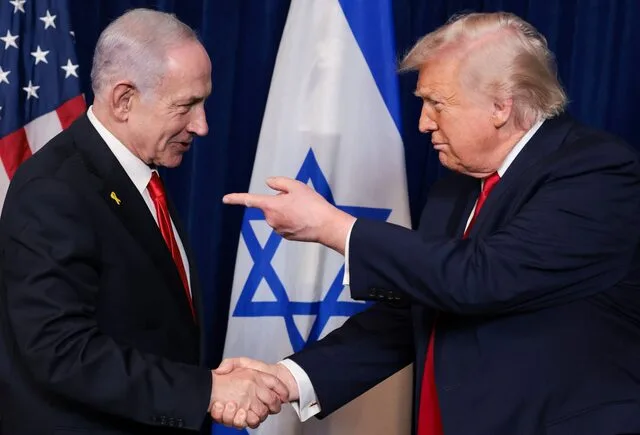
The question now surrounding the relationship between US President Donald Trump and Israeli Prime Minister Benjamin Netanyahu is no longer limited to the extent of the differences between the two men. It has come to extend to the possibility that Netanyahu has become, in the calculations of the White House, a political burden rather than a strategic ally, at a time when Trump is seeking a way out of the repercussions of the war on Iran and the defeat his party suffered in the US midterm elections.
The leak revealed by Israeli journalist Ben Caspit regarding a message conveyed from people close to Trump to Gadi Eisenkot, leader of the Israeli party "Yashar," gains its importance from its timing and the political context surrounding it, not from its content alone.
According to what Caspit reported on Israeli Channel 12, and which Israeli media outlets including Maariv relayed, figures close to the US president conveyed to Eisenkot's team a message urging him to hasten the formation of a new government and end Netanyahu's rule. Its content was clear: "Form the government now, and replace Bibi now."
This leak does not represent an official announcement from the US administration, nor does it prove that Trump issued a personal directive to remove Netanyahu. But it raises a fundamental question: has Washington begun preparing for a post-Netanyahu phase, after continuing the alliance with him has become politically costly for Trump himself?
From Alliance to Burden of War
This development cannot be read apart from the US-Israeli war on Iran, which turned from an operation that was supposed to be limited in time into a prolonged conflict that drained resources and raised energy costs, and became one of the factors that contributed to the Republicans' electoral defeat.
Vice President JD Vance, following the election of 3 November, revealed the extent of the predicament when he held the war responsible for the loss of the Republican Party, arguing that voters also want a change in the nature of the US relationship with Israel.
Trump did not deny this interpretation; rather, he acknowledged that the war was one of the reasons for the loss and that the rise in fuel prices resulting from it affected voters. At the same time, however, he stood by the decision to wage the war, asserting that he would take the same decision again.
Here the paradox appears: Trump does not want to acknowledge that his strategic decision was mistaken, yet he now faces the electoral price of that decision. Consequently, seeking another party to bear a greater share of responsibility may become an attractive political exit.
In this context, Netanyahu appears a clear candidate to bear this burden, given his role in pushing toward confrontation with Iran and his bet on American power to settle the conflict in favour of the Israeli state.
But placing responsibility on Netanyahu does not negate the fact that the decision for the United States to enter the war was taken by Trump's own administration, and that the US president still defends it.
This is a possible disagreement over the cost of the war and its management, not yet evidence of a fundamental disagreement over its objectives.
Military Aid: Another Signal of Shifting Calculations
Trump's announcement about ending the annual military aid to the Israeli occupation added another indicator to the ongoing shifts.
On 3 November, the US president announced his intention to end aid amounting to roughly four billion dollars annually, while maintaining arms sales, and said Netanyahu himself had previously discussed with him the possibility of ending that aid.
However, the announcement does not mean that funding has actually stopped. The existing agreement stipulates the provision of 38 billion dollars over ten years until 2028, and any fundamental change in funding mechanisms requires arrangements and legislative decisions.
The significance of the statement lies in the fact that Trump now speaks openly of US support for what is called "Israel" as an issue with a domestic political cost, one that the Democratic opposition could exploit, and which some of his Republican supporters even object to.
Nevertheless, a distinction must be drawn between halting direct aid and ending military support. The continuation of arms sales and industrial, technological and security cooperation means that Washington may be reshaping the tools of its support for the Israeli occupation state rather than abandoning it.
This is the difference between changing the image of the relationship before the American voter and changing its substance on the ground.
Netanyahu's Defeat Opens the Door to an Alternative
On the Israeli side, the 27 October elections placed Netanyahu before a domestic predicament coinciding with US pressure.
On 7 November, Israeli President Isaac Herzog announced his decision to task Gadi Eisenkot with forming the new government, after blocs representing 67 members of the Knesset recommended him, compared with 46 members who recommended Netanyahu.
Eisenkot is scheduled to receive the formal mandate on 8 November, with 28 days to form the government, and the deadline may be extended by an additional 14 days.
However, the mandate does not mean that Eisenkot has formed the government; parliamentary alliances remain complex, and he may not be able to turn the large number of recommendations into a stable coalition.
Nevertheless, this development gives the leak concerning the position of Trump's associates additional significance.
If Washington is indeed seeking an alternative to Netanyahu, Eisenkot represents an option that can be dealt with from within the Israeli political and security establishment itself, without the need for an upheaval in the country's strategic choices.
Here lies the most important point: Eisenkot is not a representative of a current opposed to Israeli security policies, but a former chief of the General Staff, and he affirms his commitment to maintaining the Israeli state as a Jewish state, strengthening the alliance with the United States, and continuing to work to dismantle the military and governmental capabilities of Hamas.
Accordingly, replacing Netanyahu with Eisenkot, if it were to happen, does not necessarily mean replacing Israeli policies toward Palestine, Iran or the region, but may mean administering those policies under different leadership, with tools less likely to provoke disagreement with Washington.
Will Trump Sacrifice Netanyahu to Save Himself?
It is possible that Netanyahu has lost part of his political value to Trump.
The US president, who presented himself as capable of ending wars, has found his administration entangled in a prolonged war, his party out of control of both chambers of Congress, and his promises to reduce the cost of living under growing pressure.
Under these circumstances, his continued attachment to Netanyahu may no longer be an asset, but an element that makes it harder to defend his policy before voters.
However, it is premature to regard the leak as evidence of a final rupture. The sources that conveyed the message have not disclosed their identities, and no official position has come from the White House confirming that Trump endorses the call to remove Netanyahu.
There is also a difference between the desire of some people close to the president to accelerate the formation of an Israeli government and the existence of a comprehensive American decision to change Israeli leadership.
Nevertheless, the coincidence of the leak with the electoral defeat, the debate over the Iran war, the announcement on military aid, and the decline of Netanyahu's position within the Israeli state makes the hypothesis of a shift in Washington's calculations worthy of attention.
The matter does not necessarily concern a change in Trump's convictions so much as a change in the balance of gains and losses.
From Venezuela to Iran: Calculations of a War That Did Not Materialise
This reading gains further importance when returning to the circumstances that preceded the outbreak of the war on Iran, and to the role attributed to Netanyahu in persuading Trump that a quick victory was achievable.
In a report published in May 2026, The Guardian quoted former Israeli diplomat Alon Pinkas as saying that Netanyahu used the success of the American operation in Venezuela to persuade Trump that a similar experience could be repeated in Iran, through a rapid military operation leading to regime change.
The irony is that the war that was supposed to produce decisive results quickly turned into a more complex and prolonged conflict, and its economic and political costs extended into the American domestic sphere itself.
Indeed, according to press reports, Netanyahu continued to press for the resumption of broad strikes against Iran, at a time when American circles were expressing reservations about returning to escalation.
Thus the relationship between the two allies appears governed by a growing contradiction: Netanyahu sees the continuation of military pressure as a means of achieving Israel's regional objectives, while Trump must also weigh the cost of the war on the American economy and his political future.
This contradiction may lead to an American desire to rid itself of Netanyahu personally, without abandoning the strategic objectives that brought them together.
Will the Course of the War on Iran Change?
Changing the Israeli government may open the way to reorganising the regional political landscape, and perhaps facilitating a settlement, de-escalation, or a reformulation of the objectives of the confrontation with Iran.
The Trump administration may benefit from the arrival of new Israeli leadership to present any shift in the course of the war as the fruit of political review, rather than acknowledging the failure of earlier bets.
However, this possibility does not mean that a change of leadership in the Israeli state will automatically end the war, let alone change Washington's position on Iran.
Trump, despite acknowledging the electoral cost of the war, has not retreated from defending it, and he still considers preventing Iran from acquiring a nuclear weapon a justification for continuing military operations.
On the other hand, there are not sufficient indications that Eisenkot, if he becomes prime minister, would adopt a radically different regional policy from Netanyahu's.
Language, priorities and methods of managing the conflict may change, but the security interests and military alliances on which Israeli policy rests are too deep to disappear simply because power passes from one prime minister to another.
More importantly, any genuine change should be measured by what happens on the ground: Do military operations stop? Do the terms of negotiation with Iran change? Does American support for Israeli operations decline? And do these shifts affect Israel's policies toward the Palestinians and the states of the region?
Merely changing names and rhetoric is not enough to speak of a strategic transformation.
Changing Faces or Changing Policies?
Trump may have begun searching for a new Israeli ally who does not carry the political burden that Netanyahu now represents, and those close to him may have realised that the continuation of the Israeli prime minister is no longer necessary to protect shared American and Israeli interests.
But it would be a mistake to exaggerate the interpretation of this possibility and portray it as the beginning of an American separation from the Israeli state, or a fundamental review of the policies that ignited the conflict in the region.
The political history of major alliances shows that states can sacrifice leaders they have been associated with for years when their continuation becomes a burden on their interests, without this meaning abandoning those interests.
Netanyahu today may be closer to paying the price of the failed bets he helped create, while Trump tries to contain their consequences domestically and to present himself again as the decision-maker capable of correcting the course.
Yet getting rid of the person with whom the war became associated is not the same as getting rid of the logic of war.
Hence the deeper question is not whether Trump wants to topple Netanyahu, but whether he is prepared to abandon the policies that made Netanyahu a preferred ally to begin with.
Until the answer appears in actual military and political decisions, the possibilities of change will remain open, but caution is necessary against selling illusions of a major transformation that practice does not support.
Netanyahu may leave office, Eisenkot or someone else may come, and the language of Washington and Tel Aviv may change, but the real test will remain the fate of the war on Iran and Israeli policies toward Palestine and the region, not the identity of whoever sits in the prime minister's chair.


