

Ground Fighting Reaches One of Gaza's Last Supposed "Safe Zones"
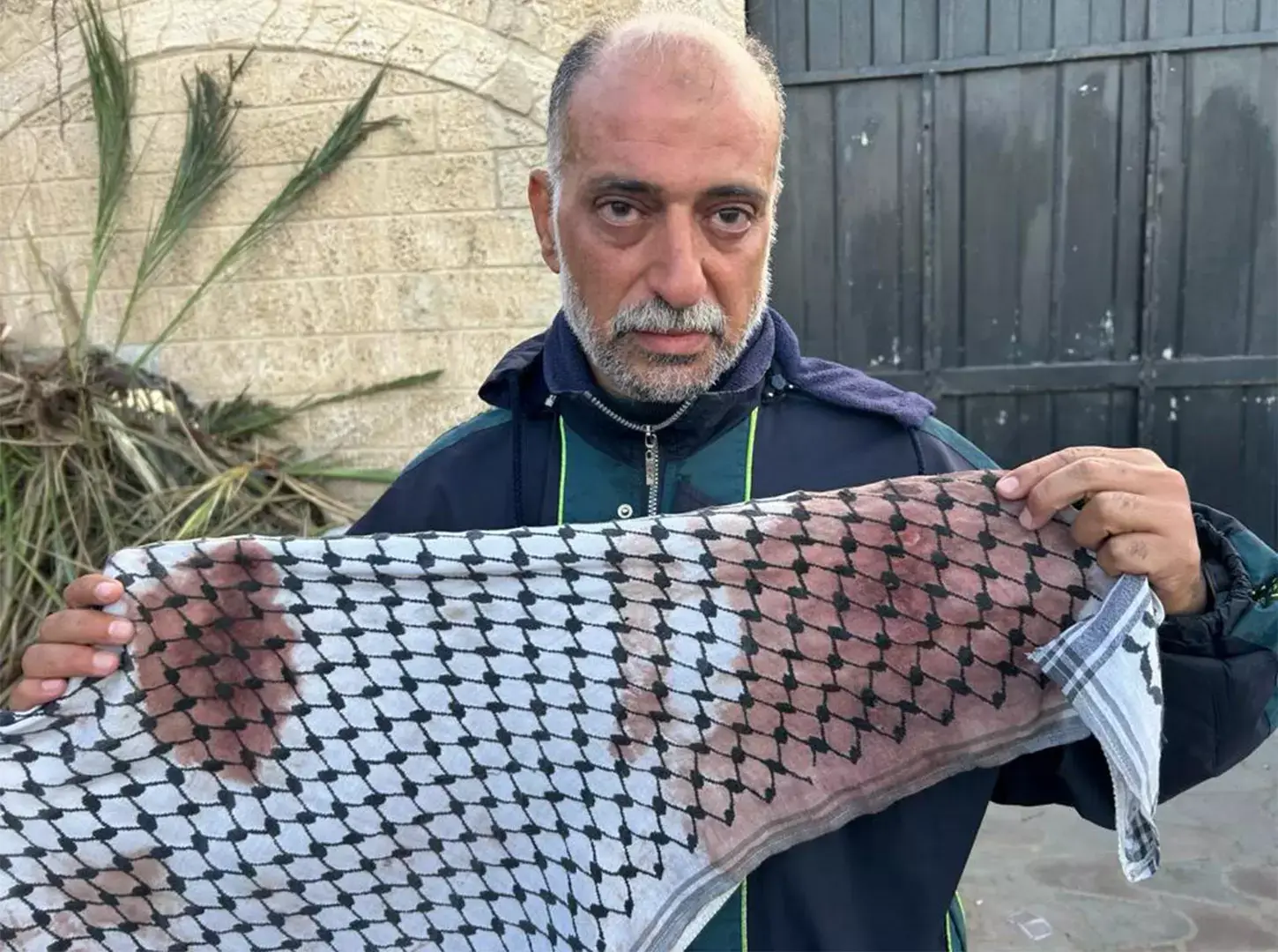
The image shows Hammada al-Fara holding the Palestinian keffiyeh in which he wrapped the body of his 13-year-old son after he was killed in a missile strike in al-Mawasi, a "safe zone" designated by the Israeli occupation in Gaza earlier this month.
Earlier this month, the New Humanitarian published a report on the harsh conditions faced by hundreds of thousands of people who have taken refuge in al-Mawasi, a supposed "safe zone" designated by the Israeli occupation in southern Gaza, where the basics needed to sustain life were scarce, relief groups struggled to operate, and bombs continued to fall.
Since then, the situation in al-Mawasi has deteriorated markedly. The narrow coastal strip stretching between the two southernmost governorates of Gaza, Khan Younis and Rafah, has come under attack as the Israeli army has encircled Khan Younis, Gaza's second-largest city.
Israeli ground forces first advanced into al-Mawasi on 10 Rajab (22 January). A strike on al-Mawasi school that day killed 10 people. Another strike the following day hit tents sheltering displaced people, according to the UN Office of the High Commissioner for Human Rights.
Then, on 12 Rajab (24 January), a strike on a building at the Khan Younis Vocational Training Centre killed at least 13 people and injured dozens more, according to the United Nations Relief and Works Agency for Palestine Refugees in the Near East (UNRWA). More than 40,000 displaced people had been registered at the centre, which is located in Khan Younis near al-Mawasi. Other displaced people had set up tents near the facility.
Cut off from medical facilities, which have been besieged by Israeli forces, and surrounded by intense fighting nearby, thousands of people who had taken refuge in al-Mawasi gathered their few belongings and fled, even as Israel continued to encourage people to shelter in the area, according to reports.
"The Most Terrifying Thing I Have Ever Experienced"
Tally after more than 100 days of war
More than 27,000 people have been killed in Gaza, including around 17,000 women and children, and more than 65,000 have been injured since the start of the Israeli military campaign on 7 October, according to health officials in the territory, which is governed by Hamas.
The Israeli army began bombing Gaza and imposing a complete siege following the Hamas attack on Israel on 7 October, which left around 1,140 people dead, roughly two-thirds of them civilians according to Israeli officials (describing Jewish settlers). Hamas and other Palestinian armed groups also took around 240 hostages into Gaza. About 136 of them are still in captivity.
The vast majority of Gaza's population has been forcibly displaced and is being crowded into the southern part of the territory, while facing a catastrophic humanitarian situation, with relief organisations warning of famine and widespread disease outbreaks. On 14 Rajab (26 January), the International Court of Justice, the highest court of the United Nations, ruled that the charges brought by South Africa against Israel of committing acts of genocide in Gaza are "plausible".
Violence by the Israeli army and settlers has also escalated in the occupied West Bank, where at least 367 Palestinians, including 94 children, have been killed and more than 1,200 people forcibly displaced from their homes since 7 October.
Abdul Razzaq al-Aswal, his wife and their two children were among those who set up temporary shelters near the UNRWA Vocational Training Centre after being displaced from their home in northern Khan Younis on 2 December.
When the centre was struck, "panic and terror overwhelmed the displaced people in the nearby shelters. Everyone began to recite the shahada when we felt our death was imminent. There was the sound of gunfire over our heads and missiles exploding near us," said al-Aswal, 30, speaking to the New Humanitarian.
Many families rushed to find shelter in a nearby warehouse, but al-Aswal decided to flee the area, despite his wife's desperate pleas.
"We were running as fast as we could, like dozens of other families. She was carrying our youngest child, and I was carrying our other son." "We ran dozens of metres under the shelling until we reached the intersection of the main street in al-Mawasi. We had to cross it to reach an agricultural area that was less dangerous."
But al-Aswal said the street was packed with Israeli tanks just a few metres away, describing how some people—overcome by fear and exhaustion—collapsed on the ground while others screamed hysterically.
"An elderly man called out: 'Don't hesitate. Don't turn back. Cross the street quickly in front of the tanks, whatever the cost.' Those moments, when we crossed the streets, were the most terrifying I have ever experienced."
"It was like something out of a film. Imagine running with your family while shelling, explosions, gunfire, smoke, tanks and death all accompany you. I never thought we would live to see another day."
"Where Will We Go?"
Nahed Barbakh, 58, and his family—13 people in total, including children and grandchildren—are staying in the agricultural area of al-Mawasi. They carefully chose a low-lying area for their shelter, hoping the surrounding sand dunes would protect them from any shells or missiles, and from the cold winds. But with Israeli tanks advancing into Khan Younis, they came to within one kilometre of the place Barbakh had chosen.
"I fear for my family and my neighbours [because of] Israeli bombardment as Israeli tanks continue to advance deeper into al-Mawasi," he said. "But where will we go? How can I move the shack I struggled to set up?"
Barbakh, who fled to al-Mawasi from his home in central Khan Younis in early December, said the humanitarian situation for people in the area is deteriorating rapidly after Israeli tanks besieged UNRWA aid distribution centres in Khan Younis—where some members of his family had been able to obtain aid—trapping them.
"The only market in Khan Younis has also been invaded by Israeli tanks, which means we need to go to Rafah or Deir al-Balah to buy our daily necessities," he added, noting that whatever was still available in the market was being sold at exorbitant prices.
"The invasion of what remains of Khan Younis has paralysed the lives of the displaced people living in al-Mawasi, and the bombardment increasingly endangers our lives. Although Israel asked us to move here, we are worried about what is to come."
"The Israeli Army Told Us the Situation Was Safe"
Standing outside a small house in al-Mawasi, Hammada al-Fara (50) held the blood-stained keffiyeh in which he had wrapped the body of his 13-year-old son, Abdul Rahim, after he was killed in an Israeli missile strike two weeks earlier.
Al-Fara and at least 40 other members of his extended family fled their home in central Khan Younis when Israel issued evacuation orders on 2 December. Following Israeli instructions, they went to al-Mawasi, taking with them the few things they could carry.
"We fled the bombardment and the incursion in central Khan Younis to al-Mawasi after the Israeli army told us it was safe," al-Fara said.
But his son Abdul Rahim was playing in front of the small house where the family had been sheltering when a missile struck a nearby wall, sending shrapnel flying. Three cars were severely damaged, and shrapnel pierced a metal door. "Can you imagine what my little boy's body looks like?" said al-Fara. "He was blown to pieces."
New Humanitarian.


