


German authorities carried out a series of raids in the city of Leipzig in eastern Germany and the neighbouring state of Saxony. Around one thousand officers took part in the raids, following investigations into some fifty Syrians suspected of involvement in smuggling and misuse of identity documents.
According to German press reports, including the regional broadcaster MDR, Der Spiegel and the Frankfurter Allgemeine Zeitung, German prosecutors in Leipzig ordered the raids after investigations began into a number of Syrian men and women, aged between 20 and 57. The reports indicate that the suspects were living in Germany, but are accused of misusing their legal identity documents. Some of those arrested in the raids are accused of entering Germany illegally, in addition to smuggling other migrants into the country.
A statement from the German police said the suspects are accused of sending their identity documents to Syria, which were then used by people resembling them to enter Germany with forged identities.
Marcel Pritzsch, a spokesperson for the German police, said the alleged fraud had come to the attention of embassy staff and border control officials at the airport.
Is it part of organised crime operations?
Investigations are ongoing, and the authorities are working in coordination with organised crime units, known as the "Clan Task Force", to determine the extent to which this group may operate within gang-like structures.
Reports indicate that German police teams raided numerous houses and apartments, as well as some businesses in Leipzig and the surrounding areas. Some of those targeted in the raids are people who sent their identity documents, while others are suspected of entering Germany illegally.
A police statement, published in Der Spiegel, said that data on those confirmed to have entered Germany illegally had been handed over to the authorities. However, the Frankfurter Allgemeine Zeitung (FAZ) confirmed that no arrests had been made on Tuesday.
Fraud exposed at the airport
The Frankfurter Allgemeine Zeitung (FAZ) revealed the "trick" when people were stopped at the airport whose features did not fully match the person named on the identity document. Some checks had already been carried out at checkpoints as travellers attempted to board flights bound for Germany from the Middle East.
According to the FAZ, German police officers and visa officials are currently working with some airlines to prevent this kind of abuse. The newspaper noted that "many cases" had come to the attention of the police.
Most of the raids were concentrated in one area of Leipzig, which has a high density of migrant residents. Other raids were carried out in neighbouring areas.
Why has the Mediterranean route become deadlier for migrants?\
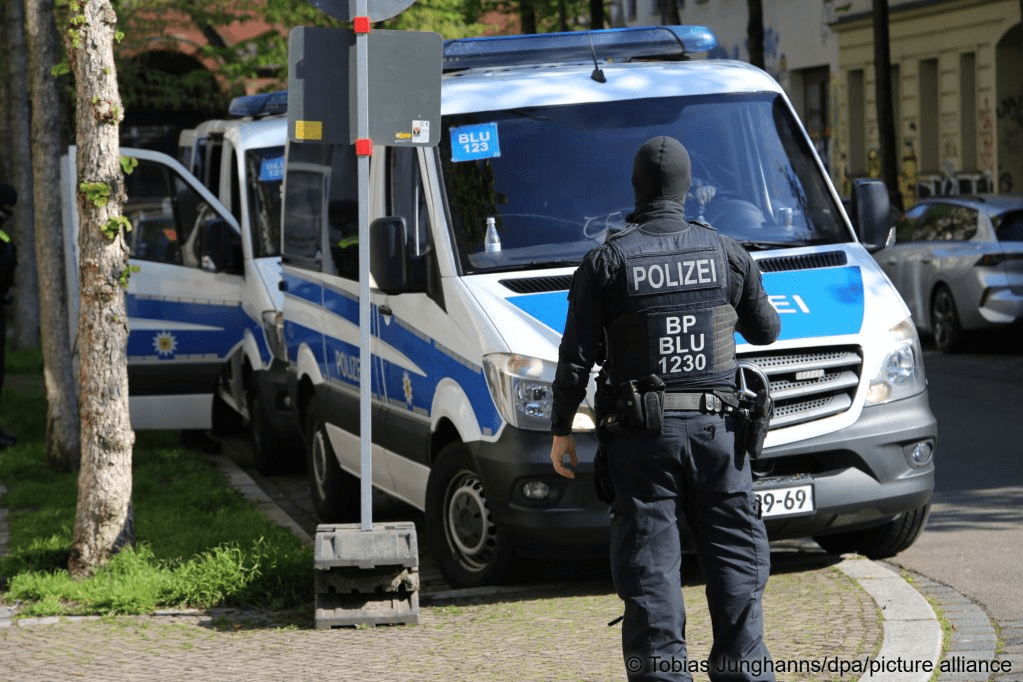
Around one thousand police officers took part in the raids targeting properties and shops across Leipzig. Police believe similar cases may occur in other parts of Germany. | Photo: Tobias Jungans/dpa/Picture Alliance
"Word of mouth"
According to Mike Fischer, a German police spokesperson who spoke to the Frankfurter Allgemeine Zeitung, the fraud spread orally among members of the Syrian community. Police believe some people paid money to use one of these cards. Police believe this type of fraud also occurs in other parts of Germany.
Last year, the local newspaper Leipziger Volkszeitung published a report on a similar case in Leipzig. In that case, a Syrian woman reported to the Leipzig Foreigners' Office (Ausländerbehörde) that she had lost two identity cards. When asked for new passports, she sent photos of a Syrian woman who was then living in Turkey.
The newspaper reported that the Syrian woman's husband sent the new passports by post from Leipzig to Turkey.
A separate case in Stuttgart
Also on Tuesday, according to a press release from the German Federal Police in Stuttgart (Bundespolizeidirektion Stuttgart), officers went to a property in Rottenburg am Neckar, in the state of Baden-Württemberg, owned by a Syrian national.
According to the police report, the 30-year-old Syrian is suspected of advertising migrant smuggling services. Prosecutors believe they have evidence that he arranged at least 15 smuggling operations, through which at least 66 people were brought to Germany.
Most of these people are believed to have been smuggled across the Polish border into Germany. Prosecutors believe he advertised his services via the Telegram app. They also found video evidence of some of the alleged smuggling operations, which they said was used to promote his services and attract more clients.
Police said they seized the man's mobile phone and other property to build a case against him.
The Syrian population in Germany numbered nearly one million, according to the latest census conducted at the end of 2024. Syrians are among the nationalities that obtained German residence in greatest numbers over the past decade, with many arriving in 2015 and 2016 and being granted refugee status or the right to asylum, which they later converted into residence permits and even citizenship.
InfoMigrants


