

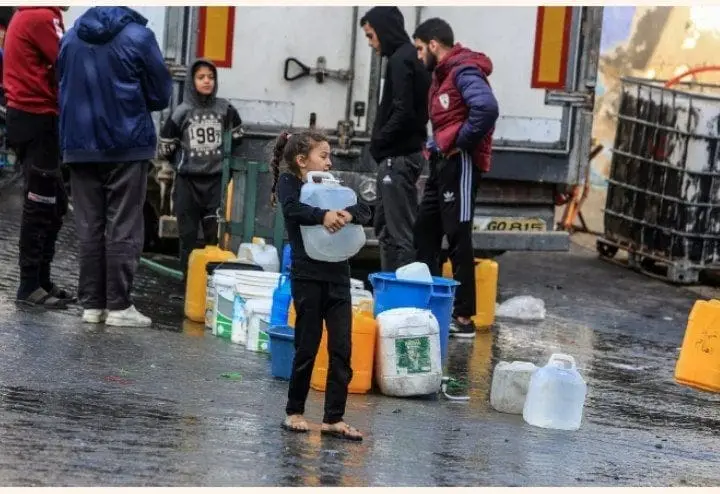
The World Health Organization has said that Palestinians in the Gaza Strip are "starving to death" because of restrictions on humanitarian aid, while access to clean water "has become a matter of life or death".
The WHO issued its statement as the genocidal war waged by Israel continues, despite a ruling by the International Court of Justice ordering the occupying state to take immediate steps to prevent civilian casualties, to halt and punish incitement to genocide, and to enable the urgent provision of the humanitarian assistance needed in Gaza.
Michael Ryan, Executive Director of the WHO's Health Emergencies Programme, said on Wednesday: "These people are starving to death, they are being pushed to the brink." "Civilians in Gaza are not parties to this conflict and must be protected, as must their health facilities."
The official noted that the Palestinian people in Gaza are in the midst of a "massive catastrophe" that could worsen. "People should not be expected to live indefinitely on food aid. Food aid is supposed to be emergency assistance to help people. If you combine malnutrition with overcrowding and exposure to the cold through lack of shelter… conditions can be conducive to large-scale outbreaks of epidemics." This is especially the case for children. Ryan added that such epidemics have already been observed.
Meanwhile, WHO Director-General Tedros Adhanom Ghebreyesus said the organisation faces "severe challenges" in continuing to support the health system in Gaza. He noted that "more than 100,000 people in Gaza have been killed, injured or are missing and presumed dead". "The risk of famine is high and increasing every day as hostilities continue and humanitarian access is restricted. The Nasser Medical Complex, the main hospital in southern Gaza, is now operating with one ambulance, and patients are being brought in on donkey carts." Ghebreyesus added that although the WHO attempted to deliver food to the hospital on Tuesday, that aid was stripped from the trucks "by crowds who are also in desperate need of food".
The United Nations Relief and Works Agency for Palestine Refugees (UNRWA) affirmed its own position that access to clean water is a matter of life or death. "In #Gaza, every day is a struggle for bread and water. Every day is a fight to survive. Without safe drinking water, more people will die from deprivation and disease."
According to UNRWA's Director of Communications, Tamara Alrifai, "continuous overcrowding, including thousands sharing a handful of bathing and toilet facilities, has worsened outbreaks of skin diseases including scabies and lice, which have been compounded by people's inability to bathe. Our latest figures show that there is one shower unit for every 2,000 people, and one toilet for every 500 people."
Days after major donors announced the withdrawal of funding from the agency, UNRWA noted that there had been at least 270 Israeli attacks so far on UN facilities sheltering displaced Palestinian families, "and this has killed 372 people". With nowhere else to go, people continue to shelter in the same UN facilities, even after the attacks. "The situation is utterly desperate."
The United Nations Conference on Trade and Development (UNCTAD) said in a new report that the level of destruction caused by the recent Israeli military operation has made Gaza "uninhabitable". UNCTAD economist Rami Alazzeh warned that "new data indicate that 50% of buildings in Gaza have been damaged or destroyed". "The longer these [military] operations continue in Gaza… the more dangerous their impact becomes."
UNCTAD said the Gaza Strip was in a dire state before the war broke out, as the blockade led by Israel for 17 years and repeated military operations, six of them major attacks, had left around 80 per cent of the territory's population dependent on international aid. The agency estimates that Gaza's already damaged economy contracted by 4.5 per cent in the first three quarters of 1444 AH (2023).
Rami Alazzeh noted that "Gaza's economic sector has come to a complete halt". He added that the only people currently working in the sector are those involved in humanitarian operations. UN officials estimate that even if reconstruction began immediately, it would take seven decades for Gaza to return to the gross domestic product level it recorded in 1444 AH (2022). Massive international assistance, "several tens of billions of dollars", is needed to rebuild Gaza and bring its development to a more liveable level.
UNCTAD concluded that only by ending the military confrontation and fully lifting the blockade on Gaza can there be hope for a sustainable solution to the political, social, economic and humanitarian crisis engulfing Gaza. "The vicious cycle of destruction and partial reconstruction must be broken through negotiating a peaceful settlement, based on international law and relevant United Nations resolutions and Security Council resolutions."


