

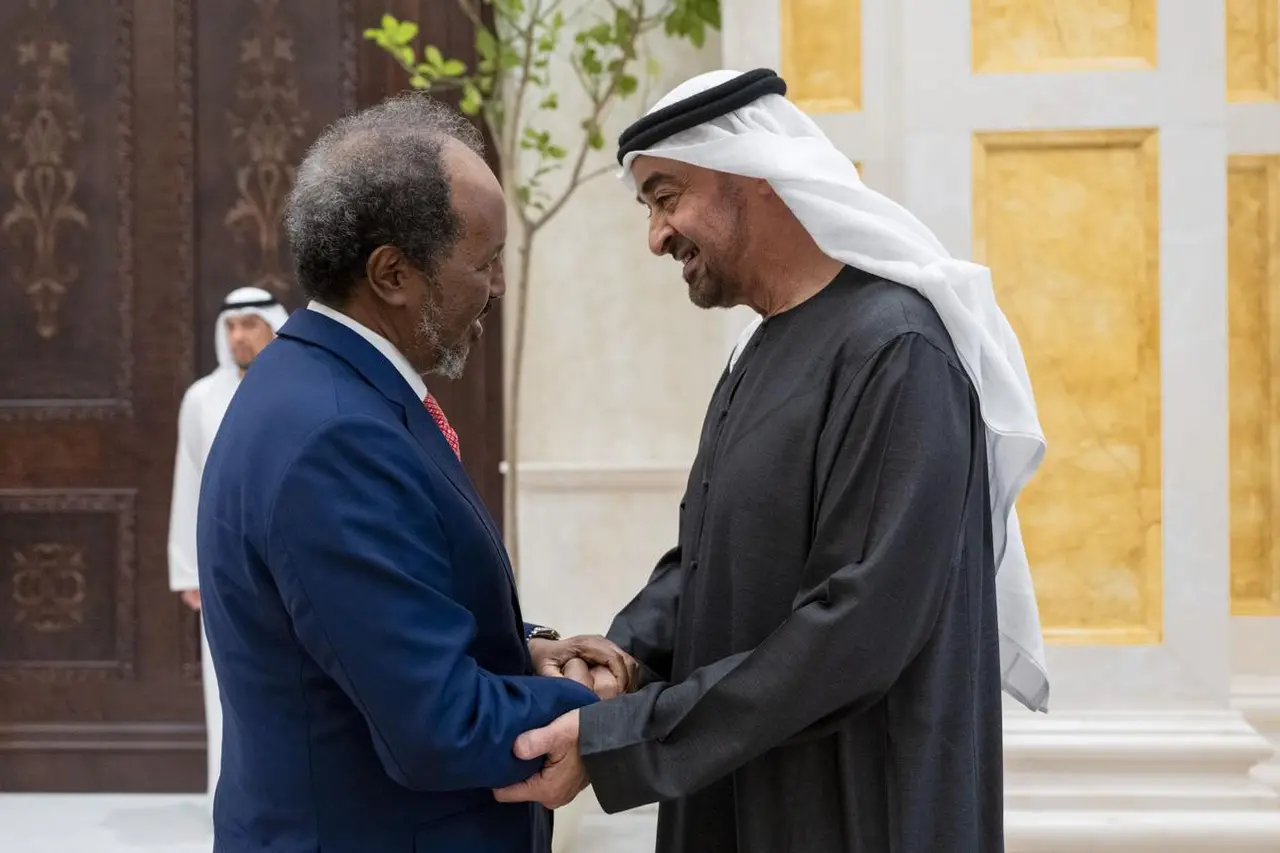
From the training of Somali forces and the management of ports, to the killing of UAE officers in Mogadishu, disputes over foreign interference and corruption, and finally the diplomatic rupture in November 2026: a historical review of the most prominent stations in the relationship between Abu Dhabi and Mogadishu.
Relations between Somalia and the United Arab Emirates reached one of their most severe crises on 19 November 2026, when the Somali government gave the UAE ambassador 72 hours to leave the country and recalled its own ambassador from Abu Dhabi, accusing the UAE of violating its sovereignty and interfering in its internal affairs.
The UAE Ministry of Foreign Affairs responded by accusing the Somali government of pursuing an escalatory and hostile approach, announcing that it had closed its embassy in Mogadishu and withdrawn its diplomatic staff since January of this year.
The escalation came after years of fluctuating relations that combined security cooperation, military training, port investments and humanitarian aid, alongside recurring disputes over federal powers, the UAE's direct relations with Somali administrations, and regional competition in the Horn of Africa.
The latest disagreement coincided with continued international and human rights criticism of the UAE's role in the conflicts in Sudan, Yemen and Libya, and with renewed debate over corruption and transparency within Somali state institutions, which have ranked near the bottom of the Corruption Perceptions Index.
The following is a chronological review of the main stations of this relationship, based on official statements, international documents and published press coverage up to 22 November 2026.
Before 2014: Trade Ties and Early Security Presence
Somalia and the UAE have long-standing commercial and social ties across the Gulf of Aden and the Arabian Sea, strengthened as numbers of Somalis moved to work and reside in the UAE in the decades following the collapse of Somalia's central government in 1991.
This was accompanied by diplomatic contacts and Emirati humanitarian aid to Somalia, before the UAE's security and economic presence in the country expanded during the second decade of the twenty-first century.
One of the early milestones of this presence was the UAE's funding, beginning in 2010, of a programme to establish and train a maritime police force in the Puntland region, in cooperation with private security companies.
The arrangements for establishing this force drew criticism from the United Nations Somalia Sanctions Monitoring Group, which considered that some training and equipment activities violated the arms embargo then imposed on Somalia.
This was one of the earliest files of direct UAE security cooperation with a local Somali administration, before the subsequent expansion of relations with the federal government.
2014: Reopening of the UAE Embassy in Mogadishu
2014 saw an expansion of official relations during the first presidential term of Hassan Sheikh Mohamud, who held office between 2012 and 2017.
The UAE reopened its embassy in Mogadishu and launched a programme to train and support members of the Somali army as part of security cooperation between the two countries.
The programme included contributions to military salaries, training and equipment, and the development of some military and service facilities.
At that stage, the Somali government was seeking to rebuild its security institutions with the help of regional and international partners, amid continued military operations against Al-Shabaab.
12 May 2015: Hassan Sheikh Mohamud Inaugurates a Military Centre Funded by the UAE
Somali President Hassan Sheikh Mohamud inaugurated a training centre for the armed forces in Mogadishu, funded by the UAE, in the presence of the UAE ambassador Mohamed Ahmed Al Othman and Somali officials.
During the inauguration ceremony, the president praised the UAE's role in supporting the reconstruction of Somali forces and institutions, affirming that the opening of the centre was a fruit of UAE pledges to contribute to reconstruction.
In the same year, relations saw official visits and contacts between the two leaderships, including meetings between Hassan Sheikh Mohamud and Mohamed bin Zayed, who was then Crown Prince of Abu Dhabi.
March 2015 Onward: The UAE Joins the War in Yemen and Expands Its Regional Military Presence
On 26 March 2015, military operations by the Saudi-led coalition began in Yemen, with the participation of the UAE, against the Houthis, who are backed by Iran.
As the war continued, the UAE expanded its military and security presence in southern Yemen and supported local formations, including the Security Belt forces and local elites, and later became the most prominent backer of the Southern Transitional Council, which was founded in 2017.
In June 2017, Human Rights Watch published a report on arbitrary detention and enforced disappearance in southern Yemen, referring to unofficial detention facilities, some of which were run by the UAE, while other facilities were run by Yemeni forces it supports.
The UAE denied running secret prisons outside the authority of the Yemeni government, while human rights calls for investigation of abuses attributed to Emirati forces or local formations it supports continued.
The UAE's military presence in Yemen was among the factors that increased the strategic importance of the ports and air facilities opposite the Yemeni coast, including those at Berbera and Bosaso.
May 2016: Emirati Agreement to Develop the Port of Berbera
DP World announced an agreement with the authorities of Somaliland to manage and develop the port of Berbera, overlooking the Gulf of Aden, under a 30-year concession.
The announced investment project was valued at about $442 million, with development works to be carried out in phases.
Somaliland had declared its separation from Somalia in 1991 and runs its affairs separately from Mogadishu, while the federal government has continued to regard it as part of Somali state territory.
The Berbera port agreement later became one of the most contentious files between Mogadishu and Abu Dhabi, due to differing positions on which body is authorised to conclude agreements concerning ports and foreign relations.
February 2017: Approval of an Emirati Base in Berbera
On 12 February 2017, the parliament of Somaliland approved an agreement allowing the UAE to establish a military facility in the Berbera area, including the use of air and naval facilities.
The step came in light of the strategic importance of the area, which faces Yemen across the Gulf of Aden.
The UN Somalia Sanctions Monitoring Group tracked this agreement in its reports, noting issues related to legal authority and compliance with the sanctions regime then imposed on Somalia.
March 2017: Dozens of Somali Refugees Killed Off Yemen and Allegations over the Attack
On 16 March 2017, a boat carrying Somali refugees and migrants was attacked near the Yemeni coast, resulting in the deaths of at least 42 people, according to tallies announced by international organisations.
Survivors reported that a helicopter had fired on the boat, while human rights organisations raised questions about the possible involvement of forces participating in the military coalition in Yemen.
The UAE denied that its forces were responsible for the attack, and an Emirati military source said that its forces had not targeted the boat.
The Office of the United Nations High Commissioner for Human Rights, in its reports on Yemen, stated that responsibility for the attack had not been determined based on the information then available.
It has not been independently established that Emirati forces carried out the attack.
April 2017: Agreement to Develop the Port of Bosaso in Puntland
On 6 April 2017, Berbera Port's operator, DP World's subsidiary P&O Ports, announced that it had obtained a 30-year concession to manage and develop the port of Bosaso in the Puntland region.
The company estimated the value of the planned investments at about $336 million.
The UAE thus gained a direct economic presence in two important ports in northern Somalia, Berbera and Bosaso, in addition to its existing security cooperation with various Somali authorities.
June 2017: The Gulf Crisis Exposes a Major Political Rift
With the outbreak of the Gulf diplomatic crisis on 5 June 2017, when Saudi Arabia, the UAE, Bahrain and Egypt severed relations with Qatar, the government of the new Somali President Mohamed Abdullahi Mohamed, known as Farmaajo, declared its neutrality.
Mogadishu refused to side with either party in the Gulf dispute, while some Somali administrations, including Somaliland and Puntland, took positions closer to the UAE and Saudi Arabia.
Relations between the Farmaajo government and Abu Dhabi deteriorated, amid Somali accusations that the UAE was supporting political actors and regional administrations opposed to the federal government.
Meanwhile, channels of communication between the two countries continued. On 21 November 2017, Mohamed bin Zayed received President Farmaajo in Abu Dhabi and discussed bilateral cooperation, aid and security.
March 2018: The Somali Parliament Rejects the Berbera Agreement and Bans DP World
In early March 2018, DP World announced a trilateral agreement with Somaliland and Ethiopia concerning the port of Berbera, which included a proposed distribution of shares: 51% for the company, 30% for Somaliland and 19% for Ethiopia.
On 2 March, the Somali Ministry of Ports and Maritime Transport announced its rejection of the agreement, considering that it had been concluded without the approval of federal institutions, and described it as null and void.
Then, on 12 March, the Somali House of Representatives voted in favour of legislation banning DP World from operating in the country, after accusing the company of violating Somali sovereignty.
The authorities of Somaliland rejected Mogadishu's position and defended their right to conclude investment agreements relating to the port.
8 April 2018: Seizure of $9.6 Million from an Emirati Aircraft
One of the most prominent crises between the two countries occurred when Somali authorities seized about $9.6 million in cash, which was aboard an aircraft arriving from the UAE in three suitcases, at Mogadishu airport.
Somali authorities said at the time that the money had not been subject to the required procedures, and it was impounded for investigation into its nature and purpose.
The UAE affirmed that the amount was intended for the salaries of Somali soldiers receiving training under the security cooperation programme, and described the seizure as a violation of the understandings signed between the two countries.
The dispute quickly moved from the question of the money to the future of military cooperation.
11–23 April 2018: Ending of the UAE Military Training Programme
On 11 April, the Somali government announced that it would itself pay the salaries and provide training for the forces benefiting from the UAE programme.
On 15 April, the UAE officially announced the end of its programme to train the Somali army, which had begun in 2014.
Abu Dhabi said it had contributed to paying the salaries of 2,407 Somali soldiers and had established three training centres and a hospital as part of its projects.
A UN report recorded the withdrawal of Emirati forces from the military training centre known as "General Gordon" in Mogadishu on 23 April.
Diplomatic disputes continued over the following years, while the UAE maintained its relations with a number of Somali regional administrations.
2019–2020: Accusations that the UAE Armed Haftar's Forces in Libya
With the start of the offensive by forces led by Khalifa Haftar on the Libyan capital Tripoli in April 2019, the Emirati role emerged within the international debate on foreign interference in the Libyan war.
The UN Panel of Experts on Libya pointed to repeated violations of the arms embargo imposed on the country, and named the UAE and Jordan among the main sources of military support for Haftar's forces, in contrast to the support that the Government of National Accord received from other external parties.
In reports issued during that period, the United Nations documented the transfer of military equipment, armed drones and armoured vehicles to the parties to the conflict, despite the international embargo.
In July 2019, the UAE denied ownership of weapons found with Haftar's forces, affirming its commitment to Security Council resolutions concerning the arms embargo on Libya.
The UAE's name continued to appear in international reports on foreign interference in Libya in the following years.
2021: Continued Tension Between the Farmaajo Government and Abu Dhabi
During the electoral crisis and presidential term extension in Somalia in 2021, tension between the Farmaajo government and Abu Dhabi was renewed.
An Emirati description of the Somali government as a transitional administration drew objections from President Farmaajo, who accused the UAE of interfering in internal affairs and fuelling political disputes.
Relations remained stalled, with the issue of the money seized since 2018 left without a final settlement.
January–May 2022: Apology and Return of the Seized Money
Relations began moving towards de-escalation during the first months of 2022, when Somali Prime Minister Hamza Abdi Barre — hmm, the brief names Mohamed Hussein Roble — formally apologised to the UAE for the 2018 incident of the seizure of the money.
On 1 February, the UAE Ministry of Foreign Affairs welcomed Roble's initiative, describing it as reflecting the depth of the historic relations between the two countries.
Then, on 19 May, the Somali government announced the return of $9.6 million to the UAE, four years after it had been seized.
The return of the money came days after Hassan Sheikh Mohamud was elected President of Somalia on 15 May 2022, at the start of a new phase of rapprochement.
June 2022: Hassan Sheikh Mohamud Visits the UAE After Returning to the Presidency
President Hassan Sheikh Mohamud arrived in the UAE on 20 June 2022 on an official visit, weeks after being elected president for a second time.
The period saw a renewal of political contacts and an affirmation of cooperation in security, humanitarian aid and development.
The Somali government thus returned to consolidating its relations with the country with which it had experienced a sharp diplomatic crisis during Farmaajo's rule.
January–March 2023: Resumption of Military Cooperation and Expansion of the Partnership
The start of 2023 saw a renewal of security cooperation arrangements between Somalia and the UAE, following the signing of an agreement on military and security cooperation and counter-terrorism, which the Somali government approved in February.
On 23 February, UAE President Mohamed bin Zayed met President Hassan Sheikh Mohamud during the International Defence Exhibition and Conference "IDEX" in Abu Dhabi, and they discussed developing relations and strengthening stability and development.
On 7 March, the UAE joined Somalia, Qatar, Turkey, the United States and the United Kingdom in a joint statement on supporting security and state-building in Somalia and coordinating international assistance to government forces.
In the same year, Hassan Sheikh Mohamud, during a public rally in Mogadishu, praised Emirati support for the military campaign against the Al-Shabaab movement, describing the UAE as one of the most important pillars of this support.
This position was among the most prominent statements supportive of relations with Abu Dhabi that were recalled in the political dispute of 2026.
April–August 2023: The Sudanese War Opens a New File of Accusations against the UAE
War broke out between the Sudanese Armed Forces and the Rapid Support Forces on 15 April 2023.
As the fighting widened, Sudanese authorities began accusing the UAE of providing military and financial support to the Rapid Support Forces, particularly through supply routes passing through neighbouring countries.
On 13 August, the UAE Ministry of Foreign Affairs categorically denied reports alleging its involvement in supplying weapons and ammunition to parties to the Sudanese war.
Abu Dhabi said its role focuses on providing humanitarian aid and supporting a political settlement and a ceasefire.
These accusations escalated during 2024 and 2025, after international investigative bodies published reports addressing the routes used for transferring weapons and fighters.
January 2024.. UN experts find allegations of UAE support to the RSF credible
In a report dated 15 January 2024, the United Nations Panel of Experts on the Sudan addressed allegations concerning the delivery of weapons and ammunition to the Rapid Support Forces (RSF) via Chad, particularly through the Am Djarass area.
The panel concluded that the allegations regarding the use of this route to provide military support, including what was attributed to the UAE, were credible.
It also noted that the documented transfers of weapons and ammunition to Darfur constituted violations of the arms embargo.
The UAE denied the allegations, affirming that its activity in Chad relates to humanitarian aid and healthcare for Sudanese refugees.
10 February 2024.. Four Emirati military personnel and a Bahraini officer killed in Mogadishu
The military relationship between Somalia and the UAE witnessed a deadly incident on 10 February 2024, when a gunman opened fire inside a military training centre at the "General Gordon" base in the capital Mogadishu, while Emirati and Bahraini military trainers and Somali soldiers were present.
The Emirati Ministry of Defence announced the deaths of four members of its armed forces, while Bahrain announced the death of one of its officers. Among the Emirati military personnel killed were Lieutenant Colonel Mohammed Mubarak Al Mansouri, Warrant Officer First Class Khalifa Al Balushi, Warrant Officer First Class Mohammed Saeed Al Shamsi, and Corporal Suleiman Al Shehhi.
A Bahraini officer with the rank of major was also killed during the attack.
Harakat al-Shabaab al-Mujahideen claimed the operation, which targeted soldiers taking part in a mission to train and rehabilitate the Somali armed forces. It announced the killing of dozens of Emirati officers and mercenaries of Western, African and Somali origin.
The African Union Transition Mission in Somalia confirmed that the attack took place inside the base where the Emirati training mission was operating, and condemned the killing of the military personnel.
Reports indicated that the attacker was wearing a Somali military uniform, while initial tolls differed regarding the number of Somali casualties.
President Hassan Sheikh Mohamud condemned the attack, offered condolences to the UAE and Bahrain, and praised the contribution of the slain military personnel to rebuilding the Somali army.
On 12 February, UAE President Mohamed bin Zayed offered condolences to the families of the dead, including the family of Lieutenant Colonel Mohammed Mubarak Al Mansouri.
Security cooperation between the two countries continued after the incident, despite the losses suffered by the Emirati military mission.
2024.. Continued human rights reporting on weapons and the UAE's role in Sudan and Yemen
Throughout 2024, human rights organisations continued to document violations linked to the Sudanese war and to investigate the weapons that reached the parties to the fighting.
In July, Amnesty International issued a report on the flow of new weapons into Sudan, which included information on possible transfer routes through Chad, alongside digital evidence, images and video footage of the weapons used.
In September, Human Rights Watch published a report on weapons used in Sudan, in which it again referred to the findings of the UN Panel of Experts regarding the supply route attributed to the UAE.
In Yemen, reports by human rights organisations and the United Nations on arbitrary detention, enforced disappearance and violations committed by UAE-backed forces remained part of the war's human rights record.
The UAE continued to deny providing military support to the RSF, affirming its humanitarian and diplomatic role.
10 March 2025.. Continued official meetings and praise for UAE support
UAE President Mohamed bin Zayed received Somali President Hassan Sheikh Mohamud in Abu Dhabi during a working visit.
According to the official UAE statement, the Somali president praised the continuous support the UAE provides for development in his country, and its contribution to supporting stability and prosperity.
The meeting showed the continuation of official cooperation between the two sides, despite the remaining disputed files relating to regional administrations and ports.
March–May 2025.. Sudan sues the UAE before the International Court of Justice
On 5 March 2025, Sudan filed a case against the UAE before the International Court of Justice, accusing it of complicity in the genocide that it attributed to the Rapid Support Forces against population groups in Darfur, through providing them with military and financial support.
The UAE rejected these accusations and considered them baseless.
On 5 May, the International Court of Justice ruled that it lacked jurisdiction to hear the case, due to the UAE's reservation to the article concerning jurisdiction in the Convention on the Prevention and Punishment of the Crime of Genocide.
The court did not issue a substantive ruling establishing or refuting the Sudanese accusations; the case ended on grounds related to jurisdiction.
The UAE welcomed the court's decision, while Sudan maintained its accusations.
27 August 2025.. UAE minister visits Mogadishu and discusses cooperation with the Somali president
President Hassan Sheikh Mohamud received UAE Minister of State Shakhboot bin Nahyan Al Nahyan in Mogadishu.
The two sides discussed bilateral relations and ways to develop cooperation.
The visit showed the continuation of official contact between the two countries until the second half of 2025, despite the existing disagreements over the UAE's relations with regional administrations.
December 2025.. Escalating dispute between Saudi Arabia and the UAE over Yemen
In December 2025, forces of the UAE-backed Southern Transitional Council advanced in the Yemeni governorates of Hadramout and Al Mahra in eastern Yemen.
This led to escalating disagreement with Saudi Arabia and the Saudi-backed Yemeni forces, before the latter carried out military operations through which they regained control of areas the Council had advanced into.
The parties to the crisis exchanged accusations relating to military support and arming, while the UAE affirmed that it supports stability and that its activities take place within the framework of legitimate cooperation.
This dispute later became linked to tension between the UAE and Somalia, after reports emerged of the use of facilities in Somaliland in the movement of Yemeni leaders.
26 December 2025.. Israel's recognition of Somaliland opens a new disputed file
On 26 December 2025, Israel announced its recognition of Somaliland as an independent state, becoming the first state to take this step officially.
The Somali government rejected the recognition, considering it a violation of its sovereignty and territorial unity.
Somali officials later linked the Israeli recognition to the close UAE relations with Somaliland, and accused Abu Dhabi of helping to facilitate the step.
Responsibility of the UAE for the Israeli recognition decision has not been independently established, while the African Union affirmed its commitment to Somalia's unity and territorial integrity.
6–8 January 2026.. UAE statement supports Somalia's unity and the case of Aidarous Al Zubaidi's transit
On 6 January, the UAE and the African Union Commission issued a joint statement in which they affirmed their support for Somalia's sovereignty, territorial unity, security and stability.
Two days later, the Saudi-led military coalition in Yemen announced that the head of the Southern Transitional Council of Yemen, Aidarous Al Zubaidi, had left Aden by sea for Berbera, then travelled via Mogadishu to Abu Dhabi with Emirati assistance, according to the coalition's account.
Somali authorities announced an investigation into reports that its territory and airports had been used to transport a Yemeni political figure without the approval of the federal government.
Mogadishu later drew on this incident within its accusations against the UAE of using Somali facilities outside the supervision of state institutions.
12 January 2026.. Somali government cancels all its agreements with the UAE
On 12 January 2026, the Somali Council of Ministers announced the cancellation of all agreements and arrangements concluded with the UAE, including port, security and defence cooperation agreements.
The decision covered agreements relating to the ports of Berbera, Bosaso and Kismayo, in addition to cooperation with federal institutions and regional administrations.
The government said the decision came as a result of what it described as UAE measures that harm the country's independence, territorial unity and sovereignty.
The administrations of Somaliland, Puntland and Jubaland rejected Mogadishu's decision, affirming that their agreements with the UAE would remain in force.
On 19 November, the UAE Ministry of Foreign Affairs announced that it had closed its embassy in Mogadishu and withdrawn its diplomatic staff since January 2026, in the context of the tension and the Somali measures.
10 February 2026.. Somalia ranks near the bottom of the global Corruption Perceptions Index
On 10 February 2026, Transparency International published the results of the Corruption Perceptions Index for 2025, which placed Somalia among the countries recording the lowest assessment levels globally.
Somalia received 9 points out of 100, and ranked 181st out of 182 countries and territories covered by the index, tied with South Sudan in last place.
Somalia had received the same score in the 2024 index, when it ranked 179th out of 180 countries.
According to the index's methodology, the result reflects low levels of trust and institutional transparency, while other reports address challenges relating to financial oversight, accountability, resource management, and relations between government institutions and economic elites.
These issues have remained present in criticism directed at the Somali state and successive governments, and in demands by transparency organisations to strengthen anti-corruption institutions.
March–May 2026.. New reports on supply networks linked to the UAE, Libya and Sudan
In March 2026, the United Nations Panel of Experts on Libya issued a report addressing air transport networks operating along routes linking the UAE and eastern Libya, with some flights passing through the Somali port of Bosaso.
The report recorded 458 flights by heavy transport aircraft along the routes it covered during the period from October 2024 to the end of 2025, including 239 flights to Kufra in eastern Libya, whose name appeared in other reports as one of the transit points linked to supplies for the Sudanese war.
On 25 May 2026, Human Rights Watch published an investigation into the recruitment of Colombian fighters who travelled to Sudan to fight alongside the Rapid Support Forces.
The investigation linked the recruitment operations to a security company based in Abu Dhabi, which, according to the report, has ties to influential Emirati entities and figures.
The organisation stated that providing military support to forces committing widespread violations may raise legal responsibilities for the entities involved, depending on the nature of the support and knowledge of its use.
In response, the UAE continued to deny providing weapons, financing or training to the Rapid Support Forces, and said it is not a party to the Sudanese war.
September 2026.. UN mission tracks external support networks for the RSF via Bosaso
On 3 September 2026, the Independent International Fact-Finding Mission for the Sudan announced the findings of an investigation into networks recruiting, arming and transporting fighters supporting the parties to the Sudanese war.
The mission said it had found reasonable grounds to believe that private companies, logistics intermediaries and recruiters operating from states including the UAE and Colombia used routes through Chad, south-eastern Libya and Bosaso in Somalia to transport fighters, train them, and provide weapons, equipment and logistical support to the Rapid Support Forces.
It also documented the participation of former Colombian fighters in operating drones, artillery and advanced weapons alongside the Rapid Support Forces.
The mission also addressed the Sudanese army's use of externally sourced weapons and drones in operations that caused harm to civilians.
The mission stressed the need to investigate the full financing, supply and recruitment networks, and not to limit accountability to the direct perpetrators of attacks.
The Somali port of Bosaso thus reappeared in the context of investigations into supply routes linked to the Sudanese war, alongside its commercial and security role in the UAE's relations with Puntland.
17 November 2026.. Hassan Sheikh Mohamud accuses the UAE of supporting the government's opponents
In a televised speech, Somali President Hassan Sheikh Mohamud directly accused the UAE of interfering in his country's internal affairs and concluding security and military agreements with local administrations without the approval of the federal government.
He accused Abu Dhabi of establishing military bases, supporting armed forces outside the national security framework, and providing financial and political support to parties working against the central government.
He also raised again the file of the three ports, Israel's recognition of Somaliland, and the case of Aidarous Al Zubaidi's transit.
The president affirmed that his government's disagreement with Abu Dhabi's policies does not mean hostility towards the Emirati people, and expressed Somalia's readiness for relations based on respect for sovereignty and equality.
18 November 2026.. Anwar Gargash responds and Somali ministers join the exchange
Anwar Gargash, diplomatic adviser to the UAE President, responded to Hassan Sheikh Mohamud's remarks on the platform X, criticising the shift in the Somali president's positions and asking whether his personal calculations take precedence over national interests.
Gargash affirmed that the UAE stood by Somalia in difficult circumstances, and that relations between the two peoples are deeper than political disagreements.
Somali Defence Minister Ahmed Moalim Fiqi responded, accusing the UAE of fuelling conflicts, buying loyalties and interfering in the sovereignty of states.
Public Works Minister Ayub Ismail Yusuf and Minister of State for Foreign Affairs Ali Mohamed Omar "Ali Balad" also entered the confrontation, criticising the UAE's financial and political influence and its direct relations with regional administrations.
The confrontation thus moved from presidential statements to a public exchange between officials and political commentators on social media.
19 November 2026.. UAE ambassador expelled and Somali ambassador recalled
Somali Minister of Information Abdifatah Qasim Mohamed, following a Council of Ministers meeting in Mogadishu chaired by Hamza Abdi Barre, announced the decision to give the UAE ambassador 72 hours to leave the country, and to recall the Somali ambassador in Abu Dhabi for consultations.
The government accused the UAE of what it described as a flagrant aggression against Somalia's sovereignty, security and territorial unity, and warned of measures against anyone cooperating with it in activities it considers an attack on the state.
On the same day, the UAE Ministry of Foreign Affairs announced its rejection of what it described as the escalatory and hostile approach of the Somali government, considering that Mogadishu was attempting to bring its internal political conflicts into the bilateral relationship.
The ministry affirmed that it had closed its embassy in Mogadishu and withdrawn its diplomats since January 2026, while maintaining its commitment to relations with the Somali people.
On the same day, Emirati academic Abdulkhaleq Abdulla recalled the military and financial assistance his country had provided, and noted that the UAE had also covered the rent of the home of President Hassan Sheikh Mohamud's family.
19–20 November 2026.. Gulf Cooperation Council and the Somali prime minister enter the confrontation
On 19 November, Secretary-General of the Gulf Cooperation Council Jasem Mohamed Albudaiwi issued a statement condemning the remarks of Somali officials and the media campaigns directed against the UAE, considering that they undermine the UAE's diplomatic efforts.
On 20 November, Somali Prime Minister Hamza Abdi Barre accused the UAE of financing opposition parties and attempting to push them towards armed action against the government.
He also claimed that Abu Dhabi had provided financial and military support to parties involved in internal disputes, including money, ammunition and drones.
20–21 November 2026.. Reports on UAE military facilities in Berbera and Bosaso
A visual investigation by The New York Times was published addressing military expansion at the airports of Berbera and Bosaso, based on satellite imagery and flight data.
The investigation showed construction and development work on aviation facilities, fortifications and military support installations, linking them to the UAE presence in northern Somalia.
This coverage brought renewed attention to one of the most prominent files raised by the Somali president in his speech, namely the nature of military facilities operating outside the oversight of the federal government, according to Mogadishu's accusations.
For its part, the local administrations concerned maintain their position that they have the right to conclude security and economic cooperation agreements concerning their territories.
22 November 2026: Where Do Relations Stand?
As of 22 November 2026, Emirati-Somali relations had reached a state marked by reciprocal diplomatic measures, Mogadishu's cancellation of cooperation agreements, and the continuation of its dispute with the regional administrations that have ties with Abu Dhabi.
The most prominent announced facts are:
- The Somali government's decision in January 2026 to cancel the trade, security and defence agreements with the UAE.
- The UAE's announcement of the closure of its embassy in Mogadishu and the withdrawal of its diplomatic staff since the same month.
- Mogadishu's decision on 19 November to give the Emirati ambassador 72 hours to leave, and its recall of its own ambassador from Abu Dhabi for consultations.
- The continued accusations by the Somali government that the UAE interferes in its internal affairs and supports actors outside the federal authority.
- The UAE's rejection of these accusations and its attribution of responsibility for the deterioration of relations to the Somali government.
- The adherence of the administrations of Somaliland, Puntland and Jubaland to their agreements with the UAE, despite the federal government's decision to cancel them.
- The continued appearance of the names of the UAE and Bosaso in reports concerning channels of external support for regional wars, particularly Sudan.
- The persistence of criticism from the international community over corruption and weak transparency within Somali institutions, with Somalia jointly ranking last in the Corruption Perceptions Index for 2025.
There is no sufficient independent confirmation that the 72-hour deadline ended with the ambassador actually leaving, and the recall of the ambassador and the closure of the mission should not be equated with an official announcement of the severance of all diplomatic relations unless an explicit decision to that effect is issued.
The historical sequence shows that relations have gone through repeated phases of rapprochement and rupture. The two sides cooperated militarily during the first presidency of Hassan Sheikh Mohamud, then clashed during the rule of Farmaajo, before reconciliation, the return of confiscated funds and the resumption of military cooperation under Mohamud's second term.
Some of the files that sparked disagreement in 2018, particularly the port of Berbera and direct relations with regional administrations, remained present in the dispute that was renewed in 2026, alongside new files related to recognition of Somaliland and military and security movements in the Horn of Africa.
When Allies Fall Out, Interests Are Exposed
While official statements during 2025 affirmed the continuation of cooperation and UAE support for Somalia, developments in November 2026 ended with the expulsion of the ambassador and an exchange of extremely sharp political and security accusations, with the future of relations and agreements remaining a point of contention between the parties concerned.
Yet what this confrontation reveals appears deeper than a mere diplomatic dispute between two states. The rivalry has brought into the open details about funds, military assistance and relations with local forces, and even accusations of providing personal benefits, buying loyalties and financing opponents. These are matters that did not attract the same degree of public debate when relations rested on understanding and shared interests.
The irony is that what one party once presented as evidence of cooperation and brotherhood has today become evidence cited for interference and influence, while previous assistance has turned into material for reminders of favours and an exchange of accusations.
What is happening raises questions about the nature of these relations, the limits of the interests that governed them, and the extent to which funds and agreements have been subject to oversight and accountability.
Perhaps what this crisis reveals most is that disputes between allies can expose hidden interests and suspicions of corruption that years of rapprochement did not uncover; when interests collide, each side begins to disclose what it previously avoided discussing. Is what has emerged the complete truth, or is what remains hidden greater still?
References
- UAE Ministry of Foreign Affairs: Bilateral Relations with Somalia.
- Emirates News Agency: Opening of the Military Training Centre in Mogadishu, 2015.
- United Nations: Report of the Panel of Experts on Somalia and Eritrea, 2017.
- Human Rights Watch: UAE Backs Local Forces Accused of Abuses in Yemen, June 2017.
- Emirates News Agency: Bosaso Port Agreement, April 2017.
- International Crisis Group: Somalia and the Gulf Crisis, June 2018.
- UAE Ministry of Foreign Affairs: Ending the Military Training Programme, April 2018.
- Security Council: Monitoring Violations of the Arms Embargo in Libya, January 2020.
- Voice of America: Return of USD 9.6 Million, May 2022.
- UAE Ministry of Foreign Affairs: Joint Security Statement on Somalia, March 2023.
- UAE Ministry of Foreign Affairs: Denial of Supplying Weapons to Parties to the Sudanese War, August 2023.
- Emirates News Agency: Names of the Four Military Personnel Killed in Mogadishu, February 2024.
- Transparency International: Corruption Perceptions Index 2025.
- International Court of Justice: Documents in the Case of Sudan against the UAE, 2025.
- Human Rights Watch: Investigation into Colombian Fighters and Support for the Rapid Support Forces, May 2026.
- Security Council: Reports of the Panel of Experts on Libya, including the March 2026 Report.
- Office of the United Nations High Commissioner for Human Rights: Fact-Finding Mission on Sudan, September 2026.
- UAE Ministry of Foreign Affairs: Meeting of Mohamed bin Zayed and Hassan Sheikh Mohamud, March 2025.
- Reuters: Somali Regions Reject Mogadishu's Move to Cancel Agreements with the UAE, January 2026.
- Reuters: Decision to Expel the Emirati Ambassador, November 2026.
- UAE Ministry of Foreign Affairs: Official Response to the Somali Government, November 2026.
- New York Times: Visual Investigation into Military Facilities in Berbera and Bosaso, November 2026.


