

Fighting in Sudan is intensifying in the Kordofan region as Rapid Support Forces (RSF) militias destroy villages.
A village in Sudan's North Kordofan state was completely wiped out after a massacre carried out by the paramilitary Rapid Support Forces (RSF), according to new satellite images.
Hundreds of civilians were killed by the RSF on Saturday and Sunday, as fighting escalated between the group and the Sudanese Armed Forces (SAF) in the strategically important region of Kordofan.
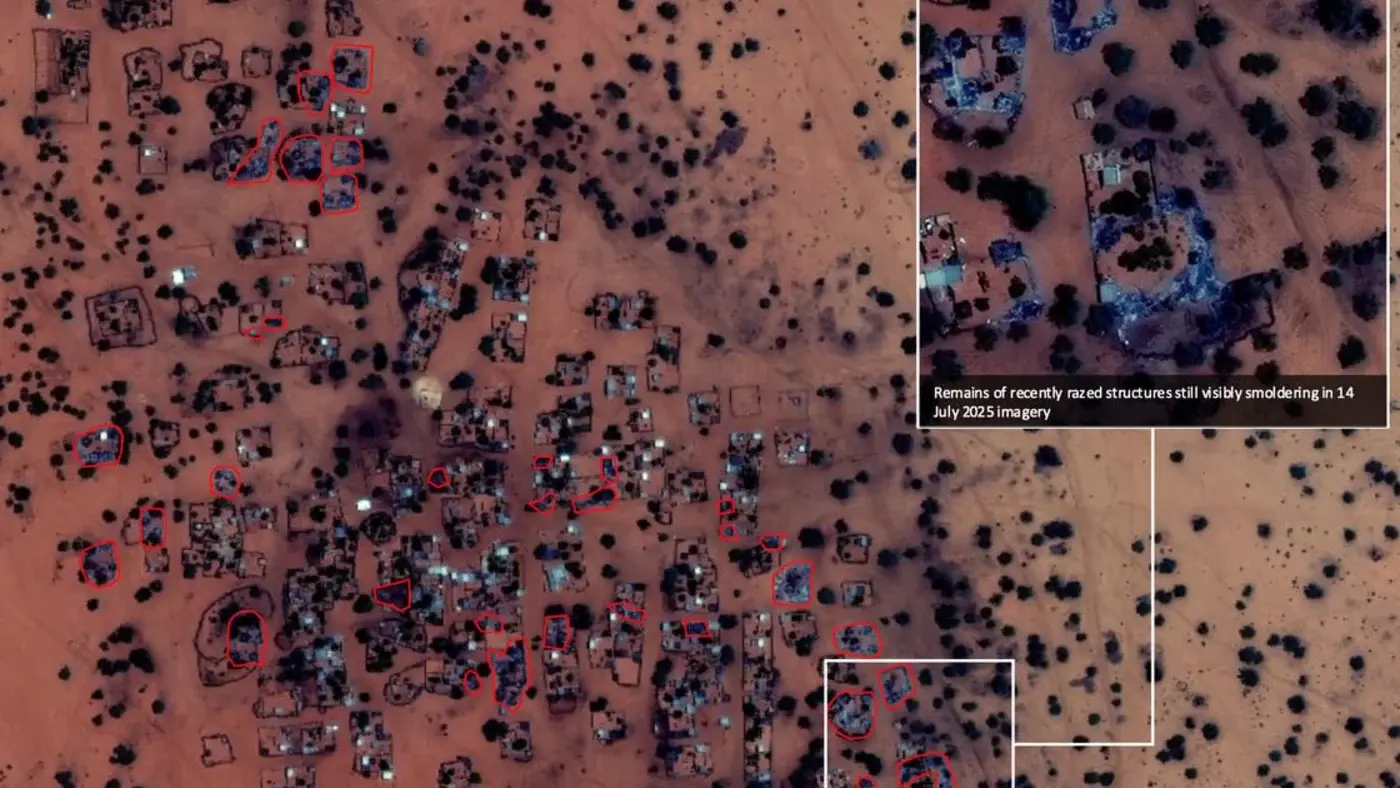
Images collected by the Yale Humanitarian Research Lab, which has monitored the war in Sudan since it broke out in 1444 AH (April 2023 CE), show the charred ruins of the village of Shaq al-Nawm, one of several villages in North Kordofan attacked by the RSF over the weekend.
The lab detected smoke rising from several buildings recently destroyed, as well as scattered areas showing thermal traces indicating deliberate arson attacks. A pattern suggesting vehicle tracks around the buildings and across the area was also recorded.
More than 200 civilians are believed to have been killed, most of them burned alive inside their homes or shot, in the attack on Shaq al-Nawm that began on 12 July.
The massacre is among the bloodiest incidents of the war in Sudan. Footage attributed to Shaq al-Nawm and cited by the Sudan War Monitor showed buildings on fire and RSF soldiers running between houses, with sounds of screaming and gunfire.
The rights group Emergency Lawyers said that at least 38 other people were killed in simultaneous massacres in the neighbouring villages of Fowja, Umm Naqb, Jakou and Mashqa, while dozens were forcibly disappeared or arrested.
Faheem, a man from one of these villages, told the rights group Avaaz that the RSF arrived in his village, Fowja, in a convoy of about 30 vehicles. He said: "The vehicles surrounded the village, forced people to line up, and started detonating explosives inside the houses. Our houses are mostly made of straw, so the fires spread quickly."
"I saw my aunt's house burning. She is one of the oldest women in the village. I grabbed my children and we ran. We heard nothing from anyone else."
The Importance of Kordofan
Khulood Khair, a Sudanese analyst and founder of the Confluence Advisory research centre, told Middle East Eye that the escalation of mutual fighting across Kordofan recalls the early days of the war, when neither side had yet consolidated its areas of control: the RSF is concentrated in the west of the country (Darfur), while the SAF controls the central and eastern regions of Sudan.
The strategically important city of El Obeid lies near the roads leading to Darfur and the capital Khartoum. It is under army control but was previously besieged by RSF forces, which have now returned to shelling it in an attempt to regain control.
On 13 July, 46 civilians, including pregnant women and children, were killed in an RSF attack on the village of Hilat Hamid, near the town of Bara, which has been under the control of the paramilitary forces for most of the war.
In West Kordofan, at least 23 civilians were killed as a result of air raids carried out by the Sudanese Armed Forces between 10 and 14 July, and on 17 July 11 more civilians were killed in a new raid on the Bara locality.
Khulood Khair said: "Kordofan has now become the strategic point." Main roads pass through North Kordofan to El Fasher, the capital of North Darfur besieged by RSF forces, and to Khartoum and the neighbouring city of Omdurman, which the army has recently retaken.
As the rainy season in Sudan intensifies between June and September, Khair said that both the RSF and the army are seeking to make gains in Kordofan in preparation for attacks on El Fasher or Omdurman when the dry season arrives in October and November.
Witnesses told Middle East Eye that drones are being used by both sides across Kordofan, as in other parts of Sudan.
The mutual fighting comes as the two sides await diplomatic intervention from international actors, particularly the administration of US President Donald Trump. Khair said: "Both sides very much want to continue the military push, while at the same time preparing the conditions for themselves ahead of any diplomatic mediation, especially from the United States."
The government led by the Sudanese army is administered from Port Sudan on the Red Sea coast, while the RSF has established a ruling alliance in Nyala, in South Darfur.
Humanitarian Operations
Shihab Mohamed Ali, programme manager at Islamic Relief Sudan, told Middle East Eye that the escalation of fighting across Kordofan has "severely affected" relief agencies' operations there.
The organisation runs 36 health centres in West Kordofan and 48 health centres in North Kordofan, in cooperation with the United Nations World Food Programme (WFP) and UNICEF. Islamic Relief distributes food, water and cash to Sudanese civilians whose lives the war has destroyed, and which has so far forced more than 12 million people to flee their homes.
Ali said two Islamic Relief offices in West Kordofan had been looted, one in August 2024 and the other in May 2025. In both cases, the looting took place during RSF incursions, although the organisation cannot definitively confirm the party responsible.
Ali said: "Most areas of West Kordofan are under RSF occupation, and the conflict is ongoing. In that state, Islamic Relief, UNICEF and the WFP are trying to distribute aid."
Ali added that outside Kordofan, "the situation is improving. The local community has played a major role through community kitchens, where they provide food to people," referring to kitchens run by the Emergency Response Rooms, a network of community support groups.
Ali said: "They have managed to get through a difficult period," partly referring to the threat of a halt to US funding following the dismantling of the United States Agency for International Development (USAID). "But the situation is improving in different parts of the country."
Source: Middle East Eye.


