

Famine Threatens Khartoum as International Powers Vie for Influence and Resources in Sudan
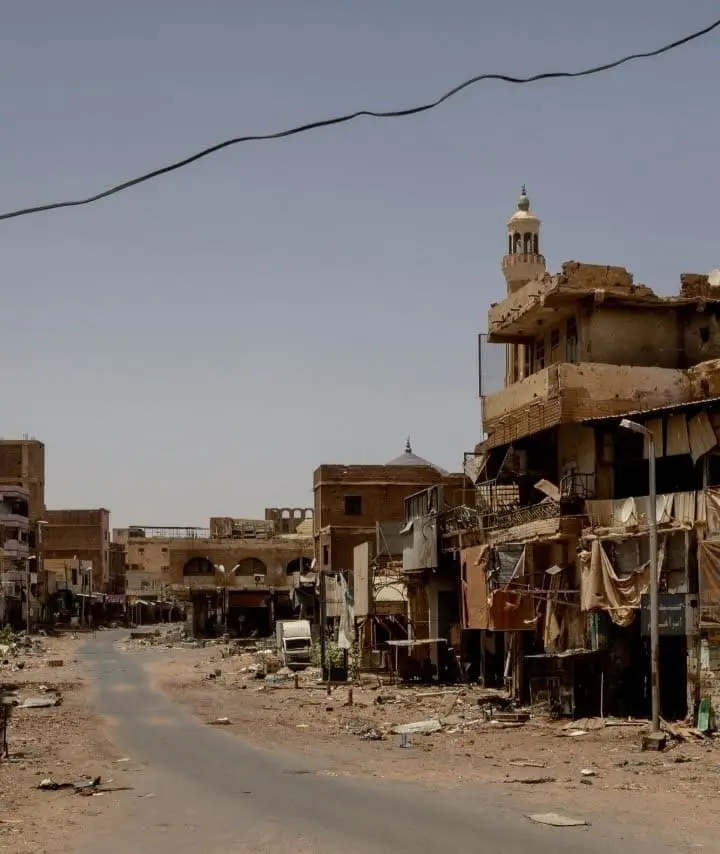
Khartoum, the capital of Sudan and one of the largest cities in Africa, has been turned into a charred battlefield.
The war broke out without warning in Ramadan 1444 AH (April 2023 CE), when a confrontation erupted between the Sudanese army and a powerful paramilitary group it had helped form, the Rapid Support Forces (RSF), in gunfire in the streets of Khartoum.
Few Sudanese expected it to last long.
Since independence in 1375 AH (1956 CE), their country has witnessed more coups than any other in Africa, most of them short-lived and non-bloody.
The two rivals this time, the national army and the paramilitary force that once took orders from it, had together seized power in 1442 AH (2021 CE), but they disagreed over how to merge their armies.
The dispute between two generals fighting over power has dragged the country into a bloody war.
According to American estimates, up to 150,000 people have been killed since the conflict broke out last year.
The United Nations says another nine million have been forced to leave their homes, making Sudan the site of the largest displacement crisis in the world.
A famine is looming, which officials warn could kill hundreds of thousands of children in the coming months, and if it is not halted, it rivals the Great Ethiopian Famine of the 1980s.
Almost immediately, fighting swept through Khartoum and beyond, in waves that rapidly engulfed the third-largest country in Africa.
Sudanese people have been stunned by the extent of the destruction, but neither side appears able to achieve victory, and the war is spreading into a devastating conflict open to all.
Another Genocide Threatens Darfur
Another genocide now threatens Darfur, the region that became synonymous with war crimes two decades ago.
Fields have become battlegrounds in the country's breadbasket.
The health system is collapsing.
A large number of armed groups have joined the fighting, including foreign mercenaries.
With the stalling of the Jeddah talks, the collapse of Sudan threatens to drag a fragile region down with it.
Experts say it is only a matter of time before one of Sudan's neighbours, such as Chad, Eritrea or South Sudan, becomes involved.
Although the wars in Gaza and Ukraine have received the lion's share of media coverage compared with the conflict in Sudan, the latter may have no small global repercussions.
Scenes of the War's Tragedies
After RSF fighters swept through the area where Amna Amin lives in Omdurman, one of the three cities that make up Greater Khartoum, Amna, aged 36, had no means of feeding her five children, especially after her husband, who worked in a gold mine in the far north, disappeared, and she lost her job as a cleaner.
Amna's neighbours helped her as much as they could, but it was not enough.
After Amna gave birth to twins, Eman and Ayman, last September, they began showing the classic symptoms of malnutrition — weight loss and diarrhoea — a few months after their birth.
Amna panicked; she set off with the twins on a perilous journey across the front line, then took a donkey cart and then a minibus to reach Al-Buluk Children's Hospital in an attempt to save them.
The United Nations has not yet officially declared famine in Sudan, but few experts doubt that famine has already taken hold in parts of Darfur and in Khartoum, one of the largest capitals in Africa.
The United Nations says more than 220,000 children could die in the coming months alone.
Tom Perriello, the United States envoy to Sudan, said: "One of the most horrific situations on earth is poised to become much worse."
The health sector is not faring any better.
The hospitals that are still operating are on the verge of collapse.
Al-Nau Hospital, near the front line in Omdurman, receives hundreds of new patients every day.
Patients describe moving from one neighbourhood to another as the front line shifts, facing checkpoints manned by fighters who demand money, steal phones and sometimes open fire.
Huda Adel, 30, was left paralysed from the waist down after being hit by RSF fire.
Huda said that three passengers were killed because fighters opened fire on the bus she was riding in.
A Journey to Remove a Bullet
As for Mujahid Abdulaziz, an RSF fighter shot him at a checkpoint after a drone strike on a nearby fuel station killed several other fighters.
This was about ten weeks ago, and it marked the start of Mujahid's journey, a 20-year-old engineering student, in his quest to have the bullet removed from his leg.
Doctors at one hospital dressed his wound, but they could not extract the bullet.
Doctors at another hospital were also unable to do so.
Mujahid crossed the Nile three times and travelled around the capital in buses that passed through deserts and around a mountain.
Finally, after a journey of 100 miles, he reached Al-Nau Hospital, where doctors removed the bullet.
An Arena for Competing International Powers
Sudan has become a playground for foreign players such as the United Arab Emirates, Iran and Russia, the Wagner mercenaries, and even a small number of Ukrainian special forces.
They are all part of a volatile mix of external interests that are pumping weapons or fighters into the conflict in the hope of seizing the spoils of war — Sudan's gold, for example, or its location on the Red Sea.
Declan Walsh, The New York Times' chief correspondent in Africa, wrote that during his visit to an arms depot next to an abandoned RSF base he saw "scattered wooden crates" and "any identifying marks had been removed — such as serial numbers or other clues indicating who had supplied the weapons."
He added that despite what appear to be attempts by "the foreign powers fuelling the war in Sudan to conceal the traces of their involvement, evidence still exists."
The United Arab Emirates, a key supporter of the RSF, has extensive interests in Sudan's gold and agriculture sectors, and before the war it signed a deal to build a $6 billion port on the Red Sea.
The Emirates smuggled weapons to the RSF last year through a base in Chad, in violation of the UN arms embargo, according to The Times.
On the other side, the Sudanese army is backed by Egypt.
But many Western officials said that the army's recent turn to Iran for drones and other weapons is what has caused concern in Washington.
Russia's Dual Support
As for Russia, it appears to have supported both sides of the conflict.
UN investigators say that earlier in the war, Wagner mercenaries supplied the RSF with anti-aircraft missiles.
The Russians later travelled to Khartoum, where they trained fighters to shoot down Sudanese military aircraft, according to two senior Sudanese officials who provided the names of the Russians and details of their movements.
Sudanese sources said that some twenty Wagner personnel are still in the capital today, most of them recruits from Libya and Syria, operating drones as well as firing mortar shells in support of the RSF.
Russia's presence even prompted Ukraine to deploy a small special forces team to counter the Russians by assisting the Sudanese army in Khartoum.
However, Russia's position may have changed since the death of Wagner's founder, Yevgeny Prigozhin.
Following a visit by the Russian Middle East envoy to Port Sudan in Shawwal 1445 AH (April 2024 CE), a senior Sudanese general recently said that Sudan is prepared to allow the Russian navy access to its ports, a long-standing Moscow desire, in exchange for weapons and ammunition.
Because the network of parties intervening in the war in Sudan has grown wide and complex, there are fears that the country is heading toward a long-term conflict like the one that occurred in Somalia in the 1990s or in Libya after 1432 AH (2011 CE).
Is the Sudanese War Spreading?
There is also a possibility that the war could spread beyond Sudan's borders.
The conflict has already caused tensions within the security services in Chad, and cut off vital oil revenues to South Sudan.
As for Ethiopia, the second most populous country in Africa, Sudanese officials have accused it of supporting the RSF.
At the same time, Eritrea, Ethiopia's traditional enemy, has sided with the Sudanese army.
Officials and relief organisations said that thousands of fighters from Ethiopia's Tigray region are stationed in a camp in eastern Sudan, threatening to open a new front in the war.


