

Experts Condemn Trips to East Turkestan as "Genocide Tourism"
The Chinese government has opened the door to tourists to Xinjiang (East Turkestan). Or at least to those it deems worthy of invitation.
Whereas officials previously allowed diplomats, journalists and those considered "friends of China", they are now presenting the turbulent region in China's far west as a tourist destination of sorts, in an attempt to remove some of the distortion of China's image as a violator of human rights in the distant west in the eyes of the international community.
Wang Wenbin, spokesperson for China's Ministry of Foreign Affairs, said at a press conference on 5 January that approximately 400 delegations and groups comprising more than 4,300 people from various countries and international organisations visited the Xinjiang Uyghur Autonomous Region (East Turkestan) in 2023 (1444-1445 AH).
He added that the visitors included government officials, diplomats, religious figures, experts, scholars and journalists, as well as ordinary travellers. Unlike travel in the rest of China, visits remain invitation-only and visitors are guided on government-sponsored tours.
Wang said these include trips to mosques and heritage sites "to learn how Xinjiang protects its traditional culture". "They went to local factories, companies and farms to learn about Xinjiang's production and development, and visited ordinary families where they saw the happy lives of people from various ethnic groups."
He said: "Seeing is believing. People are not blind to the truth. For some countries, they are comfortable telling lies about genocide and forced labour in Xinjiang. Xinjiang will keep its door open to the world."
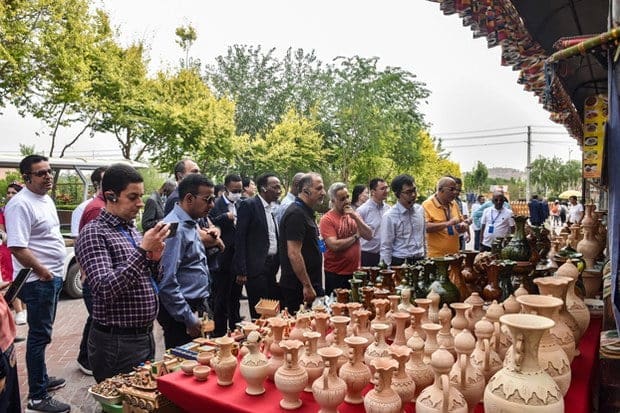
Foreign envoys visit an exhibition on Xinjiang's counter-terrorism and de-extremism work in Urumqi, the capital of the Xinjiang region in north-west China, 17 Muharram 1445 AH (4 August 2023 CE).
This move comes as China prepares for the fourth Universal Periodic Review, a Human Rights Council mechanism that calls on every UN member state to undergo peer review of its human rights record every 4.5 years. The review is scheduled to take place in Geneva, Switzerland, on 23 January.
Authorities have imposed tight controls on who enters Xinjiang (East Turkestan), where the harsh repression of Uyghurs and other Muslims has in recent years reached the level of genocide and crimes against humanity, according to the United States, the United Nations, parliaments of other Western countries and human rights groups.
Authorities in Xinjiang (East Turkestan) have detained an estimated 1.8 million Uyghurs and other Turkic Muslims, and have destroyed thousands of mosques and banned the Uyghur language in schools and government offices. China has said the "re-education camps" have been closed and has denied any policy of erasing Uyghur culture.
A recent CBS documentary on China's "rebranding" efforts shows surveillance cameras and facial recognition devices monitoring Uyghurs. The name of the old city of Kashgar appears in Chinese as "Kashi" on signs and billboards, while the Id Kah Mosque, dating back to the 15th century, which has been closed to local Muslims since 1437 AH (2016 CE), has been turned into a tourist attraction.
Experts on the region say the Chinese government is spreading, through written travel materials, a narrative that the Uyghurs live happy lives in order to cover up Beijing's grave human rights violations in Xinjiang (East Turkestan). For their part, foreign visitors have perpetuated the narrative through photos and posts on their social media accounts.
Criticism from Rights Groups
The dissemination of propaganda and China's efforts to improve the image of Xinjiang (East Turkestan) have drawn criticism from human rights groups.
Claudia Bennett, legal and programmes officer at the Human Rights Foundation, said the coordinated visits conceal the harsh realities of forced family separation, the arbitrary detention of millions in internment camps or forced labour, and thousands of Uyghurs living in exile who are forcibly rendered stateless.
She told Radio Free Asia: "In a strategic effort to legitimise its colonisation of the Uyghur region, the Chinese Communist Party carefully organises propaganda visits for diplomats, journalists and religious scholars. These tours are designed to whitewash the grave human rights violations committed by the Chinese Communist Party."
The Uyghur Human Rights Project, based in the United States, described the visits as "genocide tourism" in a report issued on 30 August last year, saying they help China conceal the genocide and crimes against humanity taking place in Xinjiang (East Turkestan).
Dolkun Isa, president of the World Uyghur Congress, took the criticism a step further.
He said: "Cooperating with Chinese propaganda amounts to complicity in genocide, a grave crime. Humanity will not forget, and the Uyghur nation will not forget. Those involved will be held accountable before history."
Travel and tour propaganda portraying life in Xinjiang (East Turkestan) as normal is part of "Beijing's current strategy", as Adrian Zenz, an expert on China's policies in Xinjiang, explained.
"They show Uyghurs and Uyghur culture, but not real, free people or culture, rather a hollowed-out version, an embalmed version, like a museum of the Chinese Communist Party," said Zenz, director of China studies at the Victims of Communism Memorial Foundation, based in the United States.
As the UN Universal Periodic Review session approaches, there can be no doubt that Beijing is promoting the visits as a means of countering criticism of its policies in Xinjiang (East Turkestan), said Sophie Richardson, former China director at Human Rights Watch.
Richardson added that the main problem with the Universal Periodic Review is that there are no penalties for non-compliance or for failing to correct violations.
"Beijing has demonstrated how easily the process can be manipulated to keep independent civil society, inside and outside China, out of the process... and to present a national report that is astonishingly dishonest in its claims of supporting human rights."
Radio Free Asia.


