

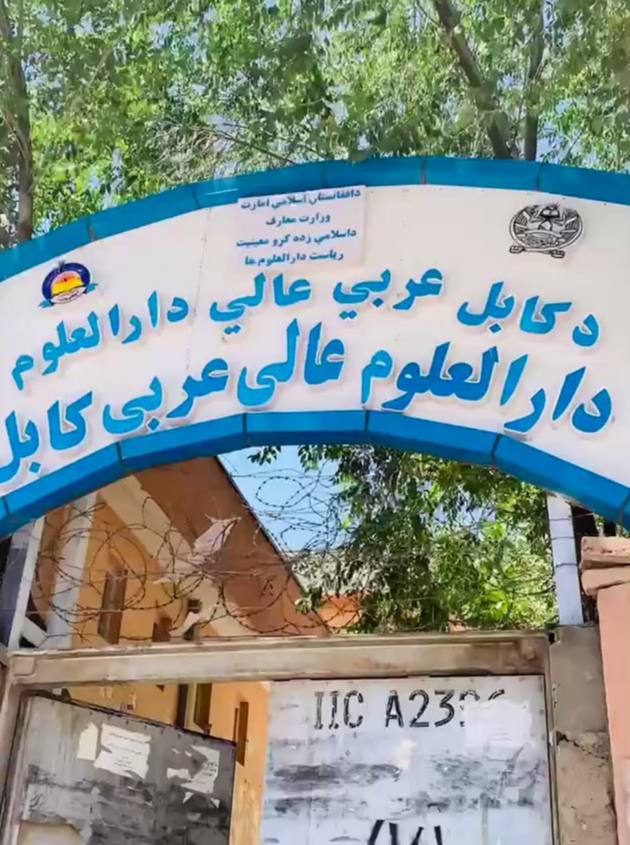
The Wasl team interviewed Ustadha Umm Usama, principal of two girls' educational institutions in Kabul and a teacher at Dar al-Ulum Government School in the capital, a school that teaches Islamic sciences with most of its subjects taught in Arabic. The interview sheds light on the situation of women's education in the country, which has sparked wide controversy recently. The interview follows:
Wasl: What is the Islamic Emirate of Afghanistan's vision of the social role assigned to women?
Ustadha Umm Usama: The Islamic Emirate's vision of the social role of women is not the complete removal of women from society, as some claim. Based on what I observe in reality now, some women work in various fields, such as the medical field, where good institutes are available with a two-year study period, open to girls. Likewise, in the educational field, Dar al-Ulum is available from the first to the fourteenth grade, open to girls. In the social field, such as the establishment of sewing workshops, some women work in such places for vocational training. As for the women who used to work in some government ministries during the occupation period, mixing with men in one office, they are now at home, their jobs suspended. However, the Emirate continued to pay their salaries in full until recently, when the Emirate set their salaries at 5000 Afghani. Some ministries, such as the Ministry of Higher Education and the Ministry of Education, have women working in the section allocated in these ministries for handling women's affairs.
There are also government schools for girls from the first to the sixth grade, open to girls, but schools beyond the sixth grade, up to secondary school and the university level, are currently closed to girls. What we know is that many women teachers who taught in government schools still do not receive their salaries in full. Women teachers who remain at home were paid their salaries in full, but, as I mentioned, for several months the Emirate has set their salaries at around 5000 Afghani per month.
In the religious schools section, schools are fully open to girls and there is no prohibition on their studying in this field. Women have complete freedom to go out and study the Quran and other religious lessons. However, many institutions associated with women have been closed by the Emirate for various reasons, including that those institutions were funded by foreigners and worked for their interests, or that the women working in them were not committed to religion and proper hijab. The last two reasons have been the main cause of the closure of educational institutions dedicated to women in Afghanistan.
Wasl: Is it true, as is said, that the Islamic Emirate of Afghanistan closed the doors of secondary schools and then universities to women, as well as parks, gyms and other facilities? And what is the reason for that?
Ustadha Umm Usama: Yes, the doors of secondary schools in government schools are closed, and so are universities, parks and gyms. As for secondary schools and universities, they have been closed since the year the Emirate took power. After taking power, universities were opened for a period on condition that female teachers be available for girls, and for this purpose the Emirate held examinations for them, but suddenly the Emirate closed the doors of the universities without mentioning any reason for the closure.
Personally, at that time I was teaching at several universities, and I will tell you what I saw with my own eyes there. I saw that there were many female university students from various disciplines whose ideas were dangerous and strange, and who were influenced by feminist ideas and Western intellectual invasion, except those whom God has spared. As a professor in the Department of Islamic Culture, when I went to other colleges to teach Islamic culture, I saw little desire among the students for religion and Islamic culture, except for a few of them. They were influenced by feminist and Western calls. The Emirate had allocated a number of Islamic culture classes in various colleges, but the students did not show a desire to learn religion, although the classes did not exceed two or three days a week. They used to say: instead of studying medicine, we go to the mosque and learn religion so we become scholars of religion! Why do we study Islamic culture more than one class a week? As for proper hijab, before the universities were closed, the government ordered female university students to wear proper hijab, but I saw that they did not fully observe it; rather, they displayed their adornments and charms beyond the hijab. In the name of hijab, decorated dresses spread, and they wore open abayas to show their charms, except for a few of them who fully wore proper hijab. As for gyms, some gyms were supported by feminist institutions, and during practical training they played music and committed religious violations. This was the reason for their closure.
Scenes from girls' schools in Afghanistan
The videos attached are from Ustadha Umm Usama and are about two months old.
First video
Second video
Third video
An awards ceremony for the elite of the eighth round of the Al-Majd competitions for women
Fourth video
Wasl: How does the Islamic Emirate deal with women who reject the decision at home and seek to participate with men in work, mixed education, holding leadership positions, and so on?
Ustadha Umm Usama: First: the Emirate rejects education and work for women in mixed places in general and in places where there was mixing, either they were closed or some of them continue to this day because of their necessity in society, but the Emirate separated men's offices from women's offices. For example: male and female employees of banks, the "Shareeha" companies, some hospitals, the passport distribution office, and the identity card distribution office. Such places are open to men and women, but the Emirate separated women's offices from men's offices in them.
Second: as for leadership positions, there are currently no women in the ministry holding the post of minister, lawyer, or judge. But in the presidencies section, there are some women who manage educational centers for girls, meaning their presidency is within women's gatherings, like some women's hospitals, and also schools.
Wasl: How accurate is what is said, that some women who were prevented from education and work by the Emirate, or who were beaten by members of the Hisba for not wearing the hijab properly, have committed suicide?
Ustadha Umm Usama: There is no truth to these rumours. I deal with various women's issues from morning until evening, and to this moment I have not encountered such a matter or heard that a woman was beaten by Emirate personnel for not wearing proper hijab, except in one exceptional case we know of, where some women, whose aim was to publicise their cause in order to leave Afghanistan for Western countries, deliberately went out of their homes improperly dressed and walked the streets improperly dressed, in front of the Emirate's soldiers, so as to provoke them to object, while behind them one of them filmed the video to tarnish the name of the Emirate, claiming that injustice falls on women and that the Emirate's soldiers beat women for not wearing the hijab. I must say this is a joke! After the Emirate came, it announced that women who work in any official or unofficial places must wear hijab, and women wear abayas with the burqa or niqab. As for those who work in the media, they appear on television wearing medical masks, or what are called face masks. This is a well-known matter in Afghanistan and is not new to its women. Therefore, the claim that women committed suicide, we have not heard of this in our reality, nor have we witnessed it among our relatives, our friends, or even our students, except for one suicide case whose motives we did not know exactly, but we heard from people that there was a case of suicide. This happens in all societies, even the decadent Western ones!
Wasl: As the director of an educational academy for girls, has your management style of the academy changed during the rule of the Islamic Emirate compared with the time of the occupation?
Ustadha Umm Usama: Regarding the difference between our approach during the Emirate's time and our approach during the occupation: I, as the director of a religious school before the Emirate, had proper hijab mandatory for students in our school, and now the same has not changed. But certainly there is a difference in motives. Students used to observe proper hijab during the occupation under the concept of democracy and personal freedom, so they did not accept that hijab be imposed as anything other than a personal choice, and that religion does not intervene in personal freedoms, and the government was protecting this idea. Unfortunately, to this day we still hear this talk from some women. As for other places, yes, the methods changed, because the Emirate required women to wear proper hijab, not only in schools but in all the various educational places and women-related workplaces. However, they wear abayas with a khimar, and some of them cover their faces with a niqab or burqa, and some do not cover their faces.
Wasl: What is your methodology in teaching Sharia subjects?
Ustadha Umm Usama: Our methodology in teaching Sharia subjects differs from school to school. We teach the Quran with reflection, memorisation, and exegesis, the principles of exegesis, hadith and the principles of hadith, and jurisprudence and the principles of jurisprudence. We teach jurisprudence according to the Hanafi school, as it is the prevailing school in Afghanistan. We also hold conferences specifically on the Prophetic biography. A student studies according to this methodology for four years, then moves to the junior course, in which she studies the translation of the Quran and the exegesis of verses of rulings and hadiths, such as the Forty Hadith of al-Nawawi, Riyad al-Salihin, Mishkat al-Masabih and the Prophetic biography, memorises several parts of the Noble Quran, and studies doctrine, such as the Tahawiyya creed, and jurisprudence. In other words, our methodology relies on teaching the foundations and Sharia subjects together, in addition to the Arabic language.
Wasl: Which subjects are focused on in teaching? For example, are foreign languages taught? If so, at what age?
Ustadha Umm Usama: The subjects focused on by the government are the Sharia subjects alongside modern sciences for boys. But as for girls, religious schools are open, and the medical institutes with a two-year study period. As you know, our country was under occupation for twenty years, and people grew up with the idea that religion is separate from our personal and individual lives, which is a secularist idea. Even most female teachers in government schools are influenced by this idea and do not know the basic matters of their religion, such as the obligatory prayers and fasting; some of them cannot even read the Quran or know the translation of Quranic surahs even at the level of Juz Amma.
The Emirate distributed books among them, then examinations. Also, in the ministries, congregational prayer is held for employees, and they must participate in prayer in their workplaces in congregation.
Yes, foreign languages are taught in the educational courses that teach the Arabic language, English, and some other languages. These are open to men without a specific age, and likewise to women. But as for women, these courses were suspended temporarily three months ago, because they did not observe the laws on preventing mixing and wearing proper hijab. However, after they committed to the Emirate's conditions for study, we returned to study, and the courses in all foreign languages were reopened, including English, German, and other foreign languages, all of which are available to women, who learn just like men but separately. As for Arabic language courses, they continue permanently, and there is an academy for teaching the Arabic language, and we have not seen any prohibition by the government on providing its teaching to women until now.
Wasl: How do you see the enthusiasm of male and female students for learning and schools?
Ustadha Umm Usama: Praise be to God, the enthusiasm of female students for schools is great and encouraging compared with the past. I am telling you about scenes I see with my own eyes: I visit different schools daily and see that the number of female students has risen in the religious schools. For example, in our school before the Emirate came we had 500 students or fewer, and after the Emirate came the number of students reached 1000. That is, it doubled. Also, before, girls were busy with government schools and did not wish to memorise the Quran; this was before the Emirate came. We had 40 students in the memorisation section, but now, after the Emirate's rule, we have more than 100 students and the number increases daily, and many girls admit that they changed in their understanding of life and their ambitions after coming to school.
Wasl: What difficulties do you face in teaching them, especially after emerging from the war?
Ustadha Umm Usama: The difficulties we face come down to a shortage of intellectual study materials and a shortage of women who hold the correct understanding, and even if we have women who hold inspiring ideas, they do not have the resources that women who worked in the women's department before had. In addition, there are few centres that have the correct methodology and work to awaken the nation and prepare it for the tasks awaiting it.
Wasl: What university specialisations are available to those who finish school? And how do you see university curricula? Are they hollow curricula, or do they truly build the Muslim personality expert in its specialisation?
Ustadha Umm Usama: As for the specialisations available to women now, they are religious, medical, and vocational, and as for the curricula, they do not build the character of the Muslim woman. The curricula have not changed much, except that they added some new books in the Islamic culture section, such as the subject of intellectual invasion, to create awareness of the conflict. But most of the female teachers or students of this subject do not know about this topic well; they only study it as a subject to pass, except those whom God has spared.
Wasl: Is there a noticeable difference between the outlook of women and girls who lived longer under the occupation and others under the rule of the Islamic Emirate, especially regarding the rules concerning women?
Ustadha Umm Usama: The root of the matter is that this generation was for a period far from Islamic rule; for this reason they do not readily accept the Emirate's rulings. The issue is fundamentally linked to the intellectual invasion that affected them greatly during the twenty years of occupation. They also do not know Islam well as it should be known, and for this reason Islamic rulings are not acceptable to them, due to their ignorance and also the influence of what is broadcast in the media hostile to Islam.
Wasl: To what extent has the Afghan woman been influenced by Western negative propaganda concerning the new conditions of women in the country?
Ustadha Umm Usama: I see the influence of Western propaganda to a large extent, truly, unfortunately, especially after the closure of schools and universities. They think according to what is published in the media about the deprivation of Afghan women from acquiring knowledge, that they are oppressed, and that Westerners love them and want their interest and good. For this reason, the closure of schools and universities opened a wider door for girls to be influenced by Western propaganda, because the Emirate, in universities and schools in terms of attendance, could employ female teachers with sound thinking to teach them. But now some girls study online at foreign schools and universities remotely, where some Western institutions provide lessons to them, and even send some of them monthly payments continuously to continue studying online.
Wasl: Please describe the role of the organisations specifically concerned with women's education and work during the presence of the occupying forces in Afghanistan.
Ustadha Umm Usama: These organisations carried out their core role, and many girls and women were affected by them. They provided job opportunities and educational opportunities such as literacy programmes. Even in the villages, these organisations ran sewing instruction programmes and were able to influence girls and women in remote areas, and more so in the capital, where their efforts were concentrated. These organisations held some conferences under the names "The Woman Leader", "The Woman President" and "The Advanced Woman". This activity was accompanied by financial support: participants were paid money as a reward, for example 100 dollars or 200 dollars, and were then given a certificate of participation. Programmes of this kind attracted even students of religious schools and those with no idea of what was going on, who took part in such conferences in order to obtain some material benefits. Even after the opening of Afghanistan, most of these organisations removed their members from Afghanistan to other countries, solely because of their participation in some conferences for which they held a certificate proving attendance; they filed cases on their behalf and demanded their resettlement in Western countries. These programmes also involved some women in usurious debts: monthly instalments of money were taken along with interest. These programmes provided usurious loans to female teachers and even to women who stayed at home and did not go out, as they would contact them and offer them such programmes. As for the media, it played a major role in spreading the feminist idea, and Afghan women were clearly influenced by these organisations.
Wasl: What is the situation of these organisations now?
Ustadha Umm Usama: Compared with the past, the number of these organisations has decreased greatly and many of their centres have closed, but their influence continues. Some organisations still operate covertly through the network and through their women members who live in Afghanistan and hold their ideas.
Wasl: Are there differences in the conditions of women between the villages and the cities, specifically the capital Kabul?
Ustadha Umm Usama: Yes, but not many differences. Those who were in the capital, because of the resources available, were more advanced than those who lived in the villages. However, those who lived in the villages were not spared the influence of those organisations; even in the villages there were organisations working in the sector of women's education and work, which is why their effects remain to this day, unfortunately.
Wasl: How did the living and economic conditions of women who support their families change after the Islamic Emirate came to power?
Ustadha Umm Usama: The living and economic conditions of women who support their families have changed. Some of the institutions in which they worked have closed, and some government departments have stopped operating. The Emirate does not see a need for their presence in some ministries, and for this reason it prevented them from working, and they now remain at home. However, the government pays a proportion of their salaries every month even though they do not work. A few months ago the Emirate extended payments to those who sit at home without work, in a specified monthly amount, as I mentioned earlier.
Wasl: Are the legal punishments of Sharia implemented, such as cutting off the hand of the thief and stoning the married adulterer?
Ustadha Umm Usama: Yes. At the beginning of the Emirate's arrival, punishments were carried out publicly, but after the media onslaught and so-called human rights and similar organisations, for some time now they have not been carried out publicly. However, I heard from one of the female employees of the Ministry of Interior in the criminal department that there is implementation of punishments but not publicly announced, and God knows best.
Wasl: Did the government impose the niqab, and do most women adhere to it?
Ustadha Umm Usama: As for the government imposing the niqab on all women, this has not happened. Rather, many women go out with their faces uncovered, or wear the niqab or the burqa. However, the government encourages women to wear the hijab. As you know, for 20 years our country was under Western occupation, and women changed a great deal, to the extent that they would go out to public places or work dressed in revealing clothing. But thank God, since the Emirate came, most women now wear abayas, and reform is proceeding gradually, and God willing we will see better results of that.
Wasl: The Emirate launched a widespread and blessed campaign against poppy cultivation, whose effectiveness the United Nations has acknowledged, and reports indicate that women were among those who sometimes cultivated it in rural areas. Have steps been taken to raise their awareness of the legal prohibitions related to this activity and to provide them with permissible means of earning a living?
Ustadha Umm Usama: This blessed campaign is truly the best and finest decision the Emirate has made. However, women's involvement in this field has not been large, with the exception of rural areas, where some women cultivated it for trade, as we saw in the media. We heard from some of our relatives that the Emirate has indeed banned this type of cultivation. As for permissible work other than this, farmers have other fields of agriculture that remain open, if they truly want lawful earnings. God knows best. There were many drug addicts in Afghanistan, and their number was increasing day by day, but after the Emirate came their number decreased noticeably, and they were gathered from the streets and treated in health centres.
Wasl: Did the prohibition of mixing play a role in reducing or eliminating the phenomenon of harassment?
Ustadha Umm Usama: Yes. After the Emirate came, mixing was prohibited in government departments and non-government ones gradually, in places where there is no need for women to work. As for places where women still work, such as the Dar al-Ulum where I now teach, before the Emirate came it was mixed: male and female teachers taught female students, and its administration was mixed. But after the Emirate came, the women's administration was separated from the men's, and the Emirate gave teaching vacancies to twenty-five female teachers at once. I was among these (25 teachers), and now our administration is separate, and men do not teach girls; we teach them. Likewise in religious schools where men used to teach, there was to some extent mixing, but the Emirate prohibited it. In some private or government schools too, it is the same, and even in some hospitals, places selling SIM cards, passport distribution offices and identity-card offices, each has an administration for women and another for men, so women serve women. Thank God, people have noticed the blessing of this. Mixing had been widespread before, to the point that people became accustomed to it and believed this matter did not contravene Sharia, but thank God, now we rarely see mixing on a large scale, and if it remains in some places it is not obvious or bold, but covert from the Emirate. We have a Ministry for the Promotion of Virtue and the Prevention of Vice, which sends its members to some places to monitor mixing and record violations of Sharia. In the past, two women would sit next to the driver in taxis and they did not mind, but now the Emirate has prohibited two women from sitting beside the driver.
Wasl: There are many reports speaking of the achievements of the Islamic Emirate. Have ordinary people truly been positively affected by these achievements?
Ustadha Umm Usama: Praise be to God, many matters have improved and are improving day by day. We see that the dollar has fallen, and also the prices of some foodstuffs compared with the time of the occupation have decreased. But people are not convinced, although they see many things with their own eyes; nevertheless they deny them and say that the time of the occupation, with all its corruption, was better than today. Unfortunately, we see clear changes in road construction and improvements in some cities, where some houses had been built on government land, all of which are now halted, because they had been built on road spaces, and the government's tyrants would not allow the demolition of these houses and the building of roads for the people. This was one aspect of government corruption in Afghanistan. But now, praise be to God, 70% of these problems have been resolved. Also, prices during the occupation kept rising, but now, praise be to God, they no longer do, and they do not rise as they did before. You will not read this information except from someone who impartially follows the positive aspects of the efforts being made.
Wasl: In your view, what is the reason why some who left Afghanistan refuse to return?
Ustadha Umm Usama: As for the departure of people of the country: I know some people here whose lives are good, yet they do not want to live in Afghanistan and want to leave. Some justify it by their children's education, or the unavailability of job opportunities for them; they spend a great deal of money and leave the country, and their real aim is not to live under the rule of the Islamic Emirate. They are not convinced of Islamic governance because their ideas are imported, and for this reason they do not see the positive aspects of the Emirate and speak only of its negatives. During the time of the occupation, unemployment was widespread in the country and people were leaving Afghanistan, so it is not a new phenomenon for Afghans. As for their return to the country, they first need to accept the Islamic idea; they do not yet realise that in the whole world there is no system better than the Islamic system. Whoever truly wants Islamic life will certainly return, and whoever does not want it will never return, even if the jobs, education and living they want are provided.
Wasl: Do you have stories of exemplary Muslim women from your reality?
Ustadha Umm Usama: Yes. There are Muslim women who raised the mujahideen, and not what they learned in universities or government schools; rather, they raised the mujahideen through their devotion and sincerity, and I reckon them so. I know a Muslim woman who, in a single night during the occupation, had five of her sons martyred under shelling, and she remains patient and seeking reward. There are also moving books about the stories of shelling during the occupation. Ustadha Halima comes to mind now: she had several schools and a religious sciences institute, and she strove to spread knowledge and Islamic upbringing. We also have other sisters who have classes at the central school where more than 1,000 female students study, and they strive in a way that is a source of pride; none of the temptations have diverted them from filling the gap of knowledge. We have other sisters who work in da'wa fields within Sharia controls, and who earned the Emirate's trust for their good commitment and diligence, so they are not prevented from working in the way of God.
I would also point out that there are some groups infiltrated into the Emirate who hold a creed that involves extremism and deviation from the Hanafi school, and these at times try to place obstacles before some religious schools whose creed is based on the correct methodology and in which female teachers of sound thought and creed work, while they want to distort their course in order to spread their superstitions and misguidance, such as the Sayfiya group (followers of the heretic Saif al-Rahman, whose heresy and unbelief was pronounced by scholars of Afghanistan and Pakistan in a document signed by nearly 200 scholars of the two countries). No country is free of challenges, and our Emirate in particular: enemies lie in wait for it day and night, may God protect us and spare us their evils. No country is free of challenges, and God knows best.
Wasl: A final word you would like to address to our honourable readers.
Ustadha Umm Usama: I say that every person errs when speaking of his opinion, but I have tried very hard not to say anything wrong or far from the truth. I have sought truthfulness in everything I have conveyed to you, and my purpose in answering these questions is to seek the pleasure of God Almighty, for the sake of God, and to explain the truth. Also, every system has positives and negatives, and so does the Emirate, but the matter of women, and what we see of a fierce war against Afghan women, is part of the war against Islam; for this reason they do not convey the full picture, and they exploit the file of women to corrupt them and spread their destructive feminist ideology. This is what drives the Emirate to confront this deception with this policy. In conclusion, I ask God to show us the truth as truth and grant us the ability to follow it, and to show us falsehood as falsehood and grant us the ability to avoid it.


