

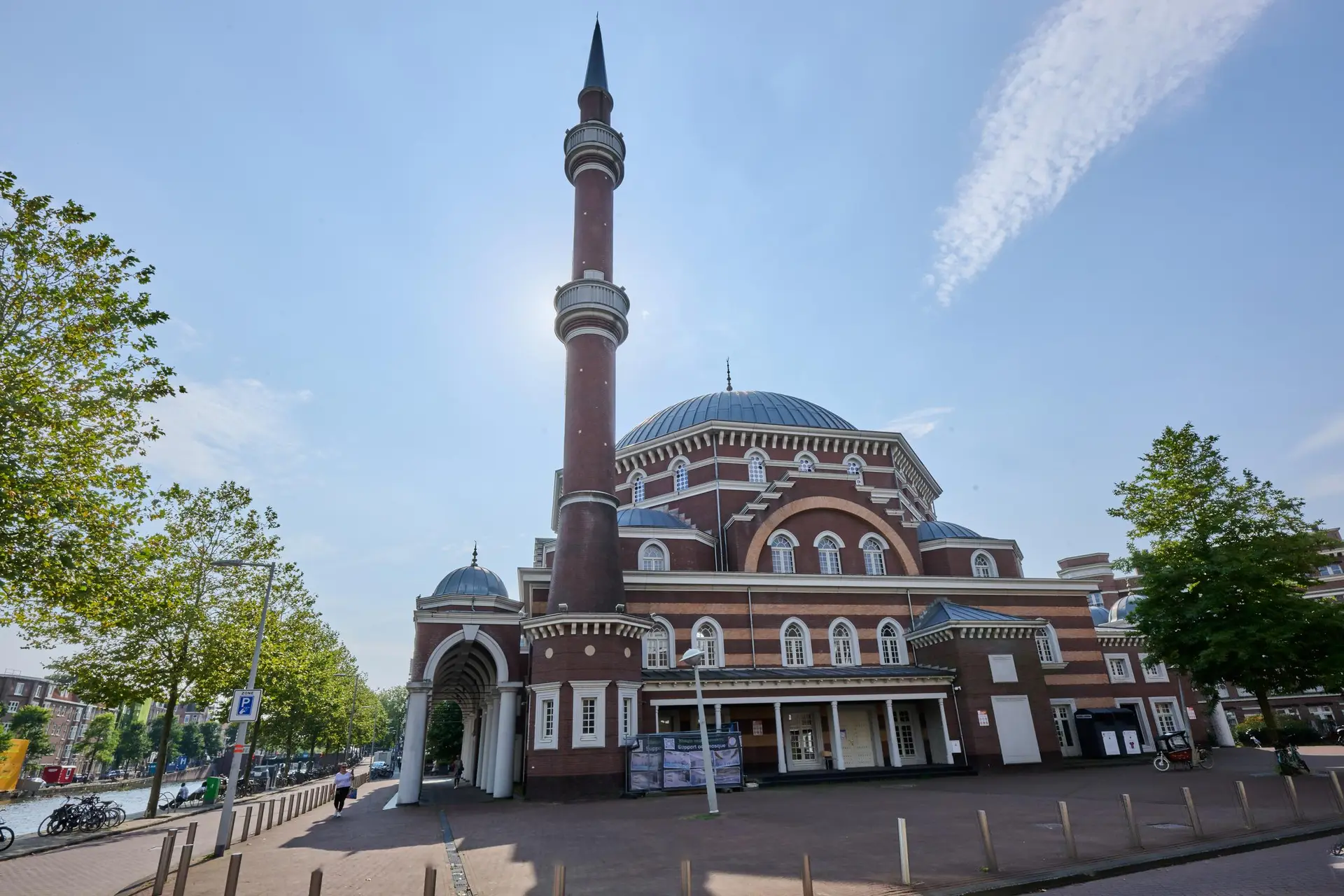
The role of the imam in a number of European countries is no longer limited to leading prayers, delivering the Friday sermon and teaching Muslims their religion. A recent academic study reveals that he is now expected to perform overlapping roles, including representing the Muslim community before official institutions, contributing to the prevention of extremism, easing social tensions, and responding to manifestations of hostility towards Islam, while at the same time maintaining the trust of worshippers and his religious independence.
The study, published in the Journal of Muslim Minority Affairs on 19 October 2026, indicates that imams in Belgium, Germany, Spain and Italy face simultaneous pressures from government authorities, the surrounding society, and from within Muslim institutions and communities themselves.
The study was prepared by the researchers Tahir Abbas, of the British university Aston, and Mai Tamimova, of the Czech Academy of Sciences, under the title "Intermediaries Between Three Parties: Imams, Securitisation and the Performance of Moderation in Belgium, Germany, Spain and Italy".
The study poses a question that goes beyond the organisation of mosques and the management of their affairs: can an imam preserve the independence of his religious discourse when he is continually required to prove that he does not pose a security or social risk?
Interviews with imams and representatives of Muslims in four countries
The researchers drew on qualitative data collected within the PROTONE project, funded by the Internal Security Fund of the European Union, during the period from 2023 to 2025.
The research material used by the study included interviews with 11 imams and four representatives of Muslim communities, in addition to four discussion groups with Muslim participants, in Brussels, Berlin, Madrid and Rome.
The broader project addressed the security of places of worship and the experiences of Christian, Jewish and Muslim religious groups, but the new study focused on the experience of Muslim imams and their position within different political and social systems.
The researchers describe this situation with the concept of "triangular mediation", referring to the need for the imam to deal with three types of pressure at the same time.
The first comes from official institutions, legal recognition frameworks, administrative regulation and security expectations. The second arises from manifestations of anti-Muslim hostility and threats that may target mosques and worshippers. The third emerges from within Muslim communities, as a result of intellectual, sectarian, ethnic and generational differences, and of divergent expectations regarding the role and positions of the imam.
The study considers that these pressures are not separate events; rather, they overlap and affect the way in which the imam exercises his religious authority and his relationship with worshippers.
When the imam becomes part of security policy
Among the most prominent ideas the study discusses is what is known in political science as "securitisation", that is, treating a social or religious issue as a security matter that calls for special measures of monitoring, regulation or intervention.
In the case examined by the study, imams are sometimes asked to take part in efforts to counter extremism, to cooperate with official bodies, and to address the concerns of the authorities regarding religious organisations, funding and public discourse.
However, the researchers point to a contradiction in this role: the imam is treated on the one hand as a partner who can be relied upon to promote stability, and on the other as a religious figure whose orientations and relationships should be subjected to scrutiny and verification.
This situation may push him to make additional efforts to demonstrate that his religious activity and public positions do not conflict with the political and security expectations surrounding him.
It may also affect how sermon topics are chosen, how political issues are addressed, and the limits of cooperation with government institutions.
The study does not claim that all imams are subject to direct security monitoring; rather, it examines how regulatory systems, security expectations and the sense of being under scrutiny affect the performance of their religious and social roles.
Belgium: the crisis of official recognition and Muslim representation
Belgium offers one of the most prominent examples of the overlap between the regulation of religious affairs and political decisions.
In autumn 2022, the Belgian authorities withdrew recognition from the Executive of Muslims of Belgium, which had officially represented Muslims since 1999, citing concerns related to foreign interference, funding and foreign influence.
The study notes that the Grand Mosque of Brussels also later lost its official recognition.
The researchers believe that these developments did not remain confined to administrative aspects, but were reflected in religious institutions and in imams, who found themselves facing questions concerning the legitimacy of Muslim representation, the relationship with the authorities, and the body entitled to speak on behalf of Muslims.
The study quotes one of the participating imams speaking about political pressures related to the choice of who represents Muslims, pointing to the sensitivity of the relationship between state institutions and the Muslim community.
A problem emerges here that goes beyond Belgium: when the legitimacy of a religious institution is tied to an administrative recognition that can be withdrawn, the relationship between religious independence and political decisions becomes a subject of continual testing.
Germany: mosques between transnational ties and political tensions
In Germany, the study focuses on the multiplicity of Islamic institutions and the intertwining of their social, ethnic and political ties with countries of origin.
The country has mosques and institutions founded by various communities, which differ in their organisational backgrounds, sources of funding and relations with official bodies.
The researchers point out that this structure sometimes requires the imam to deal with tensions that do not arise within German society alone, but extend to it from external political conflicts.
The study considers the example of groups linked to the "Hizmet" movement led by Fethullah Gülen, which the Turkish authorities have classified as a terrorist organisation since the coup attempt of 2016.
According to testimonies gathered in Berlin, these disputes affected the sense of security of some members of the movement within Turkish circles themselves, despite their shared religious affiliation.
This case shows how political disagreements between groups belonging to a shared Islamic background can affect the relationship of imams with worshippers and the nature of divisions within religious institutions.
Spain and Italy: differing legal frameworks and persistent challenges
In Spain, the study refers to the Cooperation Agreement concluded between the state and the Spanish Islamic Commission in 1992, which provided an official framework for regulating aspects of the relationship between the authorities and Islamic institutions.
However, the existence of a legal agreement does not eliminate the social challenges facing Muslims, nor does it necessarily prevent mosques from being exposed to hostility or threats.
The study cites the testimony of an imam in Madrid who spoke of an anti-Muslim slogan written on the wall of a mosque garden during the period of the Brussels attacks in 2016, which he linked to the activity of far-right extremist groups.
In Italy, a different problem arises: Muslims still lack a comprehensive agreement with the state of the type known as "Intesa", the legal framework enjoyed by other religious groups.
The study discusses how the absence of this agreement affects the status of Islamic institutions and their relationship with the authorities, and makes the work of imams dependent on uneven local and institutional arrangements and understandings.
Despite the differences in legal situations among the four countries, the researchers believe that imams face a shared challenge concerning the reconciliation of state requirements, the expectations of worshippers and social pressures.
Protection or surveillance? The dilemma of mosque security
The study addresses one of the most sensitive issues: the relationship between security measures intended to protect mosques and worshippers' fears that some of these measures may turn into means of surveillance.
In light of attacks targeting Islamic institutions in Europe, a mosque may need surveillance cameras, cooperation with the police, or additional measures to secure large gatherings.
However, the researchers found that some imams find it difficult to persuade worshippers to accept these arrangements, especially when members of the Muslim community fear that cooperation with security bodies could lead to the monitoring of their religious activities.
The study quotes an imam in Belgium as saying that some mosques are reluctant to increase surveillance, for fear that worshippers may believe the religious institution is working for the police or the local authorities.
The imam is thus required to strike a delicate balance: he seeks to protect worshippers from attacks, but he also needs to maintain their trust and avoid giving them the impression that the mosque has become a space under constant surveillance.
This dilemma shows that security measures should be assessed not only by their material results, but also by their impact on the relationship between religious institutions and members of the community.
Palestine and political discourse: when silence becomes a way to avoid problems
Among the notable findings discussed by the study is the influence of international events on religious discourse within European mosques.
Issues related to Palestine and international political conflicts can become sources of pressure on imams, who find themselves caught between the expectations of worshippers to take a clear stance and concerns about the political or security consequences of certain statements.
The study points to cases of self-censorship, in which some imams tend to avoid additional political positions, or to modify the wording of their sermons and statements for fear of provoking disputes with the authorities, the media or the local community.
This does not mean that all imams avoid speaking about Palestine, or that authorities in the four countries generally prohibit discussing it; the study does not provide evidence of a uniform policy of this kind.
Rather, it reveals how security and political expectations can influence an imam's decisions about what he says and what he prefers not to say, even without a direct order preventing him from expressing himself.
This finding raises questions about freedom of religious and political expression, and about the boundaries between the social responsibility of the imam and his right to express views on issues that concern his community.
Who defines the meaning of "moderate Islam"?
The study devotes an important section to discussing the concept of "moderate Islam", which consistently features in European political and security discourse.
The researchers argue that moderation, in the context of relations between imams and official institutions, is not always measured by doctrinal or jurisprudential positions; it may also be linked to the way in which the imam presents himself and his discourse before the authorities and society.
According to this analysis, the imam is required to demonstrate his ability to adapt to a set of divergent expectations: to be a religious authority recognised by worshippers, while at the same time being a figure who does not raise security or political concerns.
The researchers describe this process as a continuous effort to translate religious discourse and adapt to different institutional and social contexts.
However, this adaptation may expose the imam to criticism from within his community, especially from some young people who may see avoidance of sensitive issues or excessive deference to the authorities as a concession of religious independence.
A further paradox therefore emerges: conduct that some official institutions regard as evidence of moderation and cooperation may be interpreted by some worshippers as distance from the concerns of the community or submission to external pressure.
The study does not offer a religiously correct or incorrect definition of moderation; rather, it analyses the way in which this concept takes shape within political and social relations.
The study's limits and what it actually reveals
Despite the importance of its findings, the study relies on a limited qualitative sample, whose testimonies may not be representative of all imams or mosques in Europe.
The interviews included were conducted with male imams working in visible institutional roles, which means that the experiences of other religious leaders, such as women teachers and preachers, independent preachers and online activists, were not examined to the same extent.
The researchers acknowledge these limits and call for further studies on the impact of changing official policies and persistent international tensions on the work of Islamic institutions.
Nevertheless, the study offers an important comparative reading of the experience of imams in four different European systems, and shows that the challenges they face are not confined to laws or security procedures alone, but extend to daily relations with worshippers, neighbours and local authorities.
The imam's independence between the community's right and the state's requirements
The study shows that the imam in European Muslim communities performs a more complex role than appears from outside the mosque: he is not merely a preacher or teacher, but may become an intermediary between conflicting demands and a representative of his community in facing social, security and political challenges.
From this perspective, the situation of Islamic institutions cannot be assessed through legal recognition or counter-extremism programmes alone, without considering the impact of these policies on the freedom of imams, the independence of their discourse and their relationship with worshippers.
Protecting mosques from attacks is a necessary responsibility, and cooperation between religious communities and official institutions may serve the security of all; but the study raises a question about the cost borne by the imam when this relationship turns into a continuous chain of expectations and tests.
The study concludes that the issue is not whether imams are able to adapt to their European societies, but who sets the conditions for this adaptation, how its burdens are distributed, and whether it can be achieved without weakening the independence of religious institutions and Muslims' trust in their leaders.


