

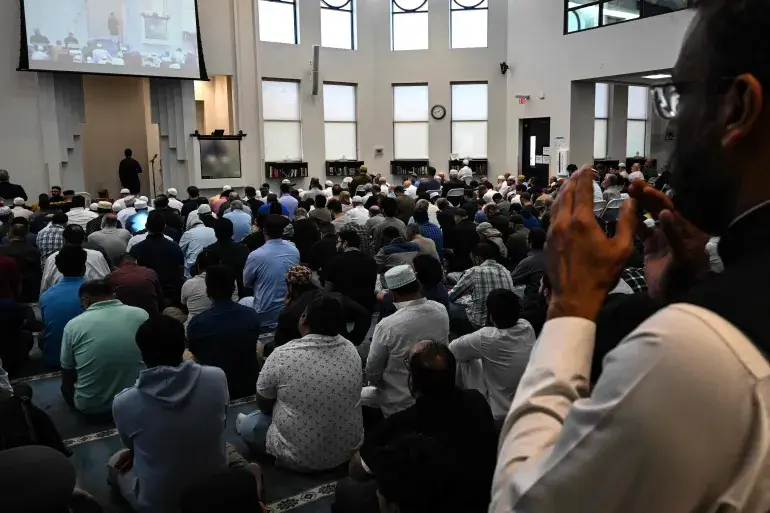
A wide academic study involving thousands of participants in Europe has found that belonging to a non-Christian religious minority is associated with a 35% higher likelihood of feeling that one's religious community is targeted by hate crimes. The perceived impact of the war in Gaza is associated with a further increase in this feeling, amid warnings that international conflicts are increasingly having a direct effect on the sense of security of Muslim and Jewish minorities within their European societies.
The study was published in the Journal for the Scientific Study of Religion on 9 September 2026, under the title "The Threat Paradox: Managing Community Security among Jewish and Muslim Minorities in Four European Countries."
It was prepared by four researchers: Tahir Abbas of Aston University in the United Kingdom, Mai Tamimova of the Czech Academy of Sciences, and Irene Triebskey and Paul Fabbiantz of Leiden University in the Netherlands.
The study examines how religious minorities deal with feelings of threat and hatred, and the extent to which wars and external conflicts affect relations between Muslims, Jews and the surrounding communities, as well as their relationship with government institutions and security agencies.
One of its most notable findings is that a growing sense of danger does not necessarily push minorities towards isolation; it may instead lead them to strengthen contact with local authorities and police, in an attempt to protect their members and places of worship.
A survey of 3,598 people and in-depth interviews in four countries
The researchers used a method combining statistical analysis and field research, through an online survey of 3,598 participants, conducted between 20 November and 27 December 2024.
The vast majority of participants came from four European countries: Spain, Germany, Italy and Belgium, totalling 3,397 people, while 201 other participants were spread across additional countries.
The sample included 2,844 participants from Christian backgrounds, 466 Muslims, 82 Jews, and 206 participants whose answers were not clearly classified under the main religious categories.
To deepen understanding of the survey results, the researchers also drew on 55 semi-structured interviews with religious leaders and experts, and five discussion groups with members of religious communities.
The interviews and discussion groups were conducted between 5 October 2023 and 15 April 2024.
The study is distinctive in that it combines testimonies collected in the first months of the war in Gaza with a survey conducted more than a year after its outbreak, allowing a comparison between initial reactions and the feelings and social patterns that persisted later.
However, the study is not a comprehensive census of all Muslims and Jews in Europe, and its estimates do not necessarily represent the entire population. An online sample was used that was not statistically weighted, with a relatively larger share of university-educated people and those who use digital media most.
Religious minorities feel 35% more targeted
After accounting for differences between countries and demographic factors and levels of religiosity, the researchers found that belonging to a non-Christian religious minority is associated with a 35% higher statistical likelihood of feeling that one's religious community is targeted by hate crimes, compared with Christian participants.
This category mainly includes Muslims and Jews, along with other participants whose religious answers were not classified under the Christian categories.
It is important to distinguish here between two different things:
The study does not say that actual hate crimes against minorities rose by 35%, nor that the proportion of people who were assaulted reached this figure. It measures a higher statistical likelihood that participants feel their religious communities are targeted.
This means the finding concerns the sense of threat and the assessment of the social environment, not a count of crimes recorded by police or judicial authorities.
The researchers used a scale covering three main aspects: the belief that the religious community is viewed negatively, the feeling that it is targeted by hate crimes, and the sense that there are tensions against religious minorities in the area where the participant lives.
The results showed that the average sense of threat was 3.37 points among participants classified as non-Christian minorities, compared with 2.64 points among Christian participants, on a five-point scale.
The researchers consider this difference to reveal an important gap in the sense of security and social belonging between religious groups, even within countries that provide laws protecting freedom of belief and the practice of worship.
The war in Gaza spills over into European communities
One of the study's most important findings is that the perceived impact of the war in Gaza on local religious life is strongly linked to the sense that the religious community is targeted.
According to the statistical analysis, each one-point increase in the index of perceived impact of the war was associated with a 55% higher likelihood of feeling targeted by hate crimes.
This result does not mean that the war directly caused a recorded increase in crimes of that size. It indicates a statistical association between participants' assessment of the war's effect on their local lives and the extent of their sense of threat.
Field interviews shed light on part of this relationship, as Muslim and Jewish religious leaders spoke about tensions linked to the Middle East conflict carrying over into European societies.
In one testimony, a Muslim imam in Germany said that members of his community feel they are being held responsible for events occurring outside their countries, and that their voices are not given sufficient attention.
He explained that this situation generates among some Muslims a sense of being second-class citizens, despite their belonging to the societies in which they live.
On the other hand, a rabbi in Belgium spoke of a rising sense of insecurity within the Jewish community, amid fears of antisemitic attacks.
The study does not equate the two communities' experiences in their historical causes or political circumstances, but it shows how international events can affect the relationships of religious minorities with local communities, and can make individuals feel obliged to justify events for which they bear no personal responsibility.
Why does a sense of danger not always lead to isolation?
The study reached a finding that the researchers described as the "threat paradox."
According to some traditional assumptions, rising social hostility leads minorities to withdraw and close in on their institutions and religious groups, as a result of losing trust in the surrounding society.
However, the findings showed a more complex relationship.
In some indicators, a higher sense of threat among minorities was associated with a better assessment of their external relations with official institutions and the local community.
The researchers believe this paradox can be explained by the fact that communities that feel exposed to attack may need to build more regular relations with local authorities, the police and community institutions in order to secure the protection of places of worship and religious activities.
This does not mean that social hostility becomes a positive factor, or that the minorities most exposed to threat enjoy better integration.
On the contrary, the study indicates that these relations may be formed out of necessity, when religious communities feel that ordinary protection measures are insufficient.
The researchers describe this behaviour with the concept of "grassroots community security management," meaning initiatives taken by minorities themselves to strengthen their safety and build preventive arrangements with local bodies.
These practices include communicating with the police and municipalities, cooperating with institutions around places of worship, developing local protection methods, and building support networks that can be relied upon when attacks or threats occur.
Imams and religious leaders face additional burdens
The interviews reveal that managing fear within religious communities has become an increasing part of the responsibilities of religious leaders.
Imams and rabbis not only face the challenges of religious education and managing institutions and social activities, but also find themselves required to respond to worshippers' concerns, calm tensions and coordinate protection measures.
In one testimony included in the study, an imam in Belgium spoke about differing positions among generations within the Muslim community regarding the appropriate way to deal with social pressures.
Some young people call for public stances and continuous protests, while other members prefer quiet work through institutions and official bodies, fearing that direct confrontation could aggravate tensions.
These differences make the imam's task more complex, as he is required to reconcile divergent orientations within the same community.
The study also addressed the psychological effects of these conditions on religious leaders, who may find themselves responsible for reassuring worshippers and showing steadiness, even when they personally suffer from anxiety and exhaustion.
The researchers believe this burden should be taken into account when formulating policies related to protecting places of worship and supporting religious communities.
Displaying religious identity: a freedom linked to greater concern
Another notable finding is that confidence in the ability to openly express religious belonging was associated with better declared relations with local institutions.
At the same time, however, it was associated with a higher likelihood of feeling targeted.
This reflects another paradox: people who express their religious identity confidently may be better able to communicate with authorities and institutions, but the visibility of their identity to others may make them more aware of social hostility.
The study also found that those who attach greater personal importance to their religious beliefs recorded a 15% increase in the likelihood of feeling targeted, while irregular participation in religious activities, compared with regular participation, was associated with a 28% decrease in this likelihood.
The researchers note that public religious presence may be linked to different experiences of social friction, but these statistical relationships do not prove that practising religious rituals is the direct cause of exposure to hatred.
The importance of these findings lies in raising questions about the ability of European societies to ensure that freedom of religion is effectively practised, so that displaying religious belonging does not become a further source of concern.
Differences between Belgium, Germany, Italy and Spain
The findings were not uniform across the four European countries.
Compared with participants in Belgium, the statistical models showed a lower likelihood of feeling targeted among participants in Germany by 42%, in Italy by 59%, and in Spain by 30%, after accounting for the factors included in the analysis.
The researchers link these differences to the possible influence of variations between legal and political systems, the nature of the state's relationship with religious institutions, and the particular historical and social experiences of each country.
However, these figures alone cannot be used to rank countries by the actual level of security for minorities, because they relate to the subjective sense of being targeted within the research sample, and do not compare officially recorded rates of hate crimes.
Nor do differences in how the relationship between the state and religious institutions is organised necessarily explain all the variations; local, historical and social factors may also have influences that the study was unable to fully isolate.
Anti-Muslim sentiment between overt discrimination and seemingly neutral policies
The researchers devoted part of the interviews to the experiences of Muslims with forms of social hostility and institutional pressure.
The study quoted an imam in Belgium criticising what he perceives as indirect discrimination, embodied in laws and policies that appear neutral in their wording but may impose particular burdens on Muslims and their religious practices.
This view raises the question of how to assess the impact of public policies on different religious groups, and whether rules that are equal on their face may produce unequal outcomes in application.
This testimony nevertheless remains an expression of one participant's experience and assessment, and does not mean that the study legally established discrimination in every policy or legislation he referred to.
These testimonies are significant in revealing the gap that can arise between the way official institutions present their policies and the way some members of minorities understand the effects of those policies on their daily lives.
What the study says to European authorities
The study concludes that protecting religious minorities should not be limited to issuing condemnation statements after attacks, or demanding that religious institutions take security measures on their own.
Communities that feel threatened need clear protection measures, relations based on trust with official bodies, and assurance that security arrangements do not become a continuous burden borne by mosques, temples and their leaders alone.
The findings also point to the importance of taking into account the local impact of international conflicts, as events occurring outside Europe can reshape feelings of safety, belonging and social relations within its cities.
One of the main conclusions is that increased contact with the police and municipalities should not automatically be interpreted as evidence of successful integration; in some cases it may be a necessary response to a growing sense of danger.
At the same time, the study highlights the role of public institutions in providing protection without discriminating between citizens on the basis of their religious beliefs, and in supporting freedom of expression and community participation.
What the findings prove and what they do not
It is necessary to view the study within the limits of its research methodology.
It relies on an online survey conducted in late 2024 and interviews conducted earlier, and it is not a direct field monitoring of hate crimes during 2026.
The sample is not weighted to represent the population, and it is heavily concentrated among people who have lived and worked in the European Union for at least ten years, with greater representation of educated and digitally connected participants.
The study relies on statistical relationships between variables, and therefore cannot prove that the war in Gaza or membership of a religious minority directly caused the rise in actual crimes.
Nevertheless, combining thousands of responses with in-depth testimonies gives the research value in explaining how concerns take shape, the relationship between religious identity and a sense of security, and the ways in which minorities respond to the pressures they face.
Religious minorities between a sense of danger and the search for protection
The study reveals a complex reality experienced by religious minorities in Europe: on the one hand, some of their members feel heightened threats and tensions linked to their identity; on the other, they continue to engage with official institutions and seek to strengthen their relationships with the surrounding society.
The findings show that the protection of minorities is linked not only to the number of crimes recorded by the police, but also to the degree of confidence individuals feel in their ability to practise their worship and express their beliefs without fear.
They also confirm that international conflicts can leave long-term social effects on groups that do not participate in them directly, yet find themselves confronting their consequences within their countries of residence.
In the end, the study's most important finding stands out: the growing contact of religious minorities with state institutions does not necessarily mean a decline in their sense of danger. Rather, it may be an attempt to protect themselves in an environment where they feel that security is no longer guaranteed.
This makes ensuring freedom of religion, protecting places of worship, and strengthening trust between religious communities and the authorities an ongoing responsibility. It extends beyond responding to crimes after they occur to addressing the causes of fear and tension before they turn into deeper crises.


