

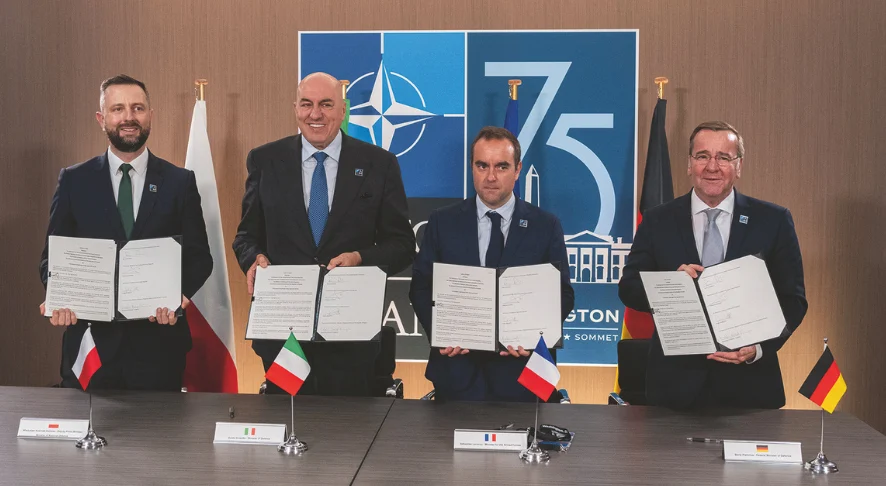
From Britain and Germany to France, Poland, Italy and Sweden, six European countries are moving toward developing a joint system for long-range precision strikes, including missiles with ranges exceeding 2,000 kilometres, multiple launch systems and low-cost offensive weapons. A recent military study reveals that the European project has moved beyond the stage of identifying requirements to executive working groups, but financing, manufacturing challenges and disputes over the distribution of roles could hinder these capabilities from entering service in the required time.
Europe is entering a new phase of rebuilding its military capabilities, as a joint initiative to develop long-range weapons moves into implementation stages, in an effort to compensate for a long-standing shortfall in conventional precision strike capabilities and to strengthen European states' ability to deter Russia without relying mainly on the American military arsenal.
A study published by the International Institute for Strategic Studies (IISS) on Thursday, 5 November 2026, revealed that the "European Long-Range Strike Approach" (ELSA) initiative has moved from planning and defining military requirements to establishing specialised implementation groups to develop missile systems and supporting technologies.
The study was prepared by researcher Matthew Bent, a specialist in missile and drone technology, under the title "European Missiles for Strikes on Land Targets: Long Range and Near Needs."
According to the researcher, the main challenge is no longer only identifying what European armies need, but also the ability to turn joint projects into actual weapons and systems, produce them in sufficient numbers, and deliver them on timelines commensurate with growing security risks.
The initiative includes six countries: France, Germany, Italy, Poland, Sweden and the United Kingdom, and aims to develop relatively independent European capabilities to carry out precision strikes deep within adversaries' territory, using conventional non-nuclear weapons.
However, the project's move to implementation does not mean that all participating states currently possess these missiles, as major projects are still in development stages, while final specifications or the date of entry into service have not been announced for many of the systems.
The war in Ukraine exposes a European military gap
The initiative's roots go back to the transformations brought about by Russia's full-scale invasion of Ukraine in February 2022.
Russia used ballistic missiles, cruise missiles and long-range air weapons to strike Ukrainian targets in areas far from the direct front lines, including military facilities and energy and transport infrastructure.
In contrast, the war revealed the limited options available to some European armies for carrying out conventional precision strikes from comparable distances.
Although some European countries possess advanced missiles launched from fighter aircraft, their capabilities to conduct long-range strikes from land-based platforms have remained less developed and less widespread than Russian capabilities.
The problem, according to the analysis, is that owning fighter aircraft and advanced air-launched missiles does not necessarily provide the same ability to launch sustained strikes from land positions, especially when aircraft face advanced air defence systems.
Dependence on American weapons also raises questions about Europe's ability to make relatively independent military decisions and to secure its needs of munitions and technologies should it face a major crisis.
Hence the concept of "Deep Precision Strike" emerged, based on having the capacity to target facilities and military objectives located at long distances behind front lines.
European planners believe this capability may enhance deterrence, because it raises the potential cost of any large-scale attack and gives armies additional response options.
However, expanding long-range offensive capabilities also carries the risk of increasing military tension, and may prompt Russia to develop countermeasures or strengthen its missile arsenal.
From the 2024 agreement to the implementation groups in 2026
France, Germany, Italy and Poland launched the initiative in July 2024, during the NATO summit held in Washington, before Sweden and the United Kingdom joined in October of the same year.
The declared goal was to unify European military requirements, reduce duplication in armament projects, and develop long-range missiles through cooperation among the defence industries of participating states.
However, the initiative began without specifying a single type of weapon or a joint launch platform, focusing instead on establishing a framework for cooperation and assessing technical and military options.
During 2025, the participating states identified 13 areas or lines of development for the required capabilities, without publicly disclosing details of all these areas.
The outlines of implementation began to appear more clearly in February 2026, when the Polish Ministry of Defence announced progress in four specialised groups, covering airborne early warning, air-launched long-range strikes, multiple missile launch platforms, and low-cost one-way offensive systems.
On 18 June, the British Ministry of Defence announced the formal transfer of the initiative to independent implementation groups, in which participating states lead their projects and develop mechanisms for cooperation, production and procurement.
By November, eight of the thirteen development areas had become publicly known, while the possibility of announcing additional groups remains open.
The researcher considers this step an important transition from formulating military ambitions to building programmes that can be converted into development projects, contracts and armament.
Eight tracks for developing missile capability
The initiative is not limited to producing a single long-range missile, but includes a set of integrated capabilities covering surveillance, launch and strike systems.
The study identified eight announced implementation tracks, distributed as follows:
First: airborne early warning. This includes developing capabilities able to detect air threats and provide information that helps manage military operations.
Second: air-launched long-range strikes. This aims to develop weapons launched by fighter aircraft or other air platforms.
Third: a European multiple missile launch platform. This targets developing a launch system that can support different types of missile munitions.
Fourth: low-cost one-way offensive systems. These include unmanned weapons with a range exceeding 500 kilometres.
Fifth: land-based missiles with a range between 300 and 500 kilometres.
Sixth: land-based missiles with a range between 500 and 2,000 kilometres.
Seventh: land-based missiles with a range exceeding 2,000 kilometres.
Eighth: long-range capabilities to suppress enemy air defences.
This diversity shows that the participating states do not seek to develop a single missile alone, but to build an integrated system comprising weapons of different ranges, reconnaissance means, launch platforms, and capabilities that help carry out military operations.
Moreover, the presence of tracks including low-cost weapons reflects interest in developing options that can be produced in larger numbers, rather than relying entirely on advanced and expensive missiles.
Britain and Germany: missiles exceeding 2,000 kilometres
The British-German cooperation is one of the most prominent projects addressed by the study, given its ambition to develop land-based strike capabilities with a range exceeding 2,000 kilometres.
The project is based on the "Trinity House" defence cooperation agreement, which London and Berlin signed in October 2024.
In May 2025, the two governments formally announced work on developing a joint long-range precision strike capability, exceeding the distance that most traditional European land systems can handle.
The potential technical options include advanced cruise missiles, hypersonic glide vehicles, and other systems capable of reaching distant targets.
The final nature of the weapon the two countries will produce has not been officially settled.
This matter is important because differences in design significantly affect cost, speed, guidance systems and manufacturing requirements.
In a more recent development, the British and German defence ministries announced, in a joint statement issued on 2 November 2026, significant progress in the project aimed at developing capabilities with a range exceeding 2,000 kilometres, and indicated work to deliver them within the current decade.
This announcement follows earlier British statements that anticipated the project entering service during the 2030s, indicating that the two governments seek to accelerate implementation, without announcing a detailed delivery schedule that can be verified so far.
These statements are evidence of the progress of the governmental track of the project, but they do not mean the missiles are ready for operational use.
France seeks to expand its role in the longer-range missile project
The institute's study indicates that France, despite being an original member of the European initiative, seeks to join directly the British-German project concerning capabilities with a range exceeding 2,000 kilometres.
Paris relies on its industrial experience in developing ballistic missiles, particularly the capabilities held by the company "ArianeGroup."
The researcher considers this experience could be a significant addition if London and Berlin choose to develop a weapon based on hypersonic glide technology.
High-speed missiles and vehicles require advanced technical and industrial capabilities, including propulsion technologies and materials able to withstand harsh conditions during flight.
However, adding a new partner to an existing project may require renegotiating the distribution of industrial work, technology rights, financing and production responsibilities.
Here emerges a recurring dilemma in European armament programmes: does expanding participation accelerate development through sharing resources and expertise, or does it cause additional delays due to the complexity of managing the project?
The study does not provide a conclusive answer, but it confirms that France's experience may be of considerable value, especially if the orientation toward developing hypersonic weapons continues.
The STRATUS project: air-launched missiles with different designs
Alongside the British-German cooperation, the study addresses the STRATUS programme, in which Britain, France and Italy participate.
The project aims to develop a new generation of air weapons, to eventually replace some of the long-range strike missiles currently in service.
The programme includes at least two main designs.
The first design relies on a subsonic weapon, with characteristics to reduce the possibility of detection by radars.
The second design focuses on developing a supersonic weapon.
The researcher notes that the programme could be one of the candidates to meet long-range air strike requirements within the European initiative.
However, the British defence investment plan for 2026 included a review of this project, and the results of the review have not yet been announced in detail.
The study raises a question about whether the estimated range of about 800 kilometres for one design of the low-radar-signature missile is sufficient, in light of growing European ambitions to develop weapons reaching greater distances.
This question represents a research possibility related to reviewing requirements, not an official announcement of changing the design or cancelling the programme.
Sweden: early warning expertise and naval missiles
Sweden stands out in the study as a country possessing advanced industrial capabilities in the field of airborne surveillance and early warning.
The Swedish company Saab produces radar systems and early warning aircraft, including the "Erieye" and "GlobalEye."
The company has supplied Poland with early warning systems, and is also linked to programmes to provide France and the North Atlantic Treaty Organization with capabilities of this type.
The researcher considers it likely that Sweden will lead the European group concerned with airborne early warning, given its industrial expertise in this field.
However, this assessment does not constitute an official announcement appointing Sweden as leader of the group.
The report also refers to the "RBS15 Mk4 Gungnir" missile, which Saab is developing in cooperation with German industry, as a potential candidate for the land-based missile category with a range between 300 and 500 kilometres.
This indicates that some participating states may contribute to the initiative through existing or under-development systems, rather than starting entirely new projects.
The greatest obstacle: who builds the missile and who pays for it?
The study holds that the transition to implementation groups does not end the problems facing joint European armament projects.
Among the most prominent of these problems is how industrial work is distributed among the participating companies and states.
Governments often seek to ensure their national industries benefit from the projects they finance, whether through producing essential components, assembling systems, or retaining technological rights.
However, these demands may complicate project management, prolong negotiations, and delay the transition from design to production.
The researcher warns that adding new states to some implementation groups may be useful if they contribute technical expertise or additional financing, but it could become a burden if negotiations over distributing roles take a long time.
This matter is of particular importance because the six participating states include a large part of the European defence industrial base.
Accordingly, the accession of additional states will not necessarily be beneficial unless they provide capabilities or resources that justify the potential costs and delays.
Mass production: the challenge that goes beyond developing the missile
The problem of European missiles is not limited to the success of the design or tests, but extends to the volume of production after development is complete.
A military programme may succeed in producing a highly advanced missile, yet fail to provide sufficient quantities to allow its use on a wide scale or to replace what is consumed during a long war.
For this reason, the researcher stresses the need to secure large and stable purchase orders that allow companies to maintain production lines and reduce the unit cost.
He suggests that participating states consider reciprocal purchase agreements, allowing each state to benefit from projects developed by other states within the initiative.
He also discusses the possibility of using joint procurement mechanisms within the North Atlantic Treaty Organization, which has experience in coordinating weapons purchases among allies.
These mechanisms could increase the size of orders and distribute financial burdens, but they require agreement on specifications, financing and timelines.
The researcher believes that achieving a credible military capability requires moving from announcing advanced projects to possessing systems that are produced and delivered on a regular basis.
A missile that achieves technical success in tests alone does not provide sustainable deterrence if it cannot be produced in sufficient numbers.
Tens of billions to strengthen long-range strikes
The developments of the ELSA initiative coincide with a broader European trend toward increased spending on precision strike capabilities.
On 8 July 2026, twelve European countries, including Britain, France, Germany, Turkey, Spain and other states, announced an investment initiative to strengthen long-range precision strike capabilities.
The participating states announced their intention to invest 50.66 billion dollars over ten years in these capabilities, as part of efforts to enhance their military contribution within the North Atlantic Treaty Organization.
The signatory states include Denmark, Estonia, Finland, France, Germany, the Netherlands, Norway, Romania, Spain, Sweden, Turkey and the United Kingdom.
It should not be confused with the "ELSA" initiative, which involves six countries. The first announcement concerns a broader European framework for strengthening military capabilities, whereas ELSA represents a specific set of development and industrial cooperation projects.
Yet both announcements reflect a shared orientation toward increasing the ability of European states to acquire long-range weapons and reducing the gaps that became apparent during the Russia-Ukraine war.
Could European Rearmament Deter Russia or Lead to a New Missile Race?
The European expansion in the development of long-range missiles raises a question that goes beyond defence industries and budgets, concerning the impact of these weapons on security stability within the continent.
From the perspective of the participating European states, conventional long-range missiles are a means of strengthening deterrence, by demonstrating the capability to strike high-value military targets if they come under attack.
According to the European view, these capabilities may allow responses to attacks from long distances without full reliance on the United States.
However, Russia may view the development of these systems as an increase in the threat faced by its military installations and vital centres.
This may lead Moscow to strengthen its air and missile defence systems, develop additional offensive weapons, or take counter-military measures.
The sensitivity of this issue is heightened by the possible overlap between some types of conventional missiles and missiles capable of carrying nuclear warheads, and the risk of miscalculation this may cause during crises.
The collapse of the Intermediate-Range Nuclear Forces Treaty between the United States and Russia in 2019 also removed a legal framework that had restricted the deployment of important categories of land-based missiles.
Therefore, the expansion of European capabilities may strengthen deterrence from the perspective of the participating states, but it remains linked to the risks of escalation, a military race, and the weakening of arms control mechanisms.
In a broader study published in November 2025, the International Institute for Strategic Studies noted that Europe needs to address these dilemmas alongside developing its technical and industrial capabilities.
Can Europe Do Without American Missiles?
The ELSA initiative does not mean that European states are moving to end their military cooperation with the United States, or that they have become able to dispense with American weapons systems.
The initiative is being developed within the framework of strengthening European capabilities within the North Atlantic Treaty Organization, not as a military system separate from it.
Nevertheless, the stated objective includes strengthening European autonomy in precision strike capabilities and reducing reliance on external suppliers for technologies, munitions and core capabilities.
Achieving this objective requires developing local industrial capacities, sustaining production, securing technical components, and harmonising standards among the participating states.
It also requires improving reconnaissance, surveillance and target-identification means, because possessing a long-range missile alone is not sufficient to carry out precise and effective strikes.
These requirements show that European military autonomy is a multifaceted project, not one achieved merely by announcing a new missile range.
Hence, the success of the initiative will be measured by its ability to produce operational systems integrated with European armed forces, not only by the announced ranges.
Conclusion: Europe Sets Its Missile Objectives, but the Test of Implementation Has Begun
The International Institute for Strategic Studies study reveals that Europe has moved from discussing the need to possess long-range missiles to building implementation groups to develop them.
This step reflects an important shift in European military thinking since Russia's invasion of Ukraine, with six states seeking to develop capabilities including land-based and air-launched missiles, surveillance and early-warning systems, and low-cost offensive means.
The British-German project, whose range exceeds 2,000 kilometres, stands out as one of the most ambitious paths, alongside other programmes in which France, Italy, Sweden and Poland participate.
However, progress in planning and governmental cooperation does not mean that obstacles have ended.
The participating states still face challenges related to the distribution of industrial work, financing, contracting and production, in addition to the need to bring the systems into service in a timeframe that allows their defensive capacity to be strengthened.
Moreover, deploying longer-range conventional missiles may expand European deterrence options, but it is not free of the risk of fuelling a new arms race with Russia.
Thus, the most significant shift revealed by the study is not that Europe already possesses a missile arsenal exceeding 2,000 kilometres, but that it has begun turning this ambition into specific implementation programmes, whose success will depend on the six states' ability to overcome their industrial and financial differences and to produce and deliver the weapons on the targeted schedules.
Between the need to deter Russia and the desire to build greater military autonomy from the United States, Europe is entering a phase that may reshape the missile balance on the continent in the coming years, though its outcomes will remain tied to what is achieved on the ground rather than what is announced in agreements alone.
Primary source: International Institute for Strategic Studies (IISS), Matthew Bennett, 5 November 2026.
Supporting sources: British and Polish Ministries of Defence, February and June 2026; British-German defence statement, 2 November 2026; International Institute for Strategic Studies study on European precision strikes, November 2025.


