

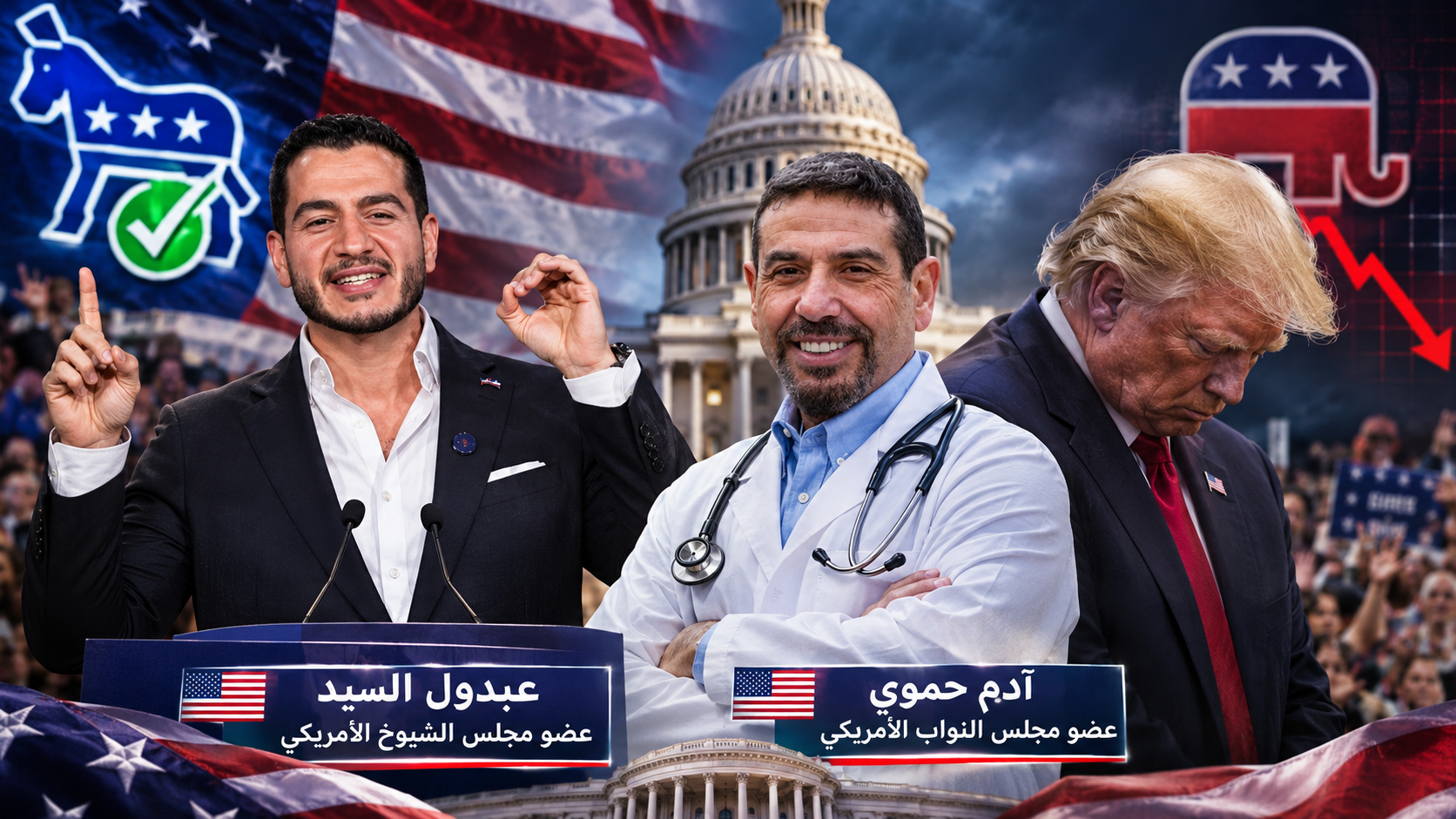
The US midterm elections brought a notable shift in the country's political representation, as Democrats wrested control of both the House of Representatives and the Senate in a sweeping electoral blow to the Republican Party and President Donald Trump, who had framed the vote as a test of whether public support for his political agenda would endure in the second half of his term.
The elections also saw two candidates of Egyptian origin win seats in the most important legislative body in the United States. Abdul El-Sayed won a Senate seat for the state of Michigan, while former military surgeon Adam Hamawi won a House seat for the state of New Jersey. The outcome carries political significance beyond individual victories, pointing to the growing presence of Arab Americans in centres of decision-making.
El-Sayed's win is a historic milestone in American political life, as he became the first Arab American of Muslim background to reach the Senate, one of the most important centres of legislative power in the country, which plays a central role in passing laws, ratifying international agreements and confirming senior presidential appointments. The significance of the result is not limited to his religious background or Egyptian origins, but extends to the nature of the contest he fought in Michigan, where he faced Republican Mike Rogers in a race marked by sharp political polarisation, in which economic issues intertwined with foreign policy, identity and representation.
El-Sayed ran on a platform that defended "LGBTQ rights," focused on reforming the healthcare system, expanding access to medical coverage and confronting the influence of large corporations and wealthy donors in financing election campaigns. He also opposed the continuation of US military aid to Israel. These positions brought him into direct confrontation with sections of the Democratic Party itself, as well as attacks from his Republican rivals, particularly President Donald Trump.
In the House of Representatives, Adam Hamawi achieved an equally significant victory, defeating Republican Greg Millie in the state's 12th district of New Jersey, becoming the first Arab American of Muslim background to represent the state in Congress. Hamawi is a plastic and reconstructive surgeon and former military physician, born in Egypt and raised in the United States, who served as a field surgeon in the US Army during the Iraq War.
His name is linked to a notable humanitarian episode dating back to 2004, when he helped save the life of US Senator Tammy Duckworth after the helicopter she was flying in was shot down during the war in Iraq. He also took part in medical and humanitarian missions in several countries, and travelled to the Gaza Strip on a medical mission in 2024, an experience that left a clear mark on his political positions and led him to enter public service.
Notably, the victories of El-Sayed and Hamawi came in an election that also saw the rise of figures from different ethnic and cultural backgrounds, reflecting shifts within American society and the declining ability of rhetoric based on fear of religious or ethnic difference to decide the votes of broad sections of the electorate.
A Double Defeat for the Republicans: Democrats Retake Both Chambers of Congress
Republican losses were not limited to the loss of a majority in one of the two chambers; they extended to states and districts long regarded as Republican strongholds. Democrats reversed the outcome of a number of races in their favour, including in states that voted for Trump by large margins in the previous presidential election. They also made gains in Senate and gubernatorial races, which indicates that the shift was not tied to limited local contests but to a broader political wave that affected the Republican Party's image and its ability to retain the electoral coalition that brought Trump to the White House.
These results reveal an important paradox: Trump was not on the ballot, yet he made himself the central figure of the Republican campaign, took part in intensive election events to support his party's candidates, and presented the elections as a referendum on his policies. It is therefore difficult to separate the Republicans' loss from the performance of the president himself, even as he later attempted to blame some candidates for the defeat.
The loss of both chambers of Congress also ends a phase in which Republicans had a greater ability to pass the White House's priorities through a legislative majority, and opens a new stage of political balance in which Trump will have to deal with a Congress controlled by the opposition, raising the likelihood of confrontation over the budget, spending, appointments, investigations and domestic and foreign policy files.
Why Did Trump Lose? The Economy, the War with Iran and Declining Trust
Several factors contributed to the Republican losses, but economic pressures, the cost of living and the war with Iran were at the forefront of issues that influenced voters' orientations, according to initial coverage and analysis of the election results. The American voter entered the electoral contest facing growing burdens related to the prices of goods, services, energy and fuel, issues that directly affect daily life and cannot be eased by political speeches or strategic promises alone. In midterm elections, economic conditions often become a practical measure for judging an administration's performance, regardless of the successes it announces in other files.
The war with Iran added a new burden for the Republicans, particularly through its effects on energy and fuel prices, and the accompanying concerns about the widening of the conflict and its military and economic costs. Trump himself acknowledged that the war played a role in his party's losses, saying in an interview with Fox News that Iran was one of the factors affecting the results, while maintaining that voters understood the importance of his moves towards Tehran.
In more telling remarks, Trump linked the position on the war to rising fuel prices, noting that voters may not have been prepared to bear the short-term cost of the war, even if they understood its strategic justifications from his point of view. This admission reveals a gap between the calculations of the political and military administration and the priorities of the American voter, who may accept national security rhetoric but remains more sensitive when external conflict is reflected in the cost of living.
In addition, questions of trust in government, allegations of corruption and the prioritisation of personal interests played a role in shaping the electoral mood. Voter polls showed that broad sections were angry or dissatisfied with the country's direction, and that a considerable segment believed the administration did not place citizens' interests at the top of its priorities.
The Republicans also struggled to maintain the electoral coalition from which they benefited in the previous presidential election, as Democrats made gains among groups of young voters and voters of Latino origin, alongside recovering support in areas and districts where Republicans had previously made clear gains. This means the party's loss was not the result of a single factor, but of an interaction between economic pressures, foreign policy, polarisation, declining trust and shifting orientations among influential electoral groups.
Trump After the Defeat: Congratulations to Democrats and Threats to Use the Veto
Trump's reactions after the results emerged carried contradictory messages. On the one hand, he congratulated the Democrats on their victory and expressed readiness to deal with them; on the other, he sought to downplay the significance of the defeat for his personal performance, rejecting the notion that it amounted to a direct referendum on his presidency.
Trump said the Democrats had run a good campaign and fought a strong race, but insisted that having his name on the ballot would have changed the result in the Republicans' favour. He also sought to distance the responsibility from his policies, blaming some Republican candidates for their failure to win, although the campaign itself was closely tied to his person and his activities.
One of the most notable images of the elections was Trump wearing a cap inscribed with the word "VETO," with which the president signalled his readiness to use presidential veto power against bills passed by Congress. He said the Democrats would send him legislation he described as "crazy," that he would object to it, and that they would later be forced to negotiate with him.
These statements reveal the outline of the coming confrontation between the White House and Congress. The president understands that losing the legislative majority will limit his ability to pass his programme, but he still possesses constitutional and executive tools that allow him to block some Democratic initiatives or redirect their course.
Trump also criticised the Fox News network, accusing it of contributing to Republican weakness by hosting Democratic figures and opposing voices, in a position that reflects an attempt to find external causes for the defeat rather than treating it as a political message from voters about the administration's and the party's performance.
The most important acknowledgement, however, came in his admission of the impact of the war with Iran on the election results. When the president himself links the war to his party's loss, he implicitly acknowledges that foreign policy is no longer a separate file from domestic electoral calculations, and that its economic and political costs can become a decisive factor in determining the future of the governing party.
What Does Democratic Control of Both Chambers of Congress Mean?
Control of the House of Representatives and the Senate gives the Democrats an opportunity to reshape the relationship between the legislative and executive branches, after two years in which Trump enjoyed a Republican majority more willing to support his priorities.
In the House of Representatives, chairmanships of influential committees will pass to the Democrats, giving them the power to set their agendas, open hearings, request documents, summon officials and exercise stricter oversight of the administration's performance. Government spending, the war with Iran, executive decisions and policies on immigration and civil rights are expected to top the political confrontation agenda.
Hakeem Jeffries, the Democratic leader in the House of Representatives, stands out as the frontrunner to become Speaker of the House, and if the party's members elect him he will become the first Black American to hold this post. This step represents a historic shift in the leadership of the legislative institution, and gives the Democrats a political leadership capable of managing the confrontation with the White House and setting the priorities of the new majority.
Control of the Senate is particularly important, because it participates in confirming senior presidential appointments, including judicial, diplomatic and administrative posts. Democrats will therefore be able to obstruct some of Trump's choices or impose political negotiations over them, in addition to influencing the course of legislation and agreements that require the chamber's approval.
However, holding a majority does not mean the Democrats are now able to pass everything they want. The president still holds the right to veto laws, and overriding a veto requires a two-thirds majority in both chambers of Congress, a high threshold that is difficult to reach amid partisan division. Senate rules, most notably the procedure known as the "filibuster," may also require the support of 60 members to end debate on many pieces of legislation, which makes cooperation with some Republicans necessary on many issues.
The most likely scenario, therefore, is that Washington will enter a period of intense legislative friction and political oversight, with the risk of major laws stalling, clashes over the budget, spending and debt, and possibly recurring crises if the two sides fail to reach compromises.
Historic Rise of Black Governors and Shifts in Political Representation
The striking results were not limited to Congress. The gubernatorial elections also saw a historic development with the election of Keisha Lance Bottoms as governor of Georgia, making her the first Black woman elected governor of a US state, alongside the Republican Byron Donalds winning the governorship of Florida and Wes Moore being re-elected governor of Maryland.
The historic precedent here lies in having more than one elected Black governor serving in office at the same time, an unprecedented development in American political history. Bottoms's win in Georgia also carries an additional partisan significance, as the Democrats wrested the governorship from a state that has long been a battleground of intense competition between the two parties.
These results reveal the broad scope of change in American political representation, whether in terms of ethnic, religious or geographic backgrounds, and the Democrats' ability to capitalise on demographic and social shifts in states that had traditionally leaned Republican.
Will the 2026 Defeat Become an Early Start to the 2028 Battle?
The repercussions of the elections extend beyond the two remaining years of Trump's term, placing both parties early on in the calculations for the next presidential election in 2028. The Democrats enter the new phase with considerable electoral momentum, but face a difficult test in turning this momentum into a political and economic programme capable of delivering tangible results to voters.
The Democratic leadership will have to prove that retaking Congress is not merely a punitive vote against Trump, but a mandate to offer alternatives on healthcare, the economy, energy, immigration and foreign policy. Possible disagreements will also emerge within the party between the progressive current, represented by politicians such as Abdul El-Sayed, and the more moderate current, over legislative priorities and the party's positions on international issues.
As for the Republicans, they will face an internal review of the reasons for the defeat, especially as Trump made the elections a test of his popularity, only to see his party lose both chambers of Congress and a number of important electoral posts. The debate within the party may be renewed over the value of tying candidates to the president's image, and the limits of the "America First" agenda when it collides with economic or military costs that voters do not directly see as bringing positive results.
For Trump, the challenge is not limited to managing a tense relationship with an opposition-controlled Congress, but extends to maintaining the cohesion of the Republican Party and preventing the electoral defeat from becoming a leadership crisis, especially as the approaching presidential contest will reopen the competition over the party's future and direction.


