

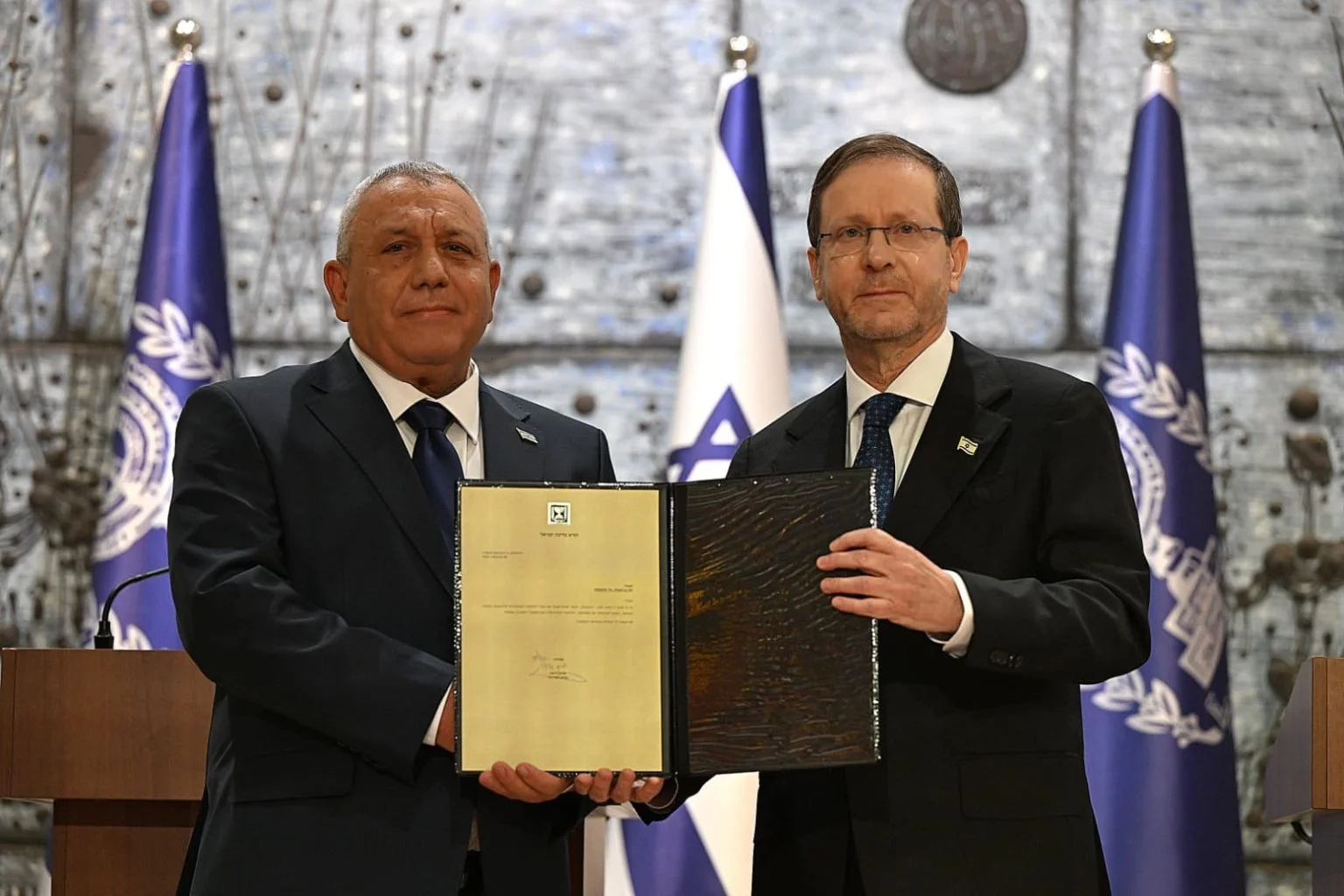
Yesh Atid leader Gadi Eisenkot began consultations on forming the new government on Sunday evening, after being formally tasked with the mandate by President Isaac Herzog, amid disputes between parties over the nature of the governing coalition and the role of the Arab parties, and the possibility of relying on parties that were part of the camp supporting Prime Minister Benjamin Netanyahu.
Eisenkot, the former Israeli Chief of Staff, received the letter of mandate at the President's office in Jerusalem, after blocs in the Knesset totalling 67 of the 120 members recommended him, following the elections held on 16 Jumada I (27 October).
Herzog said his decision came after consultations he held with representatives of the elected parties, in accordance with the provisions of the Basic Law: The Government.
The law gives Eisenkot an initial period of 28 days to form a coalition that enjoys the confidence of parliament, with the possibility of extending it by an additional 14 days.
A Call for a National Emergency Government
During the mandate ceremony, Eisenkot pledged to work toward forming what he described as a "national emergency government," arguing that the security and political challenges facing Israel require setting aside partisan disagreements.
He affirmed that forming the government will require "innovative and unconventional" political steps, along with the willingness of the various parties to make concessions on some of their electoral promises.
He addressed members of the Likud party led by Netanyahu, as well as the right-wing Religious Zionism party, inviting them to join the proposed government, without extending a similar invitation to Netanyahu personally.
He said the door to the coalition would be open to parties that accept the principles on which he seeks to build the government.
Disputes Over the Arab Parties and the Haredim
Although Eisenkot obtained the support of a majority of lawmakers during the mandate consultations, this backing does not guarantee that it will translate into a stable governing coalition.
Disputes between parties are emerging over the possibility of forming a minority government that relies on support from the Arab parties from outside the coalition, or of bringing in the ultra-Orthodox Jewish parties, the Haredim, who were among Netanyahu's most prominent allies.
Eisenkot also faces the challenge of bringing together parties that differ in their positions on matters of security, religion and the state, and on the future of the relationship between the government and the judicial and military institutions.
Israeli media outlets have reported rising discussions about the possibility of attracting lawmakers from Likud or right-wing parties into the government, which would allow the complications obstructing the formation of a coalition of parties opposed to Netanyahu alone to be bypassed.
However, Eisenkot has not yet announced a final agreement on the shape of the government or the parties that will take part in it.
Netanyahu Awaits the Outcome of the Negotiations
The mandate comes after Netanyahu's position declined in the recent elections, as blocs totalling 46 lawmakers recommended that he form the government, compared with 67 who endorsed Eisenkot.
Nevertheless, this decline does not mean that Netanyahu's political prospects have ended definitively.
If Eisenkot fails to form a government within the set period, the procedures for tasking another candidate can begin under the law, with the possibility of the mandate passing to Netanyahu or another figure if the constitutional conditions are met.
Continued failure to reach a coalition that enjoys the confidence of the Knesset could lead to a new political course that may end with another round of elections.
Eisenkot rejects resorting to new elections and affirms that forming a stable government must be a priority in light of the current challenges.
Security and Political Files Awaiting the New Government
The next Israeli government faces complex files, most notably the future of the war on Iran, policies concerning the Gaza Strip and the West Bank, and relations with the United States, in addition to the internal divisions that deepened during Netanyahu's years in power.
Eisenkot adopts a discourse focused on rebuilding trust in institutions and strengthening internal cohesion, while maintaining Israel's security and military superiority.
However, his ability to implement his programme will remain tied to the nature of the coalition he succeeds in forming and the scale of the political concessions required to ensure its continuity.
As the new Knesset prepares to convene on Tuesday, 30 Jumada I (10 November), government consultations remain open to multiple possibilities, with no guarantee that Eisenkot will succeed in securing a majority that grants him confidence and ends Netanyahu's rule.


